Key Takeaways:
- A pipeline meeting examines opportunities. A 1:1 helps the salesperson and manager work better together.
- Use four parts: what's working, what's not working, next steps, and feedback for you.
- Let the salesperson assess their work before you offer your view. Be truthful, specific, and positive when recognizing progress.
- Separate issues the salesperson owns, issues you must solve, and conditions neither of you controls.
- Leave with a clear next step and a way to check it. Helping shouldn't quietly become doing the salesperson's job.
You finish a 1:1 with your salesperson. They feel relieved. You have three follow-up emails to write, a proposal to fix, and another prospect call on your calendar.
What did that meeting teach them to do without you?
For a founder running a $1M to $10M ARR business, that's a useful question. You hired someone to carry more of the sales work. Your meetings should help them get there. If every conversation ends with you taking over, look at how you're leading the conversation.
My 1:1 approach starts with three purposes: stay connected, improve our relationship, and help us both get better. The agenda is simple. The discipline is listening long enough to understand the issue before deciding whose job it is to solve.
How is this different than a sales pipeline meeting?
A sales pipeline meeting checks the health of opportunities: buyer commitments, deal risks, next steps, and forecast timing. A 1:1 focuses on the person doing the work: their judgment, skills, obstacles, and relationship with you. A deal can provide an example, but it shouldn't take over the conversation.
Give each meeting a separate job
In the pipeline meeting, ask, "What evidence says this buyer will decide this month?" In the 1:1, ask, "What makes it difficult for you to ask a buyer about their decision process?" Same deal. Different work.
A performance review has another purpose: assess results against agreed expectations. Your Accountabilities Document belongs behind those expectations. The 1:1 can surface a performance concern, but don't disguise a formal warning as an open conversation about development.
If you're a founder with two salespeople, you may put these conversations back to back. Label the blocks and protect the time. Twenty minutes of deals followed by "Anything else?" doesn't leave much room for the salesperson to raise a difficult issue.
Measure something beyond having met
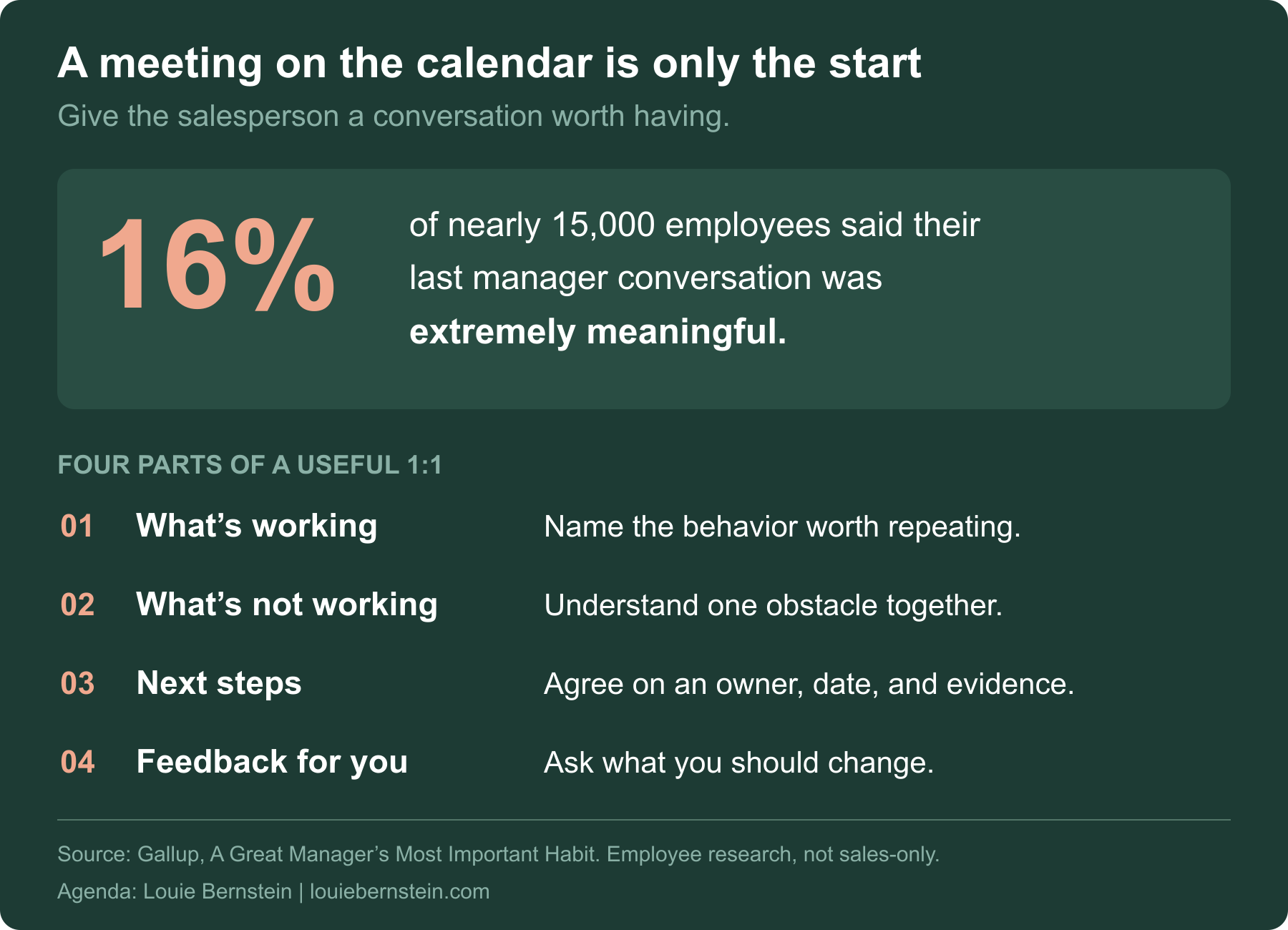
Only 16% of nearly 15,000 employees said their last conversation with their manager was extremely meaningful (Gallup). That's employee research across jobs, not a sales-team benchmark. It does challenge the idea that a recurring calendar invitation means useful coaching is happening.
Separately, Gallup reports that 80% of employees who said they received meaningful feedback in the past week were fully engaged (Gallup). That's an association with engagement, not proof that this agenda raises revenue by a particular percentage.
For your business, the test is more concrete: can the salesperson explain what they learned, apply it, and tell you what happened?
What should I cover in a 30-minute sales 1:1?
Cover what's working, what's not working, next steps, and feedback on your management. Start with the salesperson's view, add specific observations, and choose one issue to work through. End with clear ownership and a follow-up date. Thirty minutes is a useful starting point, not a rule for every situation.
Prepare without creating another reporting chore
Before the meeting, ask for one win, one obstacle, and one question for you. Bring your notes from the last conversation and one observation from their actual work. A call excerpt, buyer email, or missed commitment is more useful than a vague impression.
Use a shared note with these four headings. Here's a starting agenda I recommend:
- What's working, 5 minutes. Ask what they're proud of and what helped. Recognize a behavior they can repeat.
- What's not working, 10 minutes. Let them explain the obstacle. Ask questions before offering a fix.
- Next steps, 10 minutes. Choose one change, practice if needed, and agree on who does what by when.
- Feedback for you, 5 minutes. Ask what you're doing that helps and what you should change.
Those time allocations are my suggested structure, not research findings. Give an important concern the time it needs. Schedule a separate practice session if a skill needs more attention.
Protect a regular conversation
I'd start weekly when you're still building the sales process or helping a newer salesperson. Gallup describes 15 to 30 minutes as enough for meaningful conversations when they happen frequently (Gallup). Don't wait for the meeting to give timely feedback.
Other approaches exist. Sales Manager Now describes monthly hour-long 1:1s supported by other meetings and coaching (Sales Manager Now). Choose a cadence that gives your people reliable access to you. If a customer emergency interrupts it, reschedule it while you're both there.
What questions get a salesperson to talk honestly?
Ask questions about specific experiences, then listen without immediately correcting the answer. Start with a win, move to an obstacle, and ask what they think would help. Make room for feedback about your own behavior. Honesty becomes easier when the salesperson sees that you can hear a problem without taking over.
Start with what's working
"How do you feel you're doing?" gives them the first word. Follow with, "What are you proud of this week?" or "What process worked well?" You may discover a useful habit that never appears on the revenue report.
Then offer what I call TSP feedback: truthful, specific, positive. "Nice job" doesn't teach much. "You asked the buyer to explain the cost of waiting, then let them finish. That gave us a clearer reason for their deadline" names a behavior worth repeating.
Recognize good judgment even when it doesn't produce a win. Disqualifying a poor-fit prospect can protect selling time. If you only praise closed deals, the salesperson has little reason to discuss the decisions that prevented wasted effort.
Get past "everything's fine"
Choose a few questions from this list. Don't run through it like an interview checklist:
- Where did you get stuck this week?
- When did you first recognize the problem, and what did you try?
- Are my expectations clear? Which one needs explaining?
- Do you have the tools and authority to do what we're asking?
- What would you do differently next time?
- What am I doing that makes your job harder?
If they say you interrupt their calls, resist explaining why you had to jump in. Ask for an example. You can agree on a signal for when they want help and a separate debrief afterward. Your response tells them whether the next honest answer is worth the risk.
If you ask how you can improve, leave room for an answer you don't like.
How do I help without taking over their work?
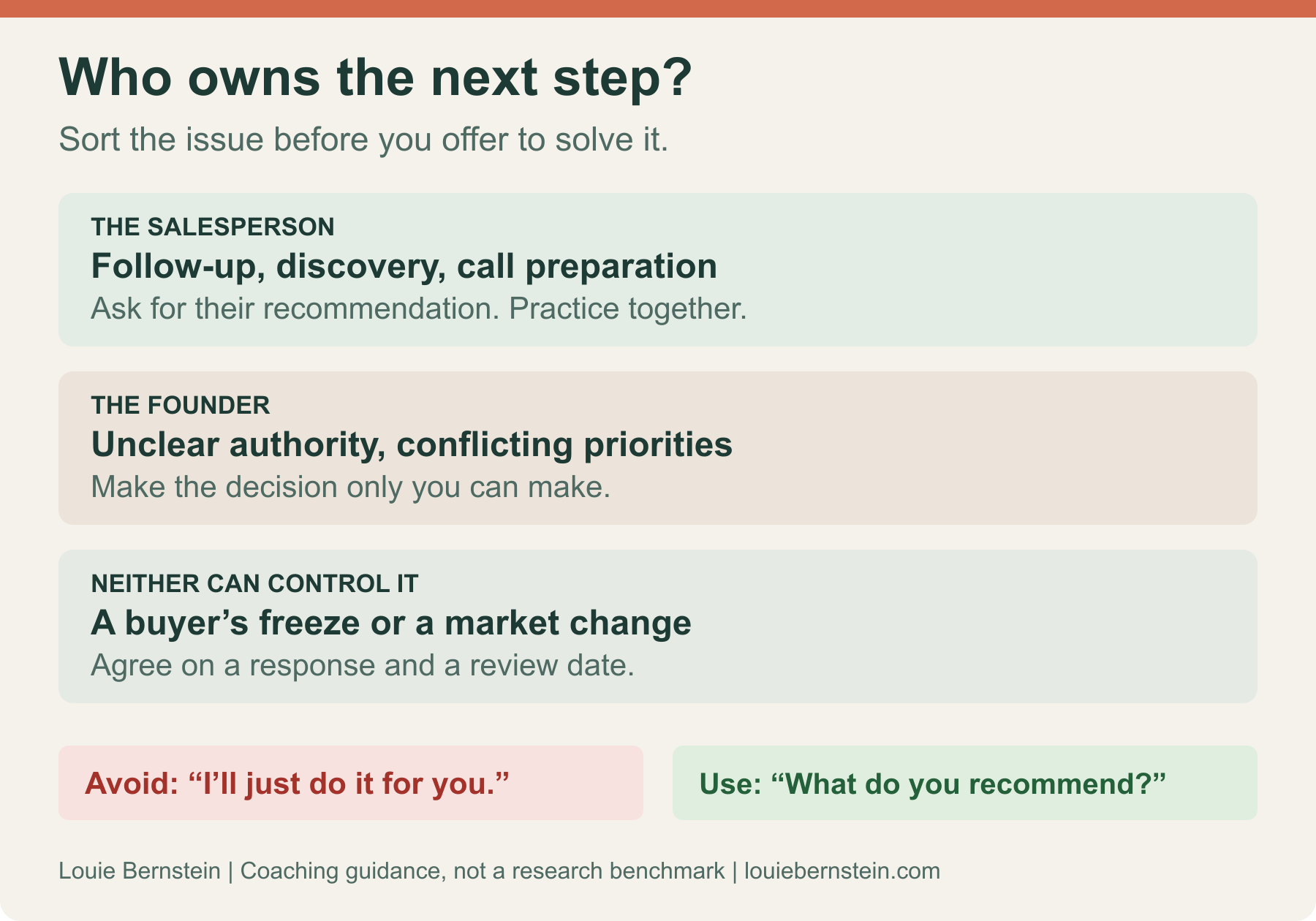
First decide whether the issue belongs to the salesperson, requires your authority, or involves something neither of you can change. Ask for their recommendation before supplying yours. Coach the part they can own, remove the obstacle only you can remove, and agree on a response to conditions outside your control.
Sort the issue before assigning the next step
My starting guide separates issues that can't be solved, issues you must solve, and issues they must solve. In practice, one problem may contain all three. A buyer's spending freeze is outside your control. Your approval policy belongs to you. Preparing a useful follow-up belongs to the salesperson.
Ask, "Should you take action and tell me what happened, or bring me a recommendation for a decision?" That question exposes unclear authority. Write the answer into the Sales Playbook when it applies beyond this one situation.
Don't use ownership as an excuse to withhold help. If they lack training, provide it. If your pricing rules contradict each other, fix them. Independence needs clear boundaries and support.
Turn one obstacle into practice
Here's an example, not a client result. A salesperson says, "Nobody answers after I send a proposal." You could volunteer to chase the buyer. Instead, ask them to walk through how they ended the previous call.
They sent the proposal without agreeing on a review conversation. Ask, "How could you handle that next time?" Let them try the question aloud. Play the buyer who says, "Just email it." Give one specific suggestion, then have them try again.
The action might be: on the next three appropriate calls, ask for an agreed review step before sending the proposal. Record what the buyer actually agrees to. Bring the examples next week.
Don't force a meeting on a buyer who doesn't want one. Coach the salesperson to discover how the buyer plans to evaluate the proposal. The purpose is a clearer buying process, not a calendar event for its own sake.
How will I know whether our 1:1s are working?
Look for completed commitments, better execution of the skill you're coaching, and clearer communication between you. Review examples from real work over several meetings. Track your own promises too. Revenue matters, but it moves for many reasons and often arrives too late to tell you whether last week's coaching helped.
Keep a short record you both use
End each meeting by writing the issue, the agreed action, the owner, the due date, and what you'll review. "Improve discovery" is too broad. "Practice the decision-process questions Tuesday and review two call examples Friday" tells both people what happens next.
At the next 1:1, ask what happened. If the action wasn't completed, find out why before adding another assignment. Was the commitment unrealistic? Was authority unclear? Did the salesperson avoid the work? Each answer calls for a different response.
You can calculate completed commitments divided by commitments due. Four completed out of five is 80%. That's an illustrative calculation, not a target or proof of better selling. Pair it with the actual work so easy tasks don't become a substitute for progress.
Check what you're learning, too
After four meetings, ask whether the same issue keeps returning. Perhaps the rep needs more practice. Perhaps your onboarding skipped the skill. If several people struggle with the same step, inspect the process before treating it as several separate talent problems.
Then ask, "What can you handle now that you needed me for a month ago?" Look for examples, not a promise to ask fewer questions. Early escalation of a real risk is good judgment. Silence alone doesn't prove independence.
No sales system yet? You can still start. Use the 1:1 to identify one unclear expectation, one skill gap, and one founder-owned obstacle. Then build the missing standards. As a Fractional Sales Leader, that's where I connect coaching to the Sales Playbook, onboarding, and the process your team needs to work without constant rescue.
Related Reading
Accountability Without Micromanaging: Scorecards, Ramps, and the Accountabilities Document →What else should founders know about sales 1:1s?
Keep the meeting useful to the individual, whether you're managing your first salesperson or a small team. Adjust the time to their needs, address problems directly, and keep formal performance decisions clear. These common questions help you protect the purpose of the 1:1 as your sales team grows.
Should my best salesperson still have a 1:1?
Yes. Ask about obstacles, career interests, and skills they want to build. A strong result doesn't tell you whether they're frustrated or unclear about their next opportunity. Avoid turning every conversation into a request to train everyone else.
What if my salesperson brings no topics?
Send the four headings beforehand. Start with one recent experience and ask for their view. If preparation remains weak, clarify what you expect. Also consider whether your past reactions have taught them that raising an issue creates more trouble than help.
Can we talk about a live deal during the 1:1?
Yes, when it helps you understand a skill or obstacle. Use the deal as an example, then return to the person. If an urgent deal needs detailed planning, make time for that and reschedule the development conversation.
What if the salesperson is missing quota?
Address the gap against clear expectations. Use the 1:1 to understand obstacles and coach specific work. If you need a formal performance conversation, say so and schedule it clearly. Don't let either conversation replace the other.
How do I get useful feedback about my management?
Ask about a specific situation: "When I joined your call Tuesday, what helped and what got in your way?" Listen, summarize, and commit to one change where appropriate. Follow up on your promise at the next meeting.
Are your sales meetings giving you more work?
If you're still solving every sales problem, let's look at the expectations, coaching, and process behind it. At LouieBernstein.com, I help founders build sales systems through Fractional Sales Leadership before they're ready for a full-time VP of Sales.
Schedule a 30-Minute CallAbout the Author
Louie Bernstein is a Fractional Sales Leader who helps founders of $1M to $10M ARR B2B businesses build repeatable sales systems, coach their teams, and reduce their dependence on founder-led selling.