Key Takeaways:
- Watching activity isn't the same as driving results. Reps already spend only about 28% of their week selling (Salesforce); micromanaging just eats into the little selling time that's left.
- Accountability is a system, not a personality. It runs on three things: a clear Accountabilities Document, a simple scorecard, and a coaching cadence, so nobody has to hover.
- Track leading metrics (calls, qualified opps, contacts per deal) to change the outcome, and lagging metrics (revenue, win rate, quota attainment) to learn from it. Coach the leading numbers.
- An Accountabilities Document, a written, agreed list of what the role is responsible for and how success is measured, prevents the surprises and resentment that vague expectations create. Never call it a "position contract"; write it as a shared agreement.
- The point of the whole system is freedom: managers drive roughly 70% of the variance in team engagement (Gallup), and a founder who builds accountability instead of surveillance can finally step back from sales and still sleep.
Every founder I meet is terrified of two opposite failures. One is being the absentee boss whose team drifts with no direction. The other is being the micromanager who hovers over every call and every CRM field until their best people quit. Most founders, out of fear, end up doing the second while worrying about the first.
Here's the resolution: accountability and micromanagement are not the same thing. In fact, they're opposites. Micromanagement is what you do when you don't have a system for accountability. Build the system, and you get the results without the hovering, and without becoming the bottleneck your whole company waits on.
This is the final piece of a bigger picture. Once your deals stop stalling and your forecast is trustworthy, the last thing standing between you and a sales team that runs without you is accountability. Let's build it.
Why Watching Activity Isn't the Same as Driving Results
Micromanagement feels productive. You're engaged, you're across the details, you know what everyone's doing. But watching activity and driving results are very different things, and confusing them is one of the most expensive mistakes a founder can make.
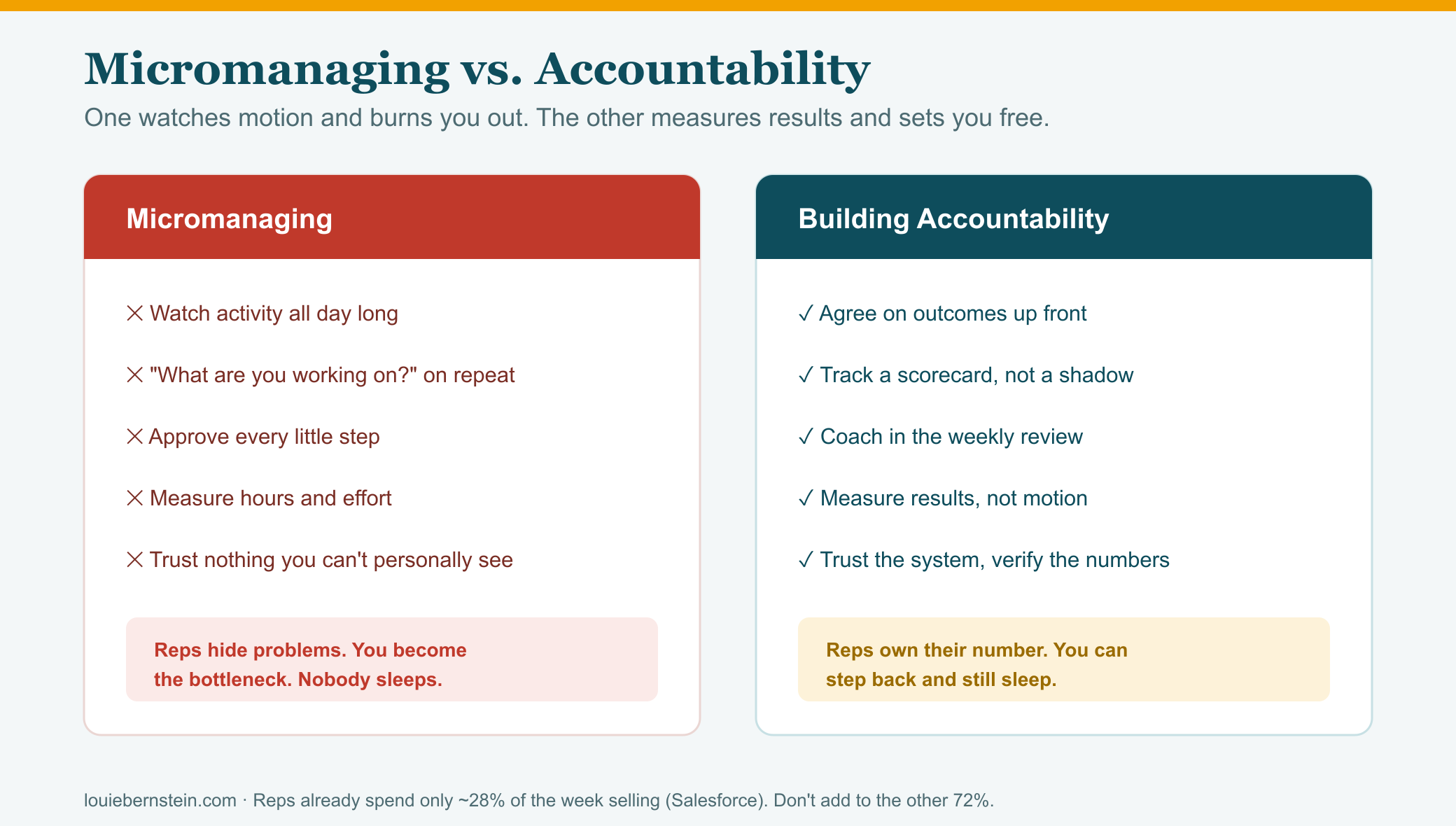
Consider the math. Reps already spend only about 28% of their week actually selling (Salesforce); the rest goes to admin, meetings, and internal back-and-forth. When you micromanage, you pile onto that 72% of non-selling time, more check-ins, more status updates, more approvals, and you shrink the sliver where they actually generate revenue. Worse, hovering teaches reps to hide problems instead of surfacing them, because every problem becomes an interrogation. You end up less informed, not more.
Micromanaging isn't being on top of your team. It's not trusting the system you never built. Build the system and the need to hover disappears.
The Scorecard That Replaces Looking Over Shoulders
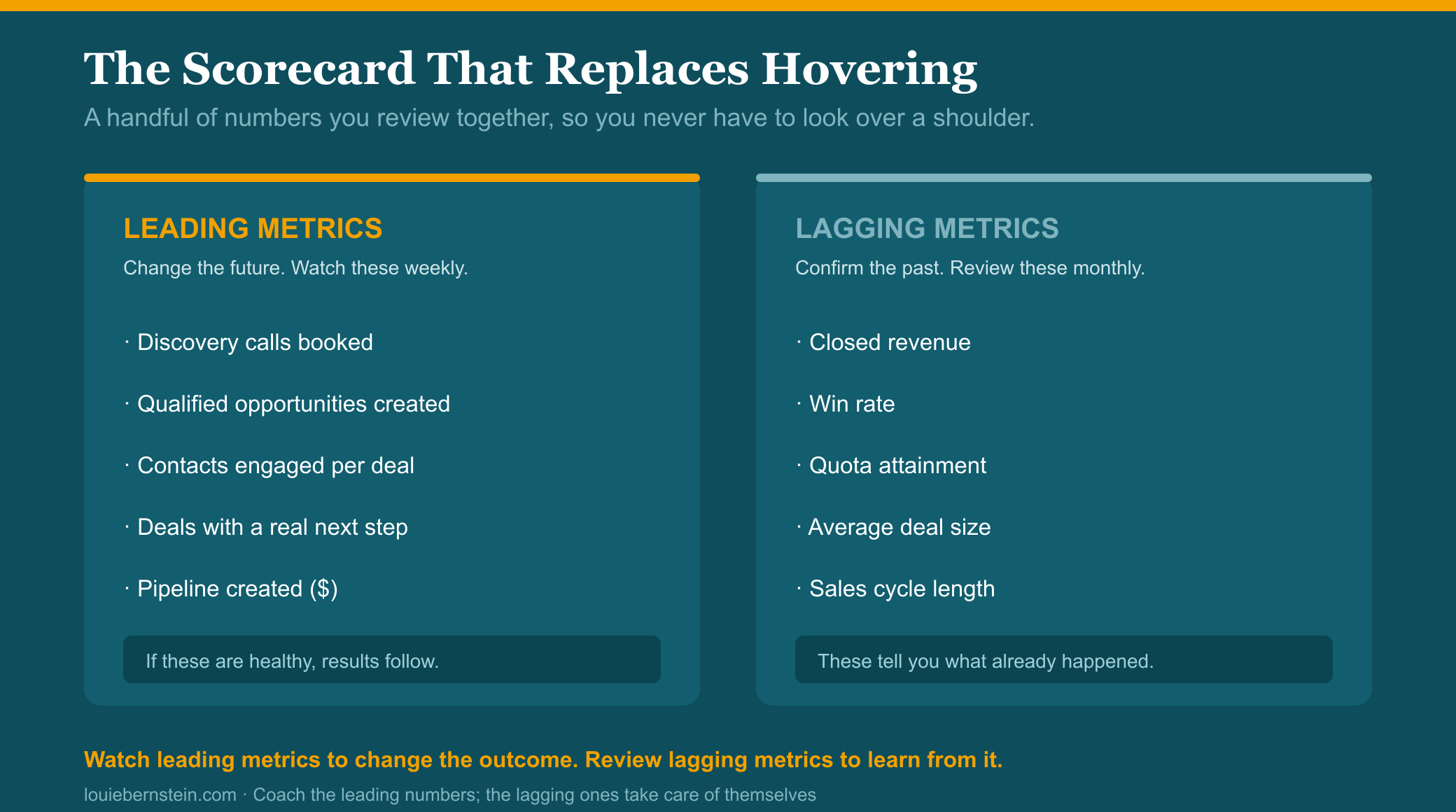
The antidote to hovering is a scorecard: a small, shared set of numbers you and the rep review together on a regular cadence. Instead of asking "what are you working on right now?" ten times a day, you look at the same handful of metrics once a week and know exactly where things stand.
The scorecard does something psychological, too. It makes accountability objective instead of personal. You're not judging the rep, you're both looking at the same numbers and asking what they tell you. That shifts the whole dynamic from surveillance to partnership. The rep knows the standard, sees their own progress, and owns the outcome. And it's the natural companion to the weekly pipeline review, the scorecard is what you actually look at in the meeting.
Leading vs. Lagging Metrics for a Small Team
Not all metrics are equal, and the distinction matters enormously for a small team. Lagging metrics, closed revenue, win rate, quota attainment, tell you what already happened. They're the scoreboard. But you can't change the past, so managing purely on lagging metrics means you only find out about a problem after it's cost you the quarter.
Leading metrics, discovery calls booked, qualified opportunities created, contacts engaged per deal, are the activities that predict future results. They're the ones you can still influence. If your leading metrics are healthy this week, your lagging metrics will be healthy next quarter. So coach the leading numbers, and let the lagging ones take care of themselves. For a small team, three or four leading metrics and three or four lagging ones is plenty, more than that and nobody watches any of them. This is the same discipline that powers a trustworthy forecast, built on real pipeline math.
The Accountabilities Document That Sets Expectations Up Front
Most accountability problems are really clarity problems. A rep isn't failing on purpose; they simply never had a clear, written picture of what the job actually requires. The fix is an Accountabilities Document: a plain, agreed statement of what the role is responsible for, what the targets are, how success is measured, and what the ramp looks like.
This isn't a legal weapon or a "position contract" to hold over someone. It's a shared agreement you build together on day one, so there are no surprises later. I've watched a rep hit 135% of quota and still get put on a plan because nobody had written down what the job actually was, everyone was measuring something different in their heads. A written Accountabilities Document ends that. It should cover the outcomes the rep owns, the activity and results targets, the ramp schedule, and exactly how their performance will be judged. When it's on paper and both of you signed off, accountability becomes fair, because the standard was clear before the work started.
You can't hold someone accountable to a standard they were never told. Write down what the job is, agree on it up front, and most "accountability problems" never happen.
Coaching the Rep Who's Busy but Not Producing
Every team has one: the rep who's clearly working hard, calls all day, calendar full, but the number isn't there. Micromanaging this rep makes it worse, because effort isn't the problem. The scorecard tells you where the real gap is, and that's where you coach.
Walk the leading metrics with them. Are they booking enough discovery calls? Then the problem is downstream, maybe discovery or qualification. Are calls high but qualified opps low? They're talking to the wrong people, or not qualifying hard. Are opps high but nothing closes? Look at multi-threading and urgency. The scorecard turns "you need to do better" into a specific, coachable diagnosis. That's the difference between managing effort and managing results: you stop telling a busy rep to try harder and start showing them exactly which number to move.
The System That Lets You Step Back and Still Sleep
Here's what all of this is really for. An Accountabilities Document, a scorecard, and a coaching cadence add up to a system that runs without you standing over it. That's the whole goal: to step back from the day-to-day of sales without the number falling apart the moment you look away.
It matters more than founders realize. Managers drive roughly 70% of the variance in team engagement (Gallup), so how you lead is the single biggest lever on whether your reps thrive or leave. A founder who builds accountability instead of surveillance gets both: an engaged team and their own time back. This is the same shift I write about in stepping back from sales, and it's the natural endpoint of the whole system: deals that don't stall, a forecast you trust, comp and quotas that work, and now a team you can hold accountable without hovering.
Building that entire operating system, the process, the pipeline discipline, the comp and quota design, and the accountability structure, is exactly what a Fractional Sales Leader does for a $1M to $10M ARR company, without the cost of a full-time VP of Sales. And if you have no system at all yet, no scorecard, no written expectations, no coaching rhythm, that's honestly the best place to start, because you're not fixing bad habits, you're building good ones from scratch. That's the whole point of louiebernstein.com: to help founders build the sales system that finally lets them let go.
Frequently Asked Questions
Q: What's the difference between accountability and micromanaging?
Micromanaging watches activity, hovers, and approves every step; it measures effort and trusts nothing it can't see. Accountability measures results against agreed standards using a scorecard, and coaches on a regular cadence. Micromanaging is what you do when you lack a system for accountability. Build the system, an Accountabilities Document, a scorecard, and a coaching rhythm, and the need to hover disappears, because everyone can see where things stand.
Q: What metrics should a small sales team track?
Track a few leading and a few lagging. Leading metrics predict the future and can still be influenced: discovery calls booked, qualified opportunities created, contacts engaged per deal, deals with a real next step, and pipeline created. Lagging metrics confirm the past: closed revenue, win rate, quota attainment, average deal size, and cycle length. Three or four of each is plenty. Coach the leading numbers, and the lagging ones follow.
Q: What is an Accountabilities Document?
It's a plain, written, mutually agreed statement of what a role is responsible for, what the targets are, how success is measured, and what the ramp looks like. You build it together on day one so there are no surprises later. It's not a legal weapon to hold over someone, it's a shared agreement that makes accountability fair. When both sides signed off on the standard before the work started, holding someone to it is just honoring what you both agreed.
Q: How do I coach a rep who's busy but not hitting the number?
Don't tell them to try harder, effort isn't the problem. Walk the leading metrics to find the real gap. Enough discovery calls but few qualified opps? They're talking to the wrong people or not qualifying. Plenty of opps but nothing closes? Look at multi-threading and urgency. The scorecard turns a vague "do better" into a specific, coachable diagnosis, so you're managing results instead of nagging about activity.
Q: Will stepping back hurt my sales numbers?
Only if you step back without a system. With an Accountabilities Document, a scorecard, and a coaching cadence in place, stepping back is exactly what lets the team own their results instead of leaning on you. Managers drive about 70% of the variance in team engagement (Gallup), so leading through a clear system rather than constant oversight tends to raise performance, not lower it, while giving you your time back.
Q: I have no system at all yet. Where do I start?
Start with the Accountabilities Document and a simple scorecard of three or four leading metrics. Write down what the role owns and how success is measured, agree on it, and review the leading numbers each week. That alone replaces most of the reasons founders feel they have to hover. Building the full accountability system, alongside the process, forecast, and comp design, is the core of what a Fractional Sales Leader sets up for founders not ready for a full-time VP of Sales.
Want to hold your team accountable without hovering?
In 30 minutes I'll help you build the scorecard, the leading metrics, and the Accountabilities Document that let you step back from sales and still sleep. See how a Fractional Sales Leader can help at louiebernstein.com.
Schedule a 30-Minute CallAbout the Author
Louie Bernstein
Fractional Sales Leader with 50 years of sales experience helping $1M–$10M ARR companies build scalable, repeatable sales systems. Founder of MindIQ (INC 500). LinkedIn Top Voice in Sales Management, Sales Operations, and Sales Coaching.