Key Takeaways:
- A comp plan is a set of instructions, and reps follow the money, not your mission statement. If you're getting the wrong behavior, look at what you're actually paying for.
- Title inflation locks you into enterprise base pay for an early-stage job. Flat commission regardless of discount turns your reps into a discount machine that quietly erodes margin.
- Paying only on closes, ignoring who stays, rewards churn-and-burn selling. A 5% lift in retention can raise profits 25-95% (Bain), so pay for customers who stay, not just customers who sign.
- Caps and harsh clawbacks punish your best people. A cap tells a top rep to coast; a brutal clawback tells them to leave. Both cost you far more than they save.
- Design the plan to reward the exact behavior you want, protect your margin, and survive scrutiny. If you can't defend every line of it to your board, rewrite it until you can.
Your comp plan is the most powerful management tool you have, and most founders treat it like paperwork. Here's the uncomfortable truth: a comp plan is a set of instructions, and your reps will follow those instructions to the letter, even when the instructions are telling them to do things that quietly destroy your business.
Reps are rational. They do what pays. So if your reps are discounting too much, chasing bad-fit deals, or coasting, don't blame the reps. Read the plan. It's almost certainly rewarding exactly the behavior you're frustrated by.
These are the comp mistakes I see most often at $1M to $10M ARR companies, the ones that don't announce themselves but slowly bleed your margin and your best people. Let's make sure none of them are hiding in your plan.
Title Inflation and the Enterprise-Pay Trap
It starts innocently. To attract a strong candidate, you offer a big title, "VP of Sales," "Head of Revenue", and the pay that comes with it. Now you're carrying enterprise-level base salary for what is really an early-stage, roll-up-your-sleeves selling job. The title wrote a check your revenue can't cash yet.
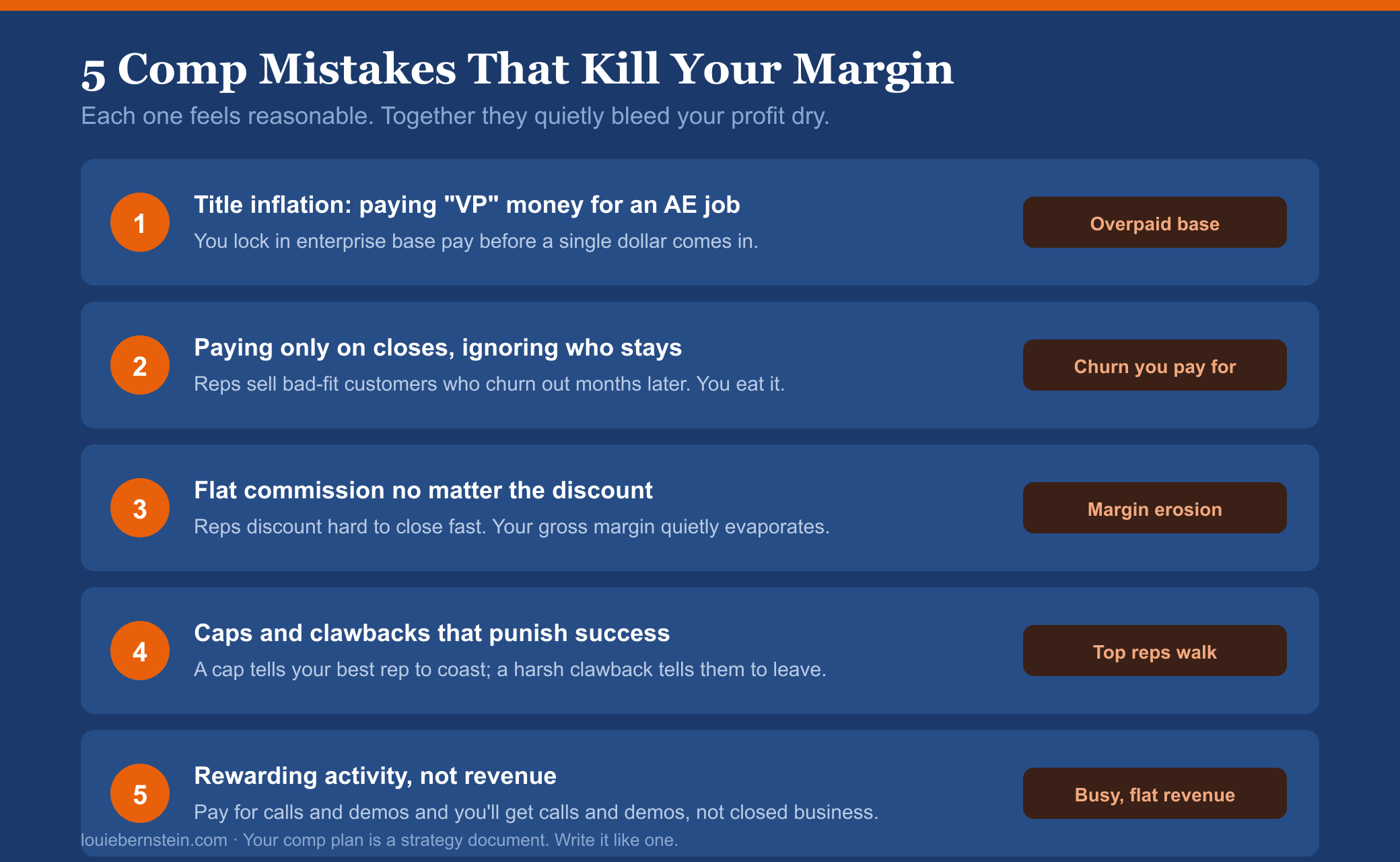
The trap has a second edge: an inflated title is nearly impossible to walk back. When you're ready for a real VP of Sales in two years, you've got someone in the seat with the title but not the scope, and unwinding that is painful for everyone. Hire for the job you have now, pay fairly for that job, and save the big title for when the role genuinely warrants it. A first sales hire is an individual contributor who sells, no matter how you dress up the business card.
Paying for Closes When You Need Customers Who Stay
This is the margin killer founders almost never see coming. When you pay commission purely on the close, you're telling your rep that their job ends at signature. So they optimize for signatures, including deals with bad-fit customers who were never going to succeed and churn out a few months later. The rep already got paid. You're left holding the loss.
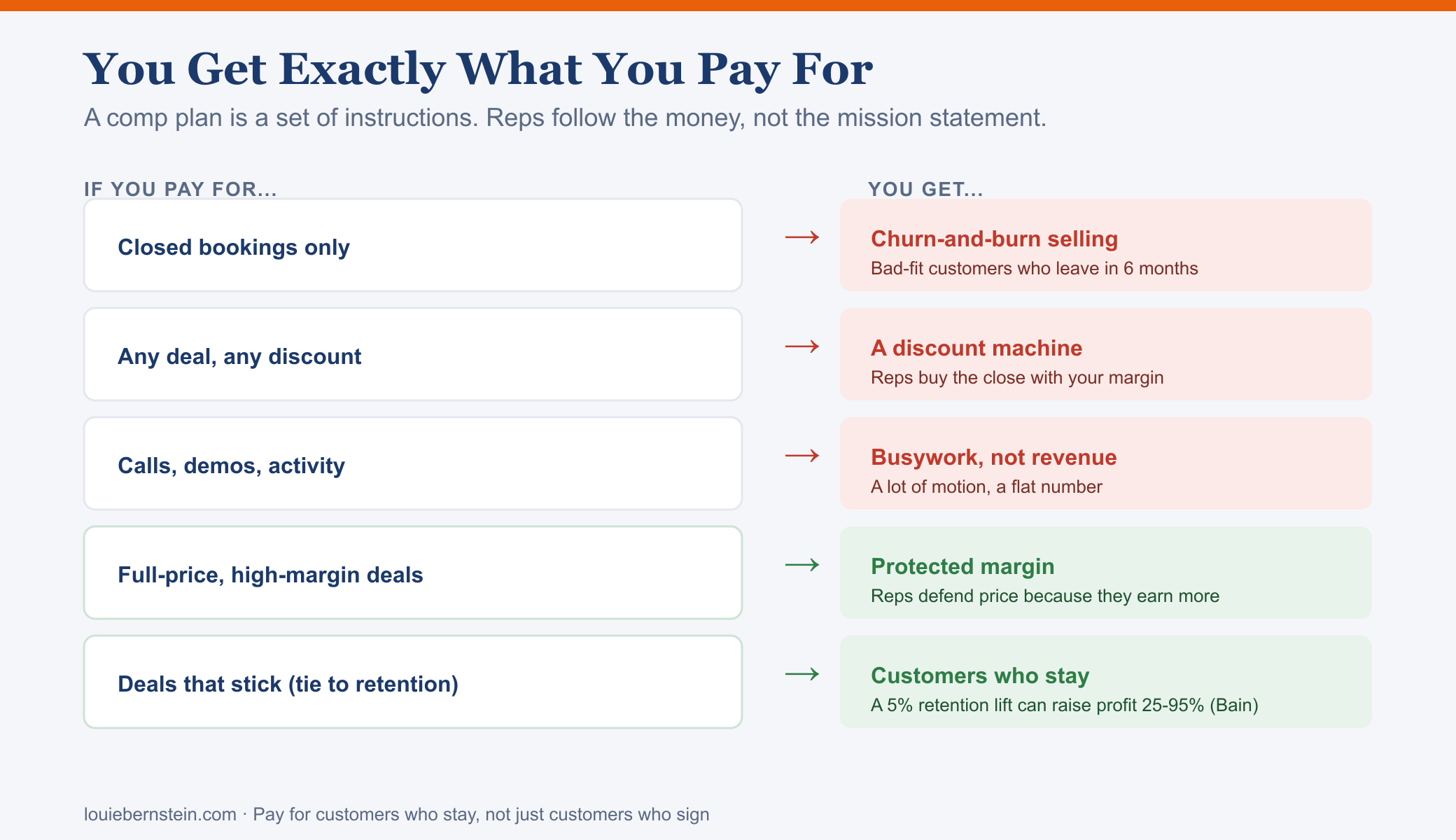
The economics here are enormous. A 5% increase in customer retention can raise profits by 25% to 95% (Bain). That's not a rounding error, it's often the difference between a business that compounds and one that runs on a treadmill. So build retention into the plan: pay a portion of commission on the renewal or on customers who make it past a retention milestone, not just the initial signature. When the rep gets paid for customers who stay, they suddenly care a lot more about selling to the right ones.
If you pay for signatures, you get signatures, including the ones that churn. If you pay for customers who stay, you get customers who stay. The plan chooses.
The Clawback and Cap Traps
Caps and clawbacks come from a good instinct, protecting the business, but both usually backfire. A commission cap tells your best rep, in writing, to stop selling once they hit the ceiling. The exact person you most want swinging for the fences is now incentivized to coast until next period. You've capped the upside of your highest performer to save money you'd have been thrilled to pay.
Clawbacks are trickier. A modest, fair clawback (if a customer churns in 60 days, the commission is recovered) can actually reinforce good selling. But a harsh, wide clawback window makes reps feel their earned money is never really theirs, and nothing drives a good salesperson out the door faster than uncertainty about their pay. Use clawbacks surgically to prevent obviously bad deals, never as a broad hedge against your own forecasting. And never, ever cap the top. If a rep makes "too much," it means they sold far more than you planned. Send a thank-you note, not a cap.
Rewarding the Wrong Behavior by Accident
Most comp mistakes are accidental. You wanted one thing and paid for another, and the reps did exactly what you paid them to do. Pay a flat commission regardless of discount, and you've told reps that a heavily discounted deal is worth as much effort as a full-price one, so they discount to close faster. Pay on activity metrics like calls and demos, and you'll get a lot of calls and demos and a flat revenue number.
The fix is to align every dollar of comp with the behavior you actually want. Want protected margin? Pay a higher commission rate on full-price deals and a lower one on discounted deals, so the rep shares your interest in holding price. Want quality pipeline? Reward closed, retained revenue, not vanity activity. This ties directly to setting a quota reps can actually hit: the quota sets the target, and the comp plan shapes how they chase it. Get both pointing the same direction and the whole team pulls with you.
Reps aren't ignoring your strategy. They're following your comp plan, which is your real strategy, whether you meant it to be or not.
When "More Variable" Stops Motivating and Starts Repelling
There's a myth that more variable pay always means more motivation, so some founders push toward commission-only or a tiny base with a huge upside. Past a point, it flips. When the base is too low to live on, you stop attracting confident, skilled reps and start attracting only the desperate, or nobody at all. The best salespeople have options, and they don't take gambles on companies that won't share any risk.
The market bears this out: established SaaS AEs sit around a 50/50 split at roughly $190K OTE with commission near 11 to 14% of bookings (Bridge Group, 2024). That balance exists because it's where security and ambition both get served. Skew too far toward variable and, counterintuitively, you'll repel the very people you're trying to motivate. Ambition needs a floor to stand on. The right split is covered in more detail in how to pay your first sales rep.
Designing a Plan You Can Defend to the Board
Here's a simple final test for any comp plan: could you sit across from your board, or your own CFO instincts, and defend every line of it? For each element, you should be able to answer three questions clearly, without hand-waving:
- What behavior does this reward? If you can't name it, the element is noise, or worse, a mistake.
- Does the math protect our margin? At full attainment, does the business still profit on every deal?
- Would a great rep find this fair and motivating? If it reads as stingy or confusing, it will cost you talent.
A plan that passes those three questions is simple, aligned, and defensible, which is exactly what you want. A comp plan you can't explain and defend is a liability disguised as a spreadsheet. Getting this right, so it rewards the behavior you want, protects your margin, and keeps your best reps, is core to what a Fractional Sales Leader does for a $1M to $10M ARR company, without the cost of a full-time VP of Sales. And if you don't yet know your margins or retention numbers well enough to design against them, that's the first thing to fix, because you can't build a smart comp plan on numbers you don't have.
Frequently Asked Questions
Q: What's the most common comp plan mistake founders make?
Paying purely on the close while ignoring whether the customer stays. It quietly rewards churn-and-burn selling: reps sign bad-fit customers who leave a few months later, and you eat the loss after the commission is already paid. Since a 5% lift in retention can raise profits 25-95% (Bain), tying part of comp to renewals or a retention milestone is one of the highest-leverage fixes available.
Q: Should I cap my reps' commissions to control costs?
No. A cap tells your best rep to stop selling once they hit the ceiling, which is the opposite of what you want. And if a rep earns "too much," it means they sold far more than you planned, that's a great outcome you should celebrate, not penalize. Controlling cost belongs in the quota-to-OTE ratio and the commission rate, set so the math works at full attainment, not in a cap that punishes success.
Q: Are clawbacks a good idea?
Used surgically, yes. A modest, fair clawback, for example recovering commission if a customer churns within 60 days, reinforces good selling and discourages bad-fit deals. But a harsh, wide clawback window makes reps feel their earned money is never truly theirs, and that uncertainty drives good salespeople out fast. Use clawbacks narrowly to prevent obviously bad deals, never as a broad hedge against your own forecasting errors.
Q: How do I stop my reps from discounting so much?
Make discounting cost the rep, not just the company. If you pay a flat commission regardless of discount, reps will discount to close faster because it costs them nothing. Instead, pay a higher commission rate on full-price deals and a reduced rate on discounted ones. Now the rep shares your interest in holding price, and they'll fight for it. You get what you pay for, so pay for protected margin.
Q: Is more variable pay always more motivating?
No, past a point it repels talent. When the base gets too low to live on, you stop attracting skilled, confident reps and attract only the desperate, or nobody. Established SaaS AEs sit around a 50/50 split at ~$190K OTE (Bridge Group, 2024) because that's where security and ambition both get served. Skew too far toward variable and, counterintuitively, you'll drive away the very people you're trying to motivate.
Q: How do I know if my comp plan is well designed?
Run every element through three questions: What behavior does this reward? Does the math protect our margin at full attainment? Would a great rep find it fair and motivating? If you can answer all three clearly, without hand-waving, the plan is sound. If any element fails, rewrite it. A comp plan you can't explain and defend to your board is a liability disguised as a spreadsheet.
Worried your comp plan is rewarding the wrong thing?
In 30 minutes I'll pressure-test your comp plan for the mistakes that bleed margin, and show you how to align it with the behavior you actually want. You'll leave with a plan you can defend. See how a Fractional Sales Leader can help at louiebernstein.com.
Schedule a 30-Minute CallAbout the Author
Louie Bernstein
Fractional Sales Leader with 50 years of sales experience helping $1M–$10M ARR companies build scalable, repeatable sales systems. Founder of MindIQ (INC 500). LinkedIn Top Voice in Sales Management, Sales Operations, and Sales Coaching.