Short answer: For most B2B account executives, the right quota-to-OTE ratio is 3x to 5x. The 2024 median for SaaS AEs is about 4.2x (Bridge Group), so a rep on $120K on-target earnings carries roughly $500K to $600K in quota. Below 3x, sales loses money on every rep. Above 5x, the quota becomes a number almost nobody hits. Use the ratio as your guardrail, then sanity-check the number against your deal size, win rate, and cycle length.
If you need the full team-sizing math (revenue target, quota by deal size, yield factor, managers and SDRs), start with how to set sales quota for a small team. This article zooms in on the ratio and on setting a number your rep can actually hit.
Key Takeaways:
- Only 28% of reps hit their annual quota (Salesforce, State of Sales), the lowest in six years. A quota almost no one hits isn't ambitious. It's broken.
- A healthy quota is one that 60-70% of good reps can realistically clear. If your number is set so that almost none can, the problem is the number, not the people.
- Build quota from your unit economics, not an investor deck. Start with the rep's OTE, apply a quota-to-OTE ratio (typically 3-5x; median 4.2x per Bridge Group, 2024), then sanity-check it against reality.
- Give new reps a ramp. Expecting full quota in month one burns runway and talent. Phase it: something like 0% in month one, 25%, then 50%, then full by month four.
- An impossible quota costs you twice: the revenue you don't get, and the rep who quits chasing a number they never had a shot at. And never move the goalposts mid-year.
Here's a stat that should make every founder pause before setting a number: only 28% of reps hit their annual quota (Salesforce, State of Sales), the lowest figure in six years. Think about what that means. Across the industry, roughly three out of four salespeople are missing the target they're measured against.
When almost nobody hits the number, that's not a workforce of underperformers. It's a signal that quotas are being set wrong, disconnected from what a good rep can actually do, and usually pulled straight from a growth target instead of built from the ground up.
For a founder making a first sales hire, this matters enormously. Set the quota too high and you'll demotivate your rep, burn your runway, and lose both the person and the revenue. Here's how to set a number that's ambitious and achievable, the way it should be.
Why Most Quotas Are Set in the Dark
Most founder-set quotas start from the wrong place: the number the company needs to hit, or worse, the number in the investor deck. The logic goes "we need $2M next year, we have two reps, so each carries $1M." That's not a quota. That's a wish divided by headcount.
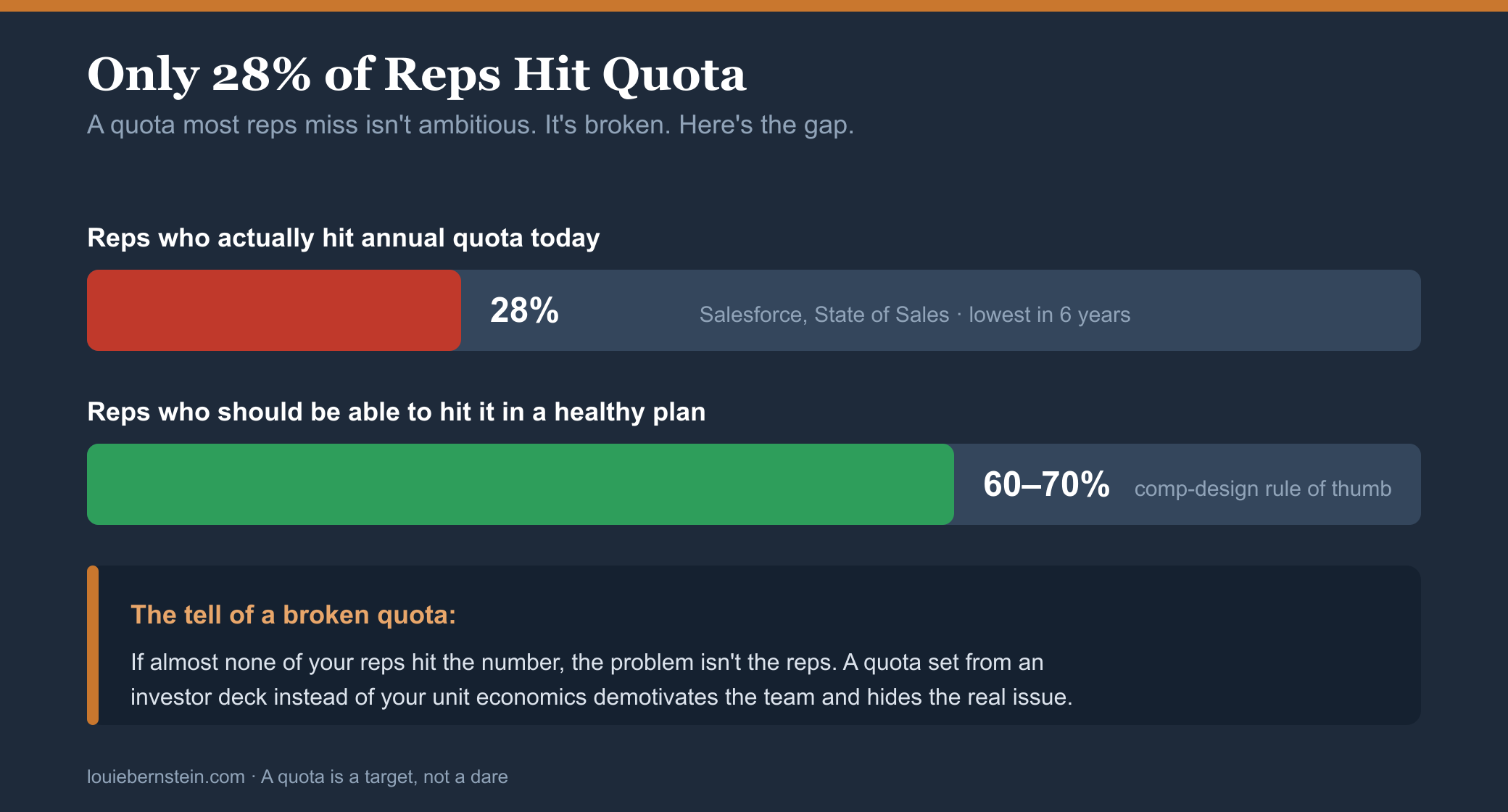
Look at that gap. A well-designed comp plan is built so that 60-70% of good reps can clear quota, that's the range where the number is motivating but still meaningful. When only 28% actually hit it, quotas across the board are being set far above what's achievable. And an unreachable quota doesn't push people to work harder. It does the opposite: reps mentally check out the moment they realize the number is impossible, because effort feels pointless when the finish line is fake.
A quota is a target, not a dare. If almost none of your reps can hit it, you didn't set a stretch goal. You set them up to fail, and yourself to miss.
Building Quota From Unit Economics, Not Investor Promises
The right way to set a quota is bottom-up, from the economics of the role, and then to check it against what's actually achievable. Here's the build.
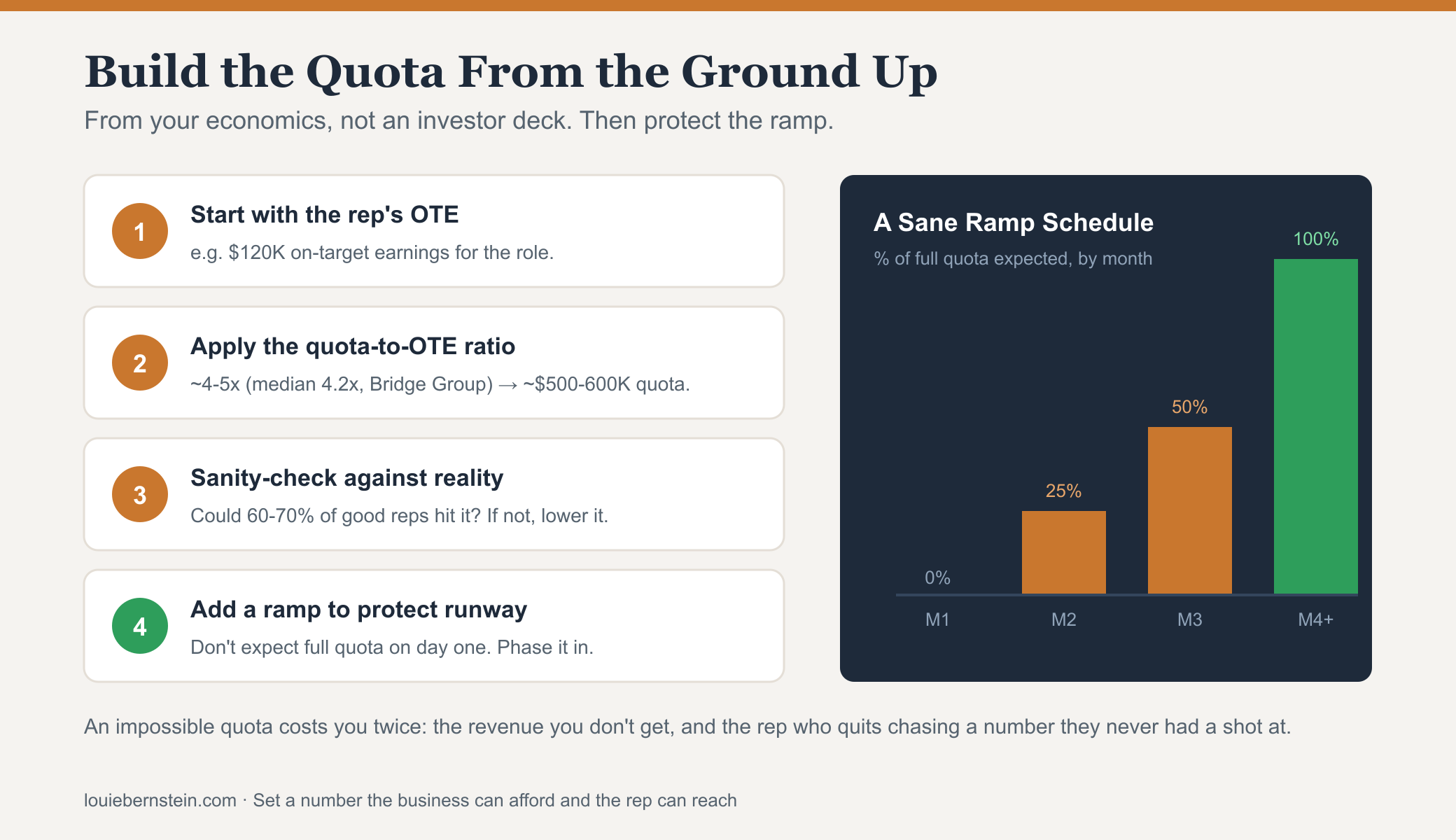
Start with the rep's OTE, apply a quota-to-OTE ratio to get the annual number, then sanity-check it. That third step is the one founders skip and it's the most important: look at the quota you just calculated and ask honestly, "could a solid, hard-working rep actually hit this given our deal sizes, cycle length, and lead flow?" If the honest answer is no, lower it. Better to set a number reps can beat than one they'll bounce off. And this only works if you actually know your pipeline math: your win rate, deal size, and cycle time are what tell you whether a quota is reachable at all.
The Quota-to-OTE Ratio That Keeps You Solvent
The quota-to-OTE ratio is the guardrail that keeps the math working for the business. It's how many dollars of sales a rep must produce for every dollar of their total pay. The 2024 median for SaaS AEs is about 4.2x, with most plans landing in the 3x to 5x range (Bridge Group). So a rep on $120K OTE would carry roughly $500K to $600K in quota.
Why does the ratio matter so much? Because it protects your margins. If you pay a rep $120K to generate only $250K, the economics don't work, sales is a cost center, not a growth engine. If you demand $2M from that same rep, the quota is fantasy and nobody hits it. The 3x to 5x band is where the rep can realistically produce the number and the business still profits from every deal. Set the ratio too aggressive and you're back in the 28% club.
The quota-to-OTE ratio is where fairness to the rep and solvency for the business meet. Too low and sales loses money; too high and the quota is a fantasy. Aim for the middle.
Ramp Periods That Protect Your Runway
Here's a mistake that quietly kills first hires: expecting a brand-new rep to carry full quota from day one. Nobody ramps that fast. A new rep has to learn your product, your market, your buyer, and your process before they can sell at full speed, and that typically takes three to six months.
So phase the quota in. A sane ramp might expect 0% of full quota in month one, 25% in month two, 50% in month three, and full quota from month four onward. This does two things. It protects your runway, because you're not paying full freight for output that can't exist yet. And it protects the rep's morale, because they get to build early wins and confidence instead of starting the job already "behind." A rep who hits their ramped numbers in month two is a rep who believes they can hit the real number in month five.
Why an Impossible Quota Costs You the Rep and the Revenue
Founders sometimes set a huge quota thinking it can't hurt, "if they only hit 60%, that's still great." It doesn't work that way. An impossible quota is actively destructive, and it costs you twice.
First, it costs you revenue. A rep who knows the number is unreachable stops trying to reach it. Motivation collapses, and 60% of a fantasy is usually a lot less than 90% of a fair number. Second, it costs you the rep. Good salespeople have options, and they leave jobs where they feel set up to fail. Losing a first rep is expensive, a bad first sales hire runs $200K-plus and a year of lost pipeline, and an impossible quota is one of the surest ways to cause that loss. You don't get more by asking for the impossible. You get less, and then you get to hire all over again.
Adjusting Without Moving the Goalposts Mid-Year
Sometimes you'll get a quota wrong, or the business will change, and you'll need to adjust. There's a right and a wrong way. The wrong way, the one that destroys trust fastest, is raising a rep's quota mid-period because they're doing well, or because you need more. That teaches your best rep that success just gets punished with a higher bar, and it's the quickest route to losing them.
If you must adjust, do it at a clear boundary (a new quarter or year), communicate the why openly, and never claw back what a rep already earned. If a quota turns out to be too low and a rep is crushing it, the honest move is to celebrate it this period and reset fairly next period, not to move the line while the game is being played. Comp and quota only motivate when reps trust the rules won't change on them mid-stream. That trust is worth more than any single quarter's overachievement.
Getting a first quota right, sized to your economics, checked against reality, and ramped sensibly, is exactly the kind of judgment a Fractional Sales Leader brings to a $1M to $10M ARR company, without the cost of a full-time VP of Sales. And if you don't yet know your win rate, deal size, or cycle time, be honest: you can't set a real quota until you do. Build that foundation first.
Frequently Asked Questions
Q: What percentage of reps should be able to hit quota?
In a healthy plan, 60-70% of good reps should be able to clear quota. That's the range where the number is motivating but still meaningful. Today only 28% of reps actually hit their annual quota (Salesforce, State of Sales), the lowest in six years, which tells you quotas across the industry are set too high. If almost none of your reps hit the number, the number is broken, not the team.
Q: How do I calculate a sales quota?
Build it bottom-up. Start with the rep's OTE, apply a quota-to-OTE ratio (typically 3-5x; the 2024 median is 4.2x per Bridge Group), and that gives you the annual quota. Then sanity-check it: given your deal sizes, win rate, and cycle length, could 60-70% of good reps actually hit it? If not, lower it. Never start from the revenue you "need", that's a wish divided by headcount, not a quota.
Q: What is a good quota-to-OTE ratio?
Most plans land between 3x and 5x, with a 2024 median around 4.2x for SaaS AEs (Bridge Group). So a rep on $120K OTE typically carries $500K-$600K in quota. The ratio protects your margins: too low and sales loses money on every rep; too high and the quota becomes fantasy nobody hits. The 3x-5x band is where the rep can realistically produce the number and the business still profits.
Q: How long should a new sales rep's ramp be?
Typically three to six months. A new rep has to learn your product, market, buyer, and process before selling at full speed. Phase the quota in rather than expecting full production on day one, for example 0% of full quota in month one, 25% in month two, 50% in month three, and 100% from month four. A ramp protects your runway and lets the rep build early wins and confidence instead of starting already behind.
Q: Is a higher quota always better for the company?
No, an impossible quota costs you twice. It costs revenue, because a rep who knows the number is unreachable stops trying, and 60% of a fantasy is far less than 90% of a fair number. And it costs you the rep, because good salespeople leave jobs where they feel set up to fail. Losing a first hire runs $200K-plus and a year of lost pipeline. You get more from a reachable, motivating quota than from an impossible one.
Q: Can I raise a rep's quota mid-year if they're doing well?
Avoid it. Raising quota mid-period because a rep is succeeding teaches your best people that success gets punished with a higher bar, and it's the fastest way to lose them. If you must adjust, do it at a clear boundary like a new quarter or year, explain the why openly, and never claw back what's already earned. Comp only motivates when reps trust the rules won't change on them mid-stream.
Not sure what quota to set?
In 30 minutes I'll help you build a quota from your real unit economics, size the quota-to-OTE ratio, and set a ramp that protects your runway, so your rep has a number they can actually hit. See how a Fractional Sales Leader can help at louiebernstein.com.
Schedule a 30-Minute CallAbout the Author
Louie Bernstein
Fractional Sales Leader with 50 years of sales experience helping $1M–$10M ARR companies build scalable, repeatable sales systems. Founder of MindIQ (INC 500). LinkedIn Top Voice in Sales Management, Sales Operations, and Sales Coaching.