Key Takeaways:
- 70–80% of first sales hires fail (SaaStr, RevHeat). That's the base rate, not bad luck, and almost none of it is about who you hired.
- Founders blame the person because it's the story that doesn't implicate them. If two or three hires have failed, it isn't the people, it's the environment they all stepped into.
- The real killer is the vacuum: no playbook to run, no pipeline to work, no process to follow or be coached against.
- Two hiring traps make it worse: the "mini-me" clone who improvises like you (minus your unfair advantages), and the star closer who needs a system you don't have.
- Fix it upstream. A documented playbook, a real pipeline, and a defined process turn a coin-flip hire into a fair shot. That's the setup a Fractional Sales Leader installs.
You finally made your first sales hire. Great résumé, sold at a company you admire, crushed the interview. Nine months later they're gone, the pipeline is a mess, and you're back to closing every deal yourself. Sound familiar? It should. It happens to most founders, and almost none of them see it coming.
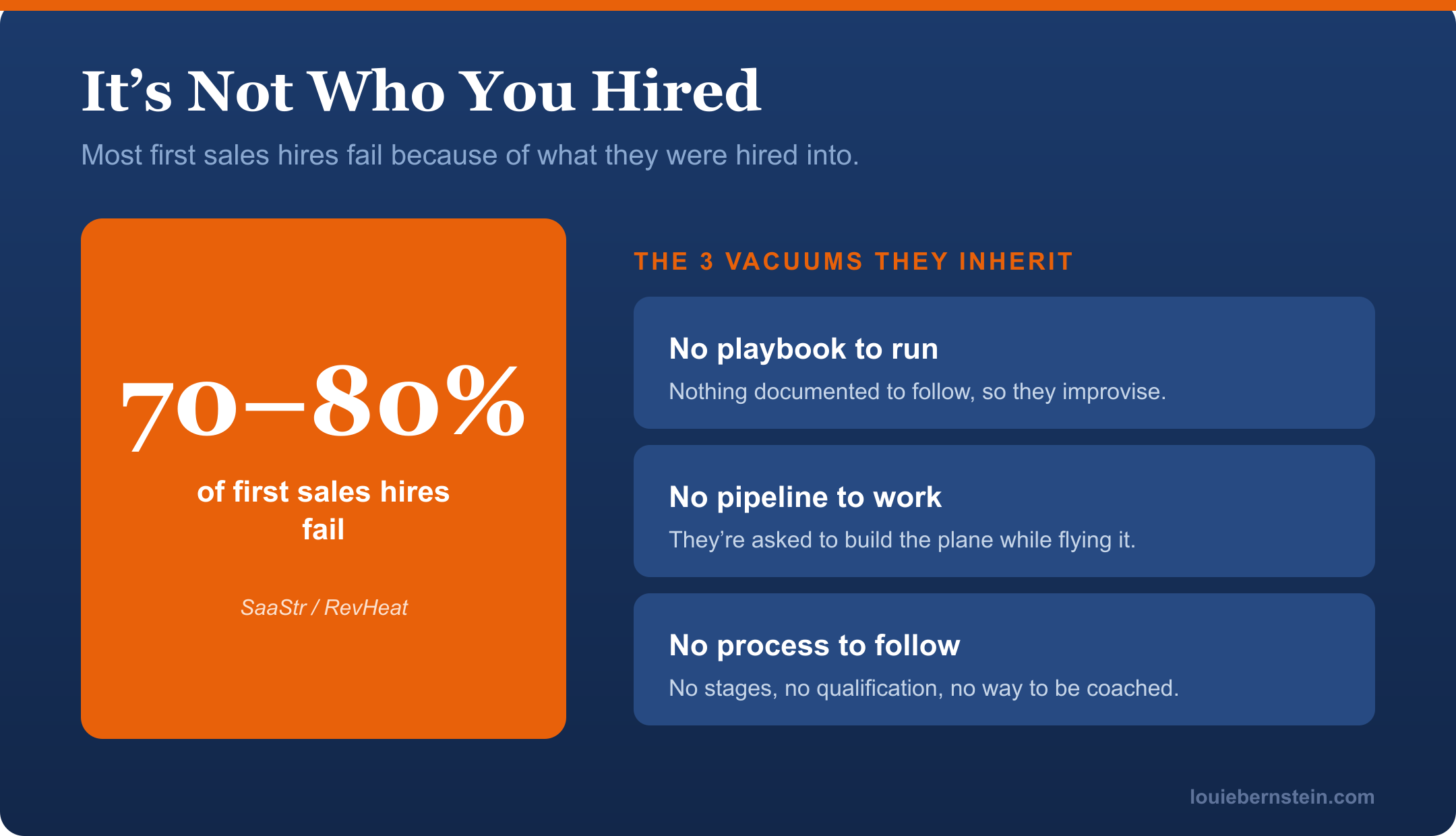
Between 70% and 80% of first sales hires fail (SaaStr, RevHeat). That's not a rounding error, it's the base rate. And here's the part that should change how you think about the whole thing: it's usually not about who you hired. The person is rarely the real problem. The setup is.
Founders instinctively blame the hire, wrong person, bad fit, should've screened harder. Then they hire again, into the exact same conditions, and get the exact same result. Let me show you why first sales hires really fail, so you can fix the thing that's actually broken before you spend another $200K finding out the hard way.
The Failure Rate Nobody Warns Founders About
The reason nobody warns you about the 70–80% failure rate is that it's embarrassing on both sides. Founders don't advertise a hire that didn't work out, and reps don't put "failed at a startup" on LinkedIn. So the number stays invisible, and every founder walks in believing they'll be the exception, placing a bet that's a coin flip at best without ever knowing the odds.
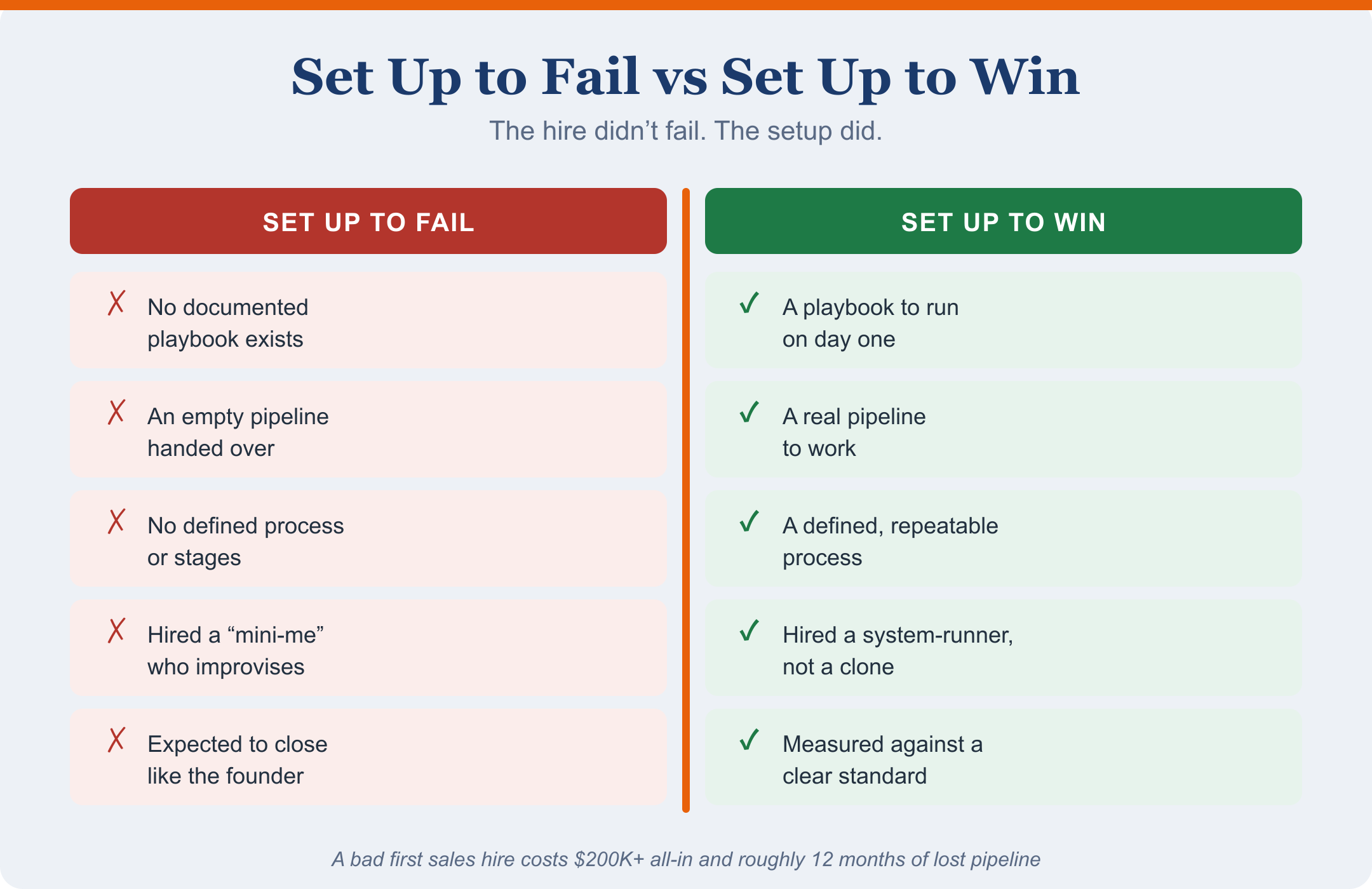
And the cost of losing that bet is steep. A bad first sales hire runs $200K or more all-in once you count salary, ramp, and the deals that leaked out while they struggled, plus roughly 12 months of lost pipeline you'll never get back. Even the hires that technically "work" often don't last, the average sales-leadership tenure is just 19 months (Gong). Go in blind and you're not just risking money, you're risking a year of your company's growth.
Why Founders Blame the Person Instead of the System
When a hire fails, "wrong person" is a comforting story. It's clean, it's external, and it doesn't implicate you. "No system" is the harder story, because it points straight back at the founder. So the person gets blamed, gets replaced, and the whole cycle runs again, with a new name in the same broken seat.
Here's the tell that you're stuck in this loop: you've now had two or three sales hires fail. At that point the odds that you keep picking uniquely bad people are tiny. What's far more likely is that they all walked into the same vacuum and got the same result. When the pattern repeats across different people, the variable that's constant is the environment, and the environment is yours to fix.
Hiring Into a Vacuum: No Playbook, No Pipeline, No Process
The vacuum has three parts, and each one alone is enough to sink a rep. No playbook: there's nothing documented to run, so they improvise from day one and reinvent every deal. No pipeline: they're handed an empty CRM and expected to hit quota, building the plane while flying it. No process: no stages, no qualification criteria, nothing to measure against, which also means nothing to coach against when things go sideways.
A rep dropped into that vacuum has to be a founder-level entrepreneur just to survive, someone who can build a motion from scratch, generate their own pipeline, and self-coach through it all. But that's not who you hired. You hired a salesperson, and a salesperson needs a system to sell inside of. Fixing the vacuum before the hire is exactly why the sales audit matters so much, which I walk through in the sales audit every founder skips before hiring.
The "Mini-Me" Mistake That Sinks the First Hire
There's a second, subtler trap layered on top of the vacuum: the "mini-me" hire. Founders love to hire someone who reminds them of themselves, same energy, same charisma, same passion for the product, and then expect that person to sell exactly the way they do. It feels safe. It's actually a mistake.
The problem is that the founder's magic doesn't transfer. You close on deep product knowledge, hard-won credibility, and the raw conviction of the person who built the thing. Your mini-me improvises like you, but without any of those unfair advantages, so the improvisation just falls flat. What you actually need is often the opposite of you: someone who thrives on running a system rather than reinventing one every single deal.
Why the Best Closer Isn't the Best First Hire
Here's the counterintuitive part. The most impressive closer in your interview pipeline is often the wrong first hire. Star closers are great precisely because they've thrived inside strong systems, steady inbound leads, sales engineering support, a proven playbook, marketing air cover. Drop that same star into your vacuum and even they flounder, and now you've overpaid handsomely for the privilege of watching it happen.
Your first hire's real job isn't to be a hero. It's to run your documented motion, help you refine it, and prove it's repeatable in someone else's hands. That calls for a coachable, process-oriented, resilient builder, not necessarily the flashiest name on the résumé. Screening for the right traits instead of the shiniest ones is its own skill, one I dig into in how do I avoid hiring the wrong salesperson.
"You're not hiring someone to sell like you. You're hiring someone to run the system you built, and make it better. Those are two very different people."
Six More Ways a First Sales Hire Gets Set Up to Fail
The vacuum, the mini-me, and the star closer are the big three. These six show up right behind them, and every one of them is fixable before the rep’s first day.
- The brand did their selling. A rep from a household-name company often had inbound demand and buyers who already wanted to buy. At your company they have to create demand from cold. Hire reps who have sold something nobody had heard of, and ask exactly how they built pipeline at their last job.
- The ICP is “anyone who might benefit.” When the target is too broad, the rep spends months on prospects who will never buy. Define industry, company size, title, pain, and buying trigger, then hand the rep a list built to that spec.
- The quota was set from a spreadsheet. “We need $2M and we have three reps” isn’t a quota. Build it from deal size, sales cycle, and how many qualified prospects a rep can actually work.
- Onboarding ended at the CRM login. No weekly 1:1s, no deal reviews, no call coaching. Without structured feedback, bad habits compound and good instincts go unnoticed. Put a 30-minute weekly 1:1 with a fixed agenda on the calendar before they start.
- The comp plan attracts the wrong people. A base-heavy plan signals safety over performance. A 50/50 base-to-variable split attracts reps who want the upside your stage requires.
- Expectations were never written down. No Accountability Document, no 30-60-90 plan, no KPIs. By the time the mismatch is obvious, you’ve lost three to four months and often $30,000–$50,000.
What Actually Has to Change Before You Hire Anyone
The fix isn't a better interview process, it's upstream of hiring entirely. Before you bring anyone on, you need three things in place: a documented playbook the rep can run on day one, a real pipeline to hand them instead of an empty CRM, and a defined process with stages and qualification they can follow and be coached against. Put those three things in place and you flip the odds, the same hire who would've been a coin flip now has a genuine shot.
This is exactly the work I do with founders as a Fractional Sales Leader: build the playbook, fill the pipeline, and install the process, so your first hire steps into a machine instead of a vacuum. That single change is the difference between joining the 70–80% failure statistic and beating it. One honest caveat: if you don't yet have a repeatable motion of your own, no hire will rescue you, they'll just fail into the same vacuum. In that case, stay in founder-led sales longer and prove the motion first, which I make the full case for in founder-led sales should last longer than you want it to. Then hire into a real system, and give your first rep the fair shot the last one never had.
Related Reading
Frequently Asked Questions
Q: Why do most first sales hires fail?
Because they're hired into a vacuum. Between 70% and 80% of first sales hires fail (SaaStr, RevHeat), and it's usually not the person, it's the setup. There's no documented playbook to run, no pipeline to work, and no defined process to follow or be coached against. A rep dropped into that has to be a founder-level entrepreneur just to survive, and that's not what you hired. Fix the environment first, a playbook, a pipeline, and a process, and the same hire suddenly has a real chance.
Q: Is it really not the person's fault when a sales hire fails?
Occasionally you do hire the wrong person, but if it keeps happening, the person is not the variable. When two or three different hires fail in the same seat, the constant is the environment, not the people. Blaming the person is comforting because it doesn't implicate the founder, but it also guarantees you'll repeat the mistake. The honest move is to look at what all those hires walked into, and fix that before you run the search again.
Q: What's the "mini-me" hiring mistake?
It's hiring someone who reminds you of yourself, same charisma, same passion, and expecting them to sell exactly the way you do. The trouble is that a founder's magic doesn't transfer. You close on deep product knowledge, hard-won credibility, and the conviction of the person who built the company. A mini-me improvises like you but without those advantages, so it falls flat. What you usually need is the opposite: someone who thrives on running a documented system rather than reinventing one on every deal.
Q: Should I just hire the most impressive closer I can find?
Usually not as your first hire. Star closers are impressive because they've thrived inside strong systems, steady leads, support, a proven playbook. Drop that same person into your vacuum and even they struggle, and you've paid a premium for it. Your first hire's job is to run your documented motion, help refine it, and prove it's repeatable. That calls for a coachable, process-oriented, resilient builder more than a flashy résumé. Match the hire to the reality they're stepping into, not to an ideal that doesn't exist yet.
Q: What has to be in place before I hire a salesperson?
Three things: a documented playbook the rep can run on day one, a real pipeline to hand over instead of an empty CRM, and a defined process with stages and qualification they can follow and be coached against. Those turn a coin-flip hire into a fair shot and are the difference between joining the 70–80% failure rate and beating it. Building them is exactly what a Fractional Sales Leader does before you hire, so your rep steps into a working machine rather than a vacuum.
Q: What if I don't have a repeatable motion yet?
Then don't hire yet, because a rep can't run a motion that doesn't exist. If you haven't personally proven a repeatable way to win, any hire will just fail into the same vacuum. Stay in founder-led sales longer, close enough deals to see the pattern, and document it as you go. Once you have a motion that works and can hand over a real pipeline and process, you're ready to hire, and your first rep gets the fair shot the failed statistic never had.
Q: How do I know if my sales hire is failing or my system is broken?
Look at activity, not just revenue. Is the rep running real discovery calls, building pipeline from cold, and following the playbook? If activity is strong and results are weak, the system needs fixing: the ICP, the messaging, or the process. If activity is weak even with a playbook and weekly coaching, it’s more likely the person.
Q: What do I do if I’ve already made a bad sales hire?
Diagnose honestly first. If the rep is underperforming because there’s no system, fix the system before any personnel decision. If activity is clearly low and coaching hasn’t moved it after 60 to 90 days, it’s time to move on. Document what you learned, so the next hire walks into a better setup.
Q: How long should I give a new rep before I know if they’ll work out?
Ninety days, with clear milestones at 30 and 60. By day 30 they should know the product and the playbook and have run managed calls. By day 60 they should be running deals on their own. By day 90 you have enough activity data and early deal feedback to make a real call.
Don't hire into a vacuum.
If you're a founder between $1M and $10M in ARR, I'll build the playbook, fill the pipeline, and install the process, so your first sales hire steps into a machine that works. See how it works at louiebernstein.com.
Schedule a 30-Minute CallAbout the Author
Louie Bernstein
Fractional Sales Leader with 50 years of sales experience helping $1M–$10M ARR companies build scalable, repeatable sales systems. Founder of MindIQ (INC 500). LinkedIn Top Voice in Sales Management, Sales Operations, and Sales Coaching.