Key Takeaways:
- The safe default for a first sales rep is a 50/50 split (half base, half variable), commission paid from dollar one, with uncapped upside. Simple, fair, and it attracts real hunters.
- Founders make two opposite mistakes: too safe (big base, no real upside, so you hire an order-taker) or too clever (capped, tiered, commission-only, so great reps walk and the rest game it).
- Uncapped commission is a screening tool. The reps who get excited by "no ceiling" are the ones you want. The reps who fixate on the base are usually not.
- Market context: the median SaaS AE earns ~$190K OTE at a 53:47 split, with 11-14% commission at full attainment (Bridge Group, 2024). Your first rep at $1M-$3M ARR usually lands below that; scale the numbers, keep the structure.
- Pass the napkin test: if a rep can't explain how they're paid in 60 seconds, the plan is too complex. A plan people don't understand can't motivate them.
Hiring your first sales rep is a big, scary bet. And the comp plan is where most founders quietly sabotage it, either by overpaying out of fear, or by building something so complicated and stingy that the good candidates walk away.
Here's the good news: paying a first rep well is not complicated. There's a default structure that works for almost every $1M to $10M ARR company, and once you understand the logic behind it, you can set a plan you'll feel confident defending to the rep and to yourself.
A bad first sales hire can cost you $200K-plus and a year of lost pipeline, and the wrong comp plan is one of the fastest ways to cause one. Let's get it right the first time.
The Two Mistakes Founders Make on the First Comp Plan
Almost every bad first comp plan I see falls into one of two buckets, and they're opposites. Knowing both helps you steer between them.
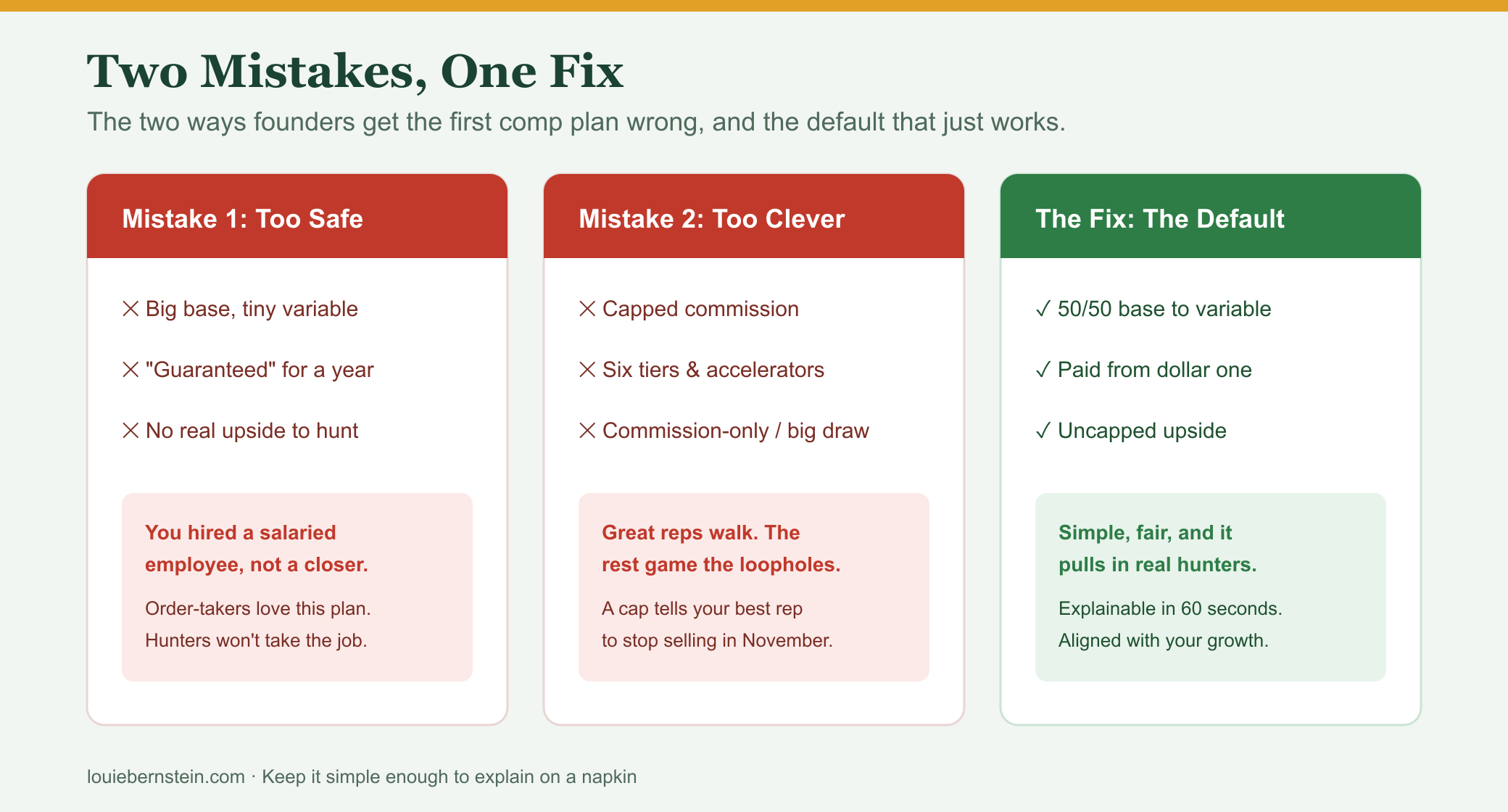
Mistake one is playing it too safe: a big base, a tiny variable, maybe a "guaranteed" first year. It feels kind, but it tells you exactly who you'll attract, someone who wants a salary, not someone who wants to hunt. Mistake two is getting too clever: capped commissions, six tiers, accelerators, decelerators, a commission-only structure with a scary draw. Complexity feels sophisticated. In practice, great reps read a convoluted plan as a red flag and walk, while the ones who stay spend their energy gaming the loopholes instead of selling.
A cap on commission tells your best rep to stop selling in November. Never put a ceiling on the exact behavior you're trying to buy.
Why 50/50 and Dollar-One Commission Is the Safe Default
The structure that avoids both mistakes is the classic one for a reason: a 50/50 split between base and variable, with commission paid from the first dollar and no cap on the top.
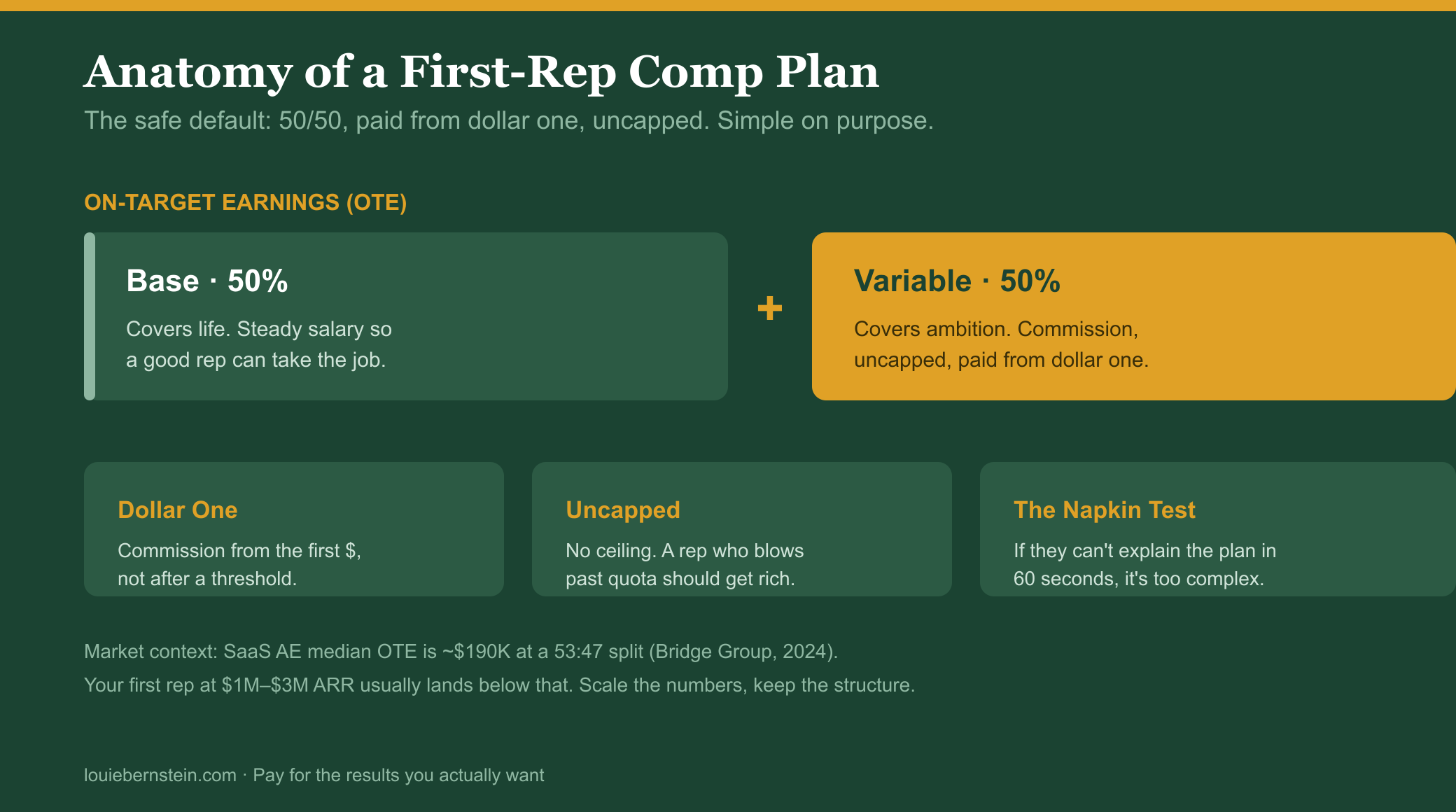
The market backs this up. Across 172 SaaS companies, the median AE earns about $190K OTE at roughly a 53:47 base-to-variable split, with commission around 11 to 14% of bookings at full attainment (Bridge Group, 2024). That's the established-market benchmark, so treat 50/50 as the principle and those percentages as the shape, then scale the actual dollars to your stage. Dollar-one commission matters because it keeps the rep motivated on every deal, not just the ones past some threshold. And the split says something important: you're sharing both the risk and the reward.
Uncapped Upside as a Screening Tool
Here's a benefit of uncapped commission that founders miss: it's a hiring filter. When you tell a candidate "there's no ceiling, if you crush quota you'll make a fortune," watch their reaction. The rep whose eyes light up is a hunter. The rep who immediately asks to negotiate the base higher is telling you they don't believe they'll hit the number, which is exactly the wrong signal in your first sales hire.
Uncapped upside costs you nothing if a rep underperforms, and it's the best money you'll ever spend if they overperform, because a rep making "too much" commission means they sold way more than you expected. That's a problem you want. Capping it to avoid that is like refusing a raise because you're worried about a bigger tax bill.
The candidate who's excited by uncapped upside is betting on themselves. The one negotiating the base up is hedging. In your first rep, you want the one who bets.
Base That Covers Life, Variable That Covers Ambition
The two halves of the plan do two different jobs, and naming them helps you set them right. The base covers life. It has to be enough that a good rep can pay their bills and take the job without financial panic. Set it too low and you'll only attract the desperate. The variable covers ambition. It's the part that says "the more you win, the more you earn," and it should be big enough to genuinely change the rep's life in a great year.
Get the balance wrong in either direction and you get the wrong behavior. Too much base and the rep coasts. Too little and they either won't take the job or they'll churn the moment a steadier offer appears. The 50/50 split exists because it keeps both jobs, security and ambition, in healthy tension. This is also why comp is downstream of the number: you can't set the variable well until you've set a quota the rep can actually hit, which is its own discipline.
The Napkin Test: Simple Enough to Explain in 60 Seconds
Here's the simplest quality check for any comp plan: can the rep explain how they get paid, accurately, in about 60 seconds, on the back of a napkin? If yes, you're good. If they stumble, or if it takes a spreadsheet and a lawyer, your plan is too complex.
This isn't just about elegance. A comp plan is a motivational tool, and a rep can't be motivated by incentives they don't understand. If your rep can't instantly calculate what closing one more deal puts in their pocket, the plan has failed at its one job. Every tier, kicker, and clawback you add is another thing between the rep and that instant calculation. Simplicity isn't laziness. It's what makes the plan actually drive behavior.
What to Pay When You Don't Have Benchmarks Yet
The hardest part for a founder is often just picking the numbers, because you have no history to base them on. Here's how to do it without benchmarks:
- Start from what a good rep needs to live in your market. That's your base floor. Under it, you won't attract talent.
- Set OTE from your economics, not ego. A rep's total pay should be a healthy fraction of the new revenue they can realistically generate, so the math works for the business.
- Use the 50/50 split to divide base and variable, then set commission so hitting quota lands the rep at OTE.
- Sanity-check against the market. The Bridge Group median ($190K OTE, ~12% commission) is the established-SaaS ceiling; expect your first, earlier-stage rep to sit below it.
- Keep it uncapped and simple, then leave it stable for at least a year. Changing comp mid-year is how you lose trust and reps.
If setting these numbers still feels like guesswork, that's normal, and it's exactly the kind of decision a Fractional Sales Leader is built to get right for a $1M to $10M ARR company, without the cost of a full-time VP of Sales. Getting the first comp plan wrong is expensive and hard to undo. Getting it right sets the tone for every rep you hire after.
Frequently Asked Questions
Q: What's a good comp structure for a first sales rep?
A 50/50 split between base and variable, with commission paid from the first dollar and no cap on the upside. That structure shares risk and reward, keeps the rep motivated on every deal, and is simple enough to understand at a glance. The market median for established SaaS AEs is about a 53:47 split at ~$190K OTE (Bridge Group, 2024), so use 50/50 as the principle and scale the actual dollars to your stage.
Q: Should I cap my sales rep's commission?
No. A cap tells your best rep to stop selling once they hit it, usually right when momentum matters most. Uncapped commission costs you nothing if a rep underperforms and is the best money you'll ever spend if they overperform, because a huge commission check means they sold far more than you expected. Capping to avoid "overpaying" is like refusing extra revenue to keep the payout tidy.
Q: How much should I pay my first sales rep?
Start from what a good rep needs to live in your market (that's your base floor), then set OTE so the rep's total pay is a healthy fraction of the revenue they can realistically generate. Split it roughly 50/50 and set commission so hitting quota lands them at OTE. The established SaaS median is ~$190K OTE (Bridge Group, 2024), but a first rep at $1M-$3M ARR typically sits below that. Scale the numbers, keep the structure.
Q: What does "paid from dollar one" mean?
It means the rep earns commission on every dollar of sales, starting with the first, rather than only after they clear some threshold or quota floor. Dollar-one commission keeps a rep motivated on every deal, including the small and early ones, and it's simpler to understand. Threshold-based plans can leave reps feeling they're "working for free" until they hit the floor, which kills momentum early in a quarter or a ramp.
Q: How complex should a comp plan be?
As simple as possible. Use the napkin test: if a rep can't accurately explain how they get paid in about 60 seconds, the plan is too complex. A comp plan is a motivational tool, and a rep can't be motivated by incentives they don't understand. Every tier, kicker, and clawback you add is another thing between the rep and instantly knowing what closing one more deal puts in their pocket. Simplicity is what makes it work.
Q: What if I get the comp plan wrong?
Getting it wrong is costly, a bad first hire can run $200K-plus and a year of lost pipeline, and changing comp mid-year erodes trust fast. That's why it's worth setting carefully and leaving stable for at least a year. If you're unsure, get a second opinion before you make the offer, not after. Structuring a first comp plan that attracts the right rep and protects your economics is a common early project for a Fractional Sales Leader.
About to make your first sales hire?
In 30 minutes I'll help you set a comp plan that attracts a real closer without overpaying, sized to your economics and simple enough to explain on a napkin. See how a Fractional Sales Leader can help at louiebernstein.com.
Schedule a 30-Minute CallAbout the Author
Louie Bernstein
Fractional Sales Leader with 50 years of sales experience helping $1M–$10M ARR companies build scalable, repeatable sales systems. Founder of MindIQ (INC 500). LinkedIn Top Voice in Sales Management, Sales Operations, and Sales Coaching.