Key Takeaways:
- Founders describe their dream first rep and accidentally describe themselves. Cloning your charisma is one of the most reliable ways to hire the wrong person.
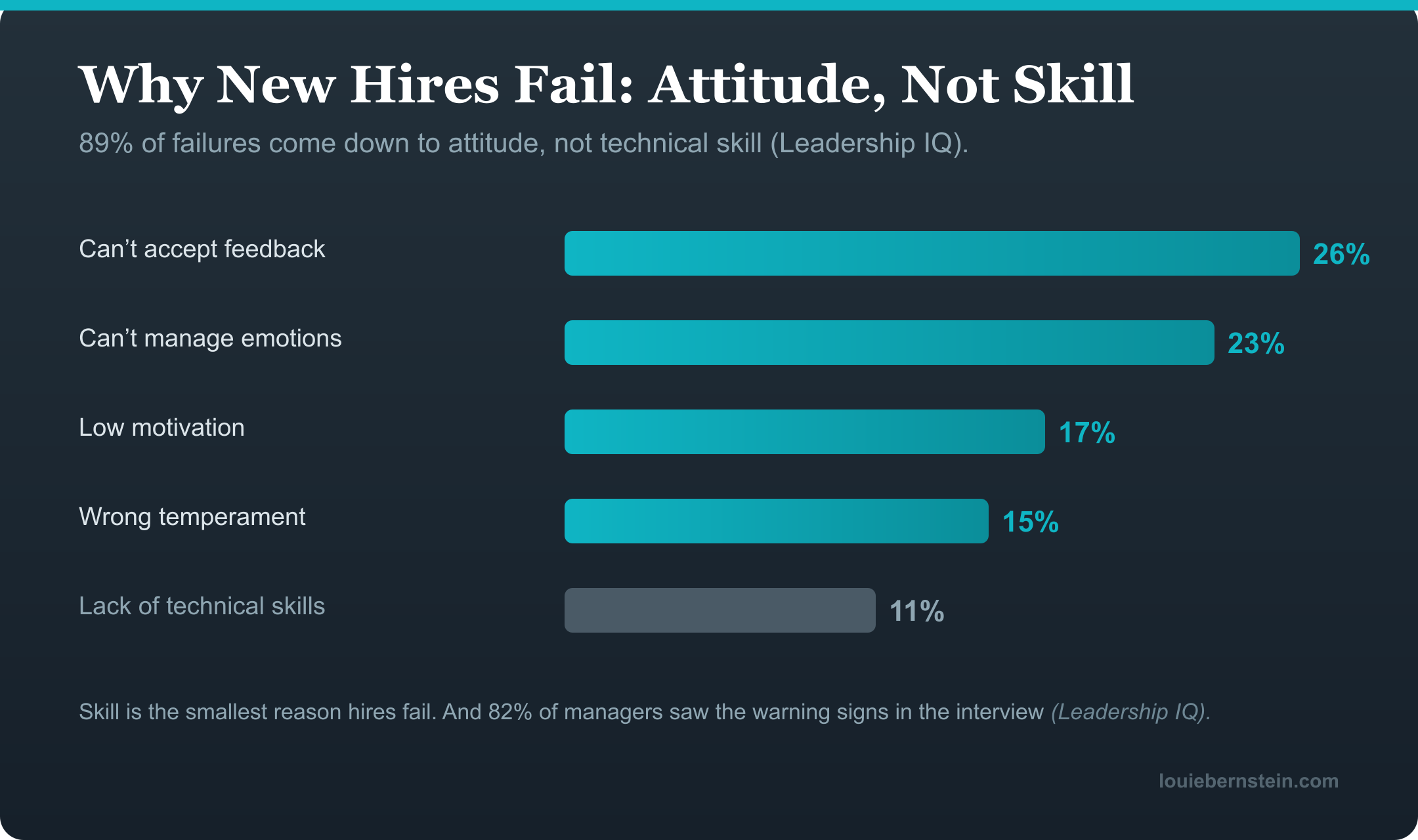
- 89% of new-hire failures come down to attitude, not skill (Leadership IQ). The single biggest reason (26%) is that they can't accept feedback. Coachability beats charisma.
- You need system-skills (running a process, taking coaching, qualifying), not just relationship-skills (charm and rapport). At your stage, the system-runner beats the improviser.
- Great first hires share five traits: coachability, process discipline, resilience, curiosity, and ego control. None of them is "reminds me of me."
- The right hire usually looks different from how you sell, and that's exactly why they work. You sold on founder magic; they'll sell on a repeatable system.
When founders describe their dream first sales rep, they almost always describe themselves. Charismatic. Passionate about the product. A natural closer. It feels right, if you could just clone yourself, the sales problem would be solved. It's also one of the most reliable ways to hire the wrong person.
The data on why hires fail is stark. In a landmark study of more than 20,000 employees, Leadership IQ found that 46% of new hires fail within 18 months, and 89% of those failures come down to attitude, not skill. Only 11% fail for lack of technical ability. The single biggest reason, at 26%, is that they simply can't accept feedback. Charisma isn't anywhere on that list. Coachability is at the very top of it.
So the thing you're instinctively screening for, a version of yourself who can sell, is mostly the wrong thing to screen for. Let me show you what to actually look for in your first sales rep, why it looks different from how you sell, and the interview questions that reveal it.
Why Founders Hire for Charisma and Regret It
Founders trust charisma because it's what they see and value in themselves. But charisma is the easiest thing to perform in an interview and the least predictive of on-the-job success. The candidate who dazzles for an hour can just as easily be the rep who quietly ignores your playbook, resists every piece of coaching, and misses quota for two straight quarters while still being fun to talk to.
The scariest stat in the Leadership IQ study isn't the failure rate, it's this: 82% of hiring managers said they saw warning signs during the interview and hired the person anyway. Charisma is usually what overrode the red flags. Someone was magnetic enough that the founder talked themselves out of the doubt they clearly felt. Learning to trust that doubt is half the battle.
System-Skills vs. Relationship-Skills: The Gap That Matters
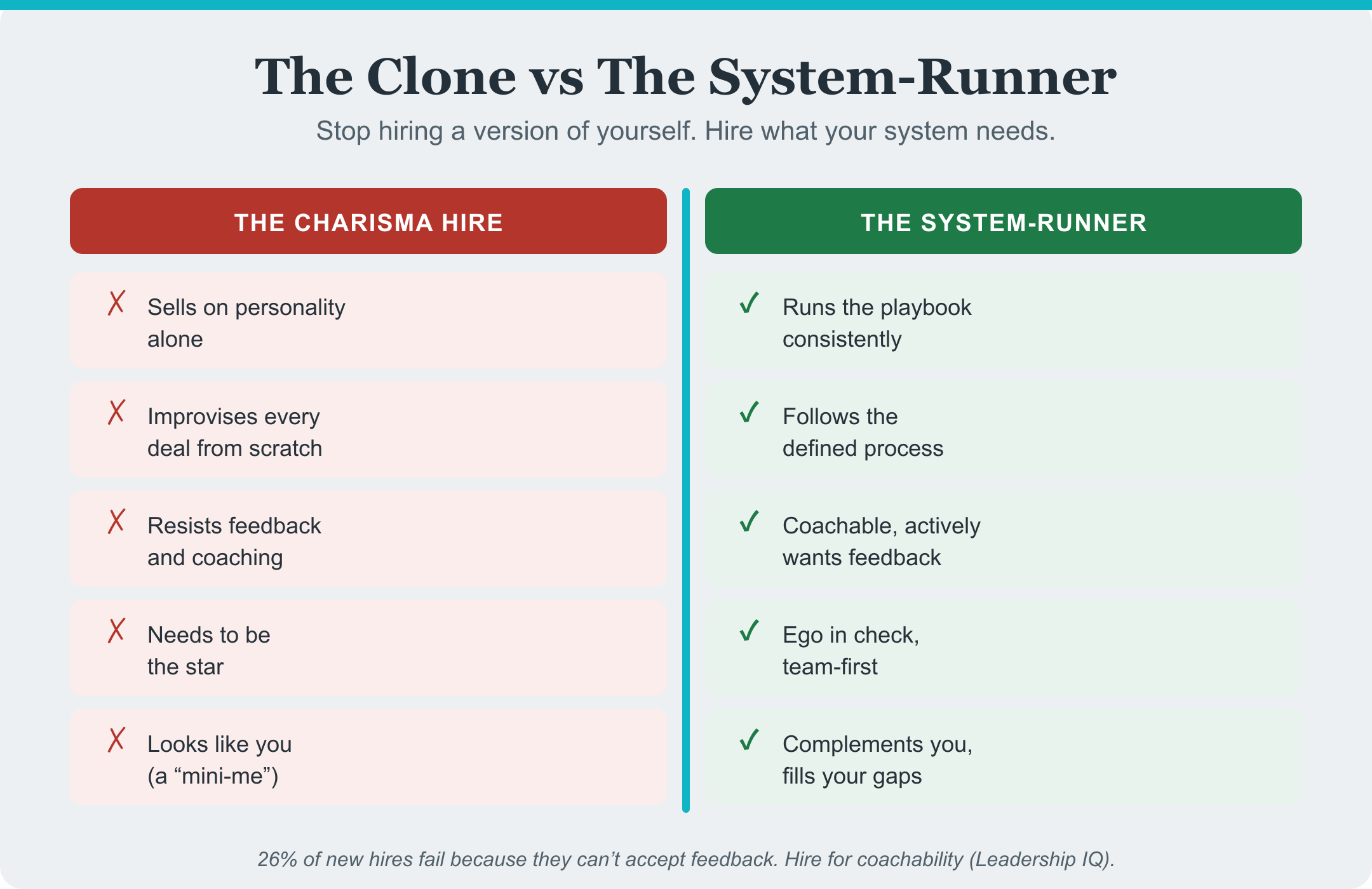
There are two different skill sets hiding under the word "sales." Relationship-skills, charm, rapport, likability, get a rep in the door and build trust. System-skills, the discipline to run a process, keep the CRM current, hold a qualification bar, and actually apply coaching, are what produce consistent, repeatable revenue. Both matter, but they're not the same, and they don't always live in the same person.
Founders massively over-index on relationship-skills, because that's their own strength and it's the visible, obvious part of selling. But at $1M to $10M in ARR, what you most need is someone who will faithfully run the system you built, and that's a system-skill. A rep with elite charm and zero process discipline will give you a thrilling first month and an unpredictable year.
The Rep Who Runs a Playbook vs. the Rep Who Improvises
Picture the two archetypes. The improviser is exciting and unpredictable, brilliant some months, terrible others, and nearly impossible to coach because there's no consistent method underneath to correct. When they win, no one can explain why; when they lose, neither can they. The playbook-runner is steadier and far more coachable, and their results compound over time because you can actually improve a repeatable process.
At your stage, you want the compounding. A steady, coachable rep who runs your motion and gets a little better every month will out-earn the volatile genius over any real time horizon, and won't give you a heart attack every forecast. The improviser is fun to hire and painful to scale.
What Great First Hires Have in Common
Across the reps I've seen succeed as a founder's first hire, five traits show up again and again, and they map almost perfectly onto the Leadership IQ data on why people fail:
- Coachability. They actively seek out feedback and apply it. This is the number-one predictor, and its absence is the number-one cause of failure.
- Process discipline. They follow a system without being told twice and keep the CRM honest.
- Resilience. They handle rejection and the general messiness of an early-stage motion without unraveling.
- Curiosity. They dig into the customer's problem instead of just reciting their pitch.
- Ego control. They're team-first, not "I'm the star," which is what makes them coachable in the first place.
"Hire the rep who asks 'what should I do differently?' over the one who tells you why they're already great. Coachability compounds. Ego doesn't."
The Interview Questions That Reveal System-Thinking
You can actually screen for these traits instead of hoping for them. A handful of questions reliably separates the coachable system-runner from the charming improviser:
- "Tell me about a time you got tough feedback. What did you do with it?" Listen for growth versus defensiveness. This is your coachability test.
- "Walk me through your process for working a deal, step by step." Do they have a repeatable method, or do they wing it?
- "Describe a deal you lost. Why did it happen?" Accountability versus blaming the product, the price, or the buyer.
- "How do you decide a deal isn't worth pursuing?" Reveals qualification discipline, or the lack of it.
- "What would you want from me in your first 90 days?" Do they want a system and coaching, or just a free hand and a comp plan?
If you want a sharper set of questions built specifically to filter out the great storytellers, I put together the five interview questions that separate real salespeople from great storytellers. The goal in all of them is the same: get past the performance and see how the person actually thinks and works.
Why the Right Hire Looks Different From How You Sell
Here's the punchline that trips up almost every founder: your first great hire probably won't remind you of yourself, and that's precisely why they'll work. You sold on founder magic, product depth, conviction, credibility, that simply can't be taught or transferred. They'll sell on a repeatable system that can. Different skill, different kind of person, better outcome for the company. If you catch yourself dismissing a strong, coachable candidate because they're "not a natural like me," that instinct is the thing to override, and it's closely related to the traps in how do I avoid hiring the wrong salesperson.
This is exactly the work I do with founders as a Fractional Sales Leader: define the real profile based on traits instead of charisma, build a scorecard, and interview for coachability and system-skills rather than gut feel, so your first hire is the one in five that succeeds instead of the four in five that don't. One honest caveat: none of this works if there's no system for the rep to run. Hire a coachable system-runner into a vacuum and they'll still fail, just politely, which is the whole point of why first sales hires fail. Build the system first, then hire the person built to run it.
Related Reading
Frequently Asked Questions
Q: What should I look for in my first sales rep?
Look for traits, not charisma: coachability, process discipline, resilience, curiosity, and ego control. These predict success far better than a magnetic personality, because 89% of new-hire failures come down to attitude, not skill (Leadership IQ). The most important single trait is coachability, since the number-one reason hires fail is that they can't accept feedback. At the $1M–$10M ARR stage, you need someone who will faithfully run the system you built and get better at it every month, not someone who improvises brilliantly and unpredictably.
Q: Why is hiring a "mini-me" a mistake?
Because the founder's magic doesn't transfer. You close on deep product knowledge, hard-won credibility, and the conviction of the person who built the company. A clone of your personality improvises like you but without those advantages, so it falls flat. What you actually need is often the opposite of you: someone with the discipline to run a documented system rather than reinvent one on every deal. The right first hire complements your gaps instead of mirroring your strengths.
Q: Isn't charisma important in sales?
Charisma helps open doors and build rapport, but it's the least predictive part of long-term success and the easiest thing to fake in an interview. The Leadership IQ data is blunt: only 11% of hires fail for lack of skill, while 26% fail because they can't accept feedback. A charming rep with no process discipline gives you a thrilling first month and an unpredictable year. Value charm as a bonus on top of coachability and system-skills, never as a substitute for them.
Q: What's the single most important trait to screen for?
Coachability. In the Leadership IQ study, the biggest single reason new hires fail, 26% of cases, is that they can't accept feedback. A coachable rep who's average today becomes strong in six months because they absorb and apply your guidance. An uncoachable rep who's impressive today plateaus, because you can't correct what they won't hear. Everything else you want, process discipline, resilience, curiosity, is easier to build in someone who genuinely wants to get better. Screen for it hard.
Q: What interview questions reveal the right traits?
Ask questions that get past the performance. "Tell me about a time you got tough feedback and what you did with it" tests coachability. "Walk me through your process for a deal, step by step" reveals whether they have a repeatable method or wing it. "Describe a deal you lost and why" tests accountability versus blame. "How do you decide a deal isn't worth pursuing?" shows qualification discipline. And "What would you want from me in your first 90 days?" tells you whether they want a system and coaching or just a free hand.
Q: My candidate is impressive but seems hard to coach. Should I hire them?
Be very careful. That exact situation is where founders get burned, 82% of hiring managers admit they saw warning signs in the interview and hired anyway, usually because charisma overrode the doubt (Leadership IQ). If the person is impressive but defensive about feedback, the impressiveness is the trap. Coachability is the strongest predictor you have, and its absence is the strongest predictor of failure. Trust the warning sign over the wow factor. A slightly less flashy but genuinely coachable rep is the far better bet.
Hire for what your system needs, not for a clone.
If you're a founder between $1M and $10M in ARR, I'll help you define the real profile, build the scorecard, and interview for coachability and system-skills, so your first hire is the one that sticks. See how it works at louiebernstein.com.
Schedule a 30-Minute CallAbout the Author
Louie Bernstein
Fractional Sales Leader with 50 years of sales experience helping $1M–$10M ARR companies build scalable, repeatable sales systems. Founder of MindIQ (INC 500). LinkedIn Top Voice in Sales Management, Sales Operations, and Sales Coaching.