Which Activities, Numbers, Definitions of a Good Month, and Ramp Expectations Belong in It?
A working AE Accountabilities Document is one or two pages with four parts: three or four weekly activity floors, three or four monthly numbers, a written definition of a good month, and a month-by-month ramp schedule. Every number is worked backward from the AE's quota. The founder's commitments sit beside the AE's. If you can't say what a good month looks like before the month starts, your early-stage AE can't either.
Key Takeaways
- A working AE Accountabilities Document holds four things: weekly activity floors, monthly numbers, a written definition of a good month, and a ramp schedule with a percentage of quota for each month.
- Derive every activity number from the quota. In one illustrative case, a $600K annual quota at a $25K average deal and a 25% win rate needs about 5 first meetings a week.
- Average AE ramp is now 6.2 months, the longest The Bridge Group has recorded in its 2026 study of 158 B2B companies, so a first AE's ramp schedule should run at least six months.
- Write three monthly outcomes before the month starts: a good month, a watch month and a problem month, each with a different founder response.
- Before your AE's first day, write the document on two pages or less and review it with them every week, not at the end of the quarter.
Here's what I usually find when I ask a founder for their AE's expectations. There's an offer letter with a quota in it. There's a job description with fifteen bullet points copied from somebody else's posting. And there's a lot of "they know what I need."
They don't. The AE knows the annual number. They don't know how many meetings a week you expect, what counts as a qualified opportunity, or whether month three is supposed to have revenue in it. So they guess. Then you guess. And at month four, you find out you were guessing different things.
A quota tells your AE where the year should end. An Accountabilities Document tells them what this week, this month and this ramp should look like on the way there.
My standard for this document has stayed the same for years: write what's expected and when it's expected. Weekly, monthly, quarterly. Here's what that looks like for an early-stage AE at a $1M to $10M ARR company.
What sections does a working AE Accountabilities Document need?
A working AE Accountabilities Document needs five sections: weekly activity floors, monthly numbers, a definition of a good month, a ramp schedule, and the founder's commitments. Each section answers a different question the AE would otherwise guess at. Keep the whole AE Accountabilities Document to one page, two at most, so both of you actually use it.
| Section | The question it answers | How often you review it |
|---|---|---|
| Activity floors | What do I have to do every week, no matter what? | Weekly |
| Monthly numbers | What results should those activities produce? | Weekly trend, monthly total |
| Good month definition | How will we both know the month went well? | Monthly |
| Ramp schedule | What's expected of me in month two versus month six? | Monthly, through full ramp |
| Founder commitments | What will the founder do so I can hit this? | Weekly |
Notice what's not on the list: a long list of duties. Duties belong in the job description and the Sales Playbook. The Accountabilities Document is about outcomes and timing. My guide to the sales Accountabilities Document covers decision rights and performance standards for every sales role. This article zooms in on the numbers for one early-stage AE.
Which activities belong in an AE's Accountabilities Document?
Only the three or four activities that the AE controls and that predict pipeline belong in an AE's Accountabilities Document, written as weekly floors. A floor is the minimum, not the goal. Activities the AE can't control, like how many inbound leads marketing sends, belong in the founder's commitments instead.
Four activity floors that work for most first AEs
- Prospecting time held. For example, 8 hours a week blocked on the calendar and actually used. Booked and skipped doesn't count.
- First meetings held. The number that comes straight from the quota math below. Held, not booked.
- CRM updated within 24 hours of every buyer conversation. If it isn't in the CRM, it never happened, and you can't coach what you can't see.
- Two recorded calls submitted for review each week during ramp. The numbers show what's happening. The calls show why.
Why fewer activity floors work better
Every activity you add to an AE Accountabilities Document takes time away from selling, and AEs don't have much to spare. Sales reps report spending 70% of their time on non-selling tasks, according to Salesforce's 2024 State of Sales survey of 5,500 sales professionals. Ten activity metrics means more reporting and less selling. Four keeps the AE in front of buyers.
Don't write how to do the work, either. "Call prospects between 9 and 11 on Tuesdays" is micromanaging. "Hold 5 first meetings a week" is an accountability. I go deeper on that line in accountability without micromanaging.
Which numbers should an early-stage AE be held to?
An early-stage AE should be held to three or four monthly numbers: qualified opportunities created, pipeline dollars created, new revenue closed, and one conversion rate. The numbers come from working the quota backward, not from a benchmark. A benchmark describes somebody else's deal size, win rate and sales cycle. Your AE has to live with yours.
Work the quota backward into weekly activity
Here's an illustrative example. A $600K annual new-business quota is $50K a month. At a $25K average deal, that's 2 wins a month. At a 25% win rate, 2 wins take 8 qualified opportunities a month. If 40% of first meetings turn into qualified opportunities, 8 opportunities take 20 first meetings a month. That's 5 first meetings a week, and 5 a week becomes the activity floor.
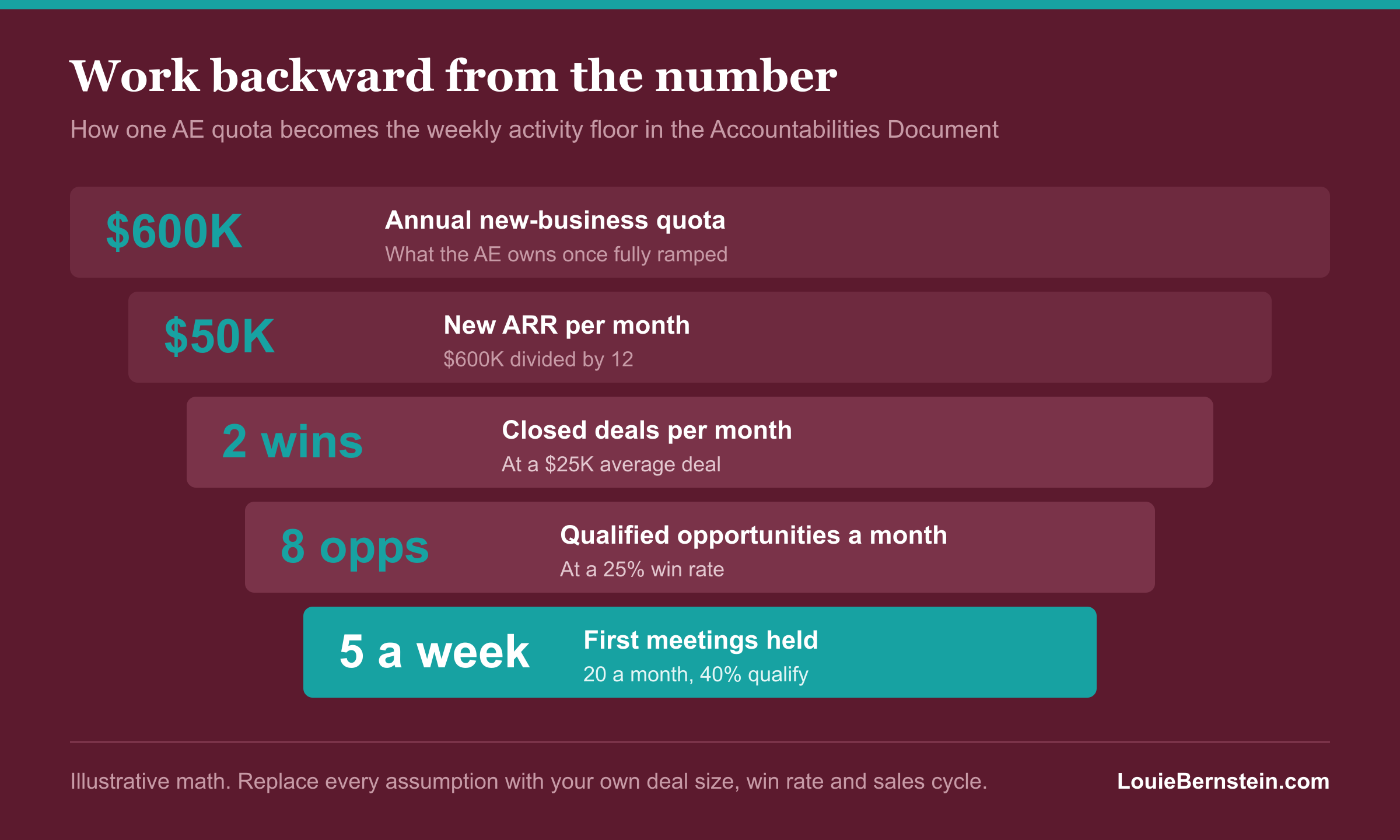
Every number in that chain is an assumption. Replace each one with your own history from the deals you closed as the founder. If you don't have the history, write the assumption down, label it as one, and set a date to revisit it with real data. My article on pipeline math for founders walks through the conversion rates step by step.
The monthly numbers for this example AE
- Qualified opportunities created: 8 a month, using your written qualification definition.
- Pipeline created: $200K a month (8 opportunities at $25K).
- New ARR closed: $50K a month once fully ramped, $150K a quarter, $600K a year.
- One conversion rate: first meeting to qualified opportunity, with 40% as the starting assumption.
Don't borrow a quota from a benchmark report
The median AE quota is $960K in The Bridge Group's 2026 AE report, and only 48% of reps were at quota, down from 51% in 2024. Those companies mostly have sales leaders, playbooks and enablement behind their AEs. A first AE at a $3M ARR company usually has the founder and a half-finished playbook. Set the number from your own math.
How do you define a good month for an AE?
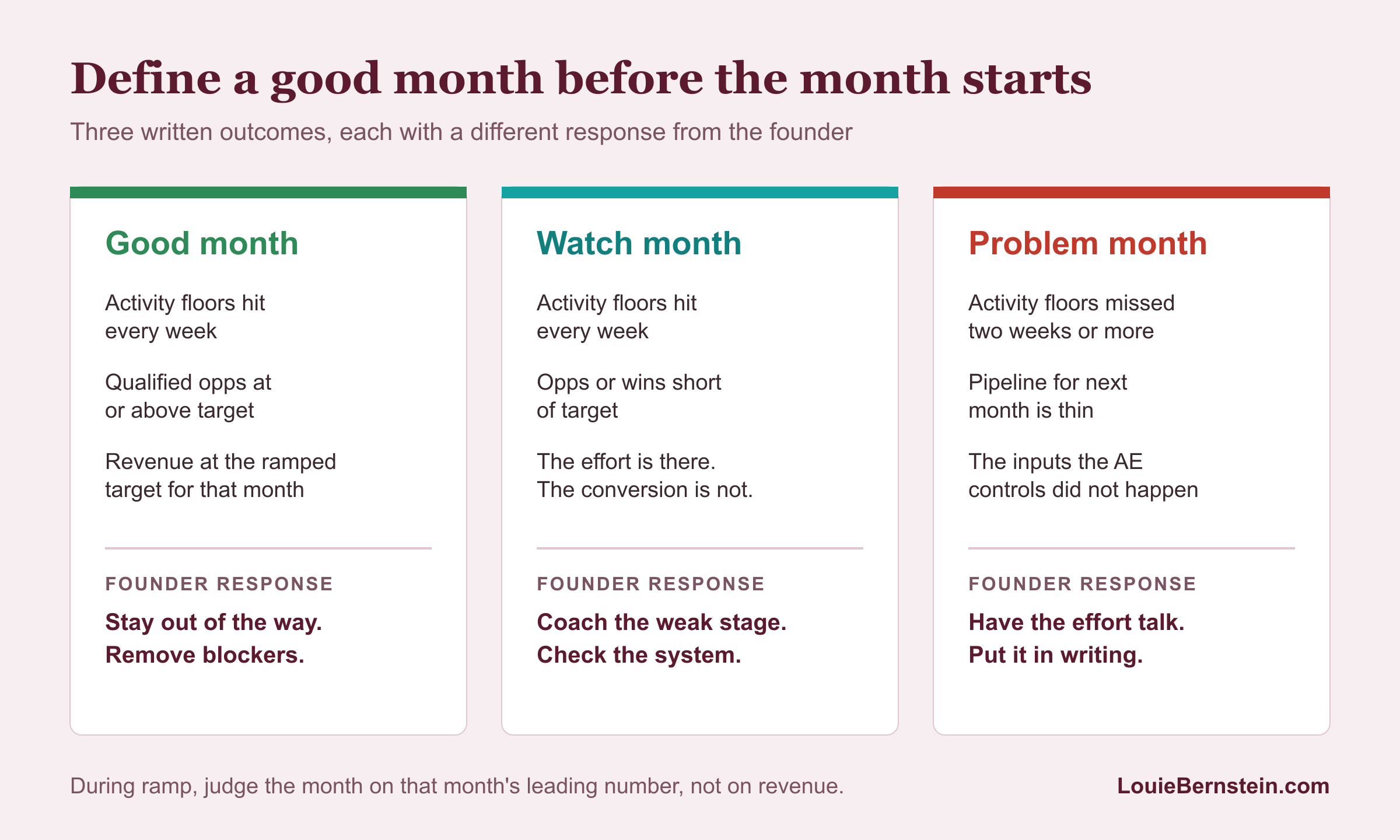
Define a good month for an AE in writing before the month starts, using three outcomes: a good month, a watch month and a problem month. Each outcome triggers a different response from the founder. A written definition stops the end-of-month argument, because you and the AE judge the month against the same standard instead of against two different feelings.
Good, watch and problem months
- Good month: activity floors hit every week, qualified opportunities at or above target, and revenue at the ramped target for that month. Your job is to stay out of the way and clear blockers.
- Watch month: activity floors hit, but opportunities or wins came up short. The effort is there and the conversion isn't. Coach the weak stage, and check whether your list, pricing or playbook is the real problem.
- Problem month: activity floors missed for two weeks or more, and next month's pipeline is thin. The inputs the AE controls didn't happen. That's an effort conversation, and it goes in writing.
Why revenue alone can't define a good month
Revenue alone can't define a good month for an early-stage AE because revenue lags the work by a full sales cycle. With a 90-day cycle, a deal your AE opens in month one closes in month four at the earliest. So during ramp, a good month is judged on that month's leading number, such as meetings held or qualified opportunities created, not on closed revenue.
The reverse is true, too. An AE who closes a big deal the founder handed over can have a great revenue month and an empty pipeline. Without a written definition, that looks like a good month. With one, it looks like a watch month, and you catch the gap 90 days early.
What ramp expectations should you write into the document?
Write a month-by-month ramp schedule into the AE Accountabilities Document, with a focus, a leading number and a percentage of quota for each month. Plan on at least six months to full quota. Average AE ramp is 6.2 months, the longest in the history of The Bridge Group's AE study, and that's at companies with more sales support than yours.
An example ramp schedule for a 90-day sales cycle
| Month | Focus | A good month means | Revenue target |
|---|---|---|---|
| 1 | Learn the playbook, shadow founder calls | Activity floors hit from week three; CRM current | None |
| 2 | Run first meetings with founder backup | 5 first meetings a week; first qualified opportunities | None |
| 3 | Run discovery alone | 6 or more qualified opportunities | None |
| 4 | Move deals through stages | 8 qualified opportunities; deals reaching proposal | 25% ($12.5K) |
| 5 | Close standard deals | First wins without the founder in the room | 50% ($25K) |
| 6 | Carry the full process | Pipeline covers next month's target | 75% ($37.5K) |
| 7+ | Fully ramped | All monthly numbers at target | 100% ($50K) |
This schedule is illustrative. Stretch it if your sales cycle is longer than 90 days. Shorten it only if your history proves deals close faster. The first revenue target should land about one sales cycle after the AE starts running meetings alone, never before.
Write the ramp before the offer
The ramp schedule belongs in the AE Accountabilities Document the candidate sees with the job description, before the offer. A good AE will push back on a ramp that's too short. That's a conversation you want during hiring, not at month four. The month-by-month review side of this is covered in the six-month scorecard for your first AEs.
Where do founders usually get the AE Accountabilities Document wrong?
Founders usually get the AE Accountabilities Document wrong in one of three ways: they write only the annual number, they write a long list of duties with no numbers, or they write the AE's side and leave out their own. Each one leaves the AE guessing about a different part of the job.
What I see when I audit sales teams
In 50 years of sales, I've watched the same scene play out over and over. The founder is frustrated at month four. The AE is frustrated too. And when I ask each of them separately what a good month was supposed to look like, I get two different answers. Neither one is wrong. Nobody ever wrote it down.
I've even seen a rep hit 135% of quota and still get put on a performance plan, because the founder and the rep were measuring different things in their heads. That's not a people problem. That's a missing document.
When you let someone go, it should never be a surprise. If it is, the expectations were never written down.
Put the founder's commitments on the same page
The AE can't hold 5 first meetings a week without a target account list, approved pricing and a founder who shows up to the weekly review. Write those commitments down beside the AE's numbers. For example: the founder supplies the account list before day one, joins the weekly pipeline review, and answers pricing questions within two business days. When the founder misses a commitment, the miss is visible too.
When to bring in outside help
If you've never closed enough deals to know your win rate, or you're about to hire two AEs at once, the math and the ramp are the hardest parts to get right alone. That's the work a Fractional Sales Leader does in a 12-week engagement: build the AE Accountabilities Document, the playbook behind it and the weekly review that keeps it honest, for roughly half the cost of a full-time VP of Sales.
Related ReadingWhat Should Your First Rep's Accountabilities Document Say? →
Frequently Asked Questions
What if I don't know my win rate or conversion rates yet?
Use your own founder-led deals from the last 12 months as the starting point, even if the sample is small. Label every number as an assumption in the AE Accountabilities Document and set a review date, usually after 90 days of the AE's own data. Then update the activity floors from what really happened.
Should my AE sign the Accountabilities Document?
Your AE should agree to the Accountabilities Document in writing, but treat it as a working agreement, not a contract. Review it together before the offer, confirm it on day one, and change it only with a recorded reason and an effective date. Agreement matters more than a signature.
What if my AE hits revenue but misses the activity floors?
An AE who hits revenue but misses activity floors is usually living on old pipeline or deals the founder handed over. Treat it as a watch month. Check next month's pipeline coverage. If coverage is healthy, the floors may be set too high. If it's thin, the revenue won't repeat.
Should activity floors change after the AE is fully ramped?
Activity floors should change after ramp only when the AE's own conversion rates prove different from the starting assumptions. An AE who qualifies 50% of first meetings instead of 40% needs fewer meetings for the same result. Recalculate the floor from the quota, write down the reason, and set an effective date.
Does a second AE get the same Accountabilities Document?
A second AE in the same seat should get the same activity floors, numbers and good-month definition, with their own ramp dates. Matching documents make the two AEs a fair comparison. If both struggle on the same number, the problem is usually the system, not the people.
Know what a good month looks like before your AE starts.
In 30 minutes, we'll work your quota backward into weekly activity floors and a ramp schedule your AE can actually hit. See how Fractional Sales Leadership at LouieBernstein.com can help you hand off sales with clear expectations.
Schedule a 30-Minute CallAbout the Author
Louie Bernstein is a Fractional Sales Leader with 50 years of sales experience and has worked as a Fractional Sales Leader since 2017. He helps B2B founders at $1M to $10M ARR build sales processes, write Accountabilities Documents, and coach teams to sell without the founder in every deal.
LinkedIn | Subscribe to The Sunday Starter for practical sales leadership guidance.