How Is an Accountabilities Document Different From a Job Description, and Why Does It Matter?
Your first rep’s Accountabilities Document should state the outcomes the rep owns, the evidence that counts, the decisions they can make, and the support you owe them. Include ramp milestones and a weekly review. Write the document before the offer, then test it with the candidate. A list of duties leaves too much room for two different versions of the same job.
Key Takeaways
- An Accountabilities Document turns broad sales duties into agreed outcomes, evidence, authority, and review dates.
- Write the founder’s commitments next to the rep’s accountabilities so blocked work has a visible owner.
- Only 49% of U.S. employees strongly agreed they knew what was expected at work in Gallup’s February 2026 findings.
- Set targets from your own sales history. The numbers in the completed example below are illustrations, not hiring benchmarks.
- Before making an offer, ask the candidate to explain the role back to you and challenge the assumptions.
You hired someone to sell. They thought marketing would supply the leads. You thought prospecting was obvious. Neither assumption made it into the job posting.
Now you’re paying for the disagreement. The rep is busy. You’re frustrated. Your calendar still fills with sales calls because nobody agreed on what you were handing off.
If the document lists only what the rep owes you, you’ve written half the job.
For a B2B founder at $1M to $10M ARR, the useful next step is a working example. Here’s how I’d write a first rep’s role so you can hire against it, coach from it, and see where the handoff breaks.
What belongs in the first rep’s Accountabilities Document?
A first rep’s Accountabilities Document needs a role purpose, measurable outcomes, evidence rules, decision rights, founder commitments, and a review schedule. Each part removes a different source of confusion. Together, the parts tell a candidate what they’re accepting and give both of you a fair way to judge progress after the start date.
Start with a clear boundary
“Grow revenue” doesn’t tell a rep whether they own new business, renewals, expansion, or all three. Write the market, buyer, product, and work you’re handing over. Also name what stays with you.
A job description can contain detailed expectations too. The distinction is how you use the document. Recruiting copy explains the opportunity. A working Accountabilities Document becomes the standard you and the rep actually review. My broader guide to sales role accountabilities covers that foundation.
Make evidence part of every outcome
“Build qualified pipeline” needs a definition of qualified. Otherwise, adding names to the CRM can look like progress. Write which buyer facts must be confirmed, where the evidence lives, and who checks it.
Role clarity isn’t a small issue. In February 2026, just 49% of U.S. employees strongly agreed they knew what was expected at work (Gallup). That finding covers employees broadly. It doesn’t tell us how many first sales hires fail or prove that a document prevents failure.
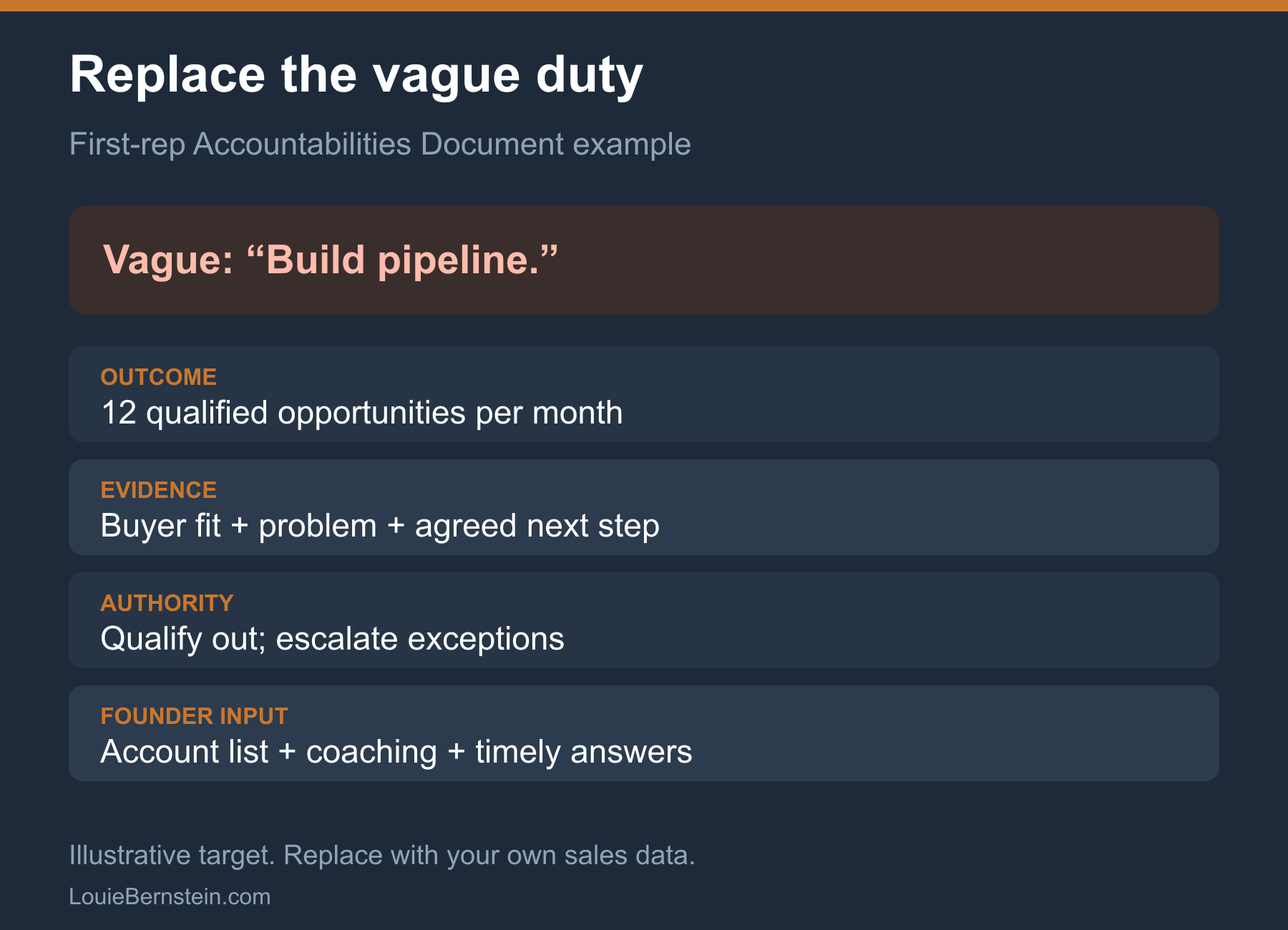
What does a completed first-rep example look like?
A completed first-rep example names one sales motion and follows the work from prospecting through the customer handoff. The example below assumes a founder has already closed similar customers and documented a repeatable approach. Every target is illustrative. Replace the assumptions with your actual deal sizes, conversion rates, capacity, and sales cycle before hiring.
Role purpose and scope
Role: First Account Executive. Purpose: Win new customers in the agreed target market using the company’s existing sales process. Reports to: Founder. Owns: Prospecting, discovery, follow-up, opportunity records, and standard proposals. Excludes: Product strategy, renewals, hiring a sales team, and approving custom contract terms.
The rep isn’t being hired to invent your entire sales system while carrying a full selling target. If building the system is part of the role, name the work, allow time for it, and hire someone with evidence they can do it.
The working agreement
| Accountability | Example wording to adapt |
|---|---|
| Prospecting | Own outreach to the agreed account list. Log buyer responses and review the list with the founder each Friday. Adjust activity targets using actual response and meeting data. |
| Qualification | Create an opportunity only after confirming target-market fit, a buyer-stated problem, and an agreed next step. Record the evidence in the CRM. |
| Pipeline | During the agreed steady-state period, create 12 qualified opportunities per month. Review opportunity quality and source, not just the count. |
| Revenue | After ramp, target $60,000 in new annual contract value per month, measured from signed agreements under the company’s booking rules. |
| CRM and forecast | Update buyer evidence, stage, amount, next action, and close-date assumptions before the weekly pipeline review. Flag a changed buying timeline promptly. |
| Handoff | Document agreed scope, buyer goals, commitments, and implementation contacts before introducing the delivery owner. The delivery owner confirms receipt. |
Here’s the illustrative math behind those targets: three wins at $20,000 annual contract value produce $60,000. At an assumed 25% opportunity-to-win rate, three wins require 12 qualified opportunities. Those opportunities must enter early enough to move through the sales cycle. They aren’t necessarily created and closed in the same month.
If your history can’t support the assumptions, don’t disguise your revenue wish as a rep accountability. Record an initial learning target and a date to revisit it. Your Sales Playbook should explain how to perform the work; the Accountabilities Document defines ownership and the standard.
What must the founder commit to in writing?
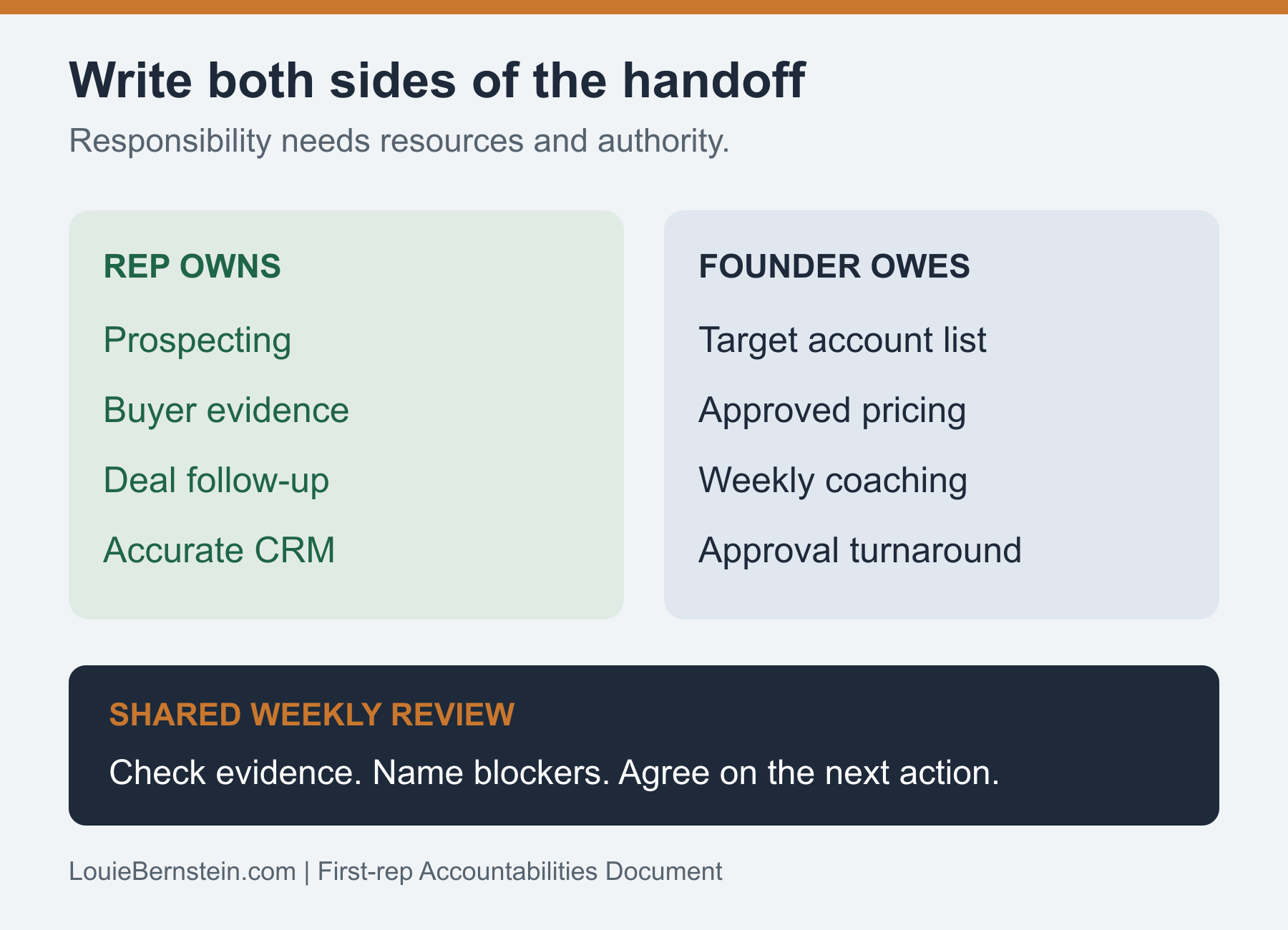
The founder must commit to the inputs the rep needs: a usable target account list, sales materials, coaching time, access to decisions, and clear approval turnaround. A rep can own a task without controlling every dependency. Writing the founder’s commitments makes blocked work visible before a missed target becomes a debate about effort.
Add the other side of the agreement
For the example above, I’d add: “The founder supplies the initial account list, approved pricing, discovery guidance, and customer examples before outreach begins. The founder holds one weekly coaching session and reviews exceptions within two business days. If an answer needs longer, the founder provides an owner and a response date.”
Two business days is an example operating agreement, not a universal rule. Choose a turnaround your business can honor. Don’t promise daily access when you know you’ll disappear for a week at a time.
Write authority beside responsibility
The rep can qualify out a poor-fit account, schedule standard demos, and send an approved proposal. Discounts, custom product promises, and nonstandard terms require the named approver. Give the rep a clear escalation path when the approver is unavailable.
My first-hire guidance has a consistent lesson: you can’t hand off a job that exists only in your head. The practical extension is to document your own part of the handoff. A rep waiting on your pricing decision hasn’t failed to follow up. You haven’t finished your part.
Don’t measure independence while making yourself the approval desk for every move.
How do you test the document before making an offer?
Test the Accountabilities Document by asking each finalist to work through the same short sales scenario and explain the role back to you. Listen for questions about assumptions, resources, and authority. The exercise should reveal whether the candidate understands the actual job and whether your expectations are clear enough for someone else to follow.
Use one scenario and one standard
Give the candidate a fictional buyer who requests a discount and a feature your product doesn’t have. Ask: “What can you decide yourself? What needs approval? What goes in the CRM? What do you tell the buyer while you wait?”
Score the answers against the written role. Look for sound qualification, honest communication, respect for decision limits, and a clear next step. You’re testing work judgment, not whether you enjoy talking to the candidate.
The U.S. Office of Personnel Management’s structured interview guidance uses predetermined questions and a common rating scale. That’s a useful discipline for comparing candidates fairly. It doesn’t mean a single exercise guarantees a successful hire.
Let the candidate challenge the math
Ask what would have to be true to produce the example’s 12 qualified opportunities. A thoughtful candidate may ask about lead sources, time available for prospecting, and the founder’s conversion history. Those questions help you find a weak assumption before you’re paying someone to discover it.
Send the revised document before the offer is accepted. Ask the candidate to explain the role, the limits, and the support they expect. Clear disagreement now is more useful than polite agreement followed by surprises.
How should you review the document after the rep starts?
Review the Accountabilities Document weekly against buyer evidence, ramp milestones, and completed commitments from both sides. Use the review to identify a specific gap and agree on the next action. Change a target only when evidence supports the change, record the reason, and give the revised expectation a clear effective date.
Separate learning from steady-state production
In an illustrative ramp, day 30 might require a demonstrated discovery call and accurate CRM records. Day 60 might require independently run discovery and accepted qualified opportunities. Day 90 might require ownership of the full standard sales process, with a pipeline appropriate to your cycle.
Those dates are review points, not a promise of full productivity. A long sales cycle changes when revenue can reasonably appear. Write the actual milestones and revenue ramp in a separate onboarding plan, then reference that plan from the Accountabilities Document.
Diagnose before you change the standard
If qualified opportunities are low, inspect the account list, buyer responses, and discovery evidence. If approvals are late, inspect the founder’s turnaround. If the rep skips agreed follow-up, coach that behavior with a real example and a date to check improvement.
Keep the document short enough to use during a conversation. Date each version and preserve earlier versions so nobody quietly moves the target. A Fractional Sales Leader can help build the role, test its assumptions, and coach the rep when you need that operating discipline before a full-time sales executive.
Related ReadingWhat Does a Founder Need to Create Before Making Their First Sales Hire? →
Frequently Asked Questions
Can one document cover a rep who sells several products?
Yes, if the document states which products take priority and how targets are divided. If the sales motions have different buyers, cycles, or approval rules, use separate sections so a single revenue target doesn’t hide conflicting expectations.
Should the compensation plan be inside the Accountabilities Document?
Reference the current compensation plan and keep the definitions consistent. The Accountabilities Document explains role ownership and performance standards. The compensation plan explains how pay is calculated. A rep shouldn’t find two different meanings of a credited sale across the documents.
What if our CRM doesn’t have the right fields yet?
Use a shared worksheet temporarily, with one agreed place for buyer evidence and next actions. Assign someone to create the necessary CRM fields. Don’t evaluate the rep against reporting requirements your tools can’t yet support.
Can I introduce the document to a rep I already hired?
Yes. Build the first version together, compare it with the expectations already discussed, and set a future effective date. Don’t use newly written standards to retroactively judge work completed under a different understanding.
What if the founder and rep disagree about whether an opportunity qualifies?
Compare the recorded buyer evidence against the written qualification rules. If the rules leave room for two reasonable answers, clarify the definition and add an example. Resolve the standard before using the disputed opportunity to judge performance.
Write the role before you hire the rep.
If your first sales hire still depends on assumptions, let’s work through the role, your commitments, and a practical review cadence. See how Fractional Sales Leadership at LouieBernstein.com can help you make a clearer handoff.
Schedule a 30-Minute CallAbout the Author
Louie Bernstein is a Fractional Sales Leader with 50 years of sales experience and has worked as a Fractional Sales Leader since 2017. He helps B2B founders at $1M to $10M ARR build sales processes, define roles, and coach teams to sell without the founder in every deal.
Subscribe to The Sunday Starter for practical sales leadership guidance.