Judge your first AEs over six months, not three, and judge them on leading indicators, not revenue. The average AE takes 6.2 months to ramp, the longest The Bridge Group has ever recorded, and only 48% of reps hit quota (The Bridge Group, 2026). Check one leading indicator each month. Then compare your two reps against each other. If both are struggling, fix the system. If one is struggling, coach that rep, then decide.
Key Takeaways:
- Month three is too early to judge a new AE on revenue. Average ramp is 6.2 months (The Bridge Group, 2026), and your reps likely have less support than the companies in that study.
- Revenue is the last number to move. Check the leading indicator for each month: activity, meetings held, qualified opportunities, stage movement, then win rate.
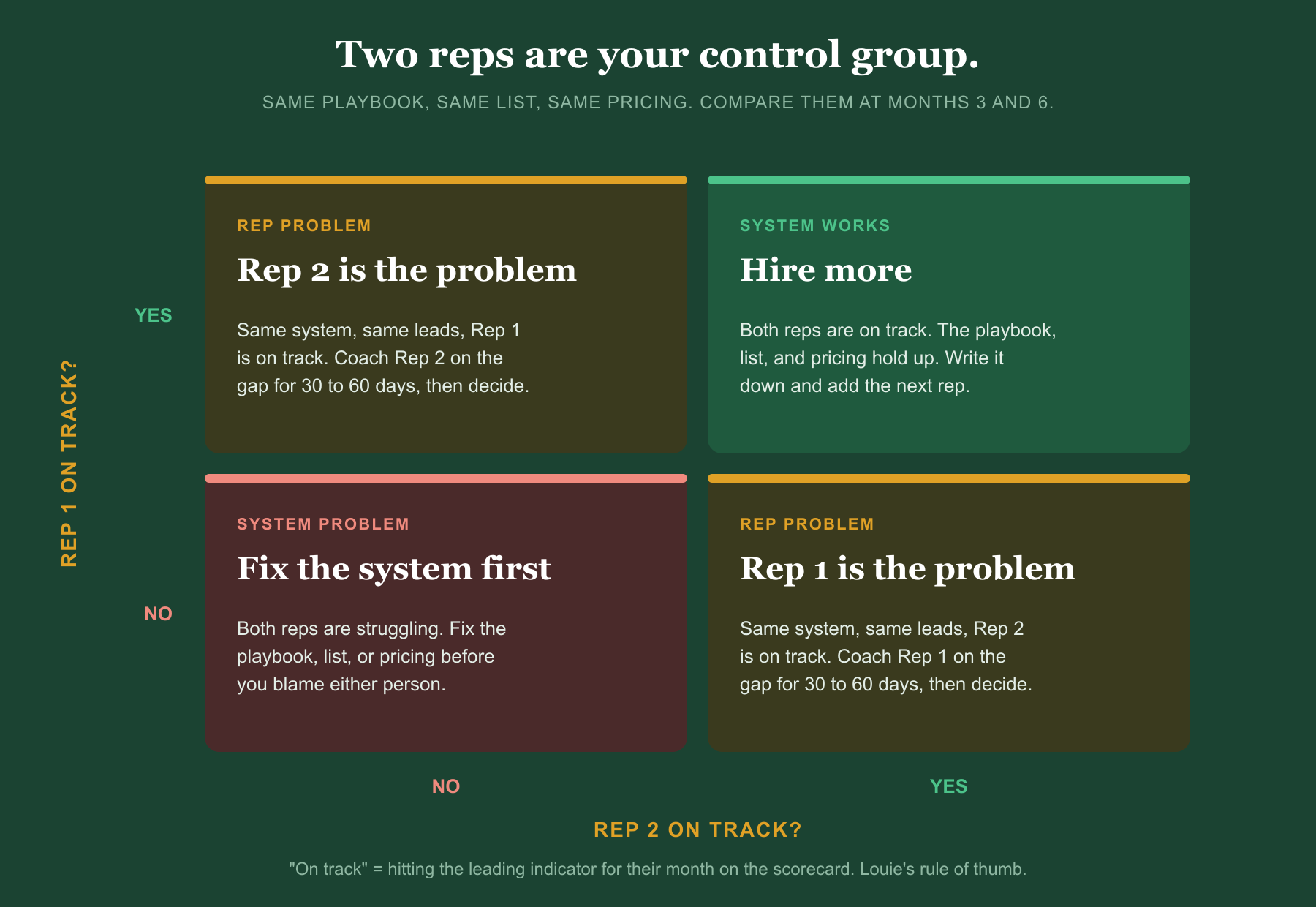
- Two reps are a control group. Same playbook, same list, same pricing. If both struggle, it's the system. If one struggles, it's the rep.
- Before you decide on a struggling rep, name the gap in writing and coach it for 30 to 60 days. That's my rule of thumb, not an industry standard.
- At month six, make one of three calls: keep, fix with a written plan, or let go. Don't drift into month nine without deciding.
Here's the moment I see over and over. It's month three. You hired two AEs. Neither has closed much. You're paying two salaries, you're still closing the big deals yourself, and a voice in your head says, "I hired the wrong people."
Maybe you did. But at month three, you can't tell yet. And the bigger risk is the other answer: the reps are fine, and the system they walked into isn't.
That's the fear under this whole series. "I can't afford a VP and I shouldn't hire one yet. But if I hire two AEs with no VP, am I just building a mess I'll clean up later?" A big part of the mess is judging reps badly. Fire a good rep at month three and you pay for ramp twice. Keep a bad rep to month twelve and you lose a year.
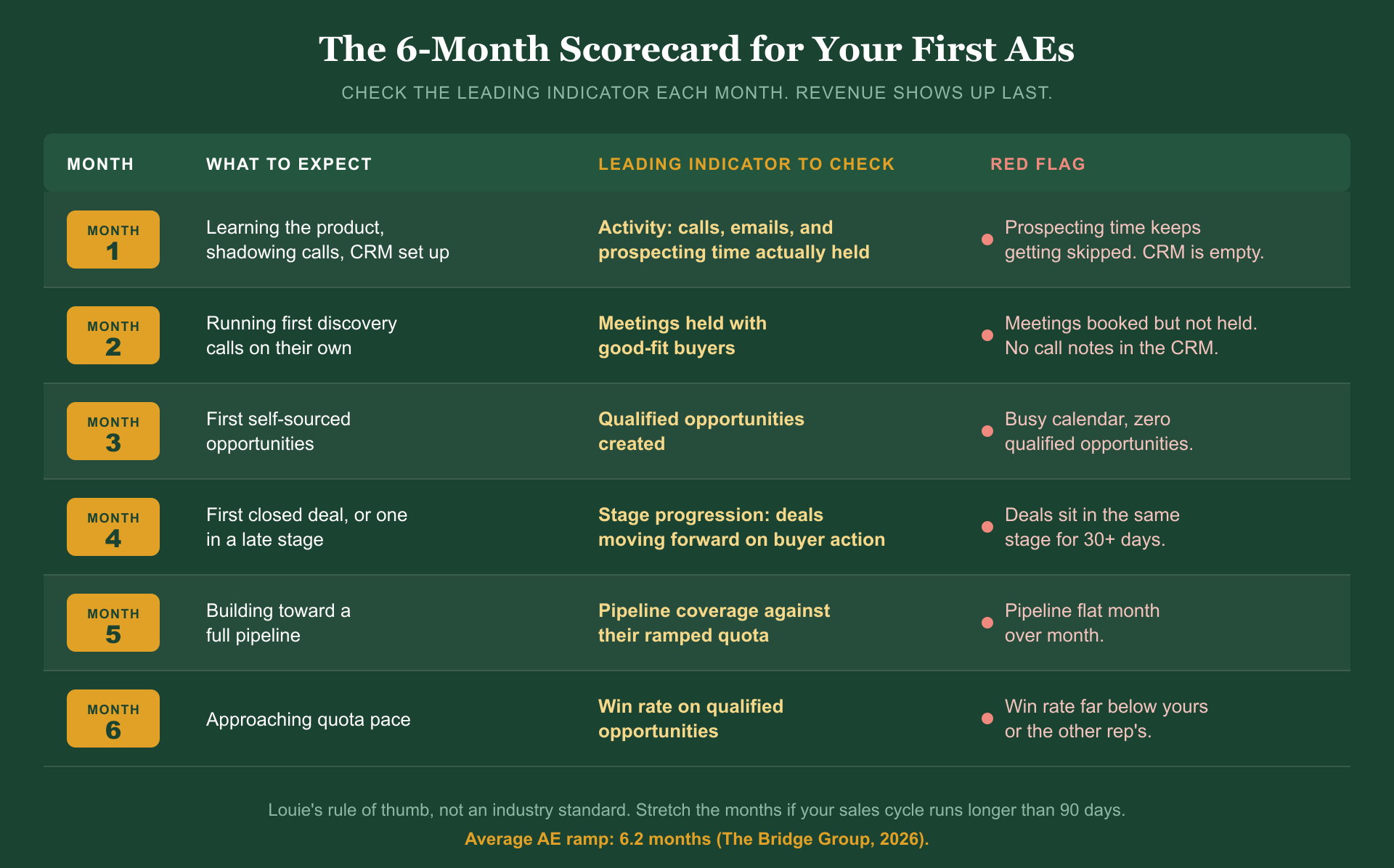
The fix is a scorecard you set before day one. It tells you what to expect each month, which number to check, and what a real red flag looks like.
At month three, revenue tells you about month one. The leading indicators tell you about month six.
Why is month three too early to judge a new AE?
Because ramp takes longer than most founders plan for. The Bridge Group's 2026 AE report, a survey of 158 B2B companies, puts average ramp to full productivity at 6.2 months. That's the highest in the study's history. The same report found only 48% of reps at quota, down from 51% in 2024.
One caution about that data. The people who answered were VPs of Sales, CROs, RevOps leaders, and CFOs. The report itself says the sample skews toward companies with engaged revenue leadership. Those companies have a sales leader, a playbook, and often an enablement team. At $1M–$10M ARR with no VP, your reps have less of that. So don't read 6.2 months as the slow case. For you, it may be the fast one.
Revenue is the last number to move
If your sales cycle is 90 days, a deal your rep starts in month one can't close until month four. So month-three revenue mostly reflects what the rep did in their first few weeks, when they knew the least. It tells you very little about where they're headed. Judge month three on revenue and you're grading the rep's first week.
The early firing costs more than the wait
Let a rep go at month three and the clock resets. You recruit again, onboard again, and ramp again. If the real problem was the system, the next rep hits the same wall at the same month. Now you've paid for two ramps and learned nothing. I cover the pattern in why first sales hires fail.
Which numbers should you check each month?
The leading ones. A lagging indicator tells you what already happened: revenue, quota attainment. A leading indicator tells you what's about to happen: activity, meetings, opportunities, stage movement. New reps show up in leading indicators months before they show up in revenue.
The scorecard above gives you one indicator per month. My rule of thumb is to check that one first, every month, and not to skip ahead to revenue. Adjust the months to your sales cycle.
Months one and two: effort and meetings
Is prospecting time on the calendar and actually held? Are first meetings happening with buyers who fit your ideal customer? Are notes going into the CRM after every call? If it isn't in the CRM, it never happened. And at month two, you can't coach what you can't see.
Months three and four: opportunities and stage movement
Now you're checking whether the work is turning into real deals. How many qualified opportunities did the rep create? Are those deals moving forward? Use action-based stages, where a deal moves only when the buyer does something, like agreeing to a demo with the decision-maker. Hope-based stages make every rep look on track. I explain how to set them up in giving your pipeline stages real exit criteria.
Months five and six: coverage and win rate
By now, you're checking whether the rep can carry a number. Is there enough pipeline to hit their ramped quota? What share of qualified deals are they winning? Compare that win rate to yours on similar deals and to the other rep's. Don't re-set quota here to make the math work. Set it once, up front. My approach is in how to calculate quota for your AEs.
Is it the rep or the system?
This is where hiring two reps pays off. I make the case for hiring two instead of one in why founders should never hire one salesperson. Here's the payoff: two reps on the same playbook, the same list, and the same pricing are a control group. When you compare them, you can separate the person from the setup.
With one rep, every miss is a guess. With two, the other rep answers the question for you.
When both reps struggle, look at the system
Two people rarely fail the same way by accident. Look for the shared pattern. Do both reps' deals die at the same stage? Does the same objection kill deals for both? Are their meetings full of buyers who don't fit? Is pricing the reason in most lost deals? Each of those points to the playbook, the list, or the price, not the people. Fix that first. Hiring two new reps into the same setup gets you the same result.
When one rep struggles, find where they split
Lay the two reps' numbers side by side, month by month, and find the first indicator where they differ. If both book meetings but only one turns meetings into qualified deals, the gap is discovery. If both create deals but only one moves them past the proposal, the gap is closing. That spot is where you coach. "Rep 2 is behind" isn't a plan. "Rep 2 turns fewer meetings into qualified deals" is.
Make sure the comparison is fair
A control group only works if the conditions match. Did both reps get the same share of inbound? Did one inherit a bigger pipeline from you? Check how leads were routed, which I cover in splitting accounts between you and your first two AEs. Check where each rep's pipeline came from, too. If one rep lived on your warm leads and the other built their own, you're not comparing the same job.
One struggling rep is a coaching question. Two struggling reps is a system question.
What does a Fractional Sales Leader check each month?
With no VP, someone still has to run this review. Here's what I look at for each rep, once a month, in about this order:
- CRM first. Are deals, notes, and next steps up to date? A messy CRM makes every other number a guess.
- The month's leading indicator. Is the rep at, above, or below the scorecard for their month?
- Two recorded calls. Numbers show what's happening. Calls show why.
- Stuck deals. Any deal with no buyer action in 30 days gets a hard look.
- The side-by-side. Where do the two reps differ, and is the difference growing or shrinking?
- A short written note to the founder. Each rep: on track, behind, or ahead, and what we're doing about it.
The written note stops the month-three panic, because you see the trend on paper instead of in your gut. If you haven't settled who runs the weekly side of this, start with who your first two AEs report to.
How long should you coach before you decide?
Long enough to see whether the gap closes. Short enough that you're not hoping. My rule of thumb is 30 to 60 days, once the gap has a name.
Name the gap in writing
Pick one indicator and one behavior. "You're booking meetings, but fewer than one in five turn into qualified deals. We're going to work on your discovery questions." Put it in writing and share it with the rep.
Coach the specific stage
Listen to their calls at the stage where they're stuck. Role-play that stage. Have them sit in on the other rep's calls at the same stage. Then check the indicator every week. You're looking for movement, not perfection. A rep who goes from one in five to one in three in six weeks is learning. A rep who stays flat after real coaching is telling you something.
Salespeople don't quit companies. They quit chaos. Clear, written feedback with a short timeline is the opposite of chaos.
A rep can't fix "step it up." They can fix "turn more meetings into qualified deals."
How do you make the keep, fix, or let-go call at month six?
Put the decision on the calendar on day one. At month six, every rep gets one of three calls. Don't let it drift into month nine because nobody wanted the conversation.
Keep
The rep has hit most of the monthly indicators. Pipeline is growing. Win rate is in range of yours or the other rep's. Move them to full quota on the schedule you already wrote down.
Fix
The rep is behind on one indicator, but it moved during the coaching window. Extend once, with a written plan, a single indicator to hit, and a firm date. My rule of thumb is one extension, not two. If it takes a second extension, you're making the let-go call slowly.
Let go
The rep missed the indicators across several months, didn't improve after written coaching, and the other rep, on the same system, is on track. That's a rep problem, and you've done the work to prove it. Make the call, treat the person with respect, and move on. Then hire against what you learned, starting with what to look for in your next rep.
And if both reps are behind at month six? Don't let both go. That's a system call, not two rep calls. Fix the playbook, the list, or the pricing, then give the fix a fair window before you judge anyone again.
Where a Fractional Sales Leader fits
A Fractional Sales Leader builds this scorecard with you before the reps start, puts it in each rep's Accountabilities Document, runs the monthly review, and makes the rep-or-system call with data instead of gut feel.
I've spent 50 years in sales, including 22 years building MindIQ into an INC 500 company. The worst hiring calls I've seen weren't the bad hires. They were good reps let go at month three for a problem that belonged to the system, and then the same problem showed up in the next rep.
Once you can judge your reps fairly, the last question in this series is how to set up the team so a future VP inherits it instead of rebuilding it. That's the next article.
Frequently Asked Questions
Q: How long should I give a new sales rep before deciding?
Plan on six months for most B2B deals. The average AE ramp is 6.2 months (The Bridge Group, 2026). Check one leading indicator each month along the way, so the month-six decision isn't a surprise. If your sales cycle is longer than 90 days, stretch the timeline.
Q: How do I know if it's the rep or my sales process?
Compare two reps on the same playbook, list, and pricing. If both struggle at the same stage or lose to the same objection, it's the process. If one is on track and one isn't, it's the rep. With only one rep, you're guessing.
Q: What are leading indicators for a new AE?
Numbers that move before revenue does. In order: activity and prospecting time held, meetings held with good-fit buyers, qualified opportunities created, deals moving forward on buyer action, and win rate on qualified deals. Check the one that matches the rep's month.
Q: Is it normal for a new AE to close nothing in the first three months?
It can be, especially if your sales cycle is 90 days or longer. A deal the rep starts in month one may not close until month four. What's not normal at month three is a rep with no qualified opportunities and nothing moving in the pipeline.
Q: When should I fire a new salesperson?
When they've missed the leading indicators across several months, didn't improve after 30 to 60 days of written coaching on a named gap, and another rep on the same system is on track. That's my rule of thumb. If every rep is struggling, fix the system instead.
Q: What should I do if both of my first AEs are underperforming?
Treat it as a system problem first. Look for what the two reps share: the stage where deals stall, the objection that kills them, the buyers on the list, and the pricing. Fix that, give it a fair window, and then judge the reps again.
Is it the rep or the system?
In 30 minutes we'll look at your reps' numbers side by side and tell you which problem you have, and what to fix first.
Schedule a 30-Minute CallAbout the Author
Louie Bernstein
Fractional Sales Leader with 50 years of sales experience helping $1M–$10M ARR companies build scalable, repeatable sales systems. Founder of MindIQ (INC 500). LinkedIn Top Voice in Sales Management, Sales Operations, and Sales Coaching.