Yes. At $1M–$10M ARR, most first AEs should be full-cycle: they work the leads you hand them and they build their own. Decide the mix before day one. Put a written weekly prospecting minimum in each rep's Accountabilities Document. Track self-sourced pipeline as its own field in the CRM. And watch for the rep who hides in prospecting to avoid hard closing conversations.
Key Takeaways:
- Feeding new reps your best leads makes them look good for about two months. Then the leads run out, and you still don't know if they can create pipeline.
- Your referral flow fed one person: you. It won't feed two reps.
- Most first AEs at this stage should be full-cycle, with a written weekly prospecting minimum. Closer-only works only when someone else owns lead flow and answers for a number.
- The pipeline mix should shift over the first six months, from mostly founder-fed to a real self-sourced share.
- Lock the lead source field in the CRM when a deal is created. If it isn't in the CRM, it never happened.
- Watch the rep whose call count climbs while late-stage deals sit still. That's prospecting used as a hiding place.
Here's how it usually goes. You hire an AE. You want them to win early, so you hand over your warm leads, your referrals, and the inbound that's been piling up while you were busy closing. The rep books meetings. Deals move. You feel smart.
Around day 60, it stops. The warm list is worked. Your referrals were coming from your relationships, not theirs. Inbound is steady, but it was sized to keep one founder busy, not two reps. Now the rep's calendar has holes, and you find out what you didn't test: can this person create pipeline at all?
This is part of the bigger worry under hiring your first two AEs without a VP. "I can't afford a VP and I shouldn't hire one yet. But if I hire two reps with no VP, am I just building a mess I'll clean up later?" Not knowing where pipeline comes from is one of the fastest ways to build that mess.
The answer isn't "make them do it all themselves." It's deciding the mix in advance, writing it down, and tracking it.
Your best leads make a new rep look good. They don't tell you whether the rep is good.
Why is feeding new reps your best leads a trap?
Because it feels like support, and it works as a delay. You're not helping the rep ramp. You're pushing the real test back two months and paying for those months.
It hides the one skill you can't see in an interview
Almost anyone can close a warm referral from a happy customer who already trusts the founder. That deal was half-won before the rep showed up. What you need to know is whether the rep can find a stranger with the problem you solve, get a first meeting, and turn it into a real deal. Feed them only warm leads, and you never find out until the warm leads are gone.
Your referral flow can't feed two people
Your referrals come from years of your relationships. They show up at the pace your network produces them, and that pace doesn't double because you hired two reps. Split that flow in half and each rep gets a trickle. Then both reps blame the leads, and they're partly right.
It sets the wrong expectation on day one
What a rep does in the first month becomes their idea of the job. If month one is "the founder sends me meetings," month three's request to start prospecting feels like a change in the deal. It's much easier to say on day one: you'll get some leads from us, and you'll build some of your own. Here's the number. This is the vacuum that sinks a lot of first hires, and I cover it in why first sales hires fail.
Should your first AEs be full-cycle or closer-only?
Full-cycle means the rep prospects and closes. Closer-only means someone else fills the calendar and the rep works the deals. Both models are real. The question is which one your company can support right now.
There's a fair case for closer-only. One VC newsletter puts it bluntly: an AE doing cold outreach all day "is an AE who is not closing" (Justo Echazarreta, Vector 3, 2026). That's true when there's a steady supply of warm pipeline. The catch is the word "when." Most companies at $1M–$10M don't have a lead machine that can fill two calendars yet. If they did, the founder wouldn't still be closing most of the deals.
When full-cycle is the right call
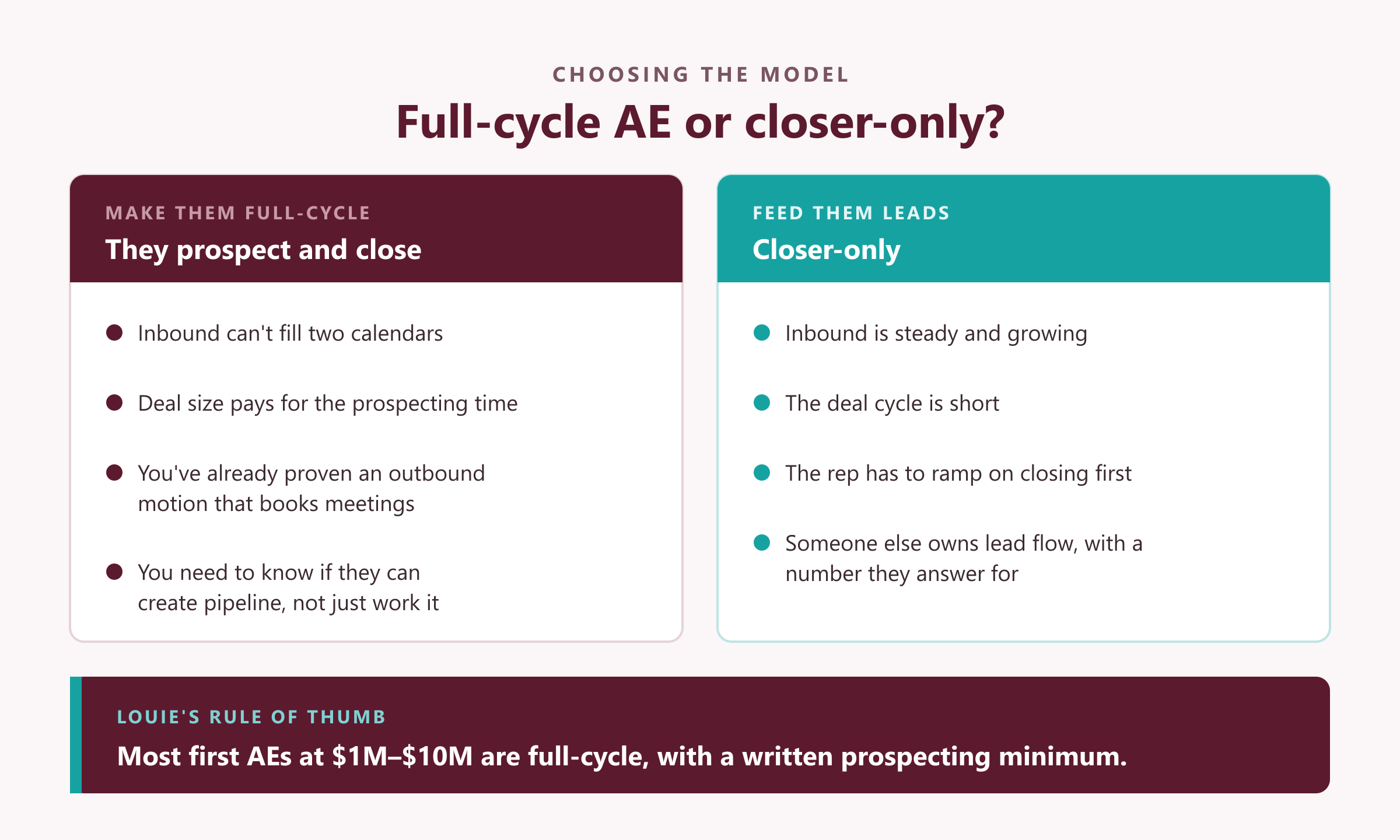
Inbound can't keep two calendars full. Your deal size is big enough that a rep's prospecting hours pay for themselves. And you've already proven that outbound books meetings for your product, even if you were the one doing it. That last one matters. If outbound has never worked for you, don't hand an unproven motion to a new rep and call it their job. Prove it first, the same way I describe in you don't need an SDR yet.
When closer-only can work
Inbound is steady and growing. The sales cycle is short, so a rep can handle a lot of deals at once. Or the rep is new to your market and needs to learn to close your deal before you add prospecting. Closer-only has one non-negotiable condition: someone else owns lead flow and answers for a number. If nobody owns it, closer-only is just hoping.
My rule of thumb: most first AEs at this stage should be full-cycle, with a written prospecting minimum. You're not choosing between "they prospect" and "they don't." You're choosing how much, and writing it down.
Closer-only without someone who owns lead flow isn't a sales model. It's a hope.
How much pipeline should a first AE source themselves?
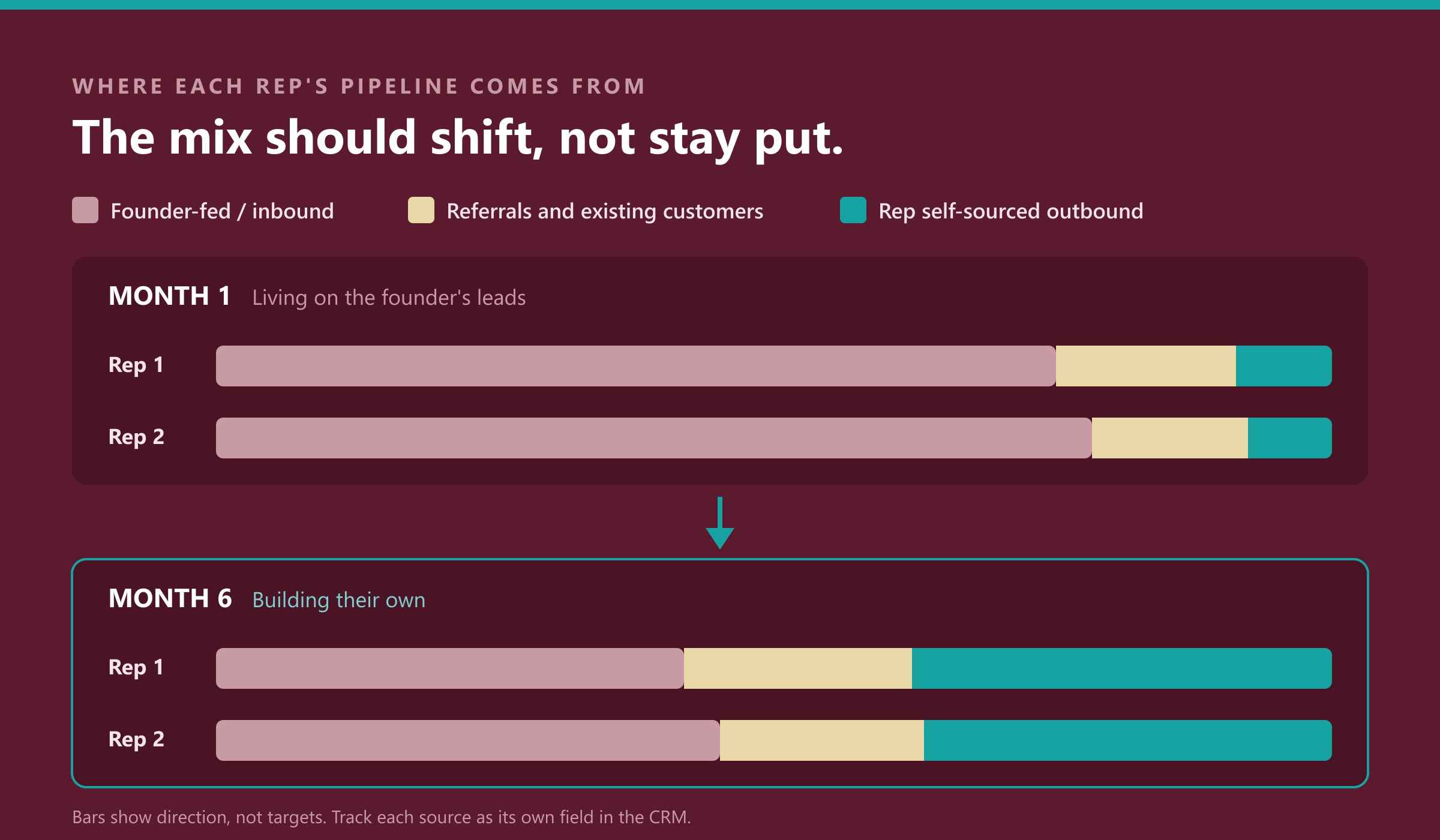
Less on day one than on day 180. The mix should move. In month one, most of a new rep's deals will come from you, from inbound, and from the pipeline they inherited. By month six, a real share should be deals they started.
There's no industry number I'd hand you as a fact. One public example: Outreach's commercial sales team moved its AEs to generating at least 30% of their own outbound pipeline after leads dried up in 2020 (Outreach, 2021). That's a larger company with a different motion, so treat it as a reference point, not a target.
My rule of thumb: by month six, at least a quarter of the new pipeline each rep creates should be self-sourced. If your inbound is strong, that can be lower. If your inbound is thin, it has to be higher, or the reps run dry. Work your own number from your lead volume and your close rate, not from someone else's benchmark.
Decide the split before they start
Write down three things. What leads the company will provide: inbound, referrals, existing customers, anything the founder passes along. How those leads get routed between the two reps. I cover the routing rule in splitting accounts between you and your first two AEs. And what each rep is expected to build on their own, starting in month one, not month four.
What goes in the written prospecting minimum?
A prospecting minimum is the weekly floor of pipeline-building work each rep commits to. It lives in the rep's Accountabilities Document, the one-page list of what they own and how they're measured. I walk through that document in accountability without micromanaging.
Measure output, not just effort
A minimum built only on activity, like "50 calls a week," gets you 50 calls. A better minimum pairs one effort number with one output number. Effort: protected prospecting time on the calendar each week. Output: new first meetings booked with people who fit your ideal customer. The time block keeps prospecting from getting squeezed out. The meeting count tells you whether the time is working.
Ramp it, then hold it
Start lower in the first month, while the rep learns the product and the pitch. Step it up on a written schedule. Then hold it steady. A minimum that drops every time the rep has a busy closing week isn't a minimum. Pick numbers you can defend from your own math: how many first meetings it takes to make one deal, and how many deals each rep needs.
Make it the same for both reps
Two reps on different rules will compare notes. If one rep's minimum is lower because they have a bigger inherited pipeline, write that down too, with an end date. Salespeople don't quit companies. They quit chaos. Unequal rules nobody explained are chaos.
How do you track self-sourced pipeline in the CRM?
With one field that gets set when the deal is created and doesn't change after. If it isn't in the CRM, it never happened. That goes double for where a deal came from, because it's the first thing people argue about.
Separate "sourced by" from "owned by"
These are two different questions. Who owns the deal now is one field. Where the deal came from is another. Give the source field a short, fixed list: founder-fed, inbound, referral or existing customer, and rep self-sourced. Make it required when a deal is created, and lock it after. A deal the founder passed along stays founder-fed, even after the rep closes it.
Look at one report every week
New pipeline created this week, by rep, by source. That's it. Over a few months, it shows you the shift you drew on day one, or it shows you the mix stuck where it started. Use action-based stages, where a deal moves only when the buyer does something, so a self-sourced deal counts only after a real first meeting, not after a hopeful email.
If the source field can be edited after the deal closes, it will be.
What's the warning sign that a rep is hiding in prospecting?
Their activity goes up while their late-stage deals sit still. Prospecting is safe work. Nobody says no to you while you're writing an email. Asking a buyer for a decision, pushing on a stalled proposal, or telling a prospect it isn't a fit: those are the hard conversations. A rep who doesn't want to have them can fill a whole week with prospecting and look busy.
What it looks like in the pipeline
Call and email counts are above the minimum. New first meetings are fine. But proposals sit out for weeks with no next step on the calendar. Deals in late stages have no date for the next buyer action. Forecast calls are full of "they're still reviewing it."
What to do about it
In the weekly one-on-one, review late-stage deals first, before activity. For each one, ask: what's the next thing the buyer has agreed to do, and when? No answer means the deal is stuck, no matter how many new conversations the rep started. The prospecting minimum is a floor, not a ceiling to hide under. If a manager runs that one-on-one, this is part of their job. If nobody does, see who your first two AEs report to.
Where a Fractional Sales Leader fits
A Fractional Sales Leader sets this up before the reps start. That means deciding full-cycle or closer-only, writing the prospecting minimum into each Accountabilities Document, building the lead source field and the weekly report in the CRM, and proving the outbound motion if it isn't proven yet. Then they run the weekly review that catches a stuck mix or a rep hiding in activity early, before it costs you a quarter.
I've spent 50 years in sales, including 22 years building MindIQ into an INC 500 company. The reps who lasted were the ones who knew on day one where their deals would come from. The ones who struggled were often handed a warm list and a vague promise.
Once you know where pipeline comes from, the next question is how to judge whether each rep is working. That's the next article in this series: the 6-month scorecard for your first AEs.
Frequently Asked Questions
Q: Should account executives prospect?
At most $1M–$10M B2B companies, yes. Inbound and founder referrals usually can't fill two reps' calendars. Make your first AEs full-cycle with a written weekly prospecting minimum. The exception is a company with steady, growing inbound and someone who owns lead flow with a number.
Q: What's the difference between a full-cycle AE and a closer?
A full-cycle AE finds their own prospects and closes them. A closer works deals someone else created, from marketing, an SDR, or the founder. A full-cycle rep costs you some closing time. A closer only works if lead flow is steady and somebody else answers for it.
Q: Should I give my first sales rep my leads?
Give them some, on purpose and in writing. Hand over a share of inbound and the open deals you aren't keeping. But don't make your best leads their whole pipeline. You'll never learn whether they can create pipeline, and your referral flow can't feed two reps for long.
Q: What percentage of pipeline should an AE self-source?
There's no single right number. It depends on your inbound volume and close rate. My rule of thumb is that by month six, at least a quarter of the new pipeline each rep creates should be self-sourced. Work out your own number from your math, then write it down.
Q: How do I set a weekly prospecting minimum?
Pair one effort number, like protected prospecting time on the calendar, with one output number, like new first meetings booked with good-fit buyers. Start lower in month one, step up on a written schedule, then hold it. Put it in the rep's Accountabilities Document so it's clear from day one.
Q: How do I know if a rep is avoiding closing?
Watch for activity going up while late-stage deals stop moving. Proposals sit for weeks with no next step, and forecast calls are full of "still reviewing." Review late-stage deals first in every one-on-one, and ask what the buyer has agreed to do next, and when.
Not sure where your new reps' pipeline will come from?
In 30 minutes we'll pick full-cycle or closer-only, size the prospecting minimum, and map the lead sources before your reps start.
Schedule a 30-Minute CallAbout the Author
Louie Bernstein
Fractional Sales Leader with 50 years of sales experience helping $1M–$10M ARR companies build scalable, repeatable sales systems. Founder of MindIQ (INC 500). LinkedIn Top Voice in Sales Management, Sales Operations, and Sales Coaching.