Split accounts into three buckets before your first two AEs start. You keep a short list of strategic logos, top relationships, and late-stage deals, each with a written sunset date. Each rep gets a book of named accounts or a territory, plus a fair share of open pipeline. New leads get routed by one written rule. Put every rule in the CRM so each account has exactly one owner.
Key Takeaways:
- Verbal promises about accounts are the mess. "That one's yours" said in a hallway turns into a fight over commission six months later.
- Keep a short founder list, and give every account on it a written sunset date. "For now" with no date means forever.
- Split open pipeline by value and stage, not by count. Ten early deals aren't worth the same as two late ones.
- Route new leads by one written rule: round-robin, territory, or named accounts. Speed matters. Leads contacted within an hour were nearly 7 times as likely to be qualified (HBR, 2011).
- Decide house accounts and dispute rules before the first dispute, not during it.
- If it isn't in the CRM, it never happened. That goes for account ownership too.
Here's a conversation I've seen play out more than once. A founder hires two AEs. On day one, they say, "Take anything in the Midwest," to one rep, and "You can have the healthcare deals," to the other. Nobody writes it down.
Three months later, a Midwest hospital system comes in through the website. Both reps think it's theirs. Both have a point. The founder has to pick, and whoever loses learns that the rules change depending on who asks.
This is the worry under the whole first-AEs decision. "I can't afford a VP and I shouldn't hire one yet. But if I hire two reps with no VP, am I just building a mess I'll clean up later?" The account split is where that mess usually starts.
The fix isn't complicated. It's three buckets, a short list of rules, and the discipline to put all of it in the CRM before the reps start.
Most early sales messes start with a handshake promise about who owns an account.
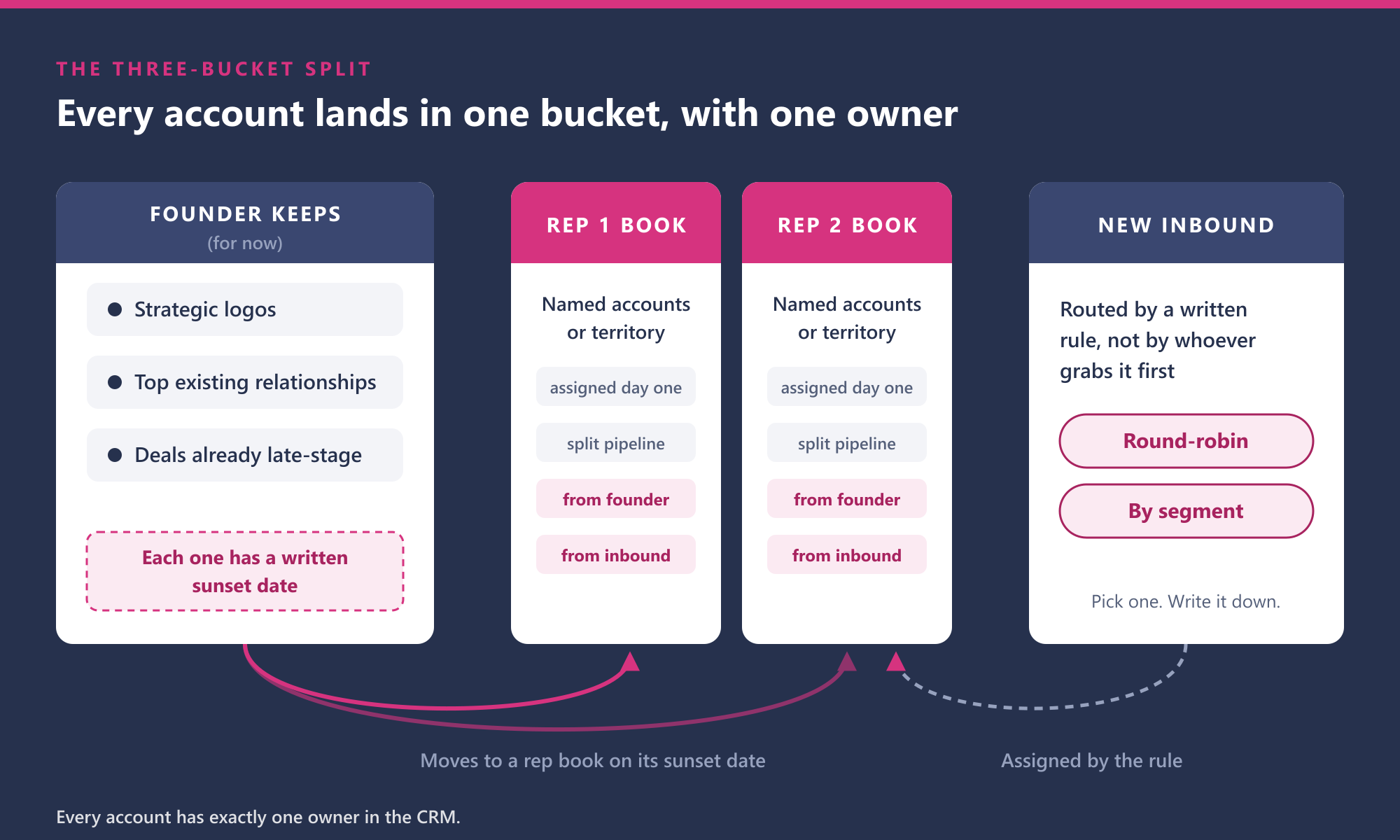
Which accounts should the founder keep?
Fewer than you want to. Keep only the accounts where losing them would hurt the year, or where the relationship truly runs through you. Everything else goes to the reps on day one. Your list should be short enough that you could name every account on it without looking.
Three kinds of accounts make the list
Strategic logos. The handful of customers or prospects that matter beyond their contract value: a reference account, a market you're trying to break into, a partner. Top existing relationships. Customers whose decision maker calls you directly and would notice if you vanished. Deals already late-stage. If a deal is in contract review the week a rep starts, finish it yourself. Handing a rep a deal at the finish line teaches them nothing and puts the deal at risk.
Every account gets a sunset date
This is the rule founders skip. Next to every account you keep, write the date it moves to a rep, and which rep. A late-stage deal sunsets when it closes or dies. A strategic logo might sunset in two quarters. A top relationship might move once the rep has met the buyer with you a few times. That process is covered in the hand-off ramp, so I won't repeat it here.
My rule of thumb: if an account on your list has no date next to it, you haven't decided to keep it. You've decided not to decide. And the reps will notice that the best accounts never seem to leave your list.
"For now" with no date on it means forever.
How do you split existing pipeline between two reps fairly?
By value and stage, not by count. Ten early-stage deals aren't worth the same as two deals with a proposal out. If you split by count, one rep gets a lucky quarter and the other spends three months chasing tire-kickers. Then you're comparing two reps on luck.
A simple way to do it
Pull every open deal the founder isn't keeping. Sort it by stage, using action-based stages, the ones where a deal moves only when the buyer does something. Then deal them out by stage, one at a time, alternating reps, so each rep ends up with a similar mix of early, middle, and late deals. Check the total value at the end. If one book is clearly heavier, trade a deal or two.
Keep the split in line with how you'll route new leads
If you're going to route new leads by territory, split the existing pipeline by territory too. If you're going with named accounts, assign open deals to whoever owns that account. A pipeline split that ignores the routing rule creates exceptions on day one, and exceptions are where disputes come from.
Don't promise a split percentage before you've looked at the actual deals. Decide your own split from the list in front of you. The goal is two books a fair person would trade for each other.
How should new leads get routed?
By one written rule that both reps can read. Not by who answers the email first, and not by who asks the founder. There are three common rules. Each one works. Each one has a weak spot you should plan for.
Whichever you pick, speed matters more than the method. In a study of 1.25 million online sales leads, firms that tried to reach a lead within an hour were nearly 7 times as likely to qualify it as firms that waited even one hour longer (Oldroyd, McElheran and Elkington, Harvard Business Review, 2011). A lead with no clear owner is a lead nobody calls fast.

Round-robin
Leads rotate between the two reps in turn. It's the simplest rule and the easiest to change later. It works best when your leads look alike. The weak spot is quality. One rep can get three great leads in a row by chance. Let it even out over a quarter, and don't let reps skip a lead they don't like.
Territory
Each rep owns a region or an industry. It builds expertise fast, because a rep who sells only to manufacturers learns manufacturing. The weak spot is balance. With two reps, one territory can run dry while the other floods. And territories are hard to change later, because moving one feels like a pay cut to the rep who loses it.
Named accounts
Each rep gets a written list of target companies. It works well when you know exactly who you sell to. The weak spot is neglect. Accounts can sit on a list for months with no activity. Set a rule up front: an account with no logged activity for a set period goes back into the pool. Pick a period that fits your sales cycle, and write it down.
If you're not sure, start with round-robin. It's the easiest to get right with two reps, and the easiest to change once you see where your deals really come from.
What's the rule for disputes over who owns a deal?
The CRM decides. Write that sentence down and mean it. When two reps both claim a deal, the owner is whoever the CRM showed as the account owner on the day the opportunity was created. Not who had coffee with the buyer. Not who remembers talking to them first.
That rule only works if reps log their work. That's the point. If it isn't in the CRM, it never happened. A rep who talked to a prospect and didn't log it has no claim. After one dispute settled that way, both reps start logging everything.
Who settles the rare case
Some disputes won't fit the rule. A referral that came through one rep for an account owned by the other. A buyer who changed companies. Those go to one person, decided once, and written down as a new rule. If your reps report to a Fractional Sales Leader, that's who rules on it. You get informed. You don't get lobbied. That's how the reporting line in the first article in this series protects your week.
Salespeople don't quit companies. They quit chaos. A rule that changes depending on who asks is chaos.
Should reps earn commission on house accounts?
A house account is one the company owns and no rep gets paid on. Your founder list is a house list until each account sunsets. The question is what reps earn on those accounts after they move over, and on renewals and expansions there.
There's no single right answer, but there is a wrong one: deciding after the deal closes. Decide up front. Some founders pay full commission once an account moves, because the rep now owns the work. Some pay a reduced rate on renewals the rep didn't have to win. Some keep a few accounts as permanent house accounts. All three can work if they're written down before the first deal closes. I cover the pay plan itself in how to pay your first sales rep.
Whatever you choose, make it the same for both reps. Two reps on different house-account rules will compare notes by the second week.
A sample set of Account Ownership Rules
Here's a starting list you can copy and edit. Fill in the blanks with your own numbers. Put it in each rep's Accountabilities Document and in a shared note pinned in the CRM.
- Every account and every open deal has exactly one owner in the CRM.
- The founder list is: [accounts]. Each account moves to [rep] on [date].
- Open pipeline was split on [date]. That split is final.
- New inbound leads are routed by [round-robin / territory / named accounts], assigned within [time] of arrival.
- Ownership is set by the CRM account owner on the day an opportunity is created.
- An account with no logged activity for [period] goes back into the pool.
- Commission on house accounts, renewals, and expansions is [your rule], the same for both reps.
- Disputes go to [the Fractional Sales Leader]. Each ruling becomes a written rule.
- These rules are reviewed every [quarter]. Changes take effect on the first day of the next one, never mid-deal.
Why do verbal promises create the mess a future VP inherits?
Because a VP can't read your memory. When you finally hire one, they'll ask who owns what and why. If the answer lives in hallway promises, they get two reps with two different stories, a founder who half-remembers, and a CRM that doesn't match either. Their first quarter goes to cleanup instead of growth.
A written split hands them the opposite. Clean ownership. A routing rule with a history. A list of every dispute and how it was settled. They can change the rules, but they don't have to dig for them.
Where a Fractional Sales Leader fits
A Fractional Sales Leader builds the split with you before day one. That means the founder list with sunset dates, the pipeline split, the routing rule set up in the CRM, and the ownership rules written into each Accountabilities Document. Then they enforce it. They settle disputes, watch for neglected accounts, and tell you when a sunset date is coming up.
I've spent 50 years in sales, including 22 years building MindIQ into an INC 500 company. I've never seen two reps fight over a rule that was written down before they started. I've seen plenty fight over a promise.
Once the split is set, the next question is where each rep's pipeline comes from after the inherited deals run out. That's the next article in this series.
Frequently Asked Questions
Q: How do you assign accounts to new sales reps?
Put every account into one of three buckets: a short founder list with sunset dates, a book for each rep, and new inbound routed by a written rule. Split open pipeline by value and stage so both books are fair. Then record the owner of every account in the CRM before the reps start.
Q: Should the founder keep their biggest accounts?
Only the few where losing them would hurt the year or where the relationship truly runs through you. Each one needs a written date when it moves to a rep. If you keep every big account with no end date, the reps learn that the best deals aren't for them.
Q: Is round-robin or territory better for two reps?
For most companies with two reps, round-robin is the easier start. It's fair on count, simple to run, and easy to change. Territory works when you have clear regions or industries with enough leads in each. Named accounts work when you sell to a known list of companies.
Q: What is a house account in sales?
It's an account the company owns and no rep earns commission on. At an early-stage company, it's usually an account the founder still runs. Decide in writing whether reps earn on house accounts once they move over, and on renewals and expansions, before the first deal closes.
Q: How do you settle a dispute between two reps over a deal?
Use the CRM. The owner is whoever the CRM showed as the account owner on the day the opportunity was created. For cases the rule doesn't cover, one person decides, and the decision becomes a written rule for next time. Never settle it by who argues hardest.
Q: Can I change the account split later?
Yes, but on a schedule. Review the rules once a quarter and make changes take effect at the start of the next quarter, never in the middle of a deal. Reps can live with rules that change on a calendar. They can't live with rules that change when you feel like it.
Splitting accounts for your first reps?
In 30 minutes we'll sort your accounts into the three buckets, pick a routing rule, and write the ownership rules before day one.
Schedule a 30-Minute CallAbout the Author
Louie Bernstein
Fractional Sales Leader with 50 years of sales experience helping $1M–$10M ARR companies build scalable, repeatable sales systems. Founder of MindIQ (INC 500). LinkedIn Top Voice in Sales Management, Sales Operations, and Sales Coaching.