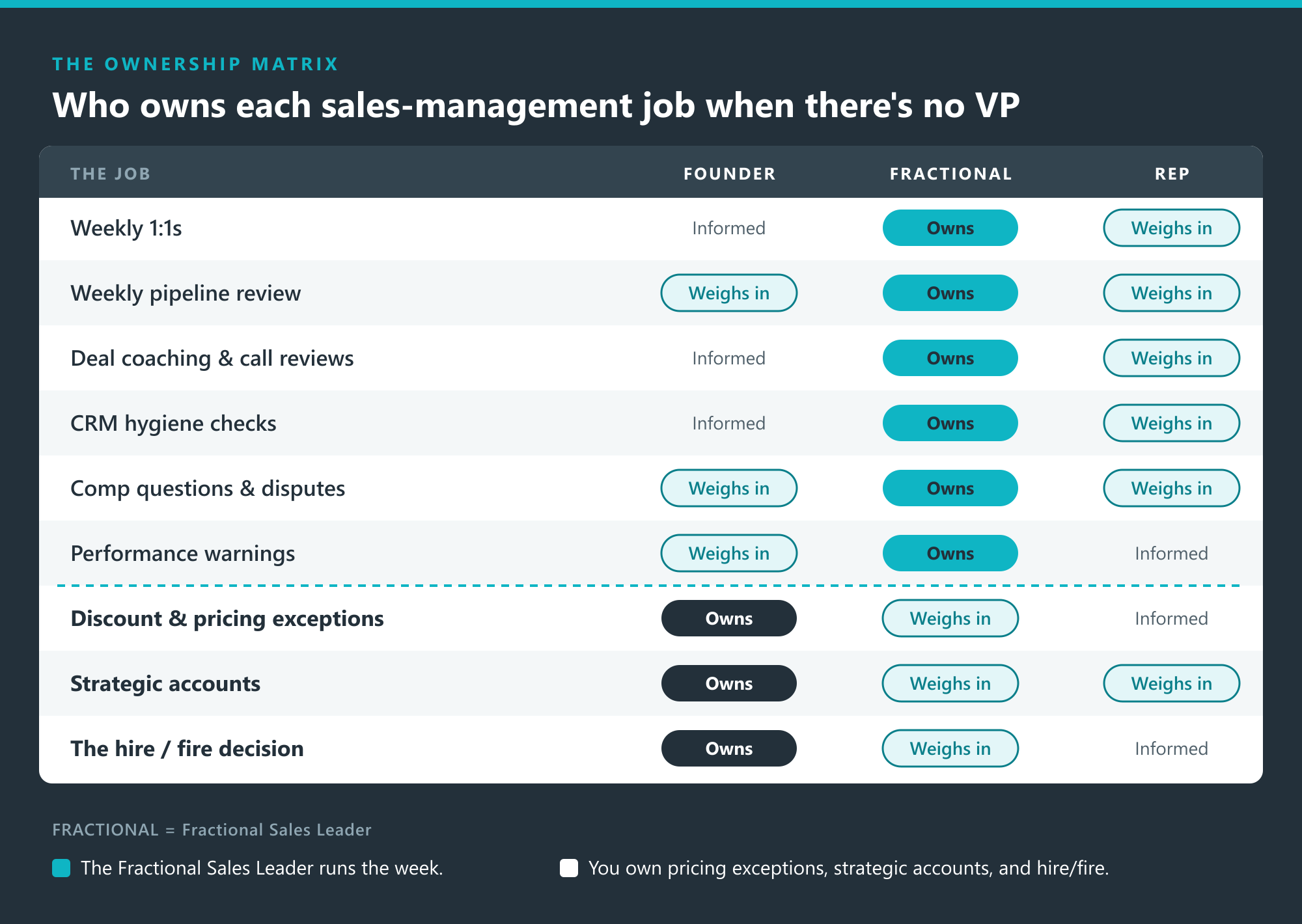
Your first two AEs report to a Fractional Sales Leader for day-to-day management: 1:1s, pipeline review, deal coaching, CRM checks, and performance conversations. They report to you, the founder, for strategy, pricing exceptions, strategic accounts, and the final hire or fire decision. Write that split down before the reps start, so everyone knows who to go to and you get your week back.
Key Takeaways:
- Two reps who report to "everyone" report to no one. Pick one person who runs their week, and write it down.
- A Fractional Sales Leader owns the day-to-day jobs: 1:1s, pipeline review, coaching, CRM checks, comp questions, and performance warnings.
- You keep the jobs only the founder should do: pricing exceptions, strategic accounts, and signing off on hire or fire.
- Managers matter more than most founders think. Gallup found managers account for at least 70% of the variance in employee engagement (Gallup, 2015).
- Avoid the three failure modes: "they report to me" with no time to manage, "they report to each other," and managing by jumping into deals.
- Run it on a fixed weekly rhythm. My rule of thumb: about one hour of founder time a week, by design.
Here's the worry I hear from founders at this stage. "I can't afford a VP of Sales, and I know I shouldn't hire one yet. But if I hire two AEs with no VP, am I just building a mess I'll have to clean up later?"
It's a fair worry. Most founders answer the hiring questions well. They hire two reps instead of one. They build the playbook first. They plan the comp.
Then the offer letters get signed, and nobody answers the next question. Who do these two people actually work for on a Tuesday afternoon?
If the answer is fuzzy, the reps fill the gap themselves. One waits for you. One makes up their own process. Within a quarter you have two different sales teams of one person each.
Two reps who report to everyone report to no one.
Who should your first AEs report to?
They should report to one person for the week and one person for the big calls. For the week, that's a Fractional Sales Leader. For the big calls, that's you. The split isn't about rank. It's about who has the time and the skill to do each job every single week.
What the Fractional Sales Leader owns
Everything that has to happen on a schedule. Weekly 1:1s. The weekly pipeline review. Deal coaching and call reviews. CRM hygiene checks. First answers on comp questions and disputes. Performance warnings when the numbers say a rep is off track. These are the jobs that slip first when a founder gets busy, and they're the jobs reps notice most when they slip.
What the founder owns
Three things. Pricing and discount exceptions beyond the written rules. Strategic accounts, the handful of deals that can make or break the year. And the final hire or fire decision. The Fractional Sales Leader recommends. You sign off. You also stay informed on everything else through the Monday pipeline review.
What the rep owns
Their own deals, their own CRM records, and their own scorecard. They weigh in on almost every management job. They bring the agenda to the 1:1. They call their own deals in the pipeline review. If it isn't in the CRM, it never happened, and keeping it current is their job, not the manager's.
Why does the reporting line matter so much?
Because the manager shapes the job more than the job description does. Gallup found managers account for at least 70% of the variance in employee engagement across teams (Gallup, State of the American Manager, 2015). With two reps, there's no team culture to fall back on. The manager is the culture.
The same Gallup research found one in two employees had left a job at some point to get away from their manager (Gallup, 2015). Now think about what "manager" means to a rep who reports to nobody in particular. It means silence, mixed signals, and two people giving different answers to the same question.
Salespeople don't quit companies. They quit chaos. A fuzzy reporting line is chaos the rep feels every single day.
Failure mode 1: "They report to me," but you have no time
This is the most common setup and it looks fine on paper. The reps report to the founder. The founder is also running product, raising money, and closing the biggest deals. So the 1:1s get moved, then shortened, then skipped.
The reps don't complain at first. They figure you're busy. But nobody reviews their calls. Nobody checks the pipeline until the end of the quarter. Nobody tells them a deal is soft until it's lost. On paper they have a manager. In practice, nobody manages them.
How you know it's happening
Look at your calendar for the last four weeks. Count the 1:1s that happened on time. Count the pipeline reviews that ran with every deal discussed. If either number is below the number you promised, the reps have a manager in name only.
A manager who cancels the 1:1 every other week isn't managing. They're hoping.
Failure mode 2: "They report to each other"
Some founders skip the question by letting the two reps sort it out. "You're both senior. Help each other." It sounds like trust. It usually turns into something else.
The stronger rep starts answering the other rep's questions. Then reviewing their deals. Then covering for them in the pipeline meeting. Within a few months, the stronger rep is an unpaid, untitled manager. Their own numbers slip because half their week goes to someone else's deals.
Then one of two things happens. The stronger rep asks for the title and the money, and you have to decide on a sales manager before you're ready. Or they get tired of doing two jobs for one paycheck and leave. Either way, you lose your best seller's selling time.
Peer help isn't the problem
Reps sharing what works is good. The problem is when peer help replaces management. Let them swap call recordings and talk tracks. Don't let either one become the person who decides what the other one does next.
Failure mode 3: You manage by jumping into deals
This one feels like leadership. A deal looks shaky, so you join the call. You save it. The rep thanks you. You feel useful. You do it again the next week.
Here's what the rep learns. When a deal gets hard, wait. The founder will show up. So they stop pushing for the next step on tough deals. They stop handling the pricing question. They hold the deal until you arrive. You've built two reps who sell the easy deals and park the hard ones for you.
Rescuing deals isn't managing reps. Managing is the 1:1 where you ask what they'll do next, and the call review where you show them what to try. Your time on a deal should follow a written rule, not your nerves. That's what the escalation rule is for.
Every deal you rescue teaches a rep to wait for rescue.
What does the weekly operating rhythm look like?
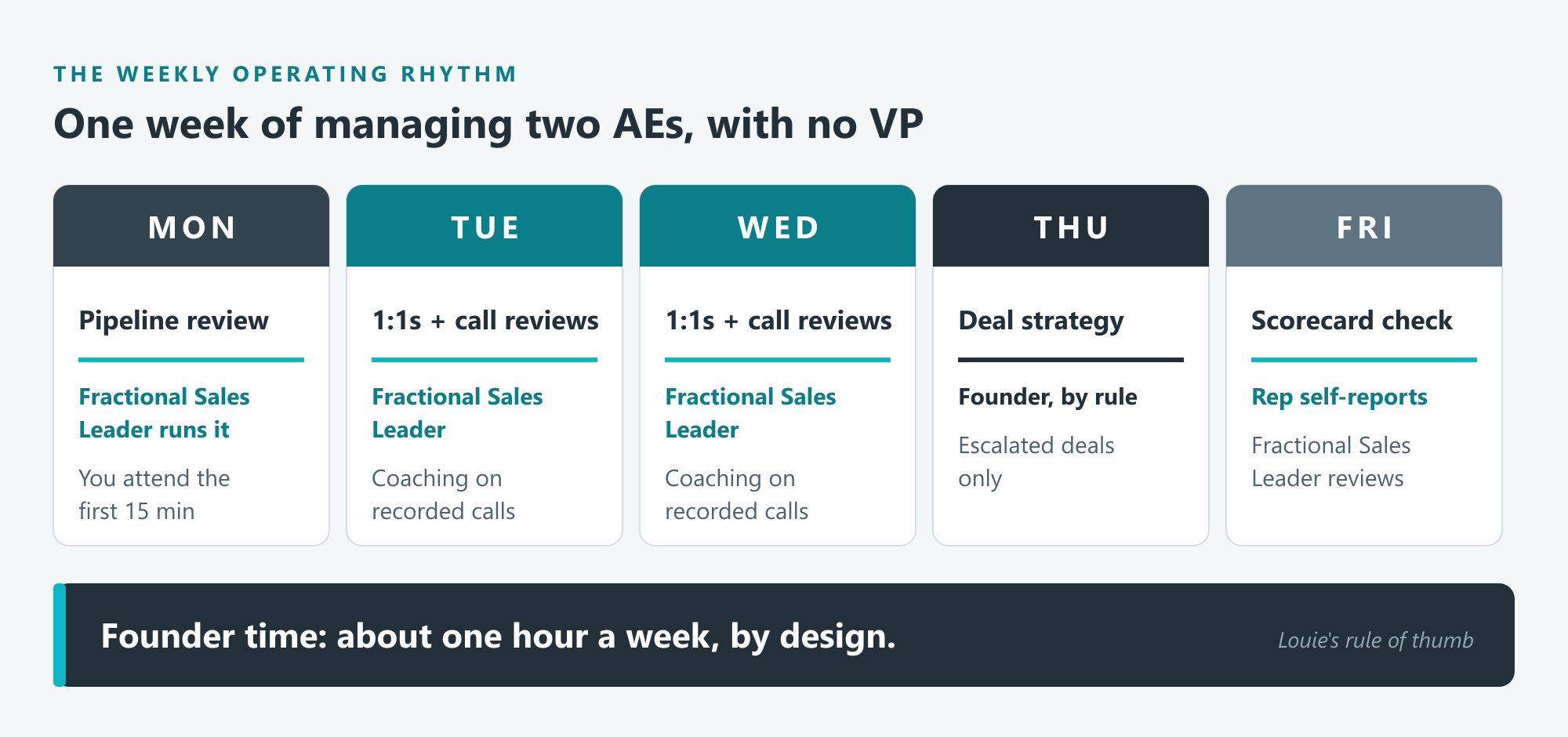
A reporting line on paper means nothing without a calendar behind it. The rhythm below is what I install with founders who have their first two AEs. It runs the same way every week, so the reps always know when they'll get help and who it comes from.
Monday: pipeline review
The Fractional Sales Leader runs it. You attend the first 15 minutes for the top-line view: what's closing this month, what moved, what's stuck. Then you leave. Each rep calls their own deals using action-based stages. A deal moves forward only when the buyer did something, like a decision maker attending or a next meeting booked. Hope isn't a stage.
Tuesday and Wednesday: 1:1s and call reviews
The Fractional Sales Leader meets each rep for a 1:1. The rep brings the agenda. Part of the time goes to a recorded call: what went well, and the one thing to change on the next call. These meetings don't get moved, because the person running them was hired to run them.
Thursday: deal strategy on escalated deals
This is your slot, and it only fills when a written escalation rule says so. A strategic account. A price below the floor. A buyer asking for terms nobody has approved. If no deal meets the rule, the slot stays empty and you get the time back.
Friday: scorecard check
Each rep reports their own numbers against their scorecard: activity, pipeline added, deals moved, deals won. The Fractional Sales Leader reviews them and flags anything off track for next week's 1:1. Self-reporting matters. A rep who tracks their own numbers spots problems before anyone has to point them out.
Your hour
Add it up. Fifteen minutes on Monday. Escalated deals on Thursday, when there are any. A short read of the Friday scorecards. My rule of thumb: about one hour a week of founder time, by design. If you're spending much more, something in the split is broken, and it's usually failure mode 3.
How do you put the reporting line in writing?
Put it in each rep's Accountabilities Document. Most founders write that document to cover outcomes, activity targets, and the ramp. Add one more section: who the rep reports to for what. I cover the rest of the document in accountability without micromanaging, so here's just the reporting part.
- Day-to-day manager: the Fractional Sales Leader, by name. 1:1s, pipeline review, coaching, CRM checks, and performance conversations.
- Founder: pricing exceptions, strategic accounts, and final hire or fire decisions.
- Escalation route: how a deal reaches the founder, and the written rule that decides when it does.
- Comp questions: go to the Fractional Sales Leader first. Disputes that change pay go to the founder.
- Weekly rhythm: the day and time of every recurring meeting above.
Go over it with both reps on day one, together. Then hold yourself to it. The fastest way to break a reporting line is for the founder to give a rep a different answer than their manager gave them an hour earlier. When a rep comes to you with a day-to-day question, send them back to the Fractional Sales Leader. Kindly, and every time.
Will this create a mess for a future VP?
No. It does the opposite. A future VP walks into written roles, a weekly rhythm, clean CRM data, and two reps who are used to being managed. That's a team they can build on. The mess comes from the setup most founders have now: no written roles, no rhythm, and two reps who learned to work around a missing manager.
When you do hire a VP, the day-to-day rows of the matrix move to them. Your rows stay with you. The reps' rows don't change at all. That's the point. You're building the seat now, so the person who fills it later inherits a system instead of a cleanup job.
What does a Fractional Sales Leader actually do here?
They manage your reps, part-time, on a fixed schedule. They run the 1:1s and the pipeline review. They review calls and coach. They keep the CRM honest. They handle the hard conversation when a rep is off track, and they bring you a clear recommendation when it's time to decide. It's the manager seat, filled at a cost a $1M to $10M ARR company can carry.
I've spent 50 years in sales, including 22 years building MindIQ into an INC 500 company. The founders who get this stage right don't have better reps. They decided who the reps work for, wrote it down, and protected the calendar that makes it real.
Once the reporting line is set, the next question is which deals each rep owns and which stay with you. That's the next article in this series.
Frequently Asked Questions
Q: Who should the first sales reps report to at a startup with no VP of Sales?
They should report to a Fractional Sales Leader for day-to-day management and to the founder for strategy, pricing exceptions, strategic accounts, and final hire or fire decisions. One person runs their week. One person makes the big calls. Write the split into each rep's Accountabilities Document.
Q: Can the founder manage the first two AEs directly?
Only if the founder can protect the time every week. That means 1:1s that happen on schedule, a weekly pipeline review, and call reviews. Most founders at $1M to $10M ARR can't, because they're also running product, money, and the biggest deals. If your 1:1s keep moving, the reps don't have a manager.
Q: Should I make one of my first two reps a player-coach?
Not yet. With two reps, a player-coach usually means your best seller sells less and manages part-time without the title or the pay. If you want a path to sales manager later, write it down with clear criteria. Until then, keep both reps selling and get the management from someone whose job it is.
Q: How much founder time does this setup take?
My rule of thumb is about one hour a week. Fifteen minutes in the Monday pipeline review, time on escalated deals when the written rule calls for it, and a short read of the Friday scorecards. If it's taking much more, you're probably managing by jumping into deals.
Q: What if a rep comes to me instead of the Fractional Sales Leader?
Send them back, kindly and every time, unless the question is one of yours: pricing exceptions, a strategic account, or a decision about their job. If you answer day-to-day questions yourself, you've created two managers, and the rep will pick whichever answer they like better.
Q: Who makes the call to fire a rep who isn't working out?
The founder signs off. The Fractional Sales Leader runs the process before that point: the scorecard, the coaching, the written warning, and a clear recommendation. That way the decision is based on numbers and a documented plan, not on how the last deal went.
Hiring your first two AEs?
In 30 minutes we'll map who owns each management job, set the weekly rhythm, and figure out how to get your week back.
Schedule a 30-Minute CallAbout the Author
Louie Bernstein
Fractional Sales Leader with 50 years of sales experience helping $1M–$10M ARR companies build scalable, repeatable sales systems. Founder of MindIQ (INC 500). LinkedIn Top Voice in Sales Management, Sales Operations, and Sales Coaching.