Key Takeaways:
- Your first hire's success is mostly decided before day one, by what's waiting for them when they log in, not by their talent or the interview.
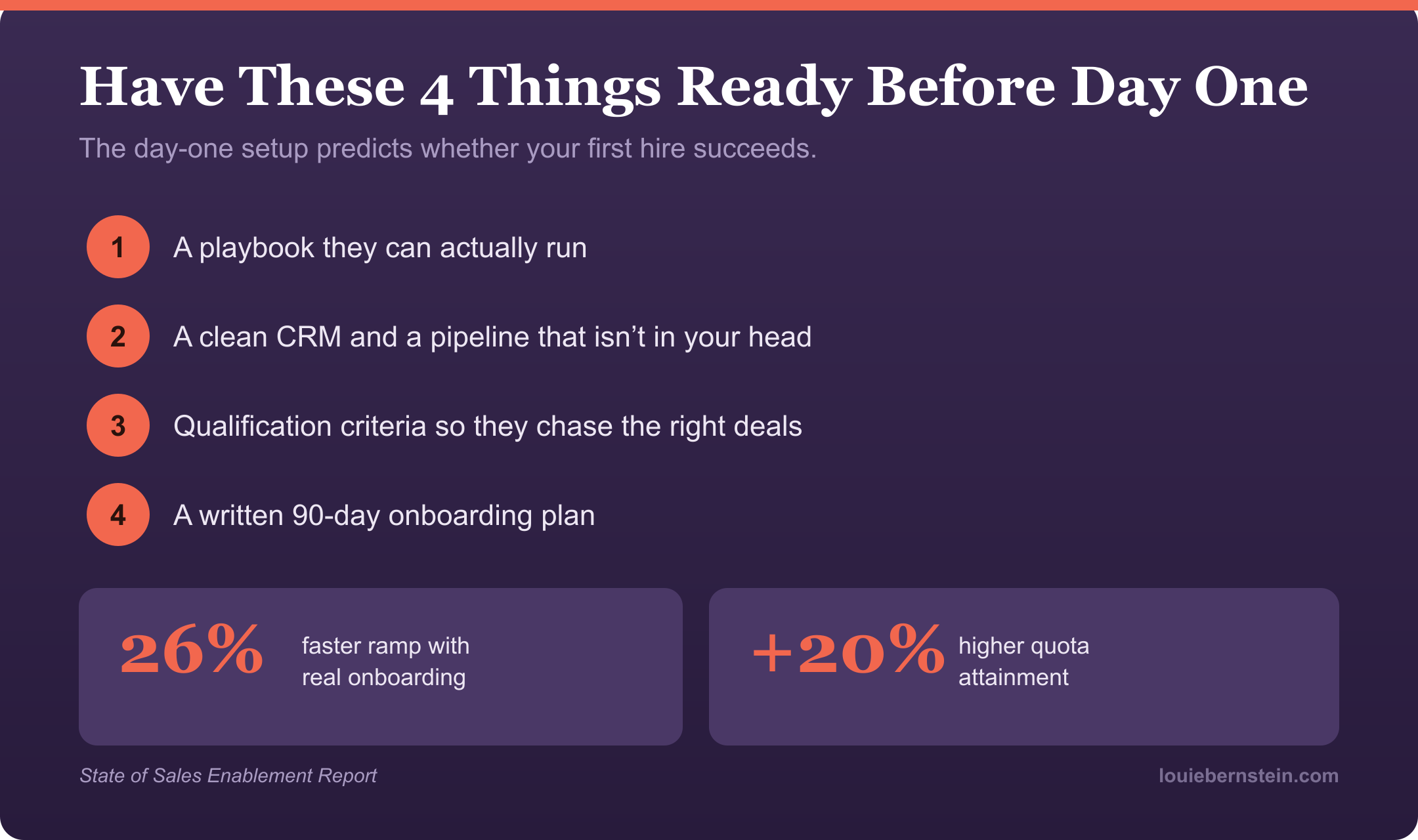
- Four things must be ready: a playbook they can run, a clean CRM and real pipeline, qualification criteria, and a written onboarding plan.
- Structured onboarding cuts ramp time by 26% and companies with strong onboarding report about 20% higher quota attainment (State of Sales Enablement Report).
- Even in a good setup a rep takes ~5–6 months to reach full productivity (Bridge Group). A bad setup stacks lost months on top of an already-long ramp.
- Founders who prep the runway don't just avoid failure, they attract and keep better reps. Good salespeople can smell a chaotic setup in the interview.
The success or failure of your first sales hire is mostly decided before they ever show up on day one. Not by their talent, not by how they interviewed, but by what's waiting for them when they log in. An empty CRM and a hearty "go get 'em" is a setup for failure. A real system is a setup for success. And the gap between those two is entirely on you, not on the person you hired.
The data backs this up hard. Structured onboarding cuts a new rep's ramp time by 26%, and companies with strong onboarding report roughly 20% higher quota attainment across the team (State of Sales Enablement Report). Even in a good setup, a rep still takes 5 to 6 months to reach full productivity (Bridge Group). Hand them a bad one and you've piled months of avoidable lost time on top of an already-long ramp.
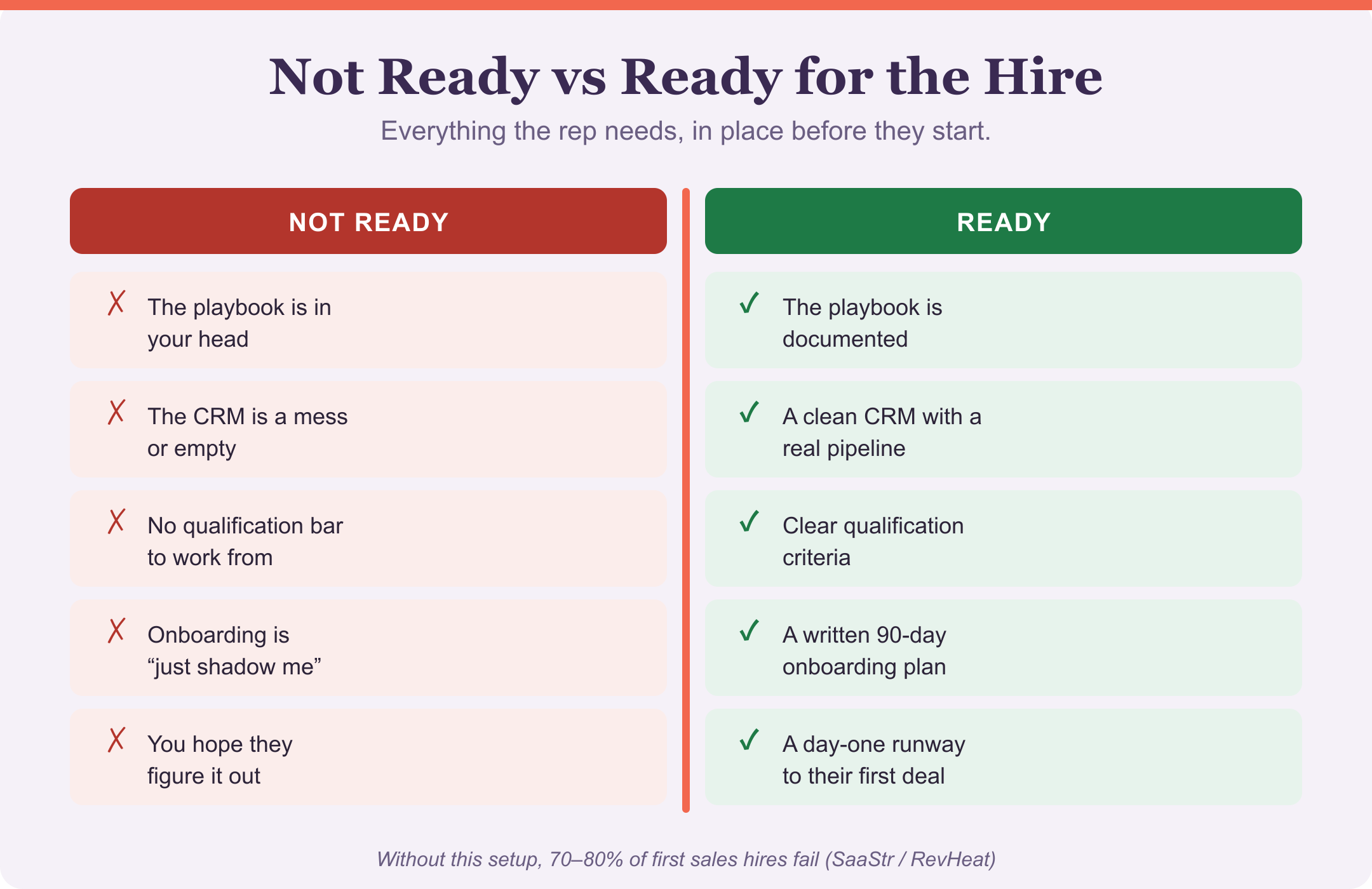
So before you post the job, get four things in place. Here's exactly what your first hire needs waiting for them on day one, and why the founder who preps this wins the hire while everyone else quietly joins the 70–80% failure rate.
The Day-One Setup That Predicts Whether They Succeed
Founders obsess over the hire and ignore the setup, which is exactly backwards. The environment does most of the predicting. A great rep dropped into a bad setup looks like a bad rep by month three, missing quota, spinning on the wrong deals, losing confidence. A merely solid rep dropped into a great setup looks like a star, because the system is doing half the work with them.
There are four pieces to that setup, and missing any one of them slows the ramp and lets doubt creep in on both sides. Get all four ready before the rep starts and you've done more for their success than any interview question ever could.
A Playbook They Can Actually Run
The first piece is a real, usable playbook, not a marketing slide deck. It should lay out your ICP, your sales stages, what to do and say and send at each one, how to handle the common objections, and your genuine winning message. The test is simple: can the rep open it and immediately know what to do next on any live deal? If yes, it's a playbook. If it's a vibe and a hope, it isn't.
This is the direct output of doing the sales audit on yourself, which I walk through in the sales audit every founder skips before hiring. If your motion still lives entirely in your head, you don't yet have a playbook to hand over, and the rep will be left to reverse-engineer your instincts on their own time. That's months of ramp you're throwing away before they even start.
A Clean CRM and a Pipeline That Isn't in Your Head
The second piece is really two problems wearing one coat. First, a messy or empty CRM means the rep has no map of what's actually happening in the business, no history, no context, no live deals to study. Second, if your pipeline lives in your head and your inbox, you literally cannot hand it over, so the rep starts from absolute zero while already carrying a quota.
Before you hire, clean up the CRM, log your real pipeline honestly, and be ready to hand over live opportunities on day one. Giving a new rep a few real, warm deals to work is one of the fastest ways to get an early win, build their confidence, and prove the motion, instead of leaving them to cold-outbound into the void for their entire first quarter.
Qualification Criteria So They Chase the Right Deals
The third piece is a clear qualification bar. Without one, a brand-new rep chases everything that moves, pours weeks into deals that were never real, and ends up with numbers that look terrible for reasons that have nothing to do with their ability. Clear criteria, who's a genuine fit, what signals a real opportunity, and when to walk away, focus their scarce time on the deals they can actually win.
Qualification criteria are also what make coaching possible. You can only tell a rep "that one wasn't a qualified deal, here's why" if you've defined qualified in the first place. Without that shared standard, every deal review turns into opinion versus opinion, and the rep never learns to spot a bad-fit deal on their own.
An Onboarding Plan Built Before You Post the Job
The fourth piece is a written onboarding plan, and "shadow me for a few weeks and you'll pick it up" does not count as one. Build a real 90-day plan before you even post the job: what they learn week by week, when they run their first call, when they take their first solo deal, and the concrete ramp milestones and targets you'll measure along the way.
This is the single highest-leverage piece of prep you can do. Structured onboarding delivers that 26% faster ramp and roughly 20% higher quota attainment (State of Sales Enablement Report), and given that only 16% of companies manage to ramp a rep in under three months (CSO Insights), a real plan is how you land on the fast end of that curve. Skip it and you get the slow, expensive version I broke down in the onboarding failure that costs you $80,000 and six months.
Why the Founder Who Preps This Wins the Hire
Here's the bonus almost no one tells you: the founders who prep this setup don't just avoid failure, they attract and keep better reps in the first place. Good salespeople can smell a chaotic, seat-of-the-pants operation from across the interview table, and the strong ones either decline the offer or leave within a few months. A documented playbook, a real pipeline, and a written plan signal a company that's worth betting a career on.
This is exactly the work I do with founders as a Fractional Sales Leader: build the playbook, clean up the pipeline, define the qualification bar, and write the onboarding plan, so your first hire steps onto a runway instead of off a cliff. One honest caveat: all of this assumes you have a proven, repeatable motion worth systematizing. If you don't yet, prepping the setup is premature, because there's nothing real to hand over. In that case, prove the motion first, which is the whole argument in why first sales hires fail, and then build the runway.
Related Reading
Frequently Asked Questions
Q: What has to be in place before my first sales hire starts?
Four things, ready before day one: a documented playbook the rep can run, a clean CRM with a real pipeline you can hand over, clear qualification criteria so they chase the right deals, and a written 90-day onboarding plan. Together these turn day one into a runway instead of a cold start. The payoff is real, structured onboarding cuts ramp time 26% and lifts quota attainment about 20% (State of Sales Enablement Report). Skip them and even a great hire looks like a bad one by month three.
Q: Why does the day-one setup matter more than the hire?
Because the environment does most of the predicting. A great rep in a bad setup misses quota, chases the wrong deals, and loses confidence, and looks like a bad hire by month three. A solid rep in a great setup looks like a star because the system carries half the load. You obsess over the interview, but what's waiting for the rep when they log in matters more. Prep the playbook, pipeline, qualification, and onboarding, and you've done more for their success than any interview ever could.
Q: What makes a sales playbook actually usable?
A usable playbook is step-by-step, not a slide deck. It spells out your ICP, your sales stages, what to do and say and send at each stage, how to handle common objections, and your real winning message. The test: can the rep open it and immediately know what to do next on any live deal? If your motion still lives only in your head, you don't have a playbook yet, you have instincts, and the rep will burn months reverse-engineering them. Document it first, then hand it over.
Q: Do I really need to hand over a pipeline?
Yes, if you want a fast, confident start. An empty CRM means the rep begins at absolute zero while already carrying a quota, cold-outbounding into the void for their entire first quarter. Handing over a few real, warm deals gives them a shot at an early win, which builds momentum and proves the motion works in their hands. If your pipeline currently lives in your head and inbox, cleaning it up and logging it honestly is a prerequisite, you can't hand over what isn't written down anywhere.
Q: What should a sales onboarding plan include?
A real 90-day plan, written before you post the job. Map what they learn week by week, when they run their first call, when they take their first solo deal, and the concrete ramp milestones and targets you'll measure. "Shadow me for a few weeks" is not a plan. Structured onboarding is the highest-leverage prep you can do, it cuts ramp time 26% and lifts quota attainment about 20% (State of Sales Enablement Report), and since only 16% of companies ramp a rep in under three months, a plan is how you get to the fast end.
Q: What if I don't have a repeatable motion to systematize yet?
Then prepping the setup is premature, because there's nothing real to hand over. A playbook, a pipeline, and a qualification bar all assume you've already proven a repeatable way to win. If you haven't, any hire will fail into the gap no matter how good your onboarding plan looks on paper. Stay in founder-led sales longer, close enough deals to see the pattern, and document it as you go. Once the motion is proven, build the runway, then hire the person to run it.
Build the runway before you post the job.
If you're a founder between $1M and $10M in ARR, I'll build the playbook, clean the pipeline, define qualification, and write the onboarding plan, so your first hire steps onto a runway, not off a cliff. See how it works at louiebernstein.com.
Schedule a 30-Minute CallAbout the Author
Louie Bernstein
Fractional Sales Leader with 50 years of sales experience helping $1M–$10M ARR companies build scalable, repeatable sales systems. Founder of MindIQ (INC 500). LinkedIn Top Voice in Sales Management, Sales Operations, and Sales Coaching.