Key Takeaways:
- Managers drive at least 70% of the variance in team engagement (Gallup). The person running your reps is the biggest lever you have. Comp them like it.
- Don't pay a sales manager like a bigger rep. A personal quota plus commission on their own deals quietly rebuilds founder-led sales one level down.
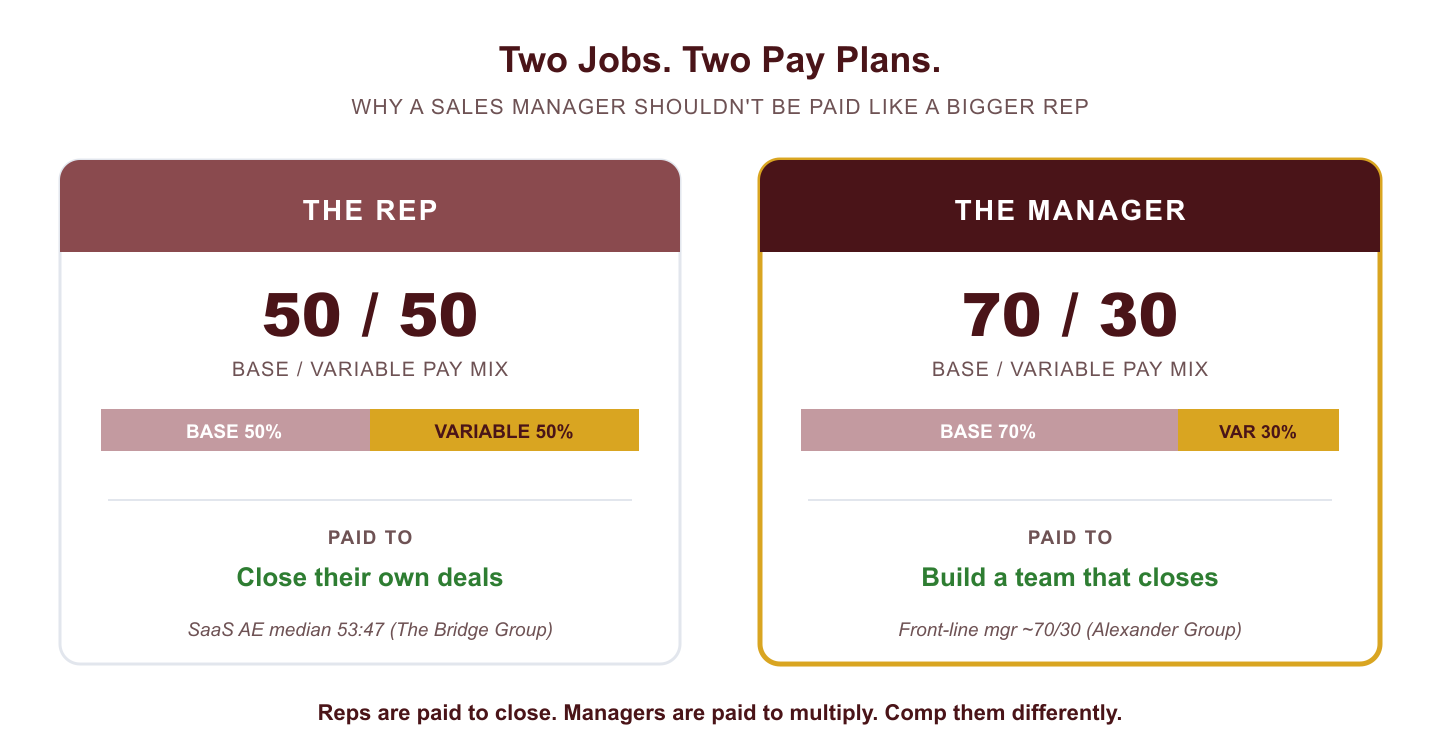
- Use a base-heavy pay mix, 70/30 or 75/25 (Alexander Group), not the roughly 50/50 you give reps (SaaS AE median 53:47, The Bridge Group). A manager moves a slow number and shouldn't be pushed back into closing to earn their variable.
- Make the team's number the core of variable, and tie part of it to the percentage of reps at quota so you're not just rewarding one hero rep.
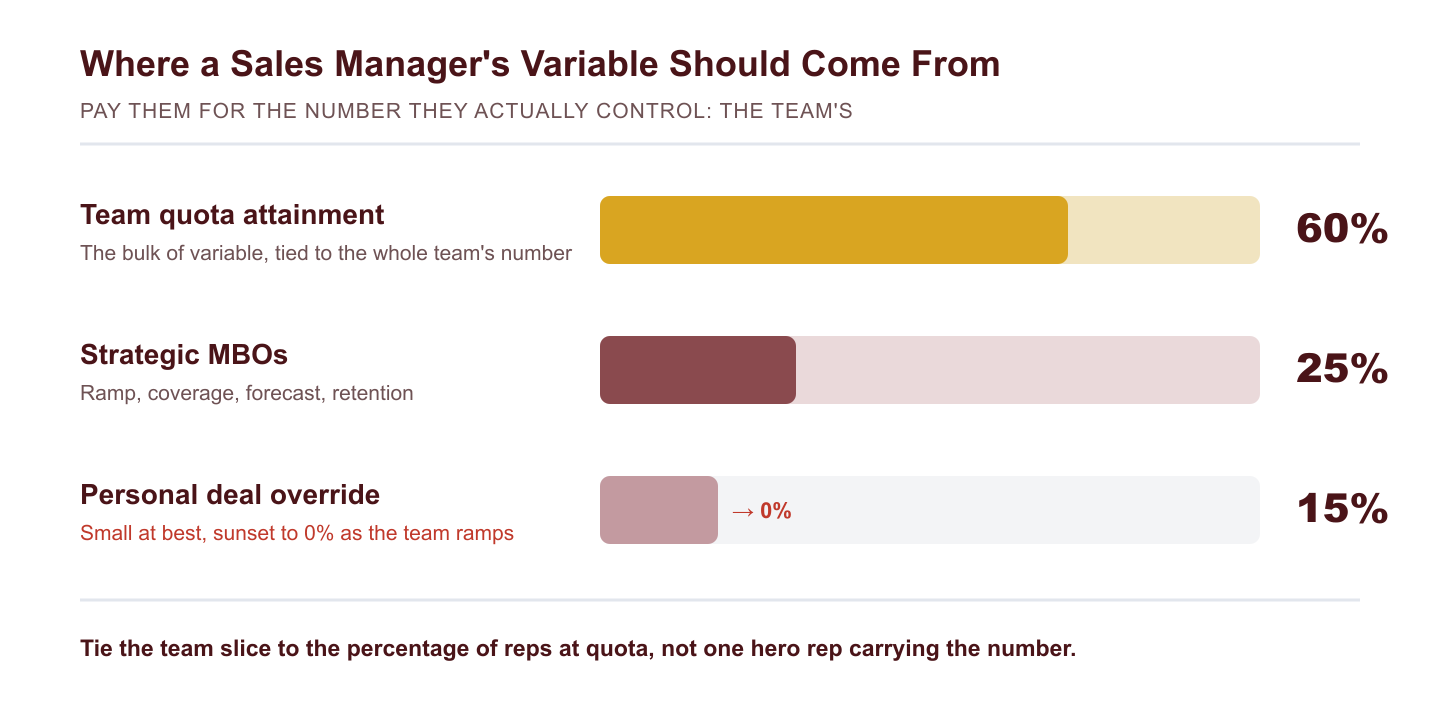
- Split variable roughly 60% team quota, 25% strategic MBOs, 15% personal override, with the personal slice sunsetting to zero as the team ramps.
- No quota, pipeline, or process yet? A comp plan won't fix that. Build the system first.
Here's a number that should stop you cold. Managers account for at least 70% of the variance in team engagement (Gallup), measured across 27 million employees. Seventy percent. The person you put in charge of your reps matters more than almost anything else you'll do this year. So why do most founders design that person's pay in about ten minutes, on the back of a rep plan?
I've watched it happen dozens of times. A founder finally steps back from selling, promotes their best rep or hires a sales manager, and pays them the way they paid the reps. A personal quota. Commission on their own deals. A small override on the team. It feels reasonable. It's a disaster.
Because you didn't hire a bigger rep. You hired someone to build a team that sells without you. If the comp plan rewards them for closing their own deals, that's exactly what they'll do. They'll hoard the good leads, work the biggest opportunities themselves, and let the reps who actually need coaching fend for themselves. You just rebuilt founder-led sales one level down.
A good comp plan for a B2B sales manager does the opposite. It pays them to multiply, not to close. Here's how to build one.
Why Most Sales Manager Comp Plans Quietly Fail
Most manager comp plans fail because they're rep plans with a bigger number. When you pay a manager on their own deals, you've told them their job is to sell, not to build. So they sell. They optimize for the paycheck, close in their own name, and the team stays dependent on one person. Sound familiar? It should. It's the exact trap you hired them to get you out of.
Reps follow the money. So do managers. That's not cynicism, it's design. A comp plan is a set of instructions, and people do what you pay them to do. Pay a manager mostly on personal production and you'll get a great individual seller who neglects the eight people around them. The forecast stays in their head. The new hires don't ramp. The pipeline reviews get skipped because there's a deal to work.
Now stack the odds. Gallup found companies pick the wrong person for the manager job 82% of the time. You already have long odds on the hire. A comp plan that rewards selling over building guarantees the wrong behavior even from the right person. Get the money pointed at the team, and a good manager has a reason to act like one.
If your sales manager's comp rewards them for closing, you didn't hire a manager. You hired an expensive rep with a title.
What's the Right Pay Mix for a B2B Sales Manager?
Pay a B2B sales manager on a base-heavy mix, usually 70/30 or 75/25 base to variable (Alexander Group), not the roughly 50/50 you'd give a rep. A rep's paycheck should swing on the deals they personally close. A manager's shouldn't. Their real output is the team's number, and that number moves slowly.
Reps sit near 50/50 for a reason. The median SaaS account executive runs a 53:47 base-to-variable split (The Bridge Group), because you want them hungry on every deal. A manager's job is different work: coaching, forecasting, hiring, building process. That work takes a quarter or two to show up in revenue. If you put half of a manager's pay at risk on a number they can only move slowly, one of two things happens. Either you scare off the good candidates who know better, or the manager you hired starts closing their own deals again to make their variable. Both are losses.
Base-heavy doesn't mean underpaid. A front-line manager should out-earn most of their reps at target. In SaaS the median AE runs about $190K OTE (The Bridge Group), so a good manager typically sits above that. Base-heavy is about the mix, not the size. You're buying stability of focus, not a discount.
Should the Plan Include a Team Performance Bonus?
Yes, but it shouldn't be a token override bolted onto a personal quota. The team's number should be the core of the manager's variable, because it's the only number a manager actually controls. Then build the bonus to reward breadth and retention, not just one hero rep who happens to carry the team that quarter.
The whole point of a manager is a team that performs without heroics. So tie the bulk of variable to team quota attainment. But be careful, because a naive "percent of team bookings" bonus is easy to flatter. One rainmaker can hit the team number while the other reps quietly drift. The manager gets paid, you feel good, and then the rainmaker leaves and the floor falls out.
Guard against it. Tie part of the payout to the percentage of reps at or above quota. Only about 43% of reps hit quota in a given year (RepVue), so moving that number is the manager's actual job. A team that hits plan because 8 of 10 reps are producing is a real team. One riding a single rep is a risk you're paying a bonus to ignore. A healthy team bonus rewards:
- Total team quota attainment, the headline number.
- The percentage of reps at quota, so you're rewarding breadth, not one hero.
- Ramped-rep retention, because you keep the people you trained.
- New-hire time-to-productivity, so the bench keeps filling.
What Should the Manager's Variable Actually Pay For?
Split the manager's variable into three buckets: the majority on team quota attainment, a quarter on strategic MBOs that build the machine, and a small, shrinking slice on personal deals if they still carry a bag. Roughly 60/25/15, with the personal piece sunsetting toward zero as the team ramps. Simple to explain, hard to game.
The 25% on MBOs is where a lot of founders under-invest. These are the leading indicators of a team that runs without you: new-hire ramp time, pipeline coverage, forecast accuracy, CRM hygiene, and rep retention. They don't show up in this quarter's bookings, but they decide next year's. Pay for them directly and your manager builds the machine on purpose instead of hoping it happens.
The personal override is the piece to watch. On a brand-new team, the manager may have to sell to keep revenue flowing while they hire. That's fine. Ring-fence it, keep it small, and put it on a timer. Every quarter it should shrink. If a manager is still earning 15% of their variable on personal deals a year in, they never built the team. They just kept selling, and you're funding it.
Pay a manager for the machine, not the heroics. The machine is what you're actually buying.
How to Build It Without Over-Engineering
Keep it simple enough that a manager can do the math in their head. Set a base-heavy mix, put the team number at the center, protect the downside with a threshold, leave the upside open, and revisit it once a year. Complexity doesn't drive behavior. Clarity does. A plan nobody understands is a plan nobody responds to.
A few guardrails I put on every manager plan:
- Set a threshold. The team bonus kicks in around 70% of plan, so you're not paying full freight for a weak quarter.
- Don't cap the upside on team attainment. You want a manager pushing past 100%, not coasting once the bonus is locked.
- Write it into an Accountabilities Document, so the manager knows exactly what they own and what they're paid for. No ambiguity, no renegotiation mid-quarter.
- Revisit annually. 97% of companies changed their comp plan for 2026 (Alexander Group). Yours will need to change too as the team grows.
One honest caution. If you don't have a real quota, a pipeline you can measure, or a documented process, a manager comp plan won't save you. You can't pay for team quota attainment when there's no quota, and you can't reward forecast accuracy when there's no forecast. If that's you, build the system first. That's usually where I start with founders, and it's the thing a Fractional Sales Leader can stand up in weeks, not quarters. Then the comp plan has something real to reward.
Frequently Asked Questions
Q: What's a typical OTE for a B2B sales manager?
It varies by market, industry, and team size, so chase the principle before the number. A front-line manager should out-earn most of their reps at target. In SaaS the median AE runs about $190K OTE (The Bridge Group), so a manager usually sits above that, with early-stage and non-SaaS teams running lower. The bigger tell isn't the size of the number, it's the mix. A manager on the same roughly 50/50 plan as the reps is a warning sign, whatever the total.
Q: How much of a sales manager's pay should be variable?
Usually 25% to 30%, versus about 50% for a rep. A manager moves a slow number, the team's, so putting half their pay at risk on it either scares off strong candidates or pushes them back into closing their own deals. A 70/30 or 75/25 base-to-variable mix (Alexander Group) keeps them focused on building the team instead of protecting their paycheck.
Q: Should a sales manager carry their own quota?
On a brand-new team, sometimes, to keep revenue flowing while you hire. Treat it as temporary. Ring-fence the personal number, keep it a small slice of variable, and shrink it every quarter until it's gone. A manager who's still carrying a full bag a year in isn't managing, they're selling, and the team you wanted never got built.
Q: What's the difference between comping a sales manager and a rep?
A rep is paid to close deals they personally own, so their plan runs close to 50/50 and rewards individual production. A manager is paid to build a team that closes, so their plan is base-heavy and rewards the team's number, breadth of performance, and retention. Same company, opposite incentives. Copying the rep plan onto the manager is the most common mistake I see.
Q: How do I keep a team bonus from just rewarding one hero rep?
Tie part of the payout to the percentage of reps at quota, not just total bookings. A team that hits plan because most reps are producing is a real team. One that hits plan on the back of a single rainmaker is fragile, and you don't want to pay a bonus that hides the risk. Reward breadth, and you'll get a manager who develops the whole roster.
Q: When is it too early for a sales manager comp plan?
When you don't yet have a quota, a pipeline you can measure, or a documented process. You can't pay for team quota attainment without a quota, or forecast accuracy without a forecast. If that's you, build the system first. A Fractional Sales Leader can stand that up quickly, and then the comp plan has something real to point at.
Build the plan that gets your manager to build the team.
You promoted or hired a sales manager to get yourself out of the deals. The comp plan decides whether that actually happens. Let's spend 30 minutes on your setup: the pay mix, the team number, and what to sunset, so your manager is paid to multiply, not to close.
Schedule a 30-Minute CallAbout the Author
Louie Bernstein
Fractional Sales Leader with 50 years of sales experience helping $1M–$10M ARR companies build scalable, repeatable sales systems. Founder of MindIQ (INC 500). LinkedIn Top Voice in Sales Management, Sales Operations, and Sales Coaching.