An embedded Fractional CRO can lead the revenue work that touches every part of your organization, but one person can't perform every employee's job. The responsibility is to connect sales, marketing, customer success, delivery, and finance so the team can execute. That cross-department involvement belongs in the agreed leadership fee. In my engagements, working with another department to solve a revenue problem doesn't add a charge.
Key Takeaways
- An embedded Fractional CRO touches the whole organization because revenue depends on the work between departments.
- Leading across departments means setting priorities, clarifying ownership, and fixing handoffs. Employees still perform their own jobs.
- Normal cross-department leadership should be included in the agreed fee, rather than billed as an extra service.
- My published engagement is $14,000 per month in renewable 12-week terms, with 20–35 hours of work per week. Cross-department involvement doesn't change my price.
- Before signing, put responsibilities, decision authority, availability, and any separate execution costs in writing.
You hire a Fractional CRO to get yourself out of the middle of every sales problem. Then the first problem turns out to involve marketing. The next involves delivery. The third needs finance.
Now you're wondering whether you bought sales leadership or opened a meter that runs every time another department enters the conversation.
If you're a B2B founder at $1M to $10M ARR, the answer matters. Your company needs someone who follows the revenue problem to its source. You shouldn't have to buy a second engagement because the source sits outside sales.
How Much More Expensive Is It Going to Be?
Normal cross-department involvement shouldn't make an embedded Fractional CRO more expensive. Working with marketing, finance, delivery, and customer success is part of leading revenue. My price doesn't increase because a sales problem requires another department's help. Agree on the leadership responsibility and fee before starting, so collaboration doesn't become an unexpected add-on.
My price covers the responsibility
I charge $14,000 per month for a renewable 12-week engagement and work 20–35 hours per week. Those are my published terms, checked in October 2026. I don't add a fee because I need to sit down with your marketing person or understand an onboarding problem.
If the leads aren't qualified, I need to know why. If sales promises something delivery can't support, I need to help fix the promise. If the forecast leaves finance guessing, I need to improve the forecast. Those conversations belong in the work you hired me to do.
Don't judge a proposal only by its monthly number. Ask whether the fee includes the work required to make the sales system function inside your actual business. A narrow proposal can leave the founder responsible for every issue between departments.
Keep separate spending visible
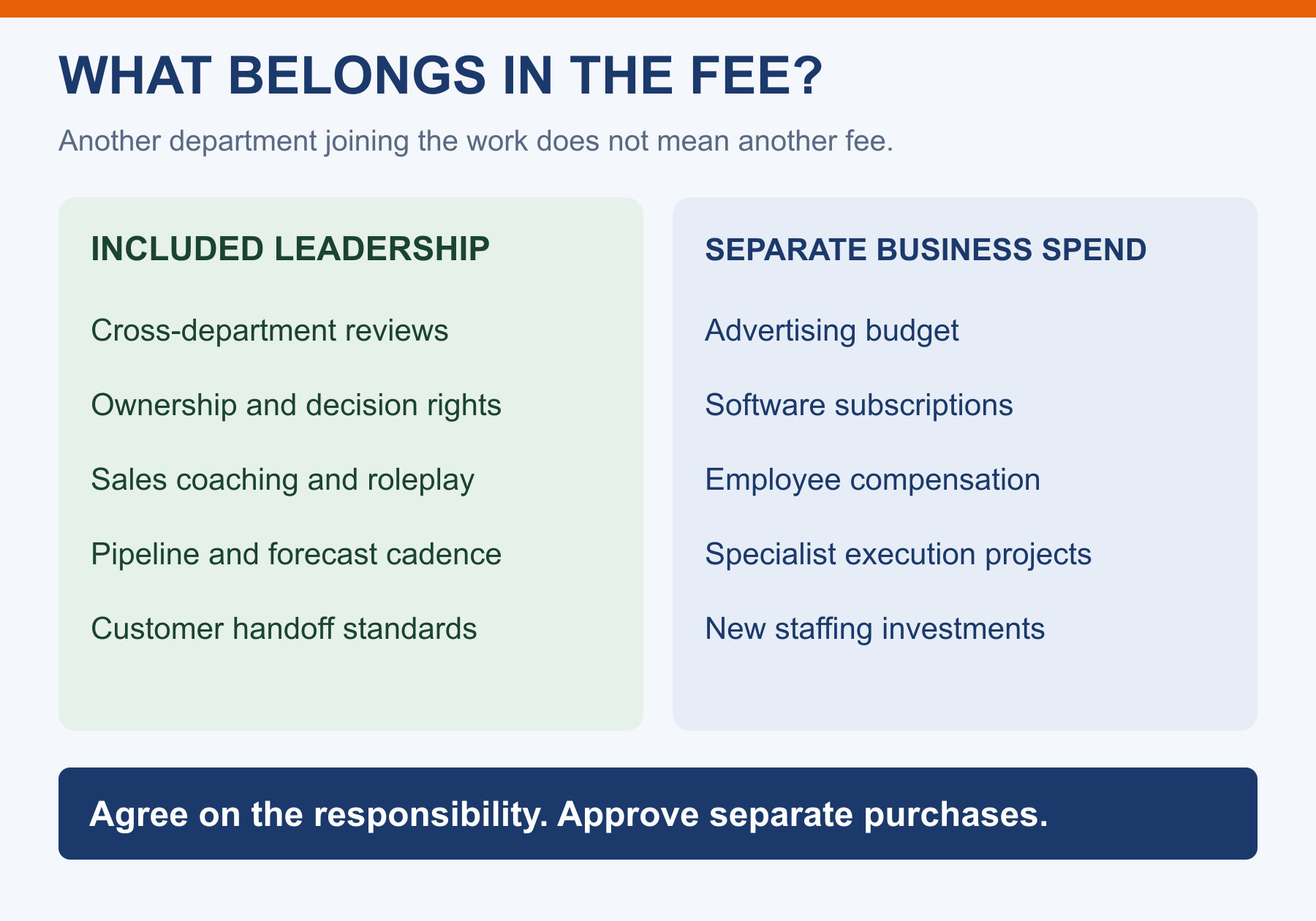
The leadership fee isn't the company's entire operating budget. Advertising, software, employee compensation, and specialist projects are separate business costs. Bringing a delivery manager into a deal review shouldn't change the leadership invoice. Hiring a developer to build a custom integration is a different purchase.
For example, agreeing on the information sales must hand to onboarding is leadership work. Purchasing an onboarding platform is a business expense. Helping marketing understand which customers sales can win is leadership work. Funding a new paid campaign is a budget decision.
A founder should approve those purchases before money is committed. The important distinction is between normal leadership across the organization and separately purchased execution. A new department joining the discussion isn't, by itself, a reason to charge more.
A revenue problem doesn't become an extra service because it crosses a department boundary.
Which Parts of the Organization Should a Fractional CRO Touch?
An embedded Fractional CRO should work with every function that affects winning, serving, and keeping customers. Sales is the starting point, but marketing quality, delivery capacity, customer expectations, and financial rules all influence revenue. The leader connects those functions around clear decisions and handoffs, while respecting each department's expertise and authority.
Follow the customer from first contact to delivery
A prospect doesn't experience your company as an org chart. The prospect sees an advertisement, speaks with a rep, receives a proposal, signs an agreement, and meets the people who will deliver the work. Each step needs to support the expectations created by the previous step.
If marketing attracts customers your product can't serve, better closing skills won't solve the mismatch. If sales skips a delivery review, a signed agreement can become a bad customer experience. The CRO needs visibility into both situations.
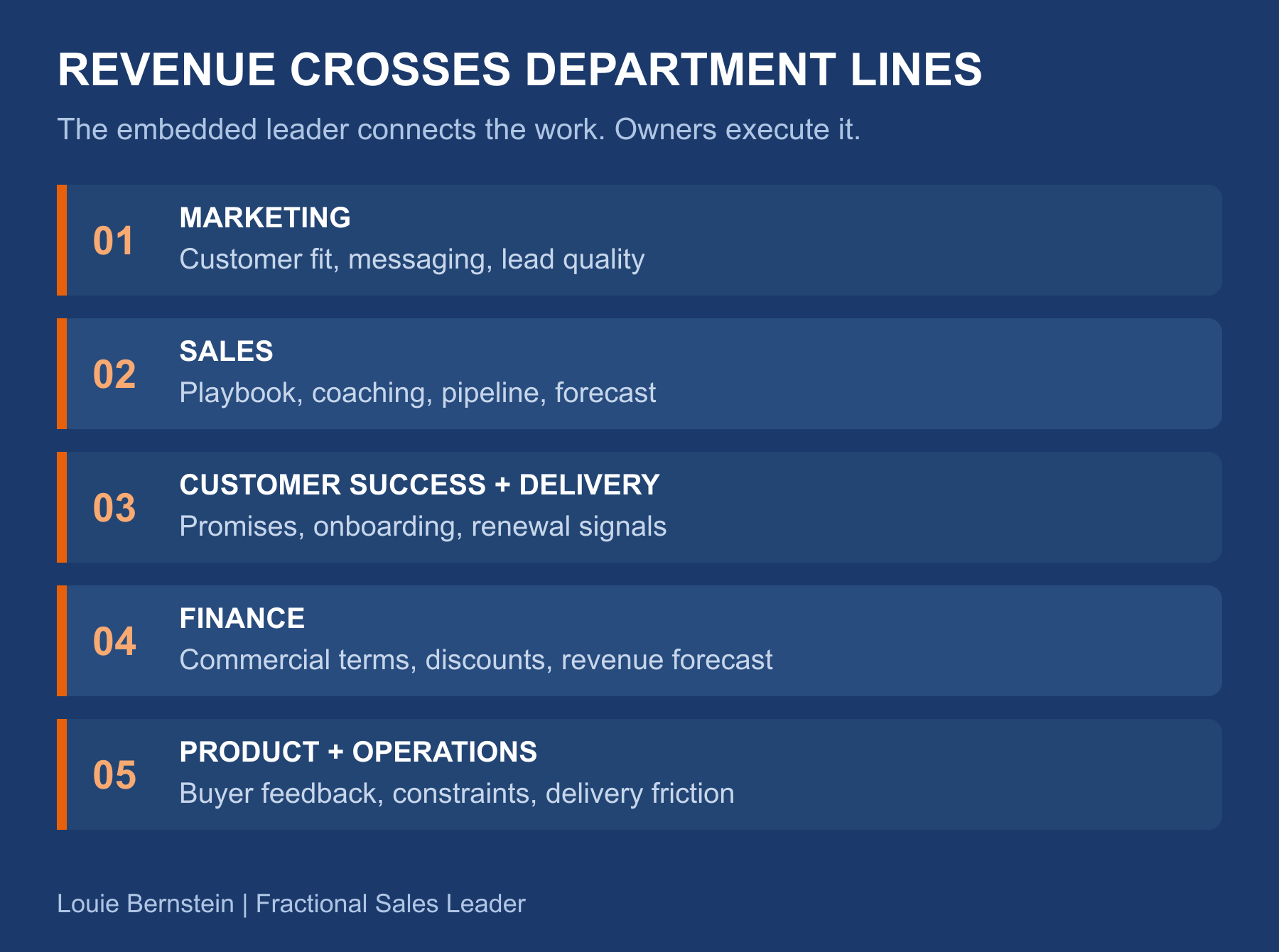
The practical responsibilities look like this:
- Marketing: agree on the ideal customer, qualification standards, messaging, and feedback on lead quality.
- Sales: build the Sales Playbook, coach reps, define stages, manage pipeline, and run the forecast.
- Customer success and delivery: clarify promises, onboarding requirements, renewal signals, and capacity constraints.
- Finance: align forecasts, discount approvals, commercial terms, and the economics of the customers being sold.
- Product and operations: bring recurring buyer objections and delivery friction to the people who can address them.
Visibility doesn't mean taking over
A Fractional CRO should understand why a customer is unhappy. The customer success owner still runs the recovery plan. The leader should understand why a proposal takes too long. Finance or operations still owns the approval work.
Some companies give the CRO direct authority over several functions. Others keep separate reporting lines. Either arrangement can work if the founder makes decision rights clear. A title alone doesn't tell employees whose decisions they must follow.
How Can One Person Lead Without Doing Everyone's Work?
One person can lead across functions by making ownership clear, teaching the team, and concentrating effort on the most important revenue constraints. A Fractional CRO can't replace a whole department's execution capacity. The workable model gives each task an owner and uses shared routines to keep the work moving without constant founder intervention.
Write the ownership down
Use an Accountabilities Document to name who owns the result, who performs the work, and who approves exceptions. Avoid assigning a task to “sales and marketing.” Shared interest doesn't tell anyone who must finish the job by Friday.
Consider a hypothetical company with leads that receive slow follow-up. Marketing owns accurate lead routing. A rep owns the first contact. The sales leader owns the follow-up standard and checks adherence. The founder approves staffing if the team lacks capacity.
The Fractional CRO connects those decisions, helps remove obstacles, and holds the owners accountable. The leader doesn't need to become the person who manually routes every lead and writes every response.
Protect time for coaching
Leadership has to include teaching. In Salesforce's 2026 State of Sales report, based on 4,050 sales professionals surveyed in 22 countries during August and September 2025, 46% of sales reps said they rarely get feedback on their sales conversations. Another 41% said they don't get enough opportunities to roleplay before customer calls (Salesforce, page 25).
Those are broad survey findings, not a diagnosis of your team. They do point to a useful question: will the leader have time to develop your reps, or will the leader spend the week doing the reps' work?
Review a call. Practice the weak part. Have the rep try again. Then check the next real conversation. Coaching should make the person better at the job, rather than make the person more comfortable handing the job to someone else.
My approach as an embedded leader
I don't treat another department as someone else's problem when its work affects sales. That's the responsibility I take on in an embedded engagement. But touching every function isn't a promise to become every employee.
I'll help clarify the decision, establish the process, and teach the people who need to carry the work forward. If every difficult call still needs me, we haven't built the independence you hired me to create.
The goal is a team that can do the work, with a leader who makes the work fit together.
What Should We Agree on Before the Engagement Starts?
Agree on the revenue priorities, named owners, decision rights, weekly working rhythm, and what the fee includes before an embedded Fractional CRO starts. The founder should also define access to information and people. Cross-department responsibility works when the leader can identify problems and act on them with the team's cooperation.
Put the working agreement on one page
You don't need a complicated document to have a useful conversation. Answer these five questions together:
- What must improve first? Pick the constraint holding back repeatable sales, such as poor qualification or inconsistent follow-up.
- Who owns each piece? Name the person responsible for sales, marketing, delivery, and finance decisions.
- What can the leader decide? Clarify hiring recommendations, sales process changes, discount limits, and escalation rules.
- How will we work together? Set the forecast review, coaching sessions, departmental discussions, and response expectations.
- What is included in the fee? Confirm normal cross-department work and identify any separately approved business purchases.
Ask one direct question during the interview: “If you discover that our sales problem starts in marketing or delivery, what happens next?” You want a concrete answer about diagnosis, ownership, and follow-through. You also want clarity about the invoice.
Give the leader access, then let people own the work
A leader who can only attend the sales meeting may never discover why delivery rejects the agreements sales brings in. Provide access to relevant CRM data, customer feedback, pricing rules, and the people responsible for the handoffs.
Tell the team why the Fractional CRO is involved. The leader is there to improve how the company wins and serves customers. Employees should know how decisions will be made and when the founder needs to get involved.
If every request still requires your personal permission, you've kept yourself in the middle. Define the boundaries once, then allow the team to work within them.
How Will I Know the Broader Responsibility Is Working?
Broader Fractional CRO involvement is working when revenue decisions improve, handoffs become reliable, and employees need fewer routine rescues from the founder. Track a small set of measures alongside specific work completed. More meetings across departments aren't proof of progress. The test is whether the company can execute more consistently without you.
Measure the friction you hired the leader to remove
If leads sit untouched, track follow-up against an agreed standard. If deals stall, examine stage age and missing next steps. If onboarding starts badly, check whether the delivery owner received the agreed customer information before the kickoff.
Use a baseline from your own business. A useful weekly review shows the previous result, the current result, the action taken, and the owner of the next action. Avoid filling a dashboard with measures nobody uses to make a decision.
Keep founder involvement visible too. Record the routine sales decisions you had to rescue and why. A falling rescue count is useful only if deal quality, customer expectations, and team performance remain sound.
Recognize a real capacity problem
A missing process and a missing employee require different solutions. If reps don't know how to qualify, teach qualification. If onboarding demand exceeds the delivery team's available hours, document the capacity gap and decide how to staff it.
The Fractional CRO should expose the gap and help you make the decision. The leader shouldn't hide the gap by permanently absorbing another person's workload. And the existence of a capacity problem doesn't automatically turn normal cross-department leadership into a surcharge.
You hired an embedded leader to help the business work as a whole. Expect that responsibility. Expect clear limits on personal execution too. Both belong in an honest agreement.
Frequently Asked Questions
Does a Fractional CRO need direct reports in every department?
No. A Fractional CRO can coordinate revenue work across separate reporting lines if the founder gives the role clear authority and departmental cooperation. Write down who decides and who resolves disagreements.
Can an embedded leader work with our existing marketing agency?
Yes. An embedded leader can align the agency's work with customer fit, qualification, and sales feedback. The agency keeps responsibility for its contracted execution, and its agency fee remains a separate expense.
What if we don't have a customer success department yet?
Name the person currently responsible for onboarding and customer follow-through, even if that's the founder. The Fractional CRO can establish the handoff with that owner and help determine when the workload requires dedicated capacity.
Will my Fractional CRO be available every hour of the day?
A fractional engagement doesn't provide unlimited availability. Agree on working hours, response expectations, and urgent escalation coverage before starting. Your team needs clear rules for moving work forward when the leader is unavailable.
Does the CRO title guarantee expertise in finance or product?
No. Evaluate the person's experience and judgment, rather than relying on a title. A revenue leader should know when to bring in the finance or product expert and should respect that expert's authority.
Is this the right model if I haven't sold the product yet?
An embedded revenue engagement needs a real business problem and evidence of customer demand to work on. If you haven't established founder-led sales, first learn who buys and why. Leadership can't substitute for customers wanting the product.
Get Clear on the Responsibility Before You Buy the Title
If you're running a $1M to $10M ARR B2B company and still connecting every part of sales yourself, let's discuss what embedded Fractional Sales Leadership should cover. Learn how I work at LouieBernstein.com. We'll talk about your team, your constraints, and the work you need included.
Schedule a 30-Minute CallAbout the Author
Louie Bernstein is a Fractional Sales Leader with 50 years of sales experience and has provided Fractional Sales Leadership since 2017. He helps B2B founders build Sales Playbooks, develop salespeople, and create repeatable sales systems that reduce founder dependence.