Key Takeaways:
- There are five common ways fractional sales leaders charge: monthly retainer, hourly, project, interim, and performance-based. Each buys a different thing.
- Most fractional sales retainers run $10K to $20K a month (gofractional, ActivatedScale). That's 30 to 60% less than a comparable full-time VP.
- A full-time VP of Sales carries a median total pay near $306K (Glassdoor) and an average tenure of just 18 months (Gong). You're buying risk, not only salary.
- I price differently. $14,000 a month for a 12-week engagement, 20 to 35 hours a week. Fixed scope, fixed clock, no long lock-in, and a real deliverable at the end.
- Good pricing includes deliverables you keep: an Accountabilities Document, a Sales Playbook, a working pipeline, and a forecast you can trust.
- If you have no product-market fit and you're not selling yet, no pricing model will help. I'll tell you that on the first call.
As a founder and CEO, you don't want a philosophy lecture on fractional leadership. You want real numbers before you switch anything. What does it cost, what do you get, and how do you know you're not overpaying for a title.
Fair questions. The problem is that "fractional sales leadership" isn't one price. It's five different pricing models wearing the same name, and each one buys you something different. A $200-an-hour advisor and a $20K-a-month interim leader are both called fractional. They are not the same purchase.
So let me lay out how fractional sales leaders actually charge, with current figures, and then show you my model and why I built it the way I did. If you're running a B2B company between $1M and $10M ARR and still closing most of the deals yourself, this is the map you've been missing.
I'll also tell you where fractional pricing is the wrong thing to be shopping for. Not every founder needs one, and I'd rather say so than sell you a retainer you can't use.
The Five Ways Fractional Sales Leaders Charge
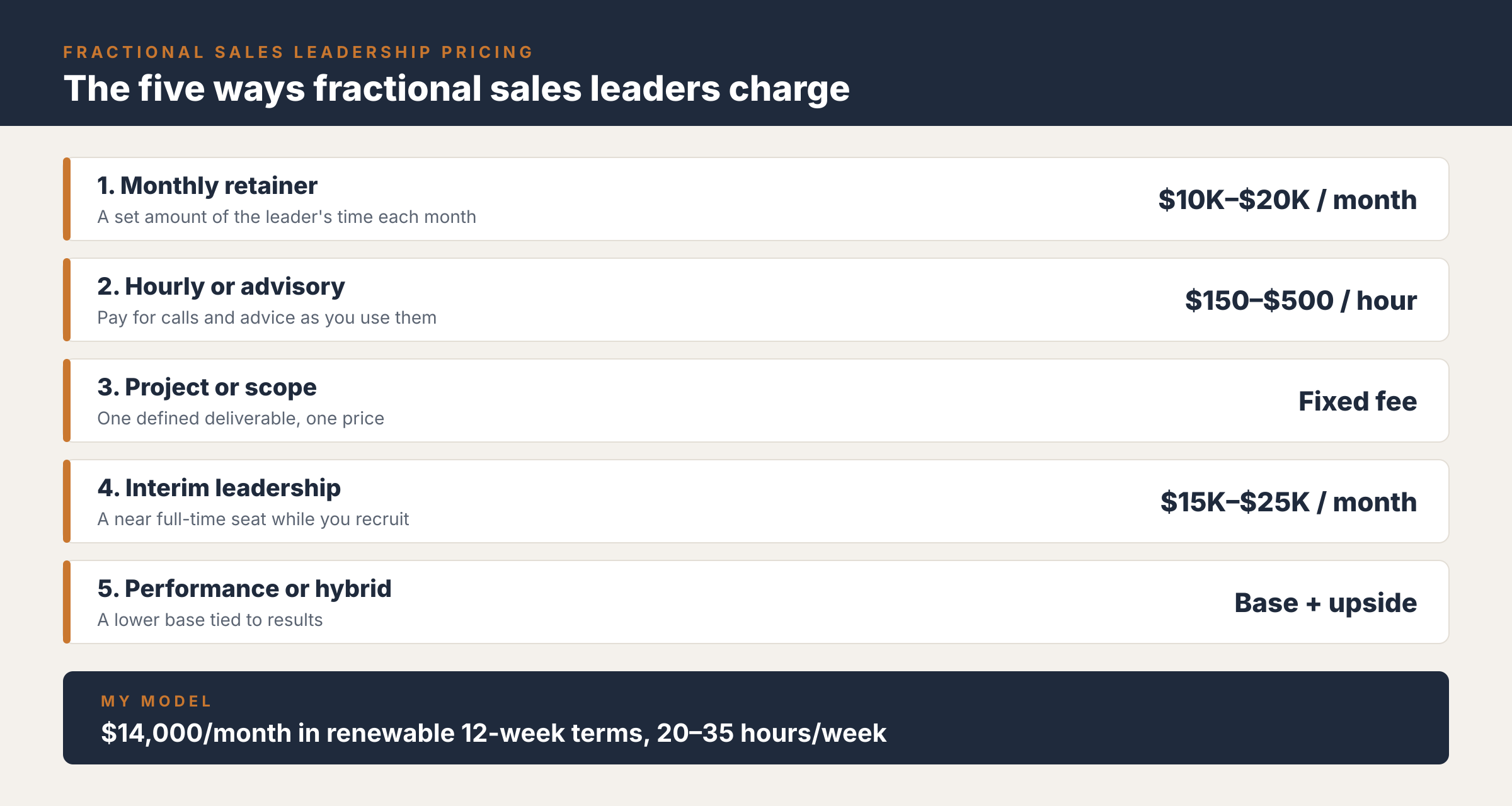
Almost every fractional sales engagement fits one of five structures. Learn these and you can read any proposal in about a minute.
Monthly retainer
The most common model. You pay a flat monthly fee for a set amount of the leader's time, usually 10 to 20 hours a week (StrategicPete). Most fractional sales retainers land between $10K and $20K a month (gofractional, ActivatedScale).
The upside is predictability. You know the invoice before it arrives. The risk is the open-ended clock. A retainer with no defined endpoint can quietly turn into a part-time salary for advice you stopped using three months ago.
Hourly and advisory
Here you pay per hour, typically $150 to $500 depending on experience and market (gofractional). It's the lightest-touch option, good for a founder who wants a sounding board a few hours a month, not someone building anything.
The trap is that hourly pricing rewards the meter, not the outcome. You'll get answers to the questions you ask. You won't get a system, because a system takes concentrated work that nobody wants to bill by the six-minute increment.
Project, interim, and performance
The other three show up when the job has a shape.
- Project or scope-based. One fixed fee for one defined build. A Sales Playbook, a CRM setup, a hiring process. You pay for the deliverable, not the hours behind it.
- Interim leadership. A near full-time seat while you recruit a permanent hire. This runs higher, often $15K to $25K a month, because it's close to a full-time commitment without the full-time term.
- Performance or hybrid. A lower base plus a bonus tied to pipeline or revenue. It sounds founder-friendly. Read the fine print, because a leader can hit a bonus on activity that never turns into cash.
What You're Actually Comparing It Against
You can't judge a fractional price in a vacuum. The real comparison is the full-time VP of Sales you're weighing it against, and that number is bigger and riskier than the salary line suggests.
The full-time number is bigger than the salary
The average base for a VP of Sales sits around $223K (Founderpath), and median total pay lands near $306K once variable and equity are counted (Glassdoor). Then add the parts that never show up on the offer letter: recruiting fees, three to five months of ramp before they're productive (an AE alone averages 4.4 months to ramp, and leaders take longer), and the payroll taxes and benefits stacked on top.
Against that, a fractional retainer at 30 to 60% less than comparable full-time leadership (ActivatedScale) stops looking like a discount and starts looking like the sane first move.
The seat you're buying might not stay filled
Here's the number founders underweight. The average VP of Sales tenure is about 18 months (Gong), and across 14,000 executives, go-to-market leaders churn at 32% a year (SaaStr). One in three sales leaders is gone within twelve months.
A mis-hire isn't free either. The Department of Labor pegs a bad hire at 30% of first-year salary, and for sales specifically the all-in cost often runs 1.5 to 2 times annual pay once you count lost pipeline and the reset. When you hire a full-time VP too early, you're not buying leadership. You're buying a coin flip with a six-figure downside.
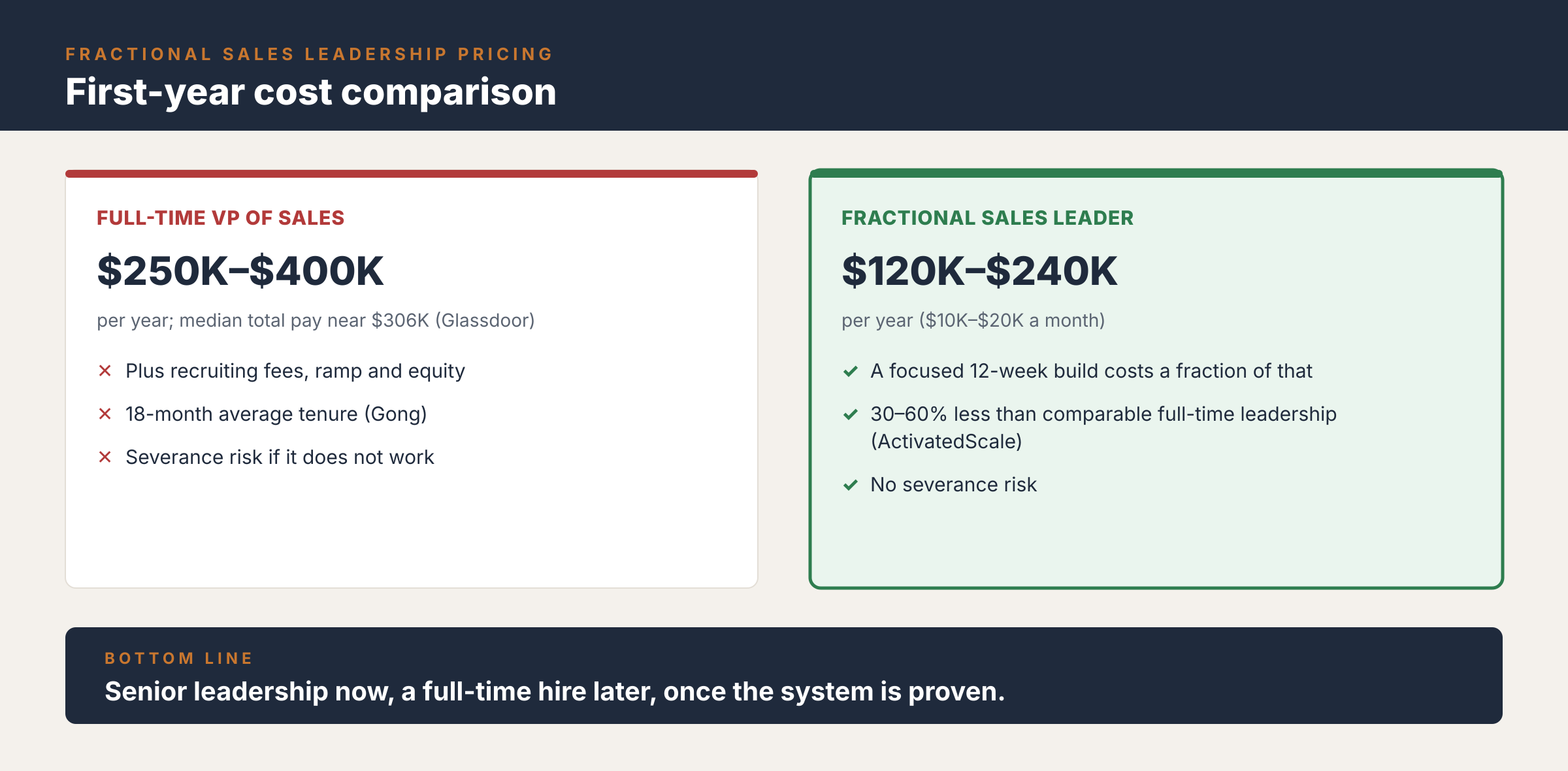
When you hire a full-time VP too early, you're not buying leadership. You're buying a coin flip with a six-figure downside.
Why I Work in 12-Week Engagements
I don't sell an open-ended retainer, and I don't bill by the hour. I charge $14,000 a month for a 12-week engagement, and I work 20 to 35 hours a week inside your business. Here's the thinking behind it, because the structure is the point.
Fixed scope, fixed clock
An open retainer has no finish line, so nobody's in a hurry. Hourly pricing punishes the deep work that actually fixes a sales org. Twelve weeks at a fixed $14,000 a month solves both. The clock is running for both of us, and the scope is agreed before we start.
You're not signing up to fund a part-time seat forever. You're funding a defined build with a date on it. That focus is what gets a founder out of the deal-by-deal grind, which is the whole reason you're reading this.
What twelve weeks buys you
Ninety days is enough to install a system and long enough to prove it works. The 90-day trial is a recognized way to de-risk fractional leadership (StrategicPete), and it happens to match how long real change in a sales process takes to hold.
In that window we build the pipeline, define the process, set the forecast, and leave you with documents your team runs on after I'm gone. If it's working and you want to keep going, we can. But the price never depended on you being unable to leave.
A good fractional engagement should make itself unnecessary. If the price only works when you can't leave, it isn't priced for you.
What Good Fractional Pricing Should Always Include
Price without deliverables is just a rate. When you evaluate any model above, ask what you keep when the engagement ends. If the answer is "advice," keep shopping.
The deliverables, not just the hours
Whatever the pricing structure, a real engagement should leave you owning these:
- An Accountabilities Document. Who owns what in the sales motion, written down, so responsibility doesn't live only in your head.
- A Sales Playbook. The repeatable path from first touch to closed deal, so a new rep can follow it instead of shadowing you for six months.
- A working pipeline and clean CRM. Every deal in one place, with stages that mean something, so you stop forecasting from memory.
- A forecast you can trust. A weekly cadence and a number you'd bet on, not a hopeful spreadsheet.
- A hiring and interviewing process. So your first or next sales hire is a decision, not a gamble against that 18-month tenure statistic.
- A clean handoff. The systems keep running after the engagement ends. That's the test of whether you bought a system or rented a person.
Questions to ask before you sign
Run any proposal through these five:
- What, exactly, do I own when this ends?
- What's the endpoint, and what happens if it isn't working?
- Are you building the system or just advising on it?
- Who does the work, you or a junior I never met?
- If this is performance-based, is the bonus tied to revenue or to activity?
When Fractional Pricing Is The Wrong Question
I'll be straight with you, because I'd rather lose the deal than take your money for something that won't work.
If you have no product-market fit, no fractional sales leader can manufacture demand that isn't there. If you personally haven't sold the product yet, you don't need a leader to systematize a motion that doesn't exist. And if you're truly pre-revenue with nothing to organize, a pricing model is the wrong thing to be comparing.
Fractional sales leadership works when you have proof, usually founder-led proof, and you're stuck turning that proof into a repeatable system. That's the exact moment. Between $1M and $10M ARR, closing deals on instinct, and out of hours to build the machine. If that's you, the pricing models above are worth studying. If it isn't yet, save your cash and go sell ten more deals yourself first.
Related Reading
How Long Should I Work With a Fractional Sales Leader? →Frequently Asked Questions
Q: How much does a fractional sales leader cost per month?
Most monthly retainers run $10K to $20K, for roughly 10 to 20 hours a week (gofractional, ActivatedScale, StrategicPete). Interim near full-time engagements run higher, often $15K to $25K a month.
Q: Is a fractional sales leader cheaper than a full-time VP of Sales?
Usually 30 to 60% less for comparable experience (ActivatedScale). A full-time VP carries median total pay near $306K (Glassdoor) plus recruiting, ramp, and severance risk, against an average tenure of just 18 months (Gong).
Q: Which pricing model is best for a founder?
A fixed-scope engagement with a defined endpoint. Open-ended retainers drift and hourly rewards the meter. I use a 12-week engagement at $14,000 a month so the scope and the clock are both agreed before we start.
Q: What should be included in the price?
Deliverables you keep: an Accountabilities Document, a Sales Playbook, a working pipeline and clean CRM, a reliable forecast, and a hiring process. If all you get is advice, you're overpaying.
Q: Should I choose a performance-based model?
Only if the bonus is tied to closed revenue, not activity. A leader can hit an activity target that never turns into cash. Make the incentive line up with the outcome you actually want.
Q: When is fractional the wrong choice?
When you have no product-market fit and haven't sold the product yourself yet. No pricing model can systematize a sales motion that doesn't exist. Get founder-led proof first, then bring in a fractional leader to make it repeatable.
See which model actually fits your stage.
If you're between $1M and $10M ARR and still the chief closer, let's talk through the numbers for your business. See how I work at LouieBernstein.com, then bring me your pipeline and I'll tell you straight whether fractional is the right call.
Schedule a 30-Minute CallAbout the Author
Louie Bernstein
Louie Bernstein is a Fractional Sales Leader with 50 years of sales experience helping $1M to $10M ARR companies build repeatable sales systems. He is the founder of MindIQ (INC 500).