Key Takeaways:
- I work in 12-week terms at $14,000 a month, renewable at the end of each term, and the total length is set by the work, not the calendar: diagnosing what's broken, building the system, installing it in the team, and proving it holds. Most clients renew for 6 to 12 months total.
- Anyone who quotes you an engagement length before they've looked at your pipeline is selling a package, not solving your problem.
- A 90-day sprint buys you a plan. It doesn't buy you a team that runs without you. A single new rep takes 3 to 9 months just to ramp (Bridge Group).
- The full-time alternative isn't permanent either. The average VP of Sales at a venture-backed SaaS company lasts about 17 months (Pavilion 2025), at north of $300K all-in (Glassdoor).
- The goal was never to keep me forever. It's to build a system that makes me unnecessary, then hand it to an internal owner. You'll know it's time when the forecast is trustworthy and the deals stop needing you.
It's the first question almost every founder asks me, usually before we've even talked about their business: "How long would I have to work with you?"
I get why. You've been burned by contracts that outlived their usefulness, and you're not looking to trade one dependency for another. Fair enough.
But here's the honest answer, and it's the same one I gave the last founder who asked: I don't know yet. The length depends entirely on what needs to be done. A company with a rough process and one decent rep needs a very different engagement than a founder who's doing 100% of the selling with nothing written down. Quoting you a number before I've seen your pipeline would be a guess dressed up as a plan.
So let me show you how I actually think about it, what the phases are, what sets the clock, and how you'll know when you don't need me anymore. Because that's the whole point.
The Length Is a Function of the Gap
Think about the distance between where your sales operation is today and a system that runs without you standing over it. That distance is the engagement. The bigger the gap, the longer it takes to close. It really is that simple.
For most B2B founders in the $1M to $10M range, the gap has four parts. There's no defined process, so every deal is run from memory. There's no trustworthy forecast, so the board conversation is a guess. There's no one but you who can close, so growth is capped at your calendar. And there's no rhythm, no cadence that keeps the whole thing moving when you look away. Closing that gap is the work. Sizing the work gives you the length.
This is why I break every engagement into four phases. You can see roughly where the time goes.
The Four Phases of a Real Engagement
Every engagement I run moves through the same four phases, in order. Some founders move through them fast because they've got pieces in place. Others take longer because we're building from nothing. Both are fine. What matters is that you don't skip a phase, because each one depends on the one before it.
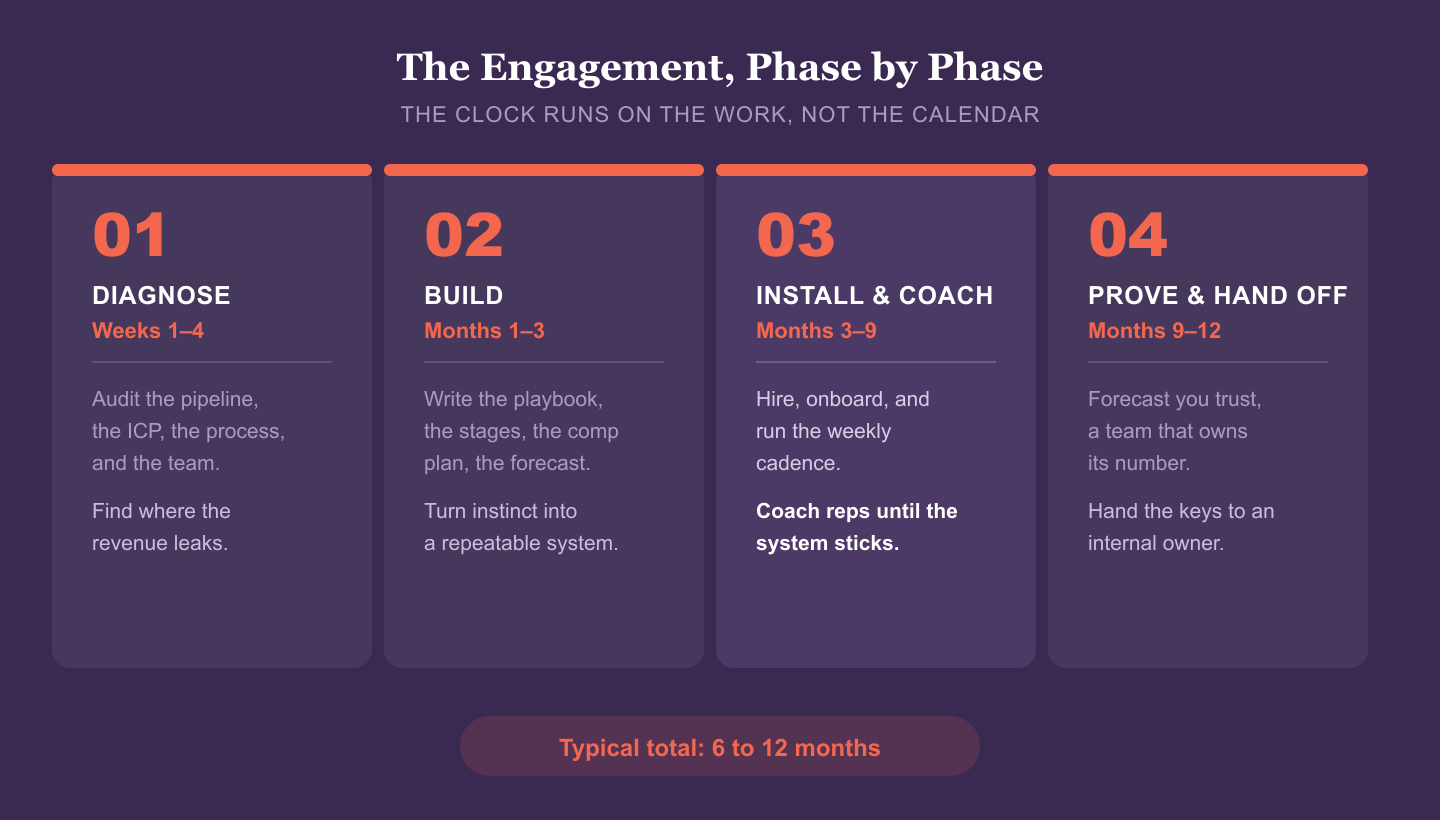
Phase 1: Diagnose (Weeks 1 to 4)
Before I change anything, I look at everything. Your pipeline, your win rates, your ICP, your CRM hygiene, how your deals actually flow, and where they die. Most founders are shocked by what this surfaces. There's almost always a leak nobody had named, a stage where half the deals stall, a "qualified" pipeline that's mostly wishful thinking. You can't fix what you haven't measured, and this month is where we measure it.
Phase 2: Build (Months 1 to 3)
Now we turn your instincts into a system. The sales process with real stages and exit criteria. The playbook, so a new rep can sell the way you sell. The comp plan that pays for the right behavior. The forecast model built on actual pipeline math instead of gut feel. This is the phase that pays for itself later, because a formal sales process is worth an 18% difference in revenue growth (HBR / Vantage Point). Structure isn't bureaucracy. It's the thing that lets someone other than you close a deal.
Phase 3: Install and Coach (Months 3 to 9)
A system on paper changes nothing. This phase is where it becomes how the team actually works. We hire the right people or coach the ones you have, run the weekly pipeline review, and drill the process until it's a habit instead of a document. This is also the phase founders most want to shortcut, and it's the one you can't. A new rep takes 3 to 9 months just to reach full productivity, averaging around 5 (Bridge Group). Coaching them through a real selling cycle is how the system sticks.
Phase 4: Prove and Hand Off (Months 9 to 12)
The last phase is the one that matters most to me: proving the thing works without me, then handing it off. We watch the forecast come in accurate for a few cycles. We confirm the team hits its number when you're not in the room. Then we transition ownership to an internal sales manager, your first real sales leader, or a lighter maintenance rhythm where I check in monthly instead of running the show. When I leave, the system stays. That's the deliverable.
My job is to work myself out of a job. If I've done it right, the day I leave your sales runs better without me than it ever did with you doing all of it yourself.
Why 90 Days Is a Test, Not a Finish Line
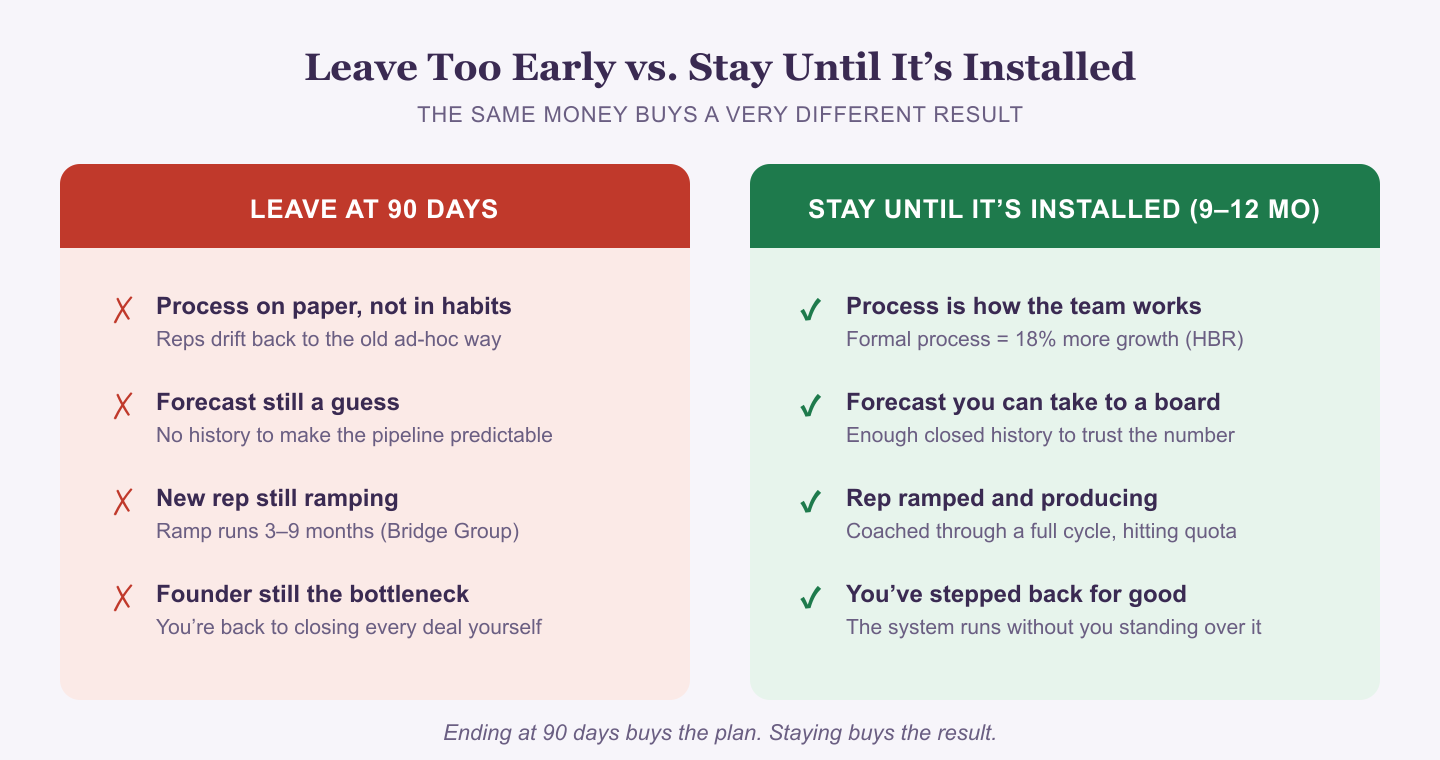
A lot of founders want to start with a 90-day sprint, and I'm all for it. Ninety days is a smart way to reduce risk. It's long enough to prove I can find your leaks, build the core of a process, and show you real movement before you commit further. Start there. Use it to decide whether we work well together.
Just don't confuse the test with the finish line. Ninety days buys you a diagnosis and a plan. It does not buy you a team that runs without you, because the two things that actually free you up, a ramped rep and a forecast built on closed history, both take longer than a quarter to exist. Leave right after the plan is written and you'll watch the team drift back to the old ad-hoc way inside a month. Same money, very different result.
What Determines Your Number: Three Starting Points
Where you start sets the clock. Here's how I'd size three founders who all ask the same question and get three different answers.
You have no system at all
You're doing all the selling. Nothing's written down, the CRM is a contact list, and "the process" lives in your head. This sounds like the longest engagement, and it's often the most satisfying, but not because it's hardest. It's the cleanest. We're not unwinding bad habits or fighting a broken comp plan. We're building good habits from scratch. Expect the full arc, roughly 9 to 12 months, because we're doing all four phases from zero, including your first real hire.
You have some pieces, but nothing connects
You've got a rep or two, a CRM you sort of use, and a process that's more suggestion than standard. The forecast still surprises you. This is the most common starting point, and it usually runs 6 to 9 months. We spend less time building and more time installing, connecting the pieces, tightening the process, and coaching the team you already have into using it.
You're scaling and need a hand on the wheel
You've got a working motion but you're outgrowing it, or a key hire fell through and you need senior leadership while you sort out the permanent answer. These can be the shortest, 3 to 6 months, or they can flex into an ongoing part-time role. Fractional doesn't have to mean temporary. It means the right amount of senior leadership for what you need right now.
If you have no system at all yet, that's not a reason to wait. It's the best time to start. You're not paying me to fix bad habits. You're paying me to build good ones before they calcify.
The Full-Time VP Isn't the "Permanent" Option You Think
Founders sometimes frame the choice as "temporary help versus a permanent hire." I'd push back on that framing, because the full-time option isn't as permanent as it looks. The average VP of Sales at a venture-backed SaaS company lasts about 17 months (Pavilion 2025). You'd be signing up for a $300K-plus all-in commitment (Glassdoor), a months-long search, a ramp for the leader on top of the ramp for the reps, and a real chance they're gone inside two years anyway.
A Fractional Sales Leader inverts that math. You get senior experience immediately, at a fraction of the cost, focused entirely on building the system rather than defending a title. And the exit is a feature, not a failure. In one fractional sales management engagement, I helped a team lift sales 61% year-over-year on a part-time arrangement, then handed the running of it back to the company. That's the model. Build it, prove it, leave it better than you found it.
When a Fractional Sales Leader Is the Wrong Call
I'd rather tell you the truth than take a check that won't work out. There are founders I turn away, and it's usually one of three situations.
- You're pre-product-market fit. If you don't yet know who buys and why, no sales system will save you. You need to nail the product and the message first. A process built on a motion that doesn't exist yet is a waste of both our time.
- You want a closer for hire, not a builder. If what you actually want is someone to just make calls and close your deals for you while nothing else changes, that's not this. I build the machine and teach your people to run it. I'm not a rented pair of hands.
- You're not actually willing to let go. The whole point is to step back. If you're going to override every decision and keep closing every deal yourself, you'll block the system from ever taking hold, and you'll have paid to prove the bottleneck was never the team.
Notice what's not on that list: "you have no sales process or systems." That one's the opposite of a disqualifier. Having nothing in place is exactly when a Fractional Sales Leader earns their keep, because we get to build it right the first time. If that's you, a founder in the $1M to $10M range with a real product and no system behind it, you're not too early. You're right on time. That's the whole reason louiebernstein.com exists: to help founders build the sales system that finally lets them let go, and to leave once it runs without them.
Frequently Asked Questions
Q: How long do most Fractional Sales Leader engagements last?
Most clients renew their 12-week terms for 6 to 12 months total. The exact number depends on where you're starting. Building a system from nothing, including your first hire, tends toward the fuller 9 to 12 months. Tightening and installing a system when you already have some pieces usually runs 6 to 9. Senior cover during a scaling stretch can be as short as 3 to 6. The work sets the length, not a standard contract.
Q: Can we start with a short pilot instead of a long commitment?
Yes, and I recommend it. A 90-day start is a low-risk way to see whether we work well together and to prove I can find your leaks and show real movement. Just go in knowing 90 days delivers a diagnosis and the core of a plan, not a finished, self-running sales team. A ramped rep and a trustworthy forecast both take longer than a quarter to exist. Treat the pilot as the on-ramp, not the destination.
Q: What actually happens when the engagement ends?
We plan the exit from the start. By the final phase, the process, playbook, comp plan, and forecast are all documented and in use, and the team hits its number without me in the room. I hand ownership to an internal sales manager, your first full-time sales leader, or a lighter monthly check-in if you want ongoing eyes on it. The system stays with you. Ending the engagement is the goal, not a breakup.
Q: Isn't hiring a full-time VP of Sales more permanent?
Less than you'd think. The average VP of Sales at a venture-backed SaaS company lasts about 17 months (Pavilion 2025), at more than $300K all-in (Glassdoor), plus a long search and a leadership ramp on top of your reps' ramp. A Fractional Sales Leader gives you senior experience right away at a fraction of the cost, focused on building the system rather than protecting a seat. And the planned exit means you keep the machine even after the person leaves.
Q: We have zero sales process. Does that make the engagement too long, or is it too early?
Neither, as long as you have product-market fit. Starting from nothing is actually the cleanest engagement, because we build good habits instead of unwinding bad ones. Expect the fuller 9-to-12-month arc since we're doing all four phases from zero, including your first hire. The only time "no system" is a problem is if you're still pre-product-market fit. Then you need to nail who buys and why before any process is worth building.
Q: How is a fractional engagement structured week to week?
Typically one to three days a week, scaled to the phase. The Build phase is more hands-on. The Prove and Hand Off phase is lighter by design as the team takes over. You get senior sales leadership embedded in your business without a full-time salary, and the time commitment tapers as the system starts running itself. That taper is the plan working, not the engagement fading out.
Not sure how long you'd actually need?
Give me 30 minutes and I'll look at your pipeline, tell you honestly what needs building, and size the engagement to the work. No package, no guesswork. See how a Fractional Sales Leader can help at louiebernstein.com.
Schedule a 30-Minute CallAbout the Author
Louie Bernstein
Fractional Sales Leader with 50 years of sales experience helping $1M–$10M ARR companies build scalable, repeatable sales systems. Founder of MindIQ (INC 500). LinkedIn Top Voice in Sales Management, Sales Operations, and Sales Coaching.