Yes. A Fractional Sales Leader can train your existing sales team through call reviews, role playing, individual coaching, and a written Sales Playbook. For a B2B founder at $1M to $10M ARR, the goal is reps who handle qualified deals without constant rescue. Start by separating skill gaps from broken processes. Cost should reflect who gets coached, who manages execution, and how much hands-on leadership your team needs.
Key Takeaways
- A Fractional Sales Leader can develop the team you already have; replacing reps should follow a fair diagnosis, not come first.
- Review real calls and deal records before buying training. A missing qualification standard needs a process fix as well as coaching.
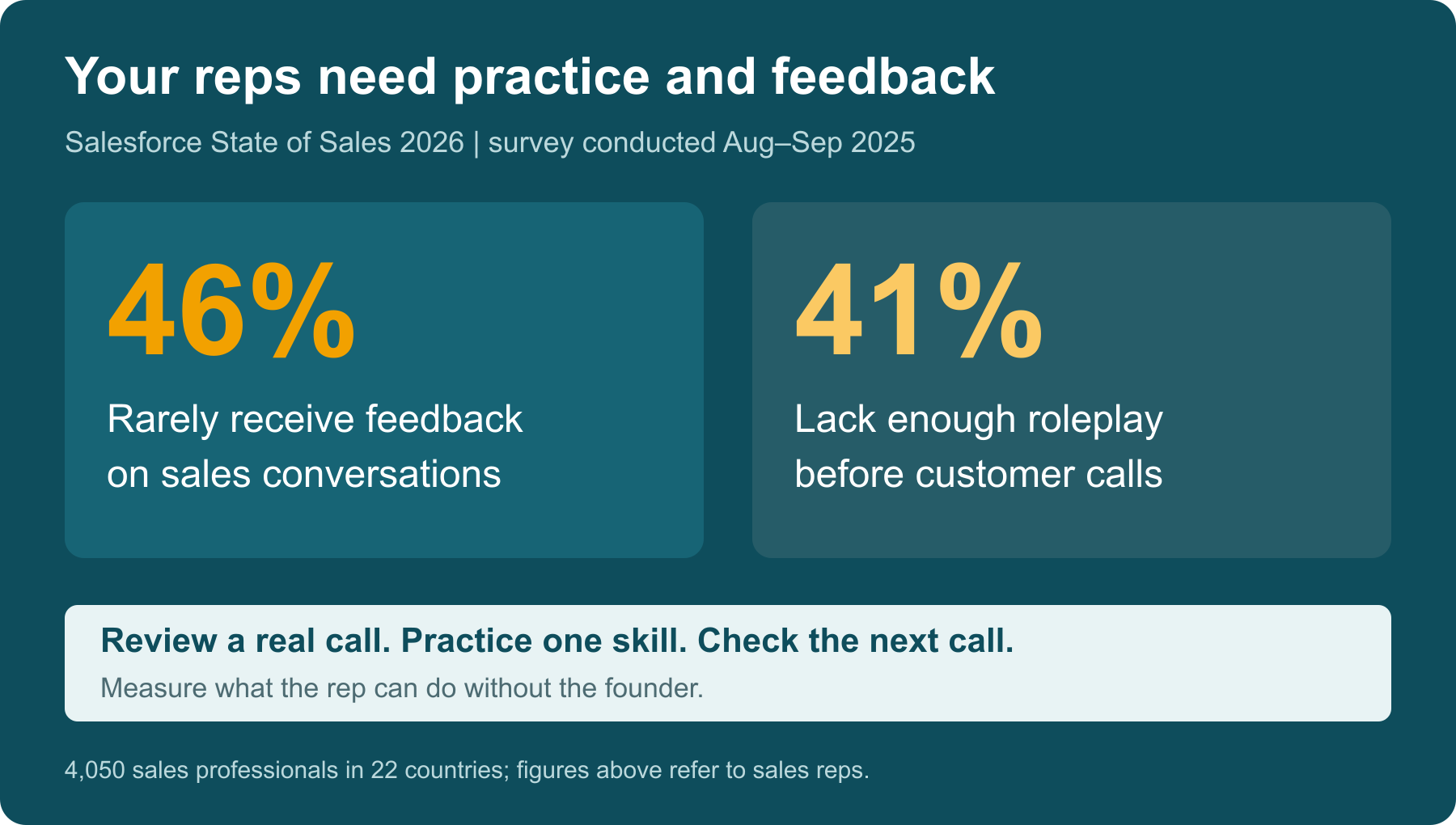
- In Salesforce’s 2026 report, 46% of surveyed reps say they rarely receive feedback on sales conversations. Training attendance alone doesn’t show skill improvement.
- Louie’s $1,400-per-month Founder’s Corner coaches the founder. Hands-on team leadership requires a separate scope and quote.
- Track both the skill being coached and how often the founder must take over. Revenue alone can hide continuing dependence.
You’ve already hired salespeople. They know the product. They work hard. But the important calls still land on your calendar, and the difficult follow-up still lands in your inbox.
Before you spend money on another hire, ask a harder question: have your current reps been taught a sales method they can actually use, or have they mostly watched you sell?
Watching the founder win doesn’t tell a rep which question to ask next. Your team needs a clear standard, a chance to practice, and someone who checks whether the skill shows up with a real buyer.
How do I know whether my existing sales team can improve?
Your existing sales team is worth developing when reps understand your market, accept feedback, and improve with clear instruction. A Fractional Sales Leader should diagnose each rep’s behavior against a written standard before recommending replacement. Missed quota alone doesn’t separate a skill gap from poor leads, unclear expectations, or a broken sales process.
Look at the work before judging the person
Choose a small sample of recent calls and opportunities for each rep. Include won, lost, and stalled deals. Listen for what the buyer actually said. Compare the rep’s notes with the conversation, then check whether the next action had a named owner and a date.
A rep who can explain the customer’s problem but never asks about the buying process needs different coaching from a rep who demos features before understanding the problem. A rep given poor-fit prospects needs a better prospecting target. Giving all three the same closing class wastes money.
Separate skill, system, and willingness
| What you find | What to do first |
|---|---|
| Rep tries but cannot ask useful discovery questions | Model the questions, role play, and review the next call |
| Team disagrees on what makes a deal qualified | Write shared qualification and stage exit criteria |
| Rep understands the standard but repeatedly refuses it | Address accountability and role fit |
| Calls are strong but prospects rarely fit | Fix targeting before changing the sales technique |
Give a willing rep a fair chance to practice the right behavior before deciding the person is wrong for the role. Fair doesn’t mean endless. Put the expectation, support, review date, and evidence in writing so nobody has to guess what improvement means.
What would a Fractional Sales Leader actually teach my team?
A Fractional Sales Leader should teach the skills your reps need to move qualified buyers through your sales process: discovery, qualification, relevant demos, objections, next steps, and CRM discipline. Coaching should use your actual product and buyers. Generic sales advice won’t help a founder step back unless reps can apply the advice independently.
Use buyer conversations, not just course material
Salesforce’s 2026 State of Sales report found that 46% of surveyed reps rarely receive feedback on sales conversations, while 41% lack enough opportunities to role play before customer calls (Salesforce, p. 25). The report surveyed 4,050 sales professionals across 22 countries in August and September 2025. These are reported experiences, not proof that coaching causes a particular revenue lift.
For your team, make the exercise specific. Have a rep practice responding to a buyer who says, ‘Just send me pricing.’ The rep should learn to ask enough about the problem and buying process to determine whether a proposal makes sense. Practice the follow-up question too, because the first answer rarely tells the whole story.
Turn the best response into a usable Sales Playbook
Document the discovery questions, qualification rules, stage exit criteria, objection examples, and follow-up standards your team will use. A Sales Playbook should help a rep prepare for the next conversation. Start with the parts that remove the most confusion, then improve the document from actual calls.
CRM training belongs here too. A rep should record the buyer’s evidence, not just ‘good meeting.’ If an opportunity advances, the record should explain why. Accurate notes let a leader coach the work without making you sit through every conversation.
What have I learned about training teams without becoming their closer?
Training a sales team works when the leader teaches reps how to make decisions instead of taking every difficult deal away from them. In my work on founder-led sales, the goal is a system the team can run. If the founder or Fractional Sales Leader remains the permanent closer, the dependence has simply changed hands.
What I’ve seen in founder-led sales
In my writing on sales processes, I describe the gap between a founder’s instincts and a method another person can learn. The founder knows the market, recognizes a weak answer, and changes direction without thinking. A rep sees the finished conversation but misses the decisions underneath. Copying the founder’s words doesn’t reproduce the founder’s judgment.
That’s why I want the rep explaining the next move. What did the buyer confirm? What’s still unknown? Why is a demo the right next step? A confident answer without evidence isn’t enough. Teach the rep to connect a decision to something the customer said or did.
If I take over every difficult conversation, your team learns when to call me. I want your team learning how to handle the conversation.
Keep a record of founder rescues
My practical suggestion is to record when you step into a deal and why. Was your involvement needed for an executive relationship, technical authority, a pricing exception, or a skill the rep should own? Those reasons shouldn’t be treated as the same problem.
Keep legitimate founder involvement where your authority helps. Coach the avoidable rescues. When a rep asks you to write the follow-up, have the rep draft it first and explain the intended outcome. Review the reasoning, let the rep send the message, and check what happened. The learning stays with the person who needs it.
And how much will it cost?
The cost depends on whether you need founder coaching or someone directly leading and training your sales team. My Founder’s Corner is published at $1,400 per month with a twelve-week minimum; hands-on Fractional Sales Leadership needs a separate quote. Compare written responsibilities, individual coaching coverage, and execution ownership before comparing monthly fees.
Don’t confuse founder coaching with team management
The Founder’s Corner helps you build the system and learn to run it. The published offer lists $350 per session and distinguishes the program from embedded team leadership. Those prices were checked on October 5, 2026. Don’t assume a founder-coaching fee includes direct coaching of every rep, weekly pipeline management, and call reviews.
For a public comparison, Sales Manager Now lists $4,400 per month for one to three B2B reps and $4,900 for four to five reps, checked October 5, 2026 (provider pricing). That’s one provider’s sales-management offer, not a market average or my price. Extra planning meetings can cost more. Ask what the fee includes for your team.
Ask what you’ll have when the engagement ends
A useful proposal identifies who reviews calls, how often each rep gets coached, which Sales Playbook sections get built, who runs pipeline meetings, and what the founder must do. Request an Accountabilities Document so ‘train the team’ becomes a set of responsibilities rather than a promise everyone interprets differently.
Include your reps’ practice time and your own review time in the budget. A cheap session that nobody applies is expensive. A larger engagement can be poor value too if the leader spends the whole month rescuing deals and leaves no repeatable method behind.
Use gross profit to check the economics. In a hypothetical example, an engagement costing $5,000 a month needs $10,000 in incremental monthly revenue at a 50% gross margin to cover the fee before other costs. That’s arithmetic, not a forecast. Don’t assume training will generate the extra revenue, and don’t count deals you would have won anyway.
How should I measure progress before committing to more training?
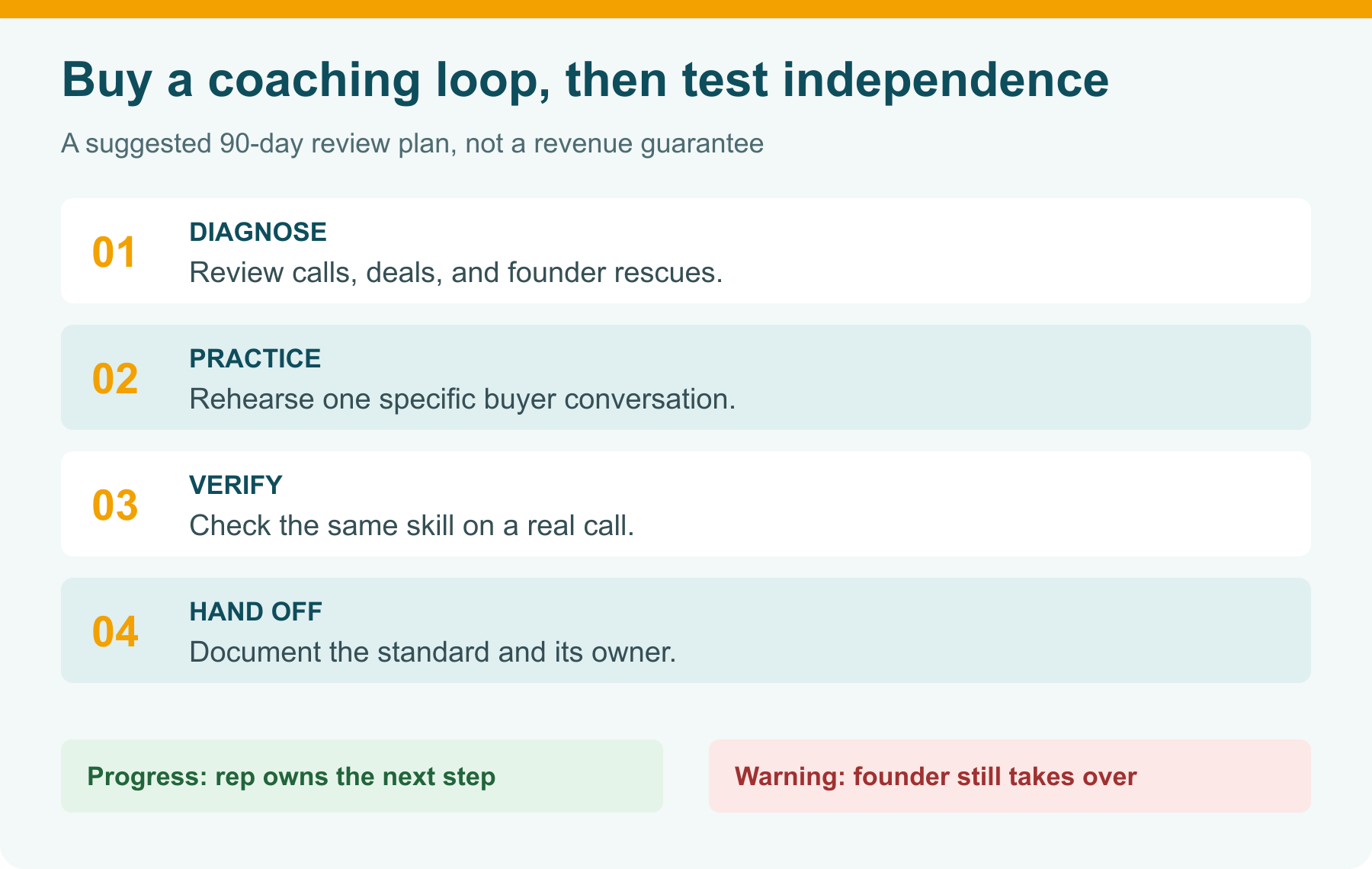
Measure training progress through observable selling behavior, movement of comparable qualified deals, and fewer avoidable founder rescues. Agree on the starting point before coaching begins. A suggested thirty-, sixty-, and ninety-day review plan helps you check implementation and independence, but closed revenue may take longer to reflect improvement when your sales cycle is long.
Start with one skill and a baseline
Pick a skill tied to a real bottleneck. If discovery calls end without a clear buyer commitment, measure how often qualified calls produce a buyer-agreed next step. Write the definition first. A rep sending a calendar invitation isn’t the same as a buyer accepting the next step.
Use counts alongside percentages. Three successes out of four calls looks impressive as a percentage but tells you little about a durable change. Compare the same type of prospect, deal size, and sales stage where possible. Better leads or a founder joining every call can improve results without proving the rep learned the skill.
Use review dates to make a decision
- By day 30: Check that the standard is written, coaching happens, and reps have practiced the chosen skill.
- By day 60: Review fresh calls for the same behavior. Identify who improves and who needs a different approach.
- By day 90: Compare deal movement, rep ownership, and founder involvement. Decide whether to continue, change the scope, or address role fit.
These are suggested checkpoints, not research benchmarks or promised results. If your sales cycle takes six months, don’t judge the entire program on new bookings after four weeks. But don’t accept a long sales cycle as an excuse for missing practice, incomplete notes, or unchanged call behavior.
When is training the wrong answer for my sales team?
Training is the wrong primary answer when your team lacks viable buyers, a sellable offer, or willingness to follow agreed standards. Coaching can improve how reps sell; coaching can’t create product-market fit or fix a refusal to do the work. A founder without sales systems can still benefit if the engagement builds those systems alongside training.
Fix the constraint that actually blocks improvement
No documented process is a reason to build one, not a reason to give up. Start with your customer profile, qualification questions, and the evidence needed to advance a deal. Teaching those standards while building them can help your existing team become more consistent.
A team that needs daily supervision requires daily coverage. Ask who provides that coverage between the Fractional Sales Leader’s working days. Don’t buy a few coaching hours and assume you’ve hired a full-time manager. Match the engagement to the responsibility you actually need someone to carry.
And don’t keep paying for instruction when the real issue is repeated refusal. Once expectations, support, and a fair review period are clear, make the role decision. Your existing team deserves a real opportunity to improve. Your company also needs people who will use the opportunity.
Frequently Asked Questions
Can remote sales reps be coached effectively?
Yes. Remote reps can practice through video role playing and review recorded calls with a leader. Agree on how calls are selected, how feedback is delivered, and how the next conversation will be checked. Being remote doesn’t remove the need for live practice.
Will my experienced reps have to use a rigid script?
No. A Sales Playbook should define the information reps need and the standards they must meet while allowing natural conversation. Experienced reps can contribute examples and better questions. Consistent qualification matters more than identical wording.
Can we start without buying another sales tool?
Yes. Start with your existing CRM, a shared coaching record, and calls you can review appropriately. Buy additional tools only when a specific coaching or reporting need justifies the expense. Software doesn’t substitute for a clear standard and someone who teaches it.
Who owns the Sales Playbook after the engagement?
Your company should retain the agreed company-specific playbook, coaching records, and process documentation. Confirm ownership and permitted use in the engagement agreement, including any limits on the leader’s pre-existing materials. Name an internal owner to keep the documents current.
Should individual coaching scores be shared with the entire team?
Keep individual coaching feedback private unless there’s a clear, agreed reason to share it. Teach useful patterns in team sessions without embarrassing the rep whose call exposed the gap. Reps need room to admit uncertainty and practice before facing a buyer.
Find out what your current team needs
If you’re a B2B founder at $1M to $10M ARR still carrying the important deals, let’s review where your reps get stuck. I’ll help you distinguish a coaching need from a process or management need, then discuss a scope that fits.
Learn about Fractional Sales Leadership.
Schedule a 30-Minute CallAbout the Author
Louie Bernstein
Louie Bernstein is a Fractional Sales Leader with 50 years of sales experience. He founded and ran MindIQ and helps B2B founders build Sales Playbooks, improve sales processes, and coach teams toward greater independence.