Key Takeaways:
- 85% of small-business owners work while on vacation, and only 14% ever fully unplug (Xero). If you can't leave for a week, you can't leave for 30 days.
- The 30-day test is simple: if you disappeared for a month, what happens to the business? The honest answer tells you exactly how dependent it is on you.
- The part that fails first is almost always sales, because in a founder-led company the pipeline runs entirely through one person: you.
- Failing the test isn't a scheduling problem. It's the founder-dependency discount showing up in your life instead of on a term sheet.
- The real acid test of a sellable business is that it runs without the owner for 12 weeks (John Warrillow). Thirty days is where you start.
- The goal isn't to disappear. It's to make your presence a choice, not a requirement, so you own a company instead of a job.
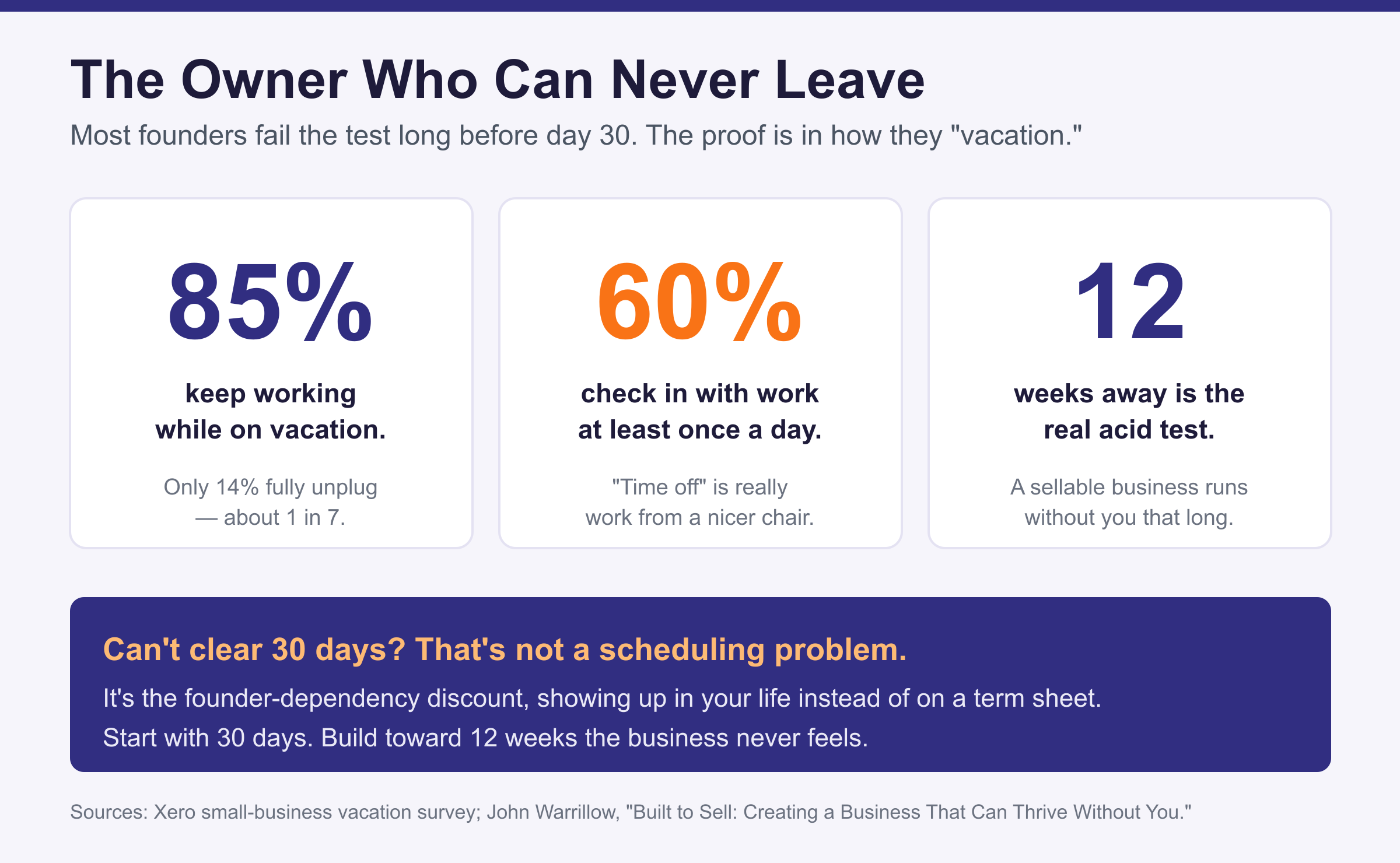
Here's a number that says more about your company than your revenue does: 85% of small-business owners work while they're on vacation, and only 14% ever fully unplug (Xero). Most owners can't get through a long weekend without checking in, let alone a month.
So let's run a test that cuts through everything. If you vanished for 30 days, no email, no calls, no "quick question" texts, what would your business look like when you got back? Not "would it be hard." Would revenue keep moving? Would deals keep closing? Would your biggest account still feel taken care of?
I ask founders this all the time, and the flinch is always the same, because they already know the answer. I know it too. I ran a company I bootstrapped for 22 years, and for a long stretch I couldn't have left for 30 hours, never mind 30 days. Let me show you what that test is really measuring, and how to pass it.
The Test Most Founders Fail Without Realizing It
Most founders think they've "taken time off" because they physically left the building. But look at what actually happens. According to Xero's research, 60% of owners check in with work at least once a day even while on vacation. That's not time off. That's work from a nicer chair.
The reason you can't stop checking in isn't discipline. It's that the business genuinely can't run the plays without you, so staying reachable is rational. Every "quick check" is your gut telling you the truth: something important would break if you looked away. The 30-day test just makes that truth impossible to ignore.
Why 30 Days Is the Number That Matters
A weekend proves nothing, anyone can let a few emails pile up. But 30 days is long enough that every weak point in the business surfaces. A full sales cycle turns over. Deals reach decision points. A big customer needs something. Thirty days is where "I'm important to this business" and "this business cannot function without me" finally separate into two different facts.
Watch what breaks first
In almost every founder-led company, the first thing to break is sales. Operations limp along. Support answers tickets. But new pipeline dries up, live deals stall waiting for your sign-off, and your marquee relationships get nervous, because all of that was routed through you. That's not a coincidence. It's the single most concentrated dependency in your business, and it sits directly on top of your revenue.
Thirty days is the on-ramp, not the finish line
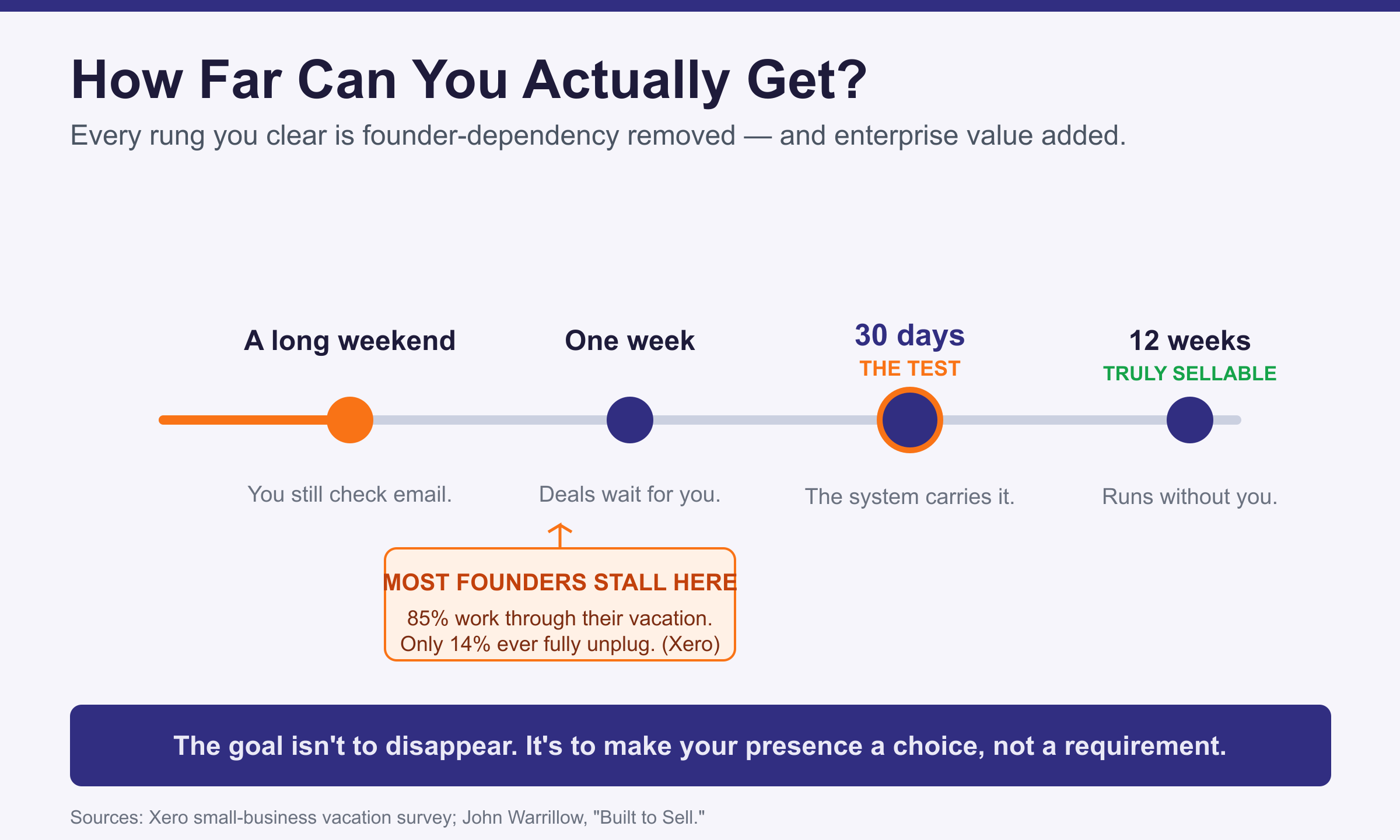
In Built to Sell, John Warrillow argues that the real acid test of a valuable business is whether the owner can step away for a full 12 weeks without the business suffering. Twelve weeks sounds impossible from where most founders sit, and that's the point. You don't start there. You start with 30 days, find every hole, plug it, and build up. Each rung you clear is dependency you've permanently removed.
What Failing the Test Is Really Costing You
Failing the 30-day test isn't just inconvenient. It's expensive in two directions at once. The obvious cost is your life: no real vacation, no true sick day, no space to think about anything but this month's number. The hidden cost is your net worth. A business that can't run without you carries a founder-dependency discount, and when you eventually try to sell, that discount gets very real. I broke down the exact numbers in what your company is worth if it can't run without you, but the short version is this: owner-dependent companies routinely sell for 30% to 50% less than independent peers.
The 30-day test measures the same thing a buyer measures. You're just getting the result early enough to do something about it.
That's the reframe. The test isn't a guilt trip about work-life balance. It's a free, early preview of the exact assessment an acquirer will run on you someday, delivered while you still have years to change the answer.
How to Pass the Test
You pass the 30-day test the same way you'd pass it if it were a fire drill: by fixing what breaks before the real thing happens. Since sales breaks first, that's where you start.
1. Get the sales process out of your head
The reason the pipeline stops when you leave is that the operating manual for winning deals lives only in your instincts. Record your calls. Write down how you qualify, how you handle the hard objection, how you know a deal is real. That document is what keeps deals moving while you're gone.
2. Hand off in order, least attached first
Let go of lead generation and qualifying first, then discovery and demos, and keep your closes and key relationships for last, introduced deliberately, not dropped. I lay out the full sequence in the article on getting out of the bottleneck. Do a mini version first: hand off one stage, then take a real week off and see what holds.
3. Replace your presence with reporting
You don't stay in control by sitting in every meeting. You stay in control with a dashboard that tells you the truth: pipeline created, deals advanced, forecast. When you can see the health of the business on one screen, you stop needing to be in the room, and 30 days away stops feeling like a cliff.
Fear of letting go is really the fear that it'll fall apart without you. The 30-day test turns that fear into a checklist. Everything that breaks is just the next thing to fix.
None of this requires the full-time VP of Sales you're probably not ready for at $1M to $10M ARR. It requires someone who has built a self-running sales motion before to install it and hand it back to you. That's exactly what a Fractional Sales Leader does: build the system that lets you leave, and lets the company keep winning while you're gone.
Frequently Asked Questions
Q: What exactly is the 30-day test?
It's a simple diagnostic: imagine you completely disappear from your business for 30 days, no email, no calls, no decisions, and ask what happens to revenue, deals, and customers while you're gone. It's not about whether you can afford the time. It's about whether the business can function without you. The honest answer measures your founder dependency more accurately than any spreadsheet, because it tests the whole system at once instead of one process in isolation.
Q: Isn't it normal for a founder to be deeply involved in their business?
Involved, yes. Load-bearing, no. There's a difference between being important to your business and being the single point of failure it can't survive without. The data shows how common the problem is: 85% of owners work through their vacations and only 14% fully unplug (Xero). Common doesn't mean healthy. A business that requires your daily presence isn't a sign of dedication, it's a structural risk, both to your health now and to your company's value later.
Q: Why does sales break first when the founder steps away?
Because in a founder-led company, sales is the most concentrated dependency you have. You qualify by instinct, you handle objections by feel, you hold the key relationships personally, and none of it is written down. Operations and support usually have some documented routine to fall back on. Your sales motion often has nothing but you. So when you leave, new pipeline stops and live deals stall. It also happens to be the dependency that most directly caps your company's value, which is why it's the first thing worth fixing.
Q: I can't just leave for 30 days to run the test. Do I have to actually do it?
No, and you shouldn't start there. Run it as a thought experiment first: go process by process and ask what breaks in week one, week two, and beyond. Then test it for real in small doses. Take a genuine long weekend with notifications off and note what piled up. Build to a real week. Each attempt exposes the next hole to plug. The 30 days is the milestone you build toward, not a stunt you pull cold. The value is in the fixing, not the disappearing.
Q: How is this connected to what my business is worth?
Directly. The 30-day test measures the same thing an acquirer measures: can this revenue continue without the owner? Businesses that can't run without their owner sell for 30% to 50% less than independent peers, and owner dependence is one of the top reasons deals fall apart in diligence. Passing the test and raising your valuation are the same project. The difference is that the test gives you the result years early, while you still have time to change it.
Q: Where do I start if I'm at a few million in ARR and closing most deals myself?
Start with sales, because it breaks first. Record your next ten calls and codify how you qualify, run discovery, and close, then hand off the top of the funnel and work down toward closing. Replace your presence with a simple reporting dashboard so you can stay in control without being in the room. If you want that installed quickly and correctly, a Fractional Sales Leader builds the whole self-running motion part-time, without the cost or commitment of a full-time VP of Sales you likely don't need yet.
Right now, could you leave for 30 days?
If the honest answer is no, and sales is the reason, that's the exact problem I help founders between $1M and $10M ARR solve. Let's spend 30 minutes finding what would break first if you stepped away, and mapping how to fix it, so your presence becomes a choice instead of a requirement. If a real sales system won't move the needle for you, I'll tell you that too.
Schedule a 30-Minute CallAbout the Author
Louie Bernstein
Fractional Sales Leader with 50 years of sales experience helping $1M–$10M ARR companies build scalable, repeatable sales systems. Founder of MindIQ (INC 500). LinkedIn Top Voice in Sales Management, Sales Operations, and Sales Coaching.