Key Takeaways:
- Existing customers deserve a place in your growth plan, with an owner and time on the calendar.
- Compare selling cost per dollar of added ARR, not just the number of deals closed.
- A happy customer is a starting point. A confirmed new need makes an expansion worth pursuing.
- Calculate account potential separately from qualified pipeline and signed revenue.
- Include delivery costs and founder hours before calling any revenue easy.
- Build the process so your team can earn the next sale without handing every account back to you.
You spend Tuesday trying to reach a stranger who might need what you sell. On Wednesday, a customer who already trusts your team opens another location. Nobody calls them.
The new prospect has a salesperson, a sequence, and a place in your pipeline review. The existing customer has a renewal date. That difference can leave good business sitting untouched.
If you're a B2B founder at $1M to $10M ARR, you can't chase every opportunity yourself. You need to decide which opportunities deserve your team's next hour. Some of the best candidates may already be paying you.
That doesn't make expansion automatic or every account profitable to grow. It means your current base deserves the same attention you give new leads. Start by looking at the economics, then check what customers actually need.
The next sale may be easier to earn because you kept the promises from the first one.
1. Compare the cost of your next revenue dollar
Use a fair comparison
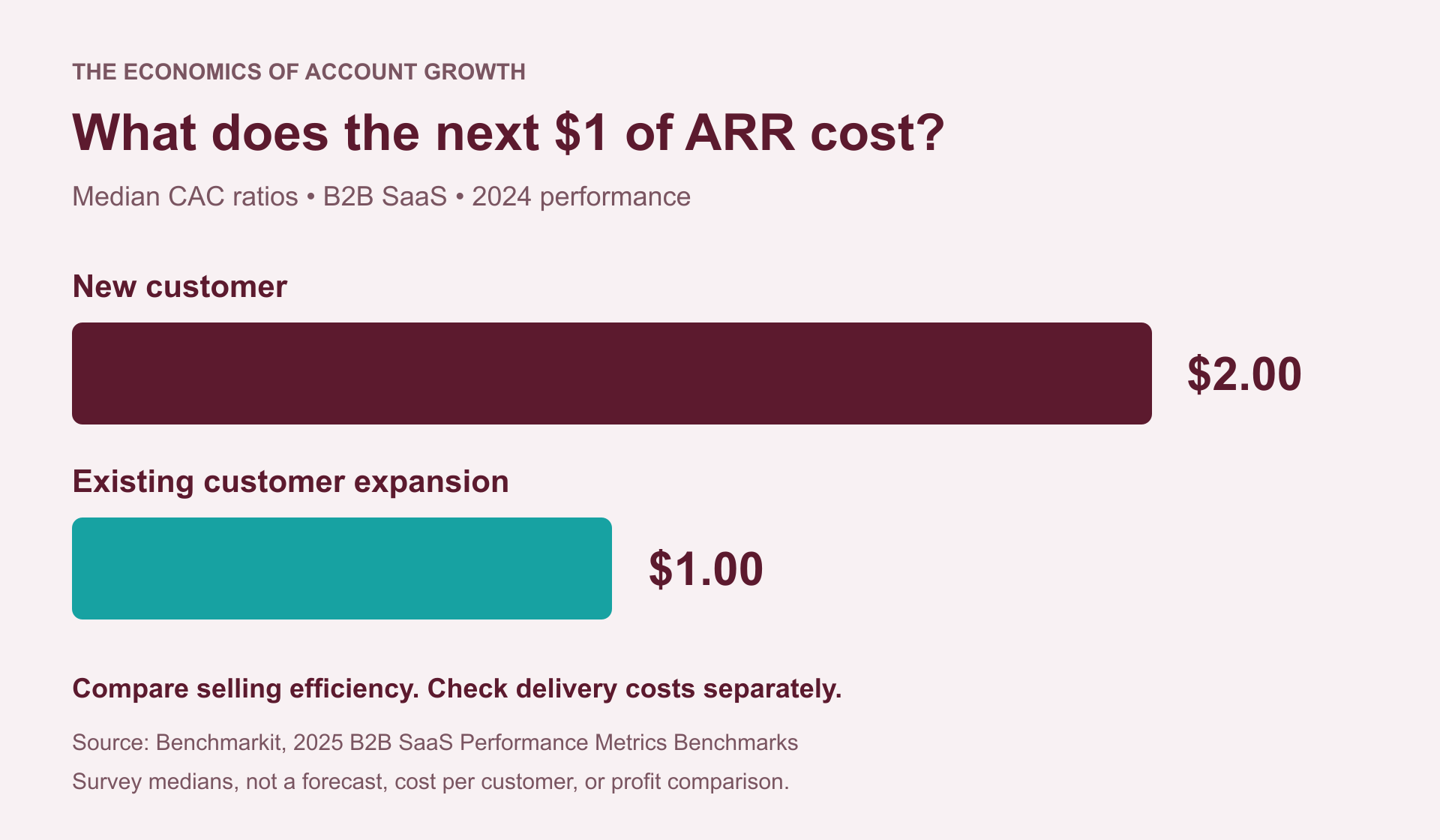
Benchmarkit's 2025 B2B SaaS report, reporting 2024 performance, gives a median new-customer CAC ratio of $2.00 and an expansion CAC ratio of $1.00. These ratios compare selling costs with added annual recurring revenue. They aren't the dollar cost of acquiring one customer.
The survey gives you a reason to investigate your own numbers. It doesn't prove your expansion work will cost half as much. Your contract size, offer, account health, and sales process affect the result.
For an internal comparison, divide the sales and marketing costs assigned to each sales motion by the ARR it produces. Use the same period and consistent cost rules. Include salaries, commissions, programs, and a reasonable allocation of shared work. If sales cycles are long, review several periods instead of judging one month.
Don't hide account-selling time inside customer support and then call expansion free. Ask whoever owns your numbers to separate retention work from expansion selling as far as the records allow. Document estimates when the data isn't clean.
Trust can remove work, but scope can add it back
An existing customer may already know your product, trust your delivery, and have an approved supplier agreement. You may spend less time proving your company belongs in the conversation.
But selling to another department can involve a new buyer, budget, security review, and rollout. Familiar company name. Different sale. Count the work before deciding which opportunity is easier.
Also separate selling efficiency from gross margin. A low-cost sale that requires custom delivery can consume more resources than it brings in. Look at both the cost to win and the cost to serve.
2. Find out why your team keeps overlooking existing accounts
Inspect what gets attention and credit
Look at last week's sales meeting. How much time went to new prospects? How much went to customer needs beyond the current contract? If expansion only comes up when someone volunteers a story, you haven't given it a process.
Then inspect ownership. Sales may think delivery owns the relationship. Delivery may think sales owns anything involving price. The founder gets copied on an email and becomes the account manager again.
Put one commercial owner in the Accountabilities Document. State who investigates a need, who brings in delivery, and who asks for the next commitment. Agree on how expansion credit works before two people start competing over the same account.
Give account work a defined place in the week
You don't need to create a customer-success department to start. You do need to make room in someone's workload. Assigning account growth on top of a full new-business quota without changing priorities invites neglect.
Start with a small review your current team can maintain. Pick five accounts, check the evidence, and assign the next conversation. Five is a manageable starting point, not an industry standard.
Ask the owner to bring one fact and one unanswered question per account. A fact might be that the customer added a location. The question is whether that location has a problem your offer can solve. That is more useful than writing "upsell potential" in the CRM.
3. Do the math on the revenue your base could support
Build from accounts, not a percentage you hope to hit
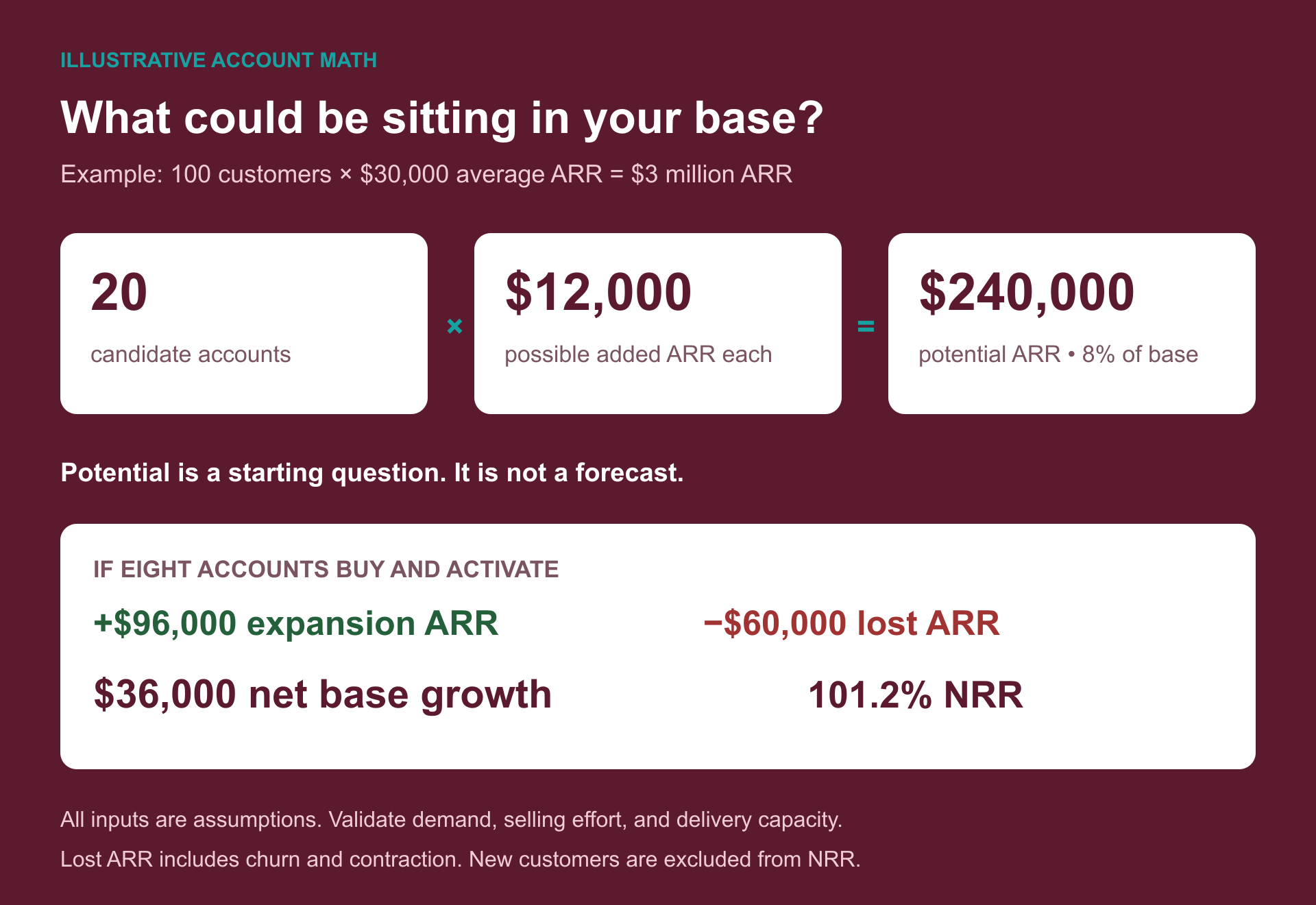
Suppose you run a hypothetical $3 million ARR business with 100 customers paying an average of $30,000 a year. Your team identifies 20 accounts where added users, a second location, or another service might fit.
Assume each of those accounts could add $12,000 in annual recurring revenue. The arithmetic is 20 times $12,000, or $240,000 in possible expansion ARR. That's 8% of the starting base. These are planning assumptions, not a typical result or a forecast.
Now test the assumptions. Does each account have a real new need? Does your current offer fit? Can the buyer fund it? Can your team deliver it? Some candidates will disappear once you ask.
Keep potential, pipeline, and revenue separate
The $240,000 belongs in an account-planning exercise. It doesn't belong in the committed forecast. Create a qualified opportunity only when the customer confirms a need and agrees to explore a next step.
For a second scenario, assume eight of those accounts eventually sign and activate the $12,000 annual increase. That adds $96,000 ARR. Eight wins are an assumption for this example, not a predicted close rate.
If the same starting customer base loses $60,000 ARR through churn and contraction during that period, its net increase is $36,000. Ending ARR from that cohort is $3,036,000. Divide by the starting $3 million and net revenue retention is 101.2%. New customers don't enter this calculation.
Your retention work still matters. Expansion can conceal losses if you only look at the combined number. Review churn and contraction separately so a few growing accounts don't hide a wider customer problem.
Check the capacity behind the number
Before you celebrate the $96,000, ask what it takes to deliver. Additional onboarding, support, software costs, and service hours all belong in the decision. An annualized run rate also isn't the cash you'll necessarily collect this year.
If added scope starts halfway through the year, don't treat its full annual amount as current-year recognized revenue. Keep ARR, bookings, cash, and recognized revenue in their own columns. Use your finance team's recognition rules.
The useful output is a short list of accounts worth investigating, with enough financial detail to rank them. A large theoretical number without a next action won't change your revenue.
4. Spend the next selling hour where the evidence is strongest
Compare specific opportunities
You don't need to choose between all expansion and all new business. Compare the real opportunities in front of you. One satisfied customer may have no room to grow. One new prospect may have a funded, urgent need.
For each serious opportunity, write down the added recurring revenue, remaining selling work, delivery burden, customer timing, and access to the decision maker. Add the founder's expected involvement. Your hours are limited even when they don't appear as an expense on the deal.
Suppose two opportunities each offer $12,000 in added ARR. One requires a standard rollout with an existing buyer. The other requires a custom proof of concept and six founder meetings. Those facts deserve attention before the team treats the deals as equal.
Don't invent a precise probability just to make a spreadsheet rank them. Mark missing evidence and assign the conversation that will resolve it. A buyer-confirmed deadline is more useful than an optimistic percentage.
Protect the relationship and the margin
Pause the expansion pitch when the original purchase isn't delivering the promised result. Ask what is missing and fix what you owe. Don't charge the customer more to complete the work they already bought.
Avoid broad discounts designed to create an easy yes. They can add scope without adding enough revenue to support it. Have delivery review unusual promises before the proposal goes out.
Also check concentration. If one customer already accounts for a large share of revenue, growing that account may increase your exposure. Keep building new relationships while you develop the base you have.
Easy revenue still needs a customer problem, a buying decision, and a delivery plan.
5. Turn the opportunity into work your team owns
Start with a customer conversation
Have the account owner ask three questions: What has improved since we started? What has changed in your business? Where is the next problem you need to solve?
Those questions should lead to discovery, not an automatic upgrade pitch. If another department has the need, ask to speak with its owner. Your existing contact may help with an introduction, but can't confirm someone else's budget.
Role play the conversation before the rep makes the call. Teach them to ask for evidence and a next step. Taking over because you know the customer better gives you another deal to manage and leaves the rep where they started.
Review progress through customer actions
Add a short expansion review to the weekly sales meeting. Keep unconfirmed ideas on account records. Move opportunities when the customer confirms the need, explains the buying process, reviews scope, and agrees to a decision step.
Record only the proposed increase as expansion pipeline. A $30,000 customer considering another $12,000 represents a $12,000 expansion opportunity, not a $42,000 one.
Track qualified opportunities, added ARR won, selling cost, and delivery effort. Track founder hours too. If every expansion still requires your personal involvement, the process needs more coaching or clearer decision rights.
At the end of the first month, review what you learned. Which signals led to real needs? Which offers fit without custom work? Where did the rep need help? Put the answers in the Sales Playbook and give the team the next group of accounts.
You don't need another impressive list of possible revenue. You need a repeatable way to earn it while your team gets stronger.
Related Reading
Frequently Asked Questions
Q: Is expanding an existing customer always cheaper than acquiring a new one?
No. An existing relationship can reduce selling work, but a new department, custom rollout, or difficult approval process can add it back. Compare your own selling costs per dollar of added ARR and check delivery costs separately.
Q: How do I estimate the expansion revenue in my customer base?
List accounts with a plausible new need, estimate the annual recurring increase for each, and document the assumptions. Add those amounts to estimate potential. Keep that separate from qualified pipeline until the customers confirm their needs and agree to explore next steps.
Q: Who should own expansion in a small B2B company?
Name one commercial owner with time to do the work. Delivery or support can identify signals and help validate scope. The owner coordinates discovery, proposals, and follow-through. Write the duties and escalation rules in the Accountabilities Document.
Q: Does a renewal count as expansion revenue?
A renewal at the same recurring price preserves revenue. Only the recurring increase counts as expansion. A longer contract at the same annual price doesn't increase ARR. Separate recurring changes from one-time fees and avoid counting the existing contract again.
Q: Should I stop prospecting while I build an expansion process?
No. Your current accounts have limits, and customer concentration matters. Give expansion a defined share of attention, then adjust based on qualified demand, economics, and delivery capacity. Keep new business and account growth visible as separate parts of the plan.
Build a growth process your team can run.
If every account opportunity still lands on your calendar, Fractional Sales Leadership may help you define ownership, build the Sales Playbook, and coach your team. Learn how I work at LouieBernstein.com.
Schedule a 30-Minute CallAbout the Author
Louie Bernstein
Louie Bernstein is a Fractional Sales Leader who helps B2B founders at $1M to $10M ARR build repeatable sales systems, develop their teams, and reduce founder dependence.