Which founder behaviors quietly cause those failures?
The first sales hire usually fails in one of five ways: the rep lives off the founder's leads and never builds pipeline, can't close without the founder on the call, chases the wrong buyers, stays busy while deals stall, or quits over expectations that keep moving. Each failure traces back to a founder behavior and a missing document. Write the documents before you hire, and most of these failures never start.
Key Takeaways
- The five most common first sales hire failures are the borrowed-pipeline stall, founder dependency, the wrong-buyer pipeline, the busy-but-stuck CRM, and the moving-target exit.
- Each failure has a founder behavior behind it: handing over warm leads, rescuing deals, never writing down the ICP, checking in with "how's it going?", and making verbal promises about comp and territory.
- Average AE ramp is now 6.2 months, and only 48% of reps hit quota (Bridge Group, 2026, 158 B2B companies). A founder who judges the first hire at month three is judging an unfinished ramp.
- Before the first sales hire starts, write five documents: an Accountabilities Document, deal decision rules, a written ICP with qualification criteria, stage exit criteria with a weekly review agenda, and a signed comp plan with a six-month scorecard.
- To tell a rep problem from a founder problem, ask one question: was the standard the rep missed ever written down? If it wasn't, the failure started with you.
Most founders I talk to can tell me exactly when their first sales hire stopped working. Very few can tell me why. They say "wrong fit" or "couldn't close," and then they go hire the next person into the same seat with the same setup.
A failed first hire isn't random. It follows one of five patterns, and you can usually see which one by month four if you know what to look for. The hard part is that every one of the five has a founder fingerprint on it.
Your first sales hire doesn't fail on the day they quit. They fail the first week you hand them your leads and no written standard.
I've written before about why first sales hires fail as a group: they get hired into a vacuum with no playbook, no pipeline and no process. This article is the autopsy. It names the five ways the failure actually shows up, the founder behavior that causes each one, and the document that prevents it.
What are the five most common ways a first sales hire fails?
The five most common ways a first sales hire fails are the borrowed-pipeline stall, founder dependency, the wrong-buyer pipeline, the busy-but-stuck CRM, and the moving-target exit. They show up at different points in the first nine months, so a founder can spot the pattern early instead of finding out at the exit interview.
The timing matters because ramp is slow and getting slower. The average ramp time for account executives hit 6.2 months in 2026, the highest in the study's history, and 48% of reps hit quota, down from 51% in 2024 (Bridge Group, 2026). Those numbers come from companies that already have sales leadership in place. A first hire with no manager and no documents starts behind them.
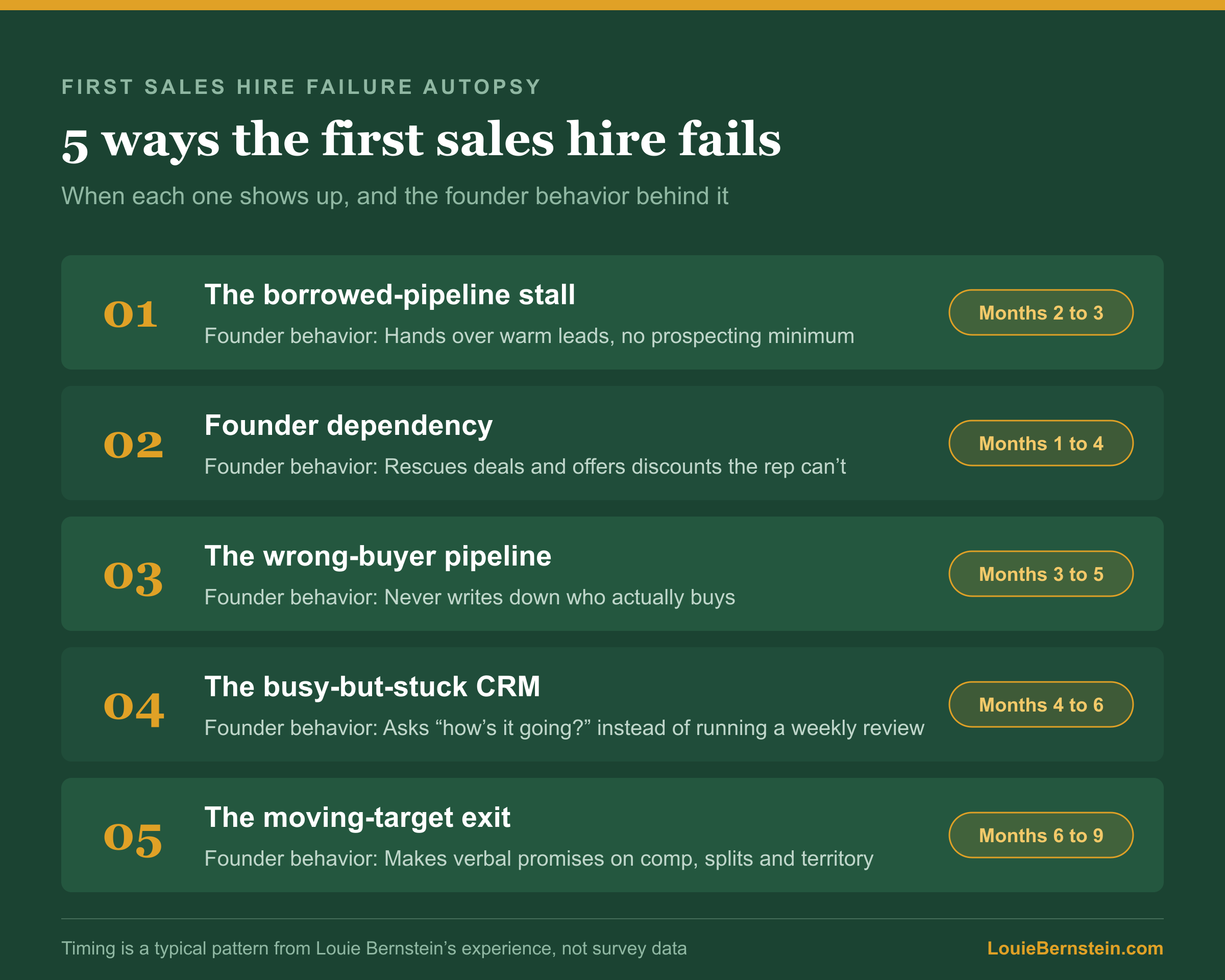
Which founder behaviors quietly cause each failure?
Founder behaviors cause first sales hire failures when the founder keeps selling the old way while expecting the new hire to sell a new way. Each of the five failures below has a specific founder habit behind it. None of these habits feels like a mistake at the time, which is why they're so hard to catch.
1. The borrowed-pipeline stall (shows up in months 2 to 3)
The founder hands the new rep a list of warm leads, old contacts and "people who were interested last year." The rep's first 60 days look great. Then the warm list runs dry, the calendar empties, and the rep has never once built pipeline from scratch at your company. The founder behavior: treating your network as the rep's pipeline and never writing down a prospecting expectation. The rep wasn't lazy. Nobody told them prospecting was the job.
2. Founder dependency (shows up in months 1 to 4)
The rep books the meetings, but deals only close when the founder joins the call. Buyers learn that the person who can really say yes is the founder, so they wait for the founder. The founder behavior: rescuing deals. You jump in when a deal wobbles, offer a discount the rep wasn't allowed to offer, or answer the buyer's email before the rep does. Every rescue teaches the buyer and the rep that the rep isn't the one who decides.
3. The wrong-buyer pipeline (shows up in months 3 to 5)
The pipeline looks big, but the win rate is terrible. The rep is working anyone who took a meeting: companies that are too small, titles that can't buy, industries you've never closed. The founder behavior: never writing down who actually buys. You know your best customers in your gut, so you say "anyone with this problem could use it." The rep takes you at your word. A written ideal customer profile with qualification criteria is the only fix that lasts.
4. The busy-but-stuck CRM (shows up in months 4 to 6)
Activity numbers look fine. Calls are logged, emails are sent, demos happen. But deals sit in the same stage for weeks, close dates slide every month, and the forecast is fiction. The founder behavior: checking in with "how's it going?" instead of running a weekly pipeline review against stage definitions. With no written exit criteria for each stage, the rep moves deals forward on hope. Bad CRM data has a real price: 44% of CRM users estimate their company loses over 10% of annual revenue to poor-quality CRM data (Validity, 2022, 1,241 respondents).
5. The moving-target exit (shows up in months 6 to 9)
The rep quits, or the founder fires them, after a fight about commission on a shared deal, a territory that shrank, or a quota that went up mid-quarter. The founder behavior: making verbal promises. "We'll figure out the split." "You'll get the Northeast." "Let's see how the first quarter goes." When nothing is written down, every disagreement becomes a question of trust, and the rep loses that argument every time, so they leave.
Every rescue call teaches the buyer that your salesperson isn't the one who decides.
How do I know if it's the rep's fault or mine?
A first sales hire failure is the rep's fault when the rep missed a standard that was written down, explained and coached. It's the founder's fault when the standard never existed outside the founder's head. That single test sorts most failed first hires in about five minutes.
Some first hires really are the wrong person, and attitude is usually the reason. In a Leadership IQ study of 5,247 hiring managers, 46% of new hires failed within 18 months, and the top reason was lack of coachability at 26%, while technical skill accounted for only 11% (Leadership IQ, 2011). That study covers all new hires, not just salespeople, and it's dated, but the pattern holds in sales: reps who won't take coaching fail. The catch is that you can't measure coachability if you never wrote down what you're coaching toward.
| It's probably a founder problem | It's probably a rep problem |
|---|---|
| ✕ The prospecting minimum was never written down | ✓ The rep missed a written prospecting minimum for six straight weeks |
| ✕ You joined late-stage calls without being asked | ✓ The rep asked you onto every call, even early ones |
| ✕ There's no written ICP or qualification criteria | ✓ The rep kept working deals that failed the written criteria |
| ✕ No weekly pipeline review was ever held | ✓ The rep skipped or stonewalled the weekly review |
| ✕ Comp and territory were verbal promises | ✓ The rep disputed terms they had signed |
| ✕ You judged the rep at month three | ✓ The rep ignored the same coaching point three times |
What should a founder document before the first sales hire starts?
A founder should write five documents before the first sales hire starts: an Accountabilities Document, deal decision rules, a written ICP, stage exit criteria with a weekly review agenda, and a signed comp plan with a six-month scorecard. Each one prevents one of the five failures, and together they take a few weeks of founder time, far less than a failed hire costs.
- Accountabilities Document (prevents the borrowed-pipeline stall). It spells out the results the rep owns, including a weekly prospecting floor and the share of pipeline the rep must source on their own. My Accountabilities Document guide shows the format.
- Deal decision rules (prevents founder dependency). One page that says when the founder joins a call, who approves discounts and up to what amount, and who owns the next step after the founder leaves the call.
- Written ICP and qualification criteria (prevents the wrong-buyer pipeline). Industry, company size, buyer title, pain and buying trigger, plus the three or four questions a deal must pass before it counts as pipeline.
- Stage exit criteria and a weekly review agenda (prevents the busy-but-stuck CRM). Each stage gets a buyer action that moves the deal forward. The weekly 30-minute review checks every deal against those actions.
- Signed comp plan and six-month scorecard (prevents the moving-target exit). Base, variable, how shared deals split, the territory, and the leading indicators you'll judge at months two, four and six.
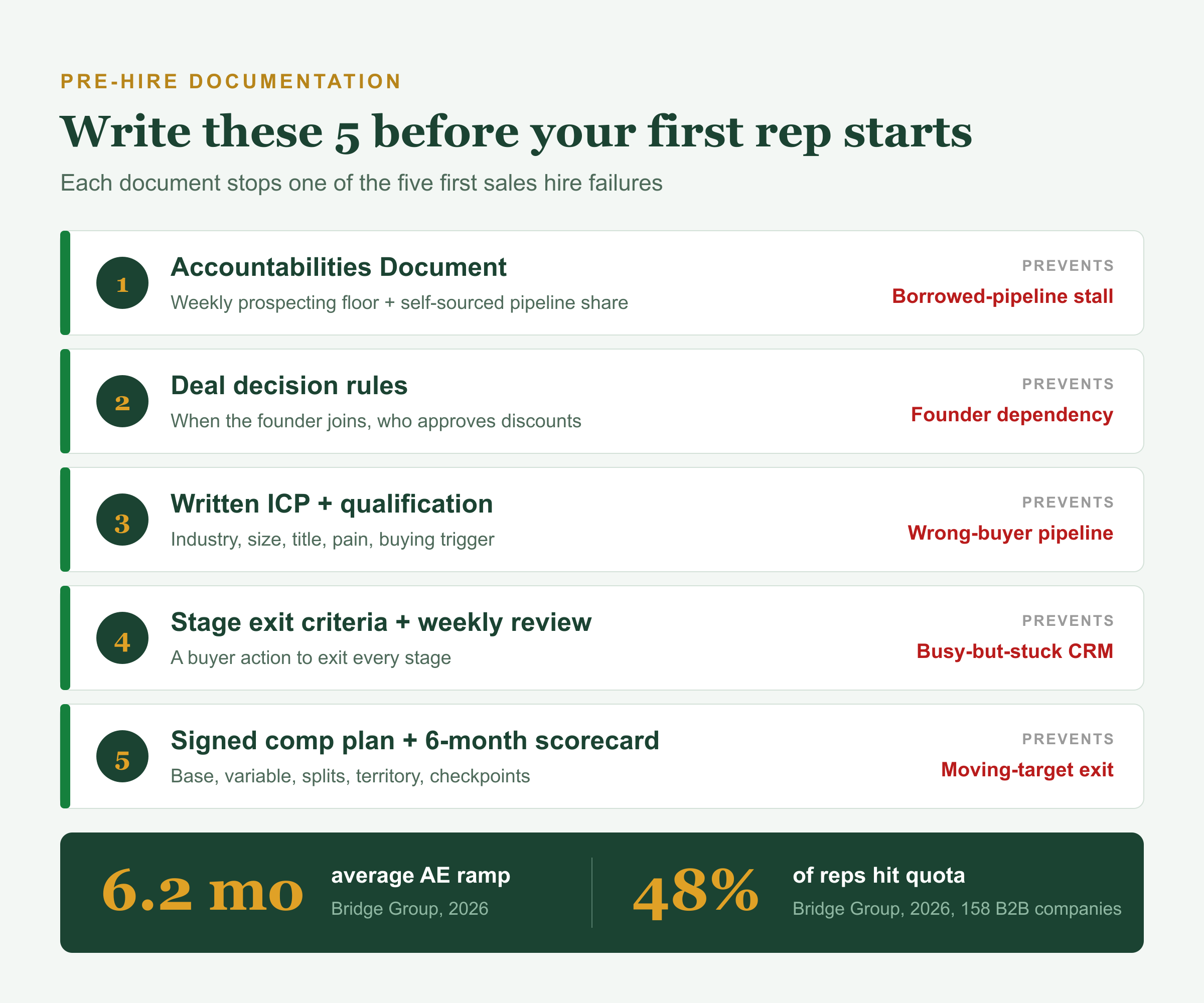
If those five documents sound like a sales playbook, that's because they're the core of one. A full sales playbook adds talk tracks, objection handling and call guides, but the five pre-hire documents are the minimum. Without them, the rep has nothing to run and you have nothing to coach against.
What does a failed first hire look like when you autopsy it?
A failed first sales hire, looked at after the fact, almost always shows the founder's habits more clearly than the rep's. In my experience the rep's calendar, the founder's sent email and the offer letter tell most of the story. What's missing from those three places is usually what caused the failure.
Here's what I see most often when I audit sales teams after a first hire didn't work. The rep's calendar is full in the first two months and thin by month four, because the meetings were the founder's introductions. The founder's sent folder has replies to the rep's prospects, sometimes sent at night, sometimes with a discount in them. And the offer letter has a base salary and the word "commission" with no plan attached. Founders are usually surprised that the paperwork, not the rep, is the first thing I want to see.
The other pattern I've seen over 50 years in B2B sales: founders almost never make the same hiring mistake on purpose twice, but they make the same management mistake again and again. The second hire gets a different personality and the same verbal promises. That's why I tell founders to fix the documents before they write the next job description.
When should a founder hold off on the first sales hire?
A founder should hold off on the first sales hire if they can't yet write the five pre-hire documents from their own closed deals. A rep can't run a sales motion the founder hasn't proven and described, and hiring before that point usually ends in the borrowed-pipeline stall or the wrong-buyer pipeline.
The fix in that case isn't to hire faster. It's to close more deals yourself while writing down what's working, or to bring in help that builds the system first. A full-time VP of Sales costs $250K to $400K a year, which is a lot to spend before there's a motion to lead. A Fractional Sales Leader typically runs $10K to $20K a month. My fee is $14K a month for 20 to 35 hours a week, in renewable 12-week engagements, and the first job is usually writing the documents that let the first hire succeed.
Frequently Asked Questions
How long should I give my first sales hire before deciding it isn't working?
Give a first sales hire about six months before making a final call, and judge leading indicators along the way. Average AE ramp is 6.2 months (Bridge Group, 2026). At months two and four, check prospecting activity, meetings held and qualified opportunities against the written scorecard rather than closed revenue.
Should I give my first sales rep my warm leads?
Give your first sales rep warm leads only alongside a written prospecting minimum. Warm leads help a new rep learn the pitch, but a rep who only works the founder's network stalls once that list runs dry, usually around month two or three.
When is it OK for the founder to join a sales call?
A founder should join a sales call when the rep asks for a specific reason, such as a technical question or an executive-to-executive conversation. Write that rule down before the hire starts. Join for that purpose, then hand the next step back to the rep.
Can I hire a second rep to fix a failing first hire?
Hiring a second rep won't fix a failing first hire if the five pre-hire documents are missing, because the second rep walks into the same setup. A second rep does help later: two reps working the same documented process show whether a problem is the person or the system.
What if my first sales hire was simply the wrong person?
If your first sales hire missed standards that were written down and coached, you hired the wrong person, and you should act on it. Lack of coachability drives more new hire failures than missing skills, 26% versus 11% (Leadership IQ, 2011). Screen for coachability in the next search.
Want your next sales hire to beat the odds?
Let's look at which of the five failures you're most exposed to and which documents you need before your next hire starts. Book a 30-minute call and we'll map it out.
Schedule a 30-Minute CallAbout the Author
Louie Bernstein is a Fractional Sales Leader with 50 years of sales experience and has provided Fractional Sales Leadership since 2017. He helps B2B founders at $1M to $10M ARR build repeatable sales systems, coach their teams, and reduce dependence on founder-led selling.