Good-Better-Best pricing packages your offer into three clear choices based on buyer needs. Good solves a smaller problem completely. Better fits your main customer. Best adds scope for a larger need. Give each tier a clear outcome, price, and delivery boundary, then coach reps to recommend the right fit. This can reduce buyer confusion and proposal revisions without pulling the founder into every deal.
Key Takeaways:
- Build each tier around a buyer situation, with a clear outcome and scope.
- Make Good a complete answer to a smaller problem. Don't sell an incomplete solution.
- Design Better for your main customer, then recommend it only when discovery supports the fit.
- Best can make the middle price easier to compare, but it must be a real offer worth buying.
- Track proposal revisions, discounts, delivery effort, and founder involvement before calling the new packages a success.
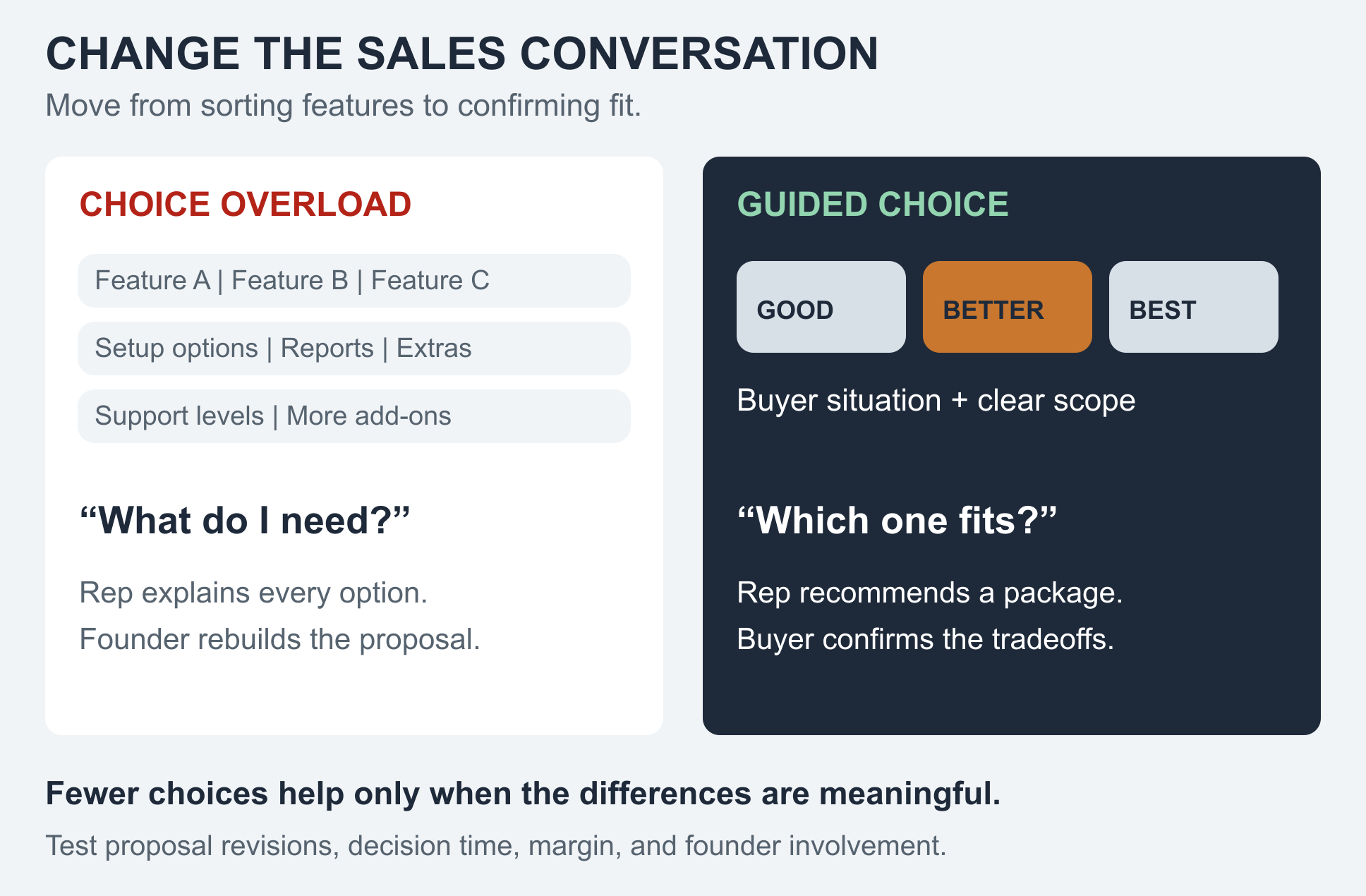
Your prospect asks for a proposal. Your rep sends a price list with twelve features, four service options, and a note that says, “Let us know what you'd like.” Now the buyer has another job: designing the solution.
When you're a B2B founder at $1M to $10M ARR, that confusion tends to come back to you. The rep needs help explaining the options. The buyer wants a custom bundle. You rebuild the proposal on a call that wasn't on your calendar.
Good-Better-Best packaging gives buyers three clear ways to buy. Each option explains who it's for, what it includes, and when it makes sense. That can move the conversation from comparing parts to choosing a fit. It won't create urgency where none exists.
If every proposal needs your explanation, the offer still lives in your head.
1. Give each tier a buyer and a job
Start with recent sales conversations, not your feature inventory. Review a manageable sample of won deals, lost deals, and deals that ended with no decision. Look for differences in what buyers needed to accomplish and what they could handle themselves.
Perhaps one group needs a single team running a standard process. Another needs several teams working together. A third needs a rollout across departments with tighter reporting and hands-on implementation.
Those differences can support three packages. “Small budget, medium budget, large budget” isn't enough. A buyer needs to recognize their situation before the price makes sense.
Write the fit sentence first
Use this sentence for each tier: “This is for a buyer who needs ___ and can handle ___ without our help.” The second blank matters. It names the work that stays with the customer.
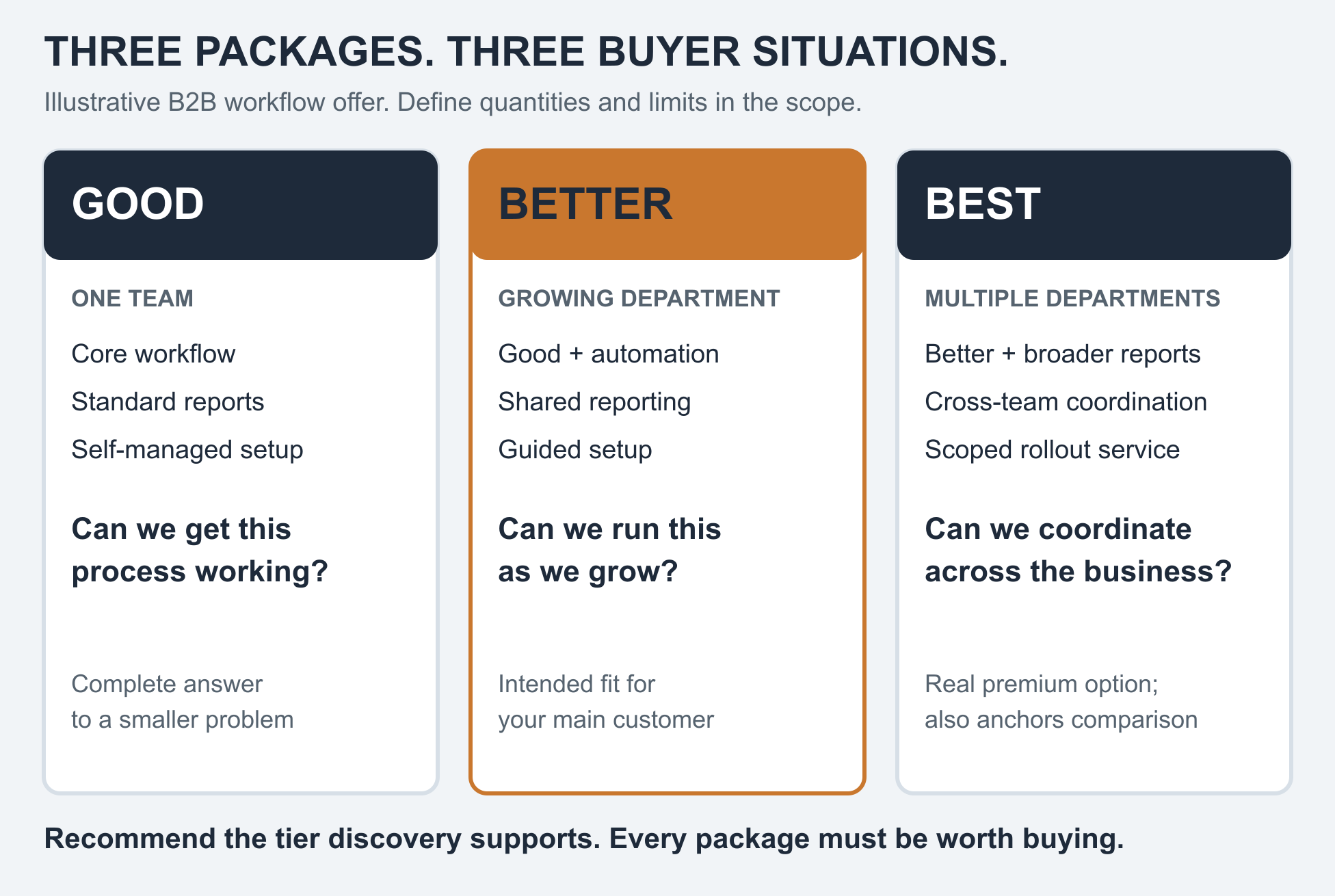
For an illustrative workflow software company, Good might fit one team with an internal owner who can manage setup. Better could fit a growing department that needs automation and guided setup. Best could fit multiple departments that need a coordinated rollout.
These are examples, not a client case study or suggested prices. Your actual packages should reflect needs you can confirm in your own deals.
Make Good worth buying
Good must deliver a useful result within its stated scope. Don't remove an essential function just to force an upgrade. If every Good customer needs an exception before getting value, you haven't built a usable entry tier.
Keep basic promises consistent. Every paying customer deserves the support and reliability you agreed to provide. Higher tiers can add service depth, scale, or capabilities without making the entry experience frustrating.
Stripe's pricing and packaging guidance makes a useful distinction: upgrades should follow needs such as team growth or greater complexity, while gating core value too early can cause resentment. Apply that idea to your proposals. The upgrade should have a reason the buyer understands.
2. Design the middle tier around your main customer
Better is where you put the combination your main customer usually needs. That is a design choice you test, not a promise that most buyers will choose it.
Write the middle package first. Include the capabilities and delivery work needed to solve the problem you most want to sell. Then define the smaller problem Good solves and the larger problem Best solves.
Use differences a rep can explain
For the illustrative workflow company, the comparison could read:
- Good: One team, the core workflow, standard reports, and self-managed setup. “Can we get this process working?”
- Better: Good plus automation, shared reporting, and guided setup for a growing department. “Can we run this consistently as we grow?”
- Best: Better plus cross-department reporting and a scoped rollout service. “Can we coordinate this across the business?”
Define quantities behind those descriptions. How many teams? Which reports? How many setup sessions? Who owns migration? A short pricing panel should lead to precise scope, not replace it.
An add-on can make sense when a need cuts across all three tiers. A one-time data cleanup, for example, may be needed by a small or large customer. Keep it separate if putting it in every package would charge buyers for work they don't need.
Make the top tier a real offer
Best gives buyers a reference point for the full scope and premium price. That can make Better look reasonable by comparison. But the higher price needs to stand on its own value.
Don't invent a package nobody should buy just to make another package attractive. Your rep should be able to name the buyer who needs Best, explain why, and deliver what was sold.
Avoid a “Most Popular” label unless your sales data supports it. “Recommended for growing departments” is a fit statement you can explain. A popularity claim is a statement about actual purchases.
3. Protect the margin behind every package
Clear tiers won't help if the extra service in Better consumes the entire price increase. Before selling the packages, review them with whoever delivers the work.
Estimate setup effort, ongoing support, third-party costs, and any work that grows with usage. Separate one-time implementation costs from recurring delivery costs. Then check whether the price supports both.
Run a simple delivery check
Here's a hypothetical service example. Good sells for $2,000 a month and requires $800 in direct monthly delivery costs. It leaves $1,200 in gross profit, a 60% gross margin. Better sells for $3,000 and costs $1,500 to deliver. It leaves $1,500 in gross profit, a 50% gross margin.
Better brings in more gross profit dollars, but a lower gross margin percentage. Neither number tells the whole story. If its extra work consumes your scarcest person's time, the higher sale may limit how many customers you can serve.
Use the calculation to test whether a package can be delivered profitably. Set the price against the value buyers receive and the alternatives they have. Costs tell you what you can afford to deliver; they don't tell you what a buyer will pay.
Write down what happens when scope changes
Put inclusions, limits, exclusions, and upgrade triggers in the Sales Playbook. State who can approve an exception and how the delivery team confirms it.
If a buyer wants Best's rollout service at Good's price, the rep should explain the scope difference. They can offer a smaller rollout or a priced add-on if your rules allow it. They shouldn't promise the work and hope operations finds a way.
Don't let an exception quietly become the next customer's standard offer. Record what changed, why it changed, and what the buyer gave in return. Repeated exceptions may reveal a missing package. One unusual deal doesn't justify rewriting everything.
A package boundary only works when your reps can explain it and your delivery team can honor it.
Related ReadingCost-Plus Pricing Is Killing Your Margin →
4. Coach reps to recommend a fit
Don't send three columns and ask the buyer to finish discovery. The rep still needs to understand the problem, its impact, who will use the solution, and who will implement it.
Packages organize the recommendation after that conversation. They don't replace it.
Practice a short recommendation
Have your rep use a talk track like this: “You told me two teams need the same workflow, and nobody has time to manage setup. I recommend Better because it includes guided setup and the shared reporting you need. Good leaves setup with you. Best adds a cross-department rollout you haven't said you need.”
Then ask: “What have I missed about how you'll use this?”
That question invites correction. If the buyer has an implementation team you didn't know about, Good may fit. If three more departments are joining, Best may deserve a closer look. The rep's job is to explain the tradeoffs and listen.
Handle the two common pushbacks
When the buyer says, “We'll take the cheapest,” ask which work they plan to handle internally. If they can own it and Good solves the problem, sell Good with confidence. Don't punish a buyer for choosing a package you offered.
When the buyer says, “Can we have one thing from Best?” clarify the need. Use an approved add-on if it exists. Otherwise, explain the higher tier or get an exception reviewed before promising anything.
Role-play both conversations in a sales meeting. Have the rep explain the recommendation without reading the pricing page. Coach where the explanation breaks down. Resist the urge to take over the next buyer call yourself.
Give the buyer a short summary they can repeat to a colleague: the problem, recommended tier, reason, price, and next step. If the internal champion can't explain the choice, a polished comparison chart won't carry the deal through approval.
5. Test whether the packages reduce sales work
Start with the next ten comparable new opportunities that reach the proposal stage. That's a practical learning sample, not statistical proof. Keep existing customer agreements intact while you learn how new buyers respond.
Use one package version, consistent terms, and the same qualification standard during the test. Changing the tiers after every call makes it hard to see what worked.
Record the decision, not just the sale
Add a few fields to your CRM: recommended tier, selected tier, reason for selection, scope exception, discount, and founder involvement. Track proposal revisions and days from proposal to a decision. Include lost and no-decision deals, not just wins.
Compare the results with similar earlier opportunities. Account for deal size, buyer type, and urgency before crediting the packages with faster decisions. Ten easy deals don't prove you've fixed a difficult sales process.
Review delivery too. Did the customer get the promised result within scope? Did onboarding require extra founder hours? A fast signature followed by weeks of unpaid setup isn't a clean win.
Use objections to improve one thing at a time
If buyers keep asking what separates Good and Better, sharpen that boundary. If everyone requests the same add-on, reconsider where it belongs. If Best never fits, check whether you are reaching the buyers it was designed for.
The outcome you want is a buyer who understands the purchase, a rep who can explain it, and a team that can deliver it. More middle-tier sales alone don't prove success.
At the end of the test, update the Sales Playbook and practice the revised explanation. That's how packaging helps you leave founder-led sales: your judgment becomes something the team can learn and use.
Frequently Asked Questions
Q: Are three pricing tiers always the right number?
No. Three is a useful starting point when you serve three distinct buying situations. If you have one clear customer need, one offer may be simpler. Don't manufacture differences to fill a comparison table. Test whether buyers can explain the choices.
Q: How much should prices increase between tiers?
There is no universal percentage. Price each tier against the value, alternatives, and willingness to pay of its intended buyer. Check delivery economics, then test the gap in real proposals. A neat price ratio doesn't prove that the extra scope is worth it.
Q: Should I push every buyer toward the middle tier?
No. Design Better for your main customer and recommend it when the facts support it. Good and Best must remain valid choices. A buyer in the wrong tier can become an onboarding problem, a scope dispute, or a lost renewal.
Q: Can a B2B service business use Good-Better-Best?
Yes, if it can define repeatable scope. Separate packages by outcomes, delivery depth, or responsibility. State meeting frequency, deliverables, and limits. Avoid promising unlimited founder access in the top tier when that would make delivery depend on you forever.
Q: Will packaging shorten my sales cycle?
It may reduce confusion and proposal revisions. It won't remove procurement requirements, create budget, or fix an unimportant problem. Measure comparable deals before and after the change, including no-decisions, and watch delivery quality alongside speed.
Build an offer your team can sell without you.
If every proposal still lands on your desk, Fractional Sales Leadership can help turn your judgment into a Sales Playbook, clear scope rules, and coached sales conversations. Learn how at LouieBernstein.com.
Schedule a 30-Minute CallAbout the Author
Louie Bernstein
Louie Bernstein is a Fractional Sales Leader and the founder of MindIQ. He helps B2B founders build repeatable sales systems through Sales Playbooks, clear sales processes, pipeline management, and coaching.