Cost-plus pricing can cap your margin because your delivery cost doesn't measure the buyer's benefit. When you get more efficient, a fixed markup can even pull your selling price down. Keep costs as a floor check, then compare your offer with the buyer's next-best alternative. Validate the dollars your outcome is worth, and put that evidence into discovery, proposals, and coaching so your reps can defend the price.
Key Takeaways:
- Cost-plus pricing can underprice a valuable outcome and give away the benefit of lower delivery costs.
- A 50% markup on cost produces a 33.3% gross margin, not a 50% gross margin.
- Compare your offer with what the buyer would actually do instead, including a manual process or doing nothing.
- Review your last 5–10 customers and ask them to confirm the problem, the improvement, and the annual value.
- Make buyer-confirmed value part of the proposal approval process. An unsupported ROI number won't help a rep hold price.
You cut delivery time. Your team gets better. Software removes work you used to do by hand. Then your pricing spreadsheet tells you to charge less.
That's a strange reward for building a better business. Yet it's exactly what happens when every quote starts with cost and ends with the same markup.
In Money Levers, article 1, I covered why founders underprice. Article 2 covered testing an easy yes. Article 3 asks what your reps should use to justify the number in the first place.
Why do so many founders use cost-plus pricing?
Cost-plus pricing appeals to founders because costs are visible and a markup feels easy to explain. You know the hours, salaries, and tools required to deliver. Customer value takes more work to uncover. The danger is treating a convenient calculation as evidence of what your market will pay.
Know what your percentage means
Suppose delivery costs $4,000 and you add 50%. Your price is $6,000. The $2,000 left over is 33.3% of revenue. Markup divides by cost; gross margin divides by price. Confusing those two measures can leave your plan short before the first negotiation.
Even that $2,000 isn't operating profit. You still have selling costs, overhead, and other expenses to cover. Include support, implementation, and founder delivery time in your cost review. “I don't pay myself for those hours” doesn't make the work free.
Keep the cost discipline
I'm not suggesting you stop calculating costs. A sustainable price must support the business at realistic volume. Cost-plus can also fit agreements that explicitly reimburse costs. But for a repeatable B2B offer, a markup alone doesn't tell you whether the customer sees a bargain or an overpriced solution.
Why don't my costs tell buyers what my product is worth?
Buyers value the result they expect compared with their other choices, not the effort you put into producing it. The same service can solve an expensive problem for one company and a minor inconvenience for another. Your cost sheet cannot show that difference. Discovery has to uncover it before you quote.
Separate effort from impact
A report that takes you an hour might prevent a costly mistake. A custom dashboard that takes you weeks might never get used. More work doesn't automatically create more value, and less work doesn't automatically destroy value.
Ask the buyer what changes when the problem is solved. Does someone stop reworking orders? Can the company avoid an outside expense? Does a delay disappear? Find the person who owns that result and ask how the company measures it.
Why getting price right matters
In its 2003 analysis of average S&P 1500 economics, McKinsey calculated that a 1% price increase would raise operating profit by 8% if volume stayed constant. The modeled impact was nearly 50% greater than a 1% variable-cost reduction and more than three times a 1% volume increase.
That's historical large-company math, not a forecast for your business. Price changes can reduce demand. Your own margins, win rates, retention, and delivery costs determine the result. The useful lesson is to examine price carefully rather than assume volume will make up for a weak quote.
What happens to my price when my delivery costs go down?
Under a fixed cost-plus formula, lower delivery costs produce a lower price and fewer gross profit dollars per sale. Holding price steady can preserve more of the efficiency gain when customer value remains intact. The choice should reflect your agreements, competitive position, and buyer outcomes, rather than an automatic spreadsheet adjustment.
Follow the dollars, not just the margin rate
Here's a hypothetical monthly service with the same scope and customer outcome. Delivery cost falls from $4,000 to $3,000. No other costs or volumes change.
| Monthly economics | Before | Keep 50% markup | Keep price |
|---|---|---|---|
| Delivery cost | $4,000 | $3,000 | $3,000 |
| Selling price | $6,000 | $4,500 | $6,000 |
| Gross profit | $2,000 | $1,500 | $3,000 |
| Gross margin | 33.3% | 33.3% | 50% |
The fixed markup gives the customer a $1,500 price reduction after you saved $1,000 in delivery. Your gross profit dollars fall 25%. Keep the $6,000 price, and gross profit dollars rise 50%. Neither outcome is guaranteed; both are arithmetic under the stated assumptions.
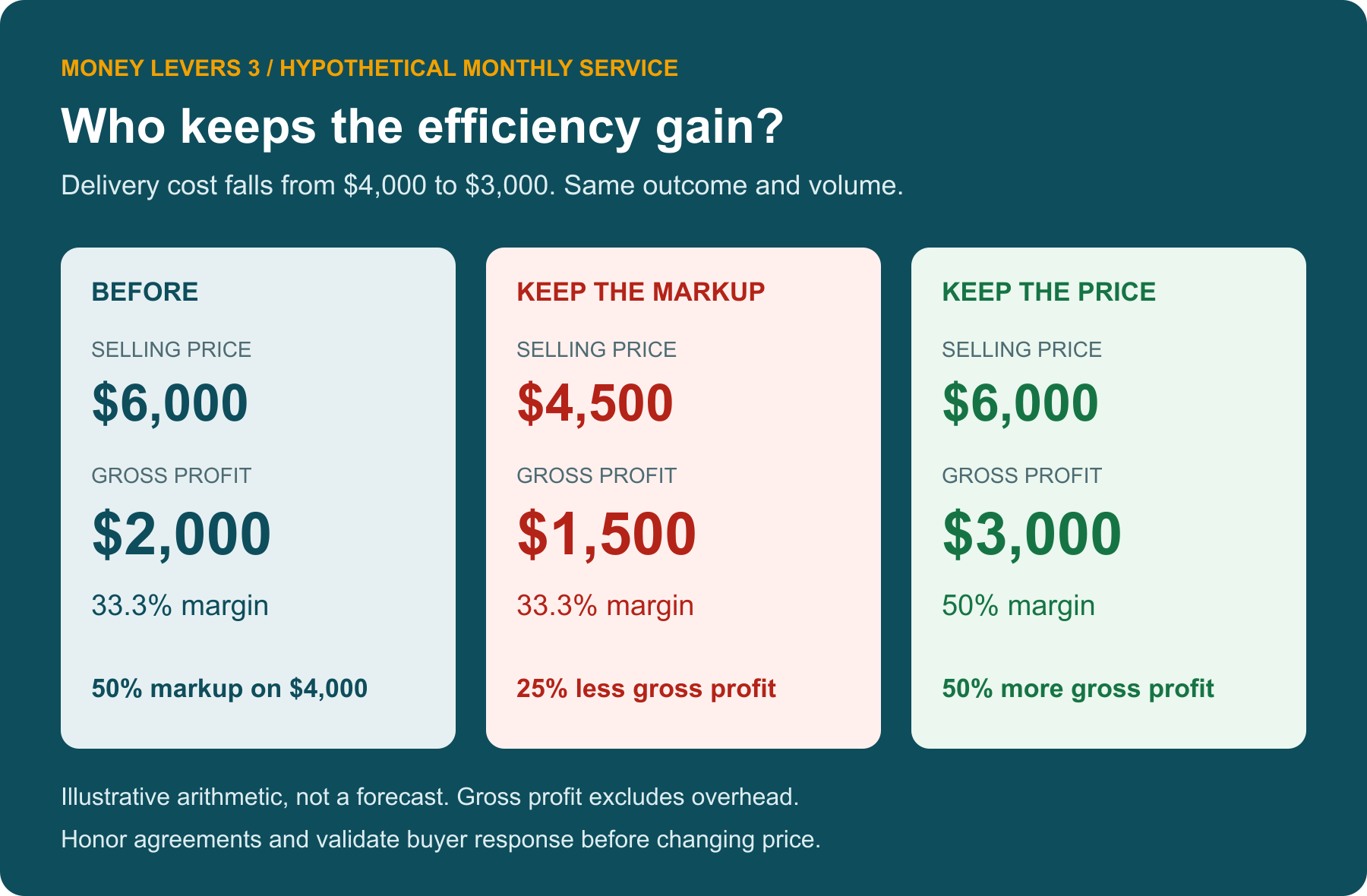
You may choose to share savings to win a larger commitment or strengthen retention. Make that a deliberate trade. Honor any contractual savings pass-through, and don't misrepresent your costs when a buyer asks. A lower internal cost doesn't, by itself, tell you the right market price.
How do I price off the buyer's next-best alternative?
Start by asking what the buyer would do if your offer weren't available, then compare equivalent outcomes and total costs. The alternative might be a competitor, an employee, a manual process, or no change. Add value only for differences the buyer recognizes, and account for switching effort and shortcomings in your offer.
Ask “compared with what?”
A competitor's list price isn't automatically the reference point. If the buyer plans to keep using a spreadsheet, your comparison must address the spreadsheet process. If the buyer is considering a hire, compare the relevant work and capacity. Don't count a whole salary as savings when the employee still has a full job.
Write three lines in the deal record: the likely alternative, the meaningful difference, and the evidence. Ask the buyer to correct them. A rep who lists features without knowing the alternative hasn't established a reason to pay more.
Leave value for the customer
Suppose a comparable alternative costs $24,000 annually. The buyer confirms your differences create another $12,000 in annual benefit, while switching requires $4,000 of one-time effort. A simplified first-year economic comparison reaches $32,000 before leaving the buyer an incentive to switch. Those are illustrative estimates, not a recommended quote.
The value ceiling isn't a purchase order. Budget, confidence, implementation risk, and competing priorities still matter. Don't add the same benefit twice, once in the alternative comparison and again in an ROI calculation. Use the comparison to form a price hypothesis, then test buyer response.
How do I put a dollar figure on the outcome I deliver?
Build a value estimate from customer evidence: the original problem, the measurable change, and a dollar amount the buyer accepts. Start with your last 5–10 customers in one segment. Use their experience to improve your questions, then validate each new buyer's numbers instead of copying a previous customer's result into every proposal.
Use a five-step customer review
- Document the starting point. Ask what the problem cost in time, outside spending, errors, or missed contribution. Record the period and source.
- Identify what changed. Compare the same measure before and after. Ask which improvements came from your work and which came from other changes.
- Convert the change to dollars. Use an agreed hourly cost, avoided expense, or contribution per additional sale. Revenue alone isn't profit.
- Adjust for reality. Allow for adoption time, customer effort, uncertainty, and recurring costs. Separate released capacity from cash savings.
- Get confirmation. Ask the buyer who can validate the inputs. Save the assumptions and approval with the proposal.
Show the calculation and its limits
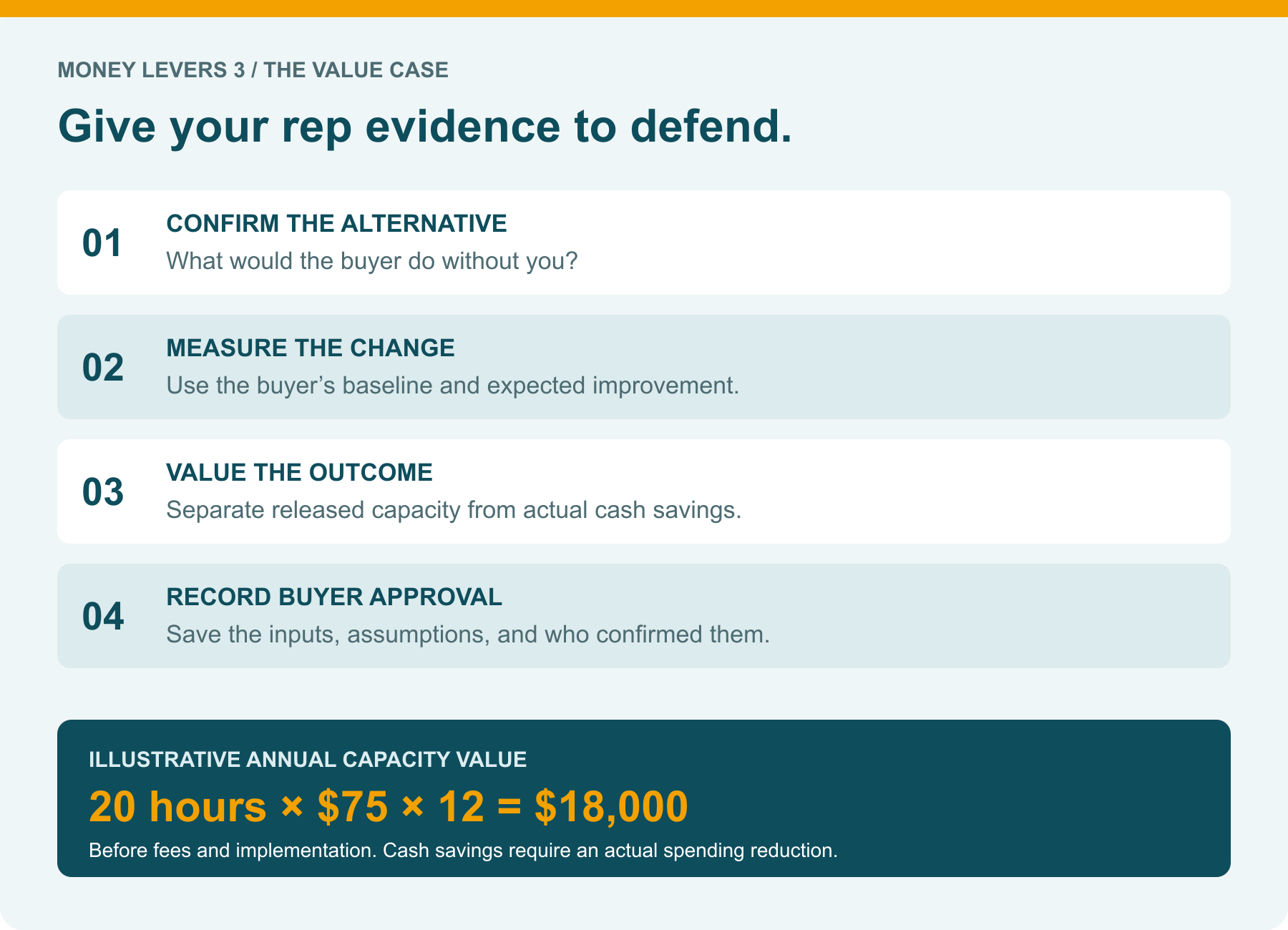
For illustration, 20 hours released each month at an agreed $75 per hour equals $18,000 of annual capacity value. That becomes cash savings only if spending actually falls. If the buyer can't redeploy the time productively, even the capacity estimate may overstate the benefit.
Put a plain sentence in the proposal: “Based on your estimate of 20 hours monthly, the expected capacity value is $18,000 annually before fees and implementation effort.” Show a lower case if the hours are uncertain. Let the buyer challenge the inputs before discussing the price.
How do I get my reps to sell and defend a value-based price?
Give reps a repeatable way to establish value before quoting, and coach them to use buyer-confirmed evidence when price is challenged. Put the questions, proposal requirements, and discount authority in your Sales Playbook. Review whether reps followed the process, rather than stepping into every negotiation and becoming the only person who can hold price.
What my founder experience adds
In The Discount Trap, I wrote about the pressure of running a bootstrapped business and how emotional attachment to a deal leads founders to surrender margin. A cost sheet can become another source of false comfort: “We're still above cost, so let's take it.”
My practical rule is to review the buyer's evidence before discussing a concession. Have the rep explain the alternative, the value, and the exact objection. If the evidence is missing, coach the next conversation. Don't rescue an incomplete discovery process with your own discount.
Your delivery cost belongs in the margin review. The buyer's outcome belongs in the price conversation.
Make the value case part of the system
Before a proposal goes out, require a recorded alternative, an agreed outcome, and the source of any dollar estimate. When value can't be quantified, document the buyer's decision criteria honestly. Don't force a fake ROI number into a required CRM field.
Role play “Your competitor is cheaper.” The rep should clarify scope and the comparison before answering. Record discounts, free work, and extended terms with an approver. Review final contribution dollars and buyer outcomes alongside wins. A higher quoted price means little if concessions quietly erase it.
Related ReadingIf Every Prospect Says Yes, Your Price Is Too Low →
Frequently Asked Questions
Q: Can I start without a CRM or formal sales process?
Yes. Use one shared value worksheet for each opportunity and choose who reviews it before quoting. Consistent questions and recorded answers matter more than buying software at the start.
Q: Should I change prices for existing customers immediately?
No. Honor current agreements and review renewal terms before proposing changes. Prepare a clear explanation of scope and value, give appropriate notice, and treat renewals separately from a new-customer price test.
Q: Does value-based pricing mean charging each buyer a different price?
No. You can use customer value to design consistent packages and prices for defined segments. Avoid arbitrary quotes that reps can't explain or administer consistently.
Q: What if the customer won't share financial information?
Ask for ranges or operational measures they can confirm. You can still discuss priorities and alternatives. Label estimates clearly and don't present your assumptions as the customer's verified savings.
Q: When should I hire a pricing specialist?
Use a specialist for formal willingness-to-pay research, complex segmentation, or a dedicated pricing study. I'm a Fractional Sales Leader. I help build the sales process, coaching, proposal discipline, and approvals that support your pricing decisions.
Give your team a price they can explain.
If you're at $1M to $10M ARR and every price objection comes back to you, let's look at how your team establishes value. Learn about Fractional Sales Leadership at LouieBernstein.com.
Schedule a 30-Minute CallAbout the Author
Louie Bernstein
Louie Bernstein is a Fractional Sales Leader and the founder of MindIQ. He helps B2B founders build repeatable sales systems through Sales Playbooks, clear sales processes, pipeline management, and coaching.