If almost every qualified prospect accepts your price without discussion, you may be undercharging. A high close rate alone doesn't prove your price is too low; strong referrals, good qualification, and urgent needs can produce the same result. Review what buyers actually accepted, then test one higher price on your next 10 comparable new proposals. Track objections, discounts, sales cycles, and margin before changing your pricing across the business.
Key Takeaways:
- Repeated, friction-free acceptance is a reason to test a higher price, not proof that every easy deal was underpriced.
- A price objection rate measures resistance among quoted buyers. A win rate measures closed outcomes. Don't confuse them.
- A buyer who can't explain the value needs better discovery before a lower price.
- Test one higher price on 10 comparable new proposals while keeping scope, terms, and discount rules consistent.
- One changed outcome moves a 10-proposal win rate by 10 percentage points. Treat the first batch as a learning exercise.
A founder sends the proposal. The buyer says yes immediately. No questions about price. No request to explain the return. The founder celebrates and sends the next proposal at the same number.
At an NYU Summer Launchpad session, TreSensa co-founder Rob Grossberg warned that never hearing you're too expensive can mean you're leaving revenue behind. His point was to pay attention to resistance, not fear every objection. NYU Entrepreneurship (July 2026) reports his advice.
For a founder still closing most sales, the useful question is simple: did the buyer accept a fair price, or did you make the decision unnecessarily cheap? Money Levers, article 1, covered why founders underprice. Article 2 is about getting an answer from your sales process.
What does it mean if almost every prospect says yes to my price?
Almost universal acceptance can mean your price sits below what qualified buyers would pay, especially when buyers accept the original scope and terms without concessions. But easy wins can also reflect excellent fit or trusted referrals. For a B2B founder, repeated acceptance is a signal to investigate the deal details before raising prices.
Find out which price they accepted
Start with the last completed proposals in one customer segment. Pull the first quote and the signed agreement. Check for free implementation, extra users, custom reporting, extended payment terms, or founder access that wasn't in the original offer.
A buyer can accept the full dollar amount while getting a much bigger package. Your CRM may call that a full-price deal. Your delivery team knows better. Record those concessions before deciding the market loves your price.
Where founders usually get this wrong
In my work on the discount trap, I've described how emotional attachment to a deal makes founders give away margin and promise work outside the offer. I know the pressure of keeping a bootstrapped business going. The relief of a signed deal can crowd out the question of whether the deal makes sense.
Apply that lesson to easy wins: review what you gave away before the buyer ever objected. If you lowered the number because you expected resistance, the buyer's quick yes tells you about your concession. It tells you very little about acceptance of your original price.
Don't call it price acceptance until you know the price, scope, and terms the buyer actually accepted.
How much price pushback should I be getting?
Some price pushback is useful, but there isn't a universal objection rate that proves your price is right. The amount depends on your buyers, deal size, buying process, and how clearly you establish value. Compare similar buyers within your own pipeline and use outside rules of thumb only to guide questions.
Use the 20%–40% range carefully
Kenneth F's Open Scout essay on pricing suggests a 20%–40% price-resistance range. Treat that as the author's heuristic, not a measured B2B benchmark. The essay doesn't establish that range as the right target for your market.
For 10 quoted prospects, that range would mean two to four expressing resistance. It doesn't mean you should lose two to four deals. Someone can question the price, understand the value, and buy at the original amount.
Don't coach reps to create objections so they hit a target. Ask them to report objections accurately. Procurement may ask everyone for a discount. A referred buyer may already know the price and have approval. Neither pattern, by itself, settles your pricing decision.
Keep the denominators straight
Calculate price resistance as quoted prospects who explicitly objected to price divided by all comparable quoted prospects. Calculate win rate as wins divided by wins plus losses, using the same stage definition for both periods. Count closed no-decisions as losses. Keep unresolved proposals visible, but separate from closed outcomes.
A proposal-stage close rate isn't comparable to a benchmark that begins with every qualified opportunity. A founder who quotes only after verbal agreement can show a wonderful proposal win rate without learning much about pricing.
How do I tell a real price objection from a value gap?
A value gap means the buyer doesn't yet understand or believe the business benefit. A real price constraint remains after the buyer understands the benefit and you confirm budget, authority, and alternatives. Ask what feels expensive, compared with what, and why. The buyer's explanation should determine your next move.
Ask for the comparison
Try: “When you say expensive, are you comparing this with another offer, your available budget, or what you expect to get back?” Then stop talking. A discount offered before that answer can solve a problem the buyer didn't have.
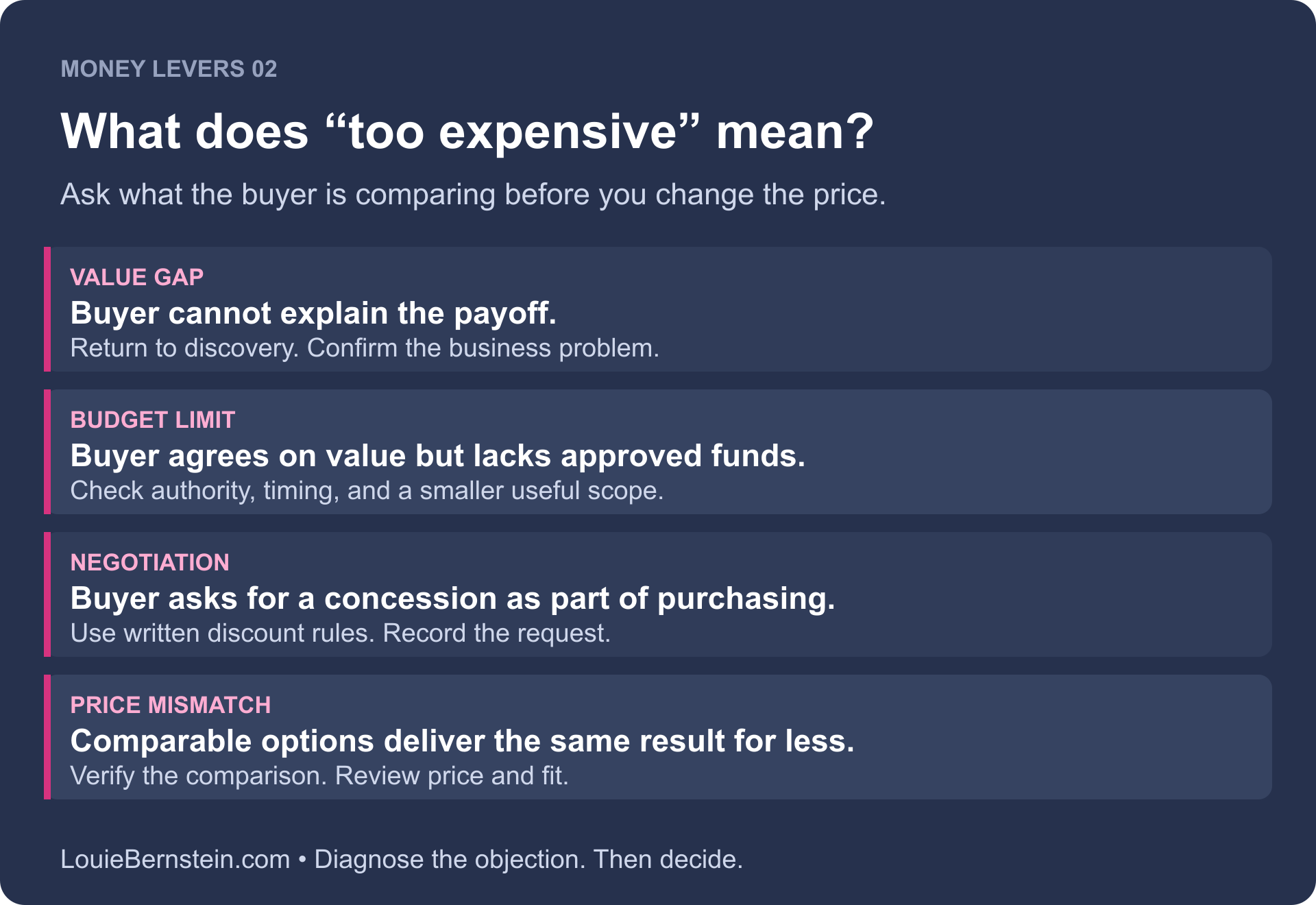
If the buyer can't describe the result they need, return to discovery. If the result matters but funding isn't approved, find out who can approve it and when. If another offer is cheaper, compare implementation, support, scope, and expected outcomes. Sometimes the cheaper offer really is enough.
Make the buyer's reasoning visible
My discovery-call approach starts with the problem, its cost, and who decides to fix it. Those answers belong in the proposal and the CRM. “They loved the demo” doesn't give a rep much to work with when price comes up.
Have the rep explain the buyer's expected outcome during a deal review. Then role play the objection. Teach the rep to ask and listen instead of taking over the negotiation yourself. The next deal needs to work without the founder in the room.
Why are some of my deals closing too fast?
Fast deals can reflect urgency, trust, simple purchasing, or a price well below the buyer's expected value. Speed alone cannot tell you which explanation applies. Compare fast deals with similar deals and check what happened before the proposal. Keep efficient buying easy while investigating repeated acceptance with no discussion of price or scope.
Separate a short cycle from a late start to measurement
If you create the opportunity after three founder conversations, the CRM misses most of the selling time. Track the same starting event, such as qualification, across deals. Also track proposal-to-decision time so you can see whether the response to the quote changed.
A buyer with an urgent deadline and approved budget may close quickly at a strong price. Don't slow the buyer down to prove you're worth more. A pattern of instant acceptance across unrelated, comparable buyers deserves a controlled test. One delighted customer deserves good service.
How do I test a higher price without risking my pipeline?
You can't eliminate risk from a price test, but you can limit the exposure. Apply one planned increase to a small group of comparable new proposals, honor existing quotes and customer agreements, and keep the rest of the offer consistent. Set review criteria before the first quote so one uncomfortable conversation doesn't drive the decision.
Run the next 10 proposals test
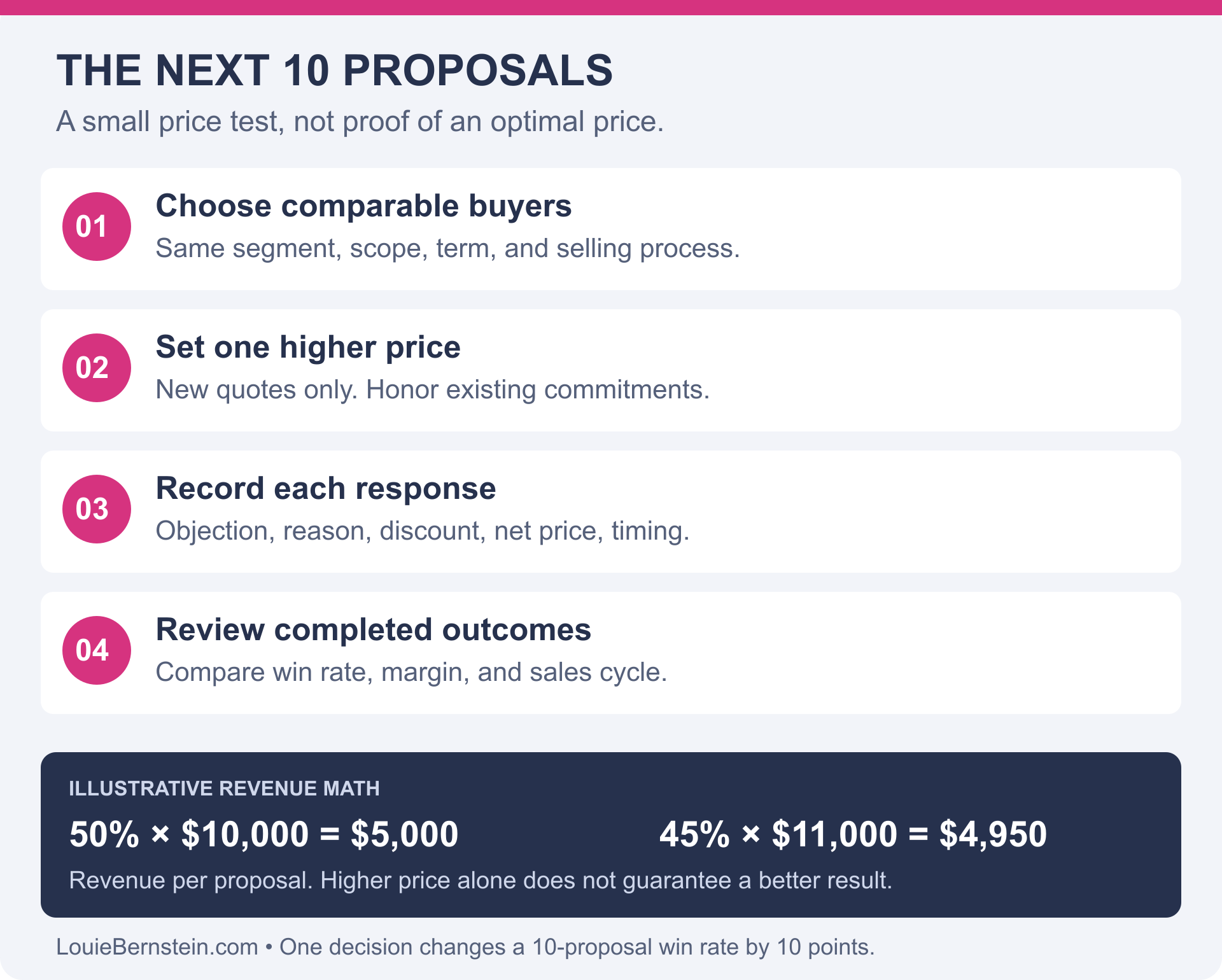
- Choose one segment. Use buyers with similar needs, company size, and deal scope. Write the selection rule before choosing opportunities. Don't quietly reserve the higher price for your easiest buyers.
- Record a baseline. Review recent comparable proposals, including losses and no-decisions. Capture original quote, final price, cycle length, and delivery cost. A historical comparison provides context, not a controlled experiment.
- Choose one increase. A 10% increase is an illustrative starting option, not a recommendation for every business. Pick a change you can explain through customer value and afford to test. Leave existing commitments alone.
- Keep the offer consistent. Hold scope, payment terms, contract length, qualification, and discount authority steady. Coach the team to explain the new price without apologizing or offering an automatic concession.
- Track all 10 proposals. Record exact objections, discounts requested and granted, final price, and days to decision. Log exceptions. A larger package or extra free work changes what you're testing.
- Review after a normal buying cycle. Set an interim review date and keep pending deals separate. Pause if a pre-agreed cash or margin limit is crossed. Continue gathering evidence if the outcomes remain unclear.
Judge the economics, not just the percentage of wins
Here's illustrative math, not a forecast: a 50% win rate at $10,000 produces $5,000 in expected revenue per proposal. At $11,000, a 45% win rate produces $4,950. With a 10% price increase, the revenue break-even win rate is about 45.45%, assuming comparable offers and no discounts.
That calculation ignores delivery costs, selling time, retention, and cash timing. Review contribution dollars after direct delivery costs as well. A lower win rate can still make economic sense, but a higher quoted price doesn't guarantee it.
Ten proposals won't prove the best price. One outcome changes the final win rate by 10 percentage points. Use the first batch to find patterns, check execution, and decide what to test next. Don't declare a pricing breakthrough after two yeses.
What price signals should I track in my CRM?
Track the quoted offer, the buyer's reaction, and the final economics in separate CRM fields. Keeping those records separate shows whether customers accepted the higher price or reps quietly reduced it. Review comparable deals monthly, with the salesperson present, so the numbers lead to better questions and specific coaching.
Start with fields the team can maintain
- Test group and offer: segment, price version, scope, term, and quote date.
- Price objection: yes, no, or not yet discussed. Silence isn't acceptance.
- Objection reason: value unclear, budget, alternative offer, negotiation, or unknown. Add the buyer's words.
- Discount requested versus granted: amount, percentage, approver, and what changed.
- List, quoted, and final price: compare on the same term and scope. Include noncash concessions.
- Outcome and timing: won, lost, no-decision, or pending; qualification and decision dates; expected delivery cost.
At the monthly review, ask which objections changed the outcome, which concessions were authorized, and whether the team followed the agreed process. Put the next action into the Sales Playbook. If the founder grants exceptions outside the CRM, the founder is breaking the test too.
Related ReadingThe Money You Left on the Table: Why Founders Underprice →
Frequently Asked Questions
Q: What if we don't have a CRM yet?
Use a shared spreadsheet with the same fields and one owner. Start recording proposals before changing price. Without a consistent record of who received which offer, you won't be able to interpret the results.
Q: Should I announce the test to existing customers?
A test limited to new proposals doesn't require changing existing customers' agreements. Honor their terms. If a customer asks about a different quote, explain the applicable offer honestly. Don't invent a promotion or a false deadline.
Q: What if a salesperson refuses to quote the higher price?
Ask whether the concern comes from buyer evidence or the rep's discomfort. Practice the value conversation together and clarify discount authority. Log exceptions openly. A test with two unofficial price lists won't answer your question.
Q: Can I test price and packaging together?
You can test a new offer, but you won't know which change caused the response. If your question is whether buyers will pay more for the current offer, keep the package consistent. Test packaging separately when possible.
Q: When do I need a pricing specialist?
Bring in a specialist when you need willingness-to-pay research, complex segmentation, or a formal pricing study. I'm a Fractional Sales Leader. My role is to build price discipline into discovery, proposals, coaching, discount approvals, and CRM reviews.
Put price discipline into your sales process.
If you're at $1M to $10M ARR and every pricing decision still comes back to you, let's look at the system behind your proposals. Learn how Fractional Sales Leadership can help at LouieBernstein.com.
Schedule a 30-Minute CallAbout the Author
Louie Bernstein
Louie Bernstein is a Fractional Sales Leader and the founder of MindIQ. He helps B2B founders build repeatable sales systems through Sales Playbooks, clear sales processes, pipeline management, and coaching.