What's the best way for me to build a sales team?
Consulting founders can remove themselves from daily lead generation by turning their expertise, referral relationships, and qualification judgment into a process a team can run. Start with one clear buyer problem, document why clients choose your firm, assign prospecting and follow-up to named owners, and coach the handoff. Keep the founder available for defined expert conversations while the team learns to create qualified opportunities without the founder opening every door.
Key Takeaways
- Consulting founders can delegate lead generation when the team can explain the firm's expertise, qualify a buyer's problem, and secure a next step without a founder introduction.
- Separate prospecting from expert diagnosis. A salesperson can earn the first conversation while a consultant answers technical questions later.
- In Edelman and LinkedIn's 2025 U.S. findings, 71% of hidden decision-makers said thought leadership demonstrates potential vendor value more effectively than conventional marketing or sales materials.
- Review your last 10 wins and 10 lost or stalled opportunities before writing the first sales job description. Use fewer if your history is limited.
- Measure qualified opportunities created without founder intervention alongside founder hours, opportunity quality, and project margin.
Your consulting firm gets busy delivering work. Prospecting stops. When delivery eases, you start calling people again. A few months later, the same cycle repeats.
A founder at $1M to $10M in recurring revenue, or comparable annual consulting revenue, can mistake a strong personal network for a working sales system. Your contacts trust you. Your new salesperson doesn't inherit that trust with a company email address.
Your first sales handoff has to explain why a buyer should trust someone besides you.
Why does consulting lead generation keep coming back to me?
Consulting lead generation returns to the founder when buyer trust, account selection, and follow-up decisions live in the founder's head. A new salesperson can't reproduce a relationship built over years. The firm needs evidence and a qualification process that let another person earn a credible first conversation with the right buyer.
Find the part of the sale that only you can explain
Look at your last 10 wins. Why did each buyer take the first meeting? An introduction? A problem you described better than anyone else? A project your team delivered? Write the answer beside the source, buyer role, business problem, and first paid engagement.
Then examine 10 losses or stalled deals. Did the prospect need work you couldn't profitably deliver? Was the contact curious but unable to sponsor a project? Did your reputation win a friendly meeting without creating a reason to buy? Those differences belong in your Sales Playbook.
For a consulting firm, a qualified opportunity needs more than someone willing to talk. The buyer has a costly problem your team can solve, a credible route to funding, and a reason to act. Your delivery team must also have a realistic way to fulfill the work.
What building MindIQ taught me
At my IT training and consulting business, MindIQ, an MCI buyer first hired us for an introductory course after receiving a postcard. After the course, she explained that the assignment had been a test. Her larger problem involved networked systems at six call centers. We had five full-time consultants on site within a week.
The useful lesson for a consulting founder is the sequence. An initial offer gave the buyer a way to judge our work before trusting us with a bigger problem. Teach your team to recognize that kind of opening. Asking a new rep to sell your entire expertise in one cold email makes the job unnecessarily hard.
What should I document before handing off prospecting?
Before handing off consulting prospecting, document one buyer group, one expensive problem, relevant proof, and a clear first conversation. The team needs enough specificity to choose accounts and explain why the buyer should respond. Start with a narrow offer your firm has delivered successfully, then expand after the team proves the approach.
Build a small package your team will actually use
Your Sales Playbook should answer practical questions. Who has the problem? What events make the problem urgent? What makes an account unsuitable? What evidence can a rep share? What should the buyer agree to before the opportunity enters your pipeline?
Give the rep an approved case example, a useful article, discovery questions, and clear limits on promises. Remove confidential client details. A consultant should review every claim about delivery, scope, and outcomes before the material goes to prospects.
For example, a hypothetical operations consultancy might target a specific type of manufacturer struggling with production scheduling. An initial conversation would explore missed commitments and planning constraints. The rep wouldn't promise a transformation or invent savings. The rep would earn a discussion with a consultant who can diagnose the problem.
Make your expertise available before the meeting
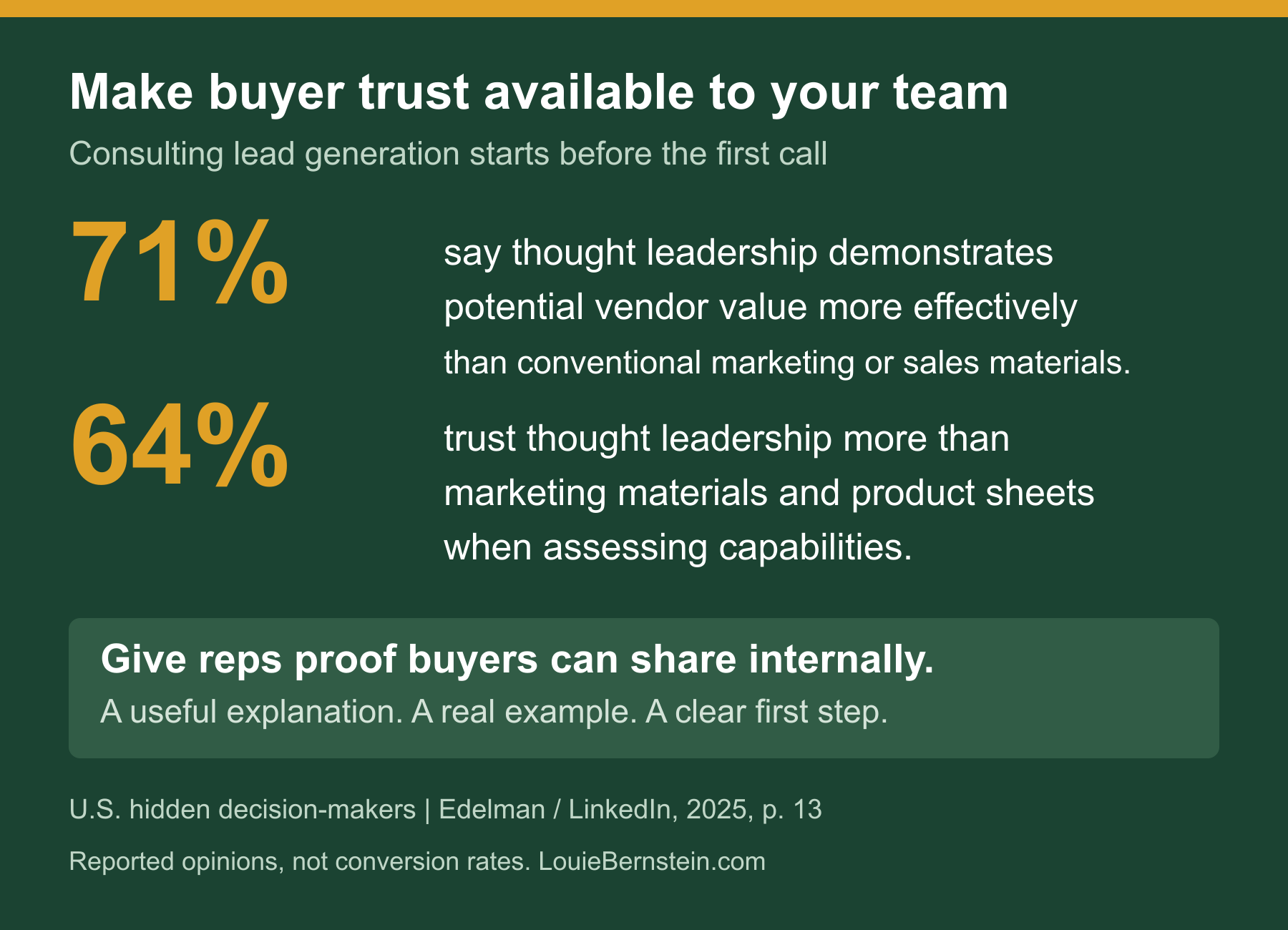
In Edelman and LinkedIn's 2025 U.S. findings, 71% of hidden decision-makers rated thought leadership more effective than conventional marketing or sales materials at showing potential vendor value. 64% trusted thought leadership more than marketing materials and product sheets when assessing capabilities (Edelman/LinkedIn, p. 13).
Those are reported opinions, not conversion rates or consulting-only results. They support a practical choice: let prospects examine how your firm thinks. Give the team a specific explanation of a buyer problem that can be forwarded to finance, operations, or another stakeholder who won't attend your first call.
What's the best way for me to build a sales team?
Build your consulting sales team around the work buyers need done: consistent prospecting, credible discovery, expert diagnosis, and commercial follow-through. Assign an owner to each responsibility before deciding job titles. Choose people who can learn your buyer's business, and give a sales leader responsibility for coaching rather than leaving every question with the founder.
Keep a consultant close to the sale
A consulting salesperson needs access to delivery expertise. The rep can research accounts, follow up, qualify initial interest, and manage next steps. A consultant can join when the buyer needs a serious discussion of feasibility. Give that consultant scheduled capacity so sales doesn't compete with billable work for every answer.
Hinge's 2026 professional-services webinar reports that seller-doers represented 34.4% of full-time equivalents at high-growth firms with $1M to $4.9M revenue, versus 15.7% at no-growth firms in the same size band (Hinge, slide 23). Seller-doers both sell and deliver client work. The association doesn't prove a staffing formula, but it challenges the idea that expertise should disappear from sales when the founder steps back.
Interview for the actual work
Give candidates an anonymized account brief and ask them to explain whom they'd contact, why the account fits, and what they'd say. Role-play a prospect with a plausible problem who wants free advice. Watch whether the candidate asks useful questions, respects scope limits, and earns a next step.
Put prospecting, CRM updates, qualification, and handoff duties in an Accountabilities Document. Don't promise that one hire will also create your positioning, invent the process, manage delivery, and teach themselves the business. Decide who will coach the person before you make the offer.
How do I hand off referrals and outreach without losing trust?
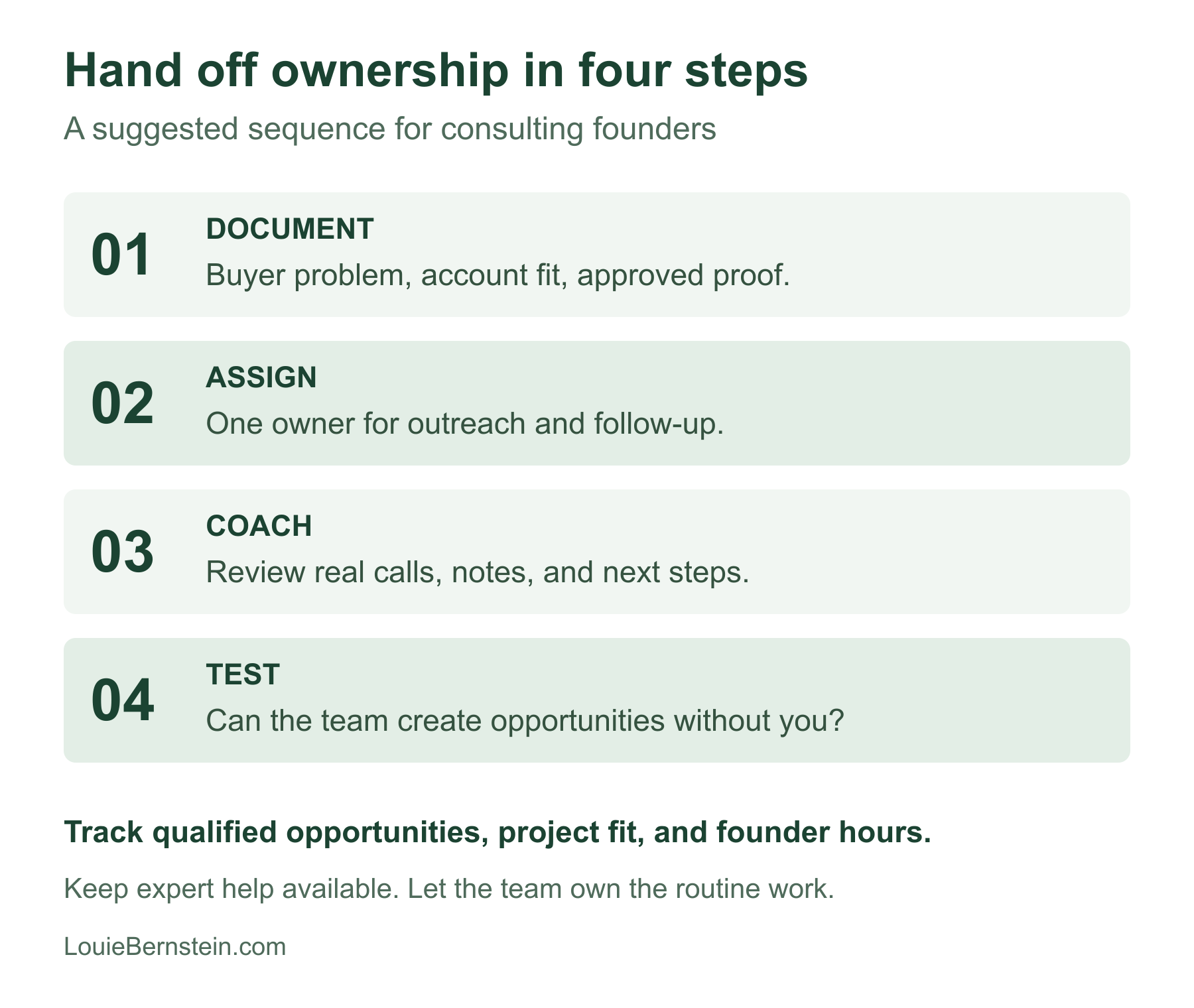
Hand off consulting referrals by introducing a named team member, explaining that person's role, and keeping the first promise small and specific. The founder can sponsor the relationship while someone else owns follow-up. Transfer routine work first, then reduce founder involvement as the team demonstrates sound judgment and buyers accept the new owner.
Use a handoff the buyer can understand
- Name the owner. Tell referral partners who will respond and why that person understands the work.
- Give the owner the history. Record what the partner knows, what the buyer needs, and what you already promised.
- Let the owner act. Have the team member schedule, qualify, and send the recap. Don't quietly redo each step.
- Review the evidence. Coach from the message, meeting notes, and agreed next action.
Keep outreach honest. A team member shouldn't impersonate you or imply a personal relationship that doesn't exist. If outreach uses your name, make the sender's role clear. A short, relevant note from someone who knows the problem is more credible than manufactured familiarity.
Give the team routes beyond your address book
Start with one repeatable source alongside referrals: a focused account list, a partner relationship, or educational sessions for a defined buyer group. Make the team responsible for research, invitations, follow-up, and qualification. You can contribute expertise on a schedule without owning the entire campaign.
If every opportunity still begins with your personal introduction, the handoff remains incomplete. The founder sales handoff should gradually move ownership to the team, with explicit reasons for bringing you back into a conversation.
What should I measure before stepping back further?
Before stepping back further, measure qualified opportunities created without founder intervention, their progress, and the founder hours required to produce them. A full calendar can hide weak buyers and unpaid consulting. Judge the handoff by whether your team creates suitable work at acceptable economics while your routine sales involvement declines.
Review quality and independence together
Track the source, named owner, buyer problem, agreed next step, and founder involvement for each opportunity. Separate team-created opportunities from founder introductions. Compare qualification and eventual wins by source once enough deals have matured. Don't treat a handful of early meetings as a reliable conversion benchmark.
Include expected project margin and delivery capacity. A campaign that fills the pipeline with custom work your team can't profitably deliver creates another founder bottleneck. A smaller number of suitable projects can be worth more than a calendar full of exploratory calls.
Test a planned absence
Try one normal prospecting week without routine founder participation. Keep an emergency contact available, but let the team research, follow up, qualify, and run the review. Write down where work stopped. A missing case example calls for better proof. Unclear scope limits call for a delivery rule. Reps waiting for approval on every email need coaching and authority.
A 12-week build can establish the playbook, responsibilities, coaching, and an initial handoff test. It doesn't guarantee independent revenue by week 12, especially when projects have long buying cycles. For a firm with no sales system, building those foundations is the first job. Hiring more prospectors won't remove the need.
Related Reading
Frequently Asked Questions
Q: Should I pay commission on consulting revenue or gross profit?
Choose a compensation basis that protects project economics and can be measured consistently. Gross profit can discourage unprofitable scope promises, but the rep needs a clear calculation and visibility into the inputs. Write down how discounts, subcontractors, cancellations, and collected payments affect compensation.
Q: Can an appointment-setting agency replace my first salesperson?
An agency can execute a defined outreach process, but someone inside your firm must own qualification and follow-through. Test a small segment, review actual conversations, and agree what makes a meeting acceptable. Paying for meetings without checking fit can fill your calendar with unpaid advice calls.
Q: What if my consulting work is confidential?
Use client-approved anonymized examples, your diagnostic method, or a clearly labeled hypothetical example. Explain the problem and your reasoning without exposing client information. Never turn an anonymized example into an invented result or imply permission to name a client.
Q: Should AI write the team's prospecting messages?
AI can help draft and organize messages after your team defines the buyer, problem, and approved proof. A person must verify relevance and factual claims before sending. Don't let software invent relationships, client outcomes, or expertise your firm doesn't have.
Q: What if prospects demand free recommendations before buying?
Give enough insight to show you understand the problem, then define the boundary between qualification and paid diagnosis. Explain what a scoped assessment would produce and what the buyer needs to provide. Teach the rep to hold that boundary without dismissing legitimate buyer questions.
Build the sales team your consulting firm can support
If you're still creating every lead and closing most deals, I'll help you identify what must be documented, who should own the work, and where you can step back. My Fractional Sales Leadership engagements are 12 weeks, renewable, at $14K per month for 20 to 35 hours per week.
Schedule a 30-minute conversationAbout the Author
Louie Bernstein is a Fractional Sales Leader with 50 years of sales experience and has worked as a Fractional Sales Leader since 2017. He built MindIQ, an IT training and consulting business, and helps founders at $1M to $10M ARR build repeatable sales systems.