What Kind of Experience Do I Need?
You become a Fractional Sales Leader by having already done the job a founder needs done: built a sales process from scratch, hired and coached salespeople, owned a team number, and lived through deals and hires that went wrong. Most working fractionals have more than 15 years behind them. Then you pick one type of company to serve, package a clear offer, and build a reputation that brings founders to you.
Key Takeaways
- To become a Fractional Sales Leader, you need a track record of building and leading sales teams, not just a record of closing your own deals.
- In a 2024 Frak survey of 250 fractional professionals, 72.8% had more than 15 years of experience and only 6.4% had under 10.
- Founders at $1M to $10M ARR pay for judgment they can use in week one. Your failures, and what you learned from them, are part of that judgment.
- Write down three times you built something in sales from nothing: a process, a team, a forecast. If you can't fill the list, take one more leadership role first.
- Your first clients come the way you'd tell any founder to sell: a narrow ideal customer, a defined 12-week offer, and a reputation buyers can see before they call you.
A lot of sales leaders want this job right now. The Fractional Jobs 2026 Fractional Work Report counted 688 aspiring fractional workers among its 1,733 survey responses. That's roughly 40% of the people answering who want in but aren't working fractionally yet (Fractional Jobs, 2026).
The demand is real, too. Frak estimated that the number of fractional leaders doubled from about 60,000 in 2022 to 120,000 in 2024. But growth in supply means founders have more choices, and they're getting pickier about who they let near their pipeline.
Founders don't hire a Fractional Sales Leader to learn on their dime. They hire someone who has already made the expensive mistakes somewhere else.
I've been a Fractional Sales Leader since 2017, after 50 years in sales and 22 years running MindIQ. Here's the honest answer to what it takes, and how to tell whether you're ready.
What kind of experience do I need to become a Fractional Sales Leader?
To become a Fractional Sales Leader, you need experience building and running a sales function, not just selling inside one. Founders hire a fractional leader to install a process, coach a team and own a forecast in 20 to 35 hours a week. Without that leadership record, there's nothing for a founder to buy.
You've built it, not just inherited it
The founders I work with are at $1M to $10M ARR and stuck in founder-led sales. They usually have no written sales process, no consistent pipeline stages and no way to forecast. A Fractional Sales Leader walks into that and builds the system: the Sales Playbook, the stages, the hiring profile, the weekly cadence.
If every sales leadership job you've held came with a process already in place, you've run a machine someone else designed. That's valuable. It's not the same as designing one. Founders need someone who can write a Sales Playbook from a blank page, because that's usually where they're starting.
You've owned a team number
Carrying your own quota and owning a team's number are different jobs. When the number is the team's, you live with forecasts, missed months, reps who freeze and deals you can't save yourself. A Fractional Sales Leader has to sit with a founder and explain why the quarter will land where it will land. You learn that only by doing it.
You've hired, coached and let people go
Most founders I meet have made at least one bad sales hire. They want someone who has interviewed a lot of salespeople, knows the warning signs, and has had the hard conversation when a rep wasn't working out. If you've never fired anyone, a founder will find that out in the first interview.
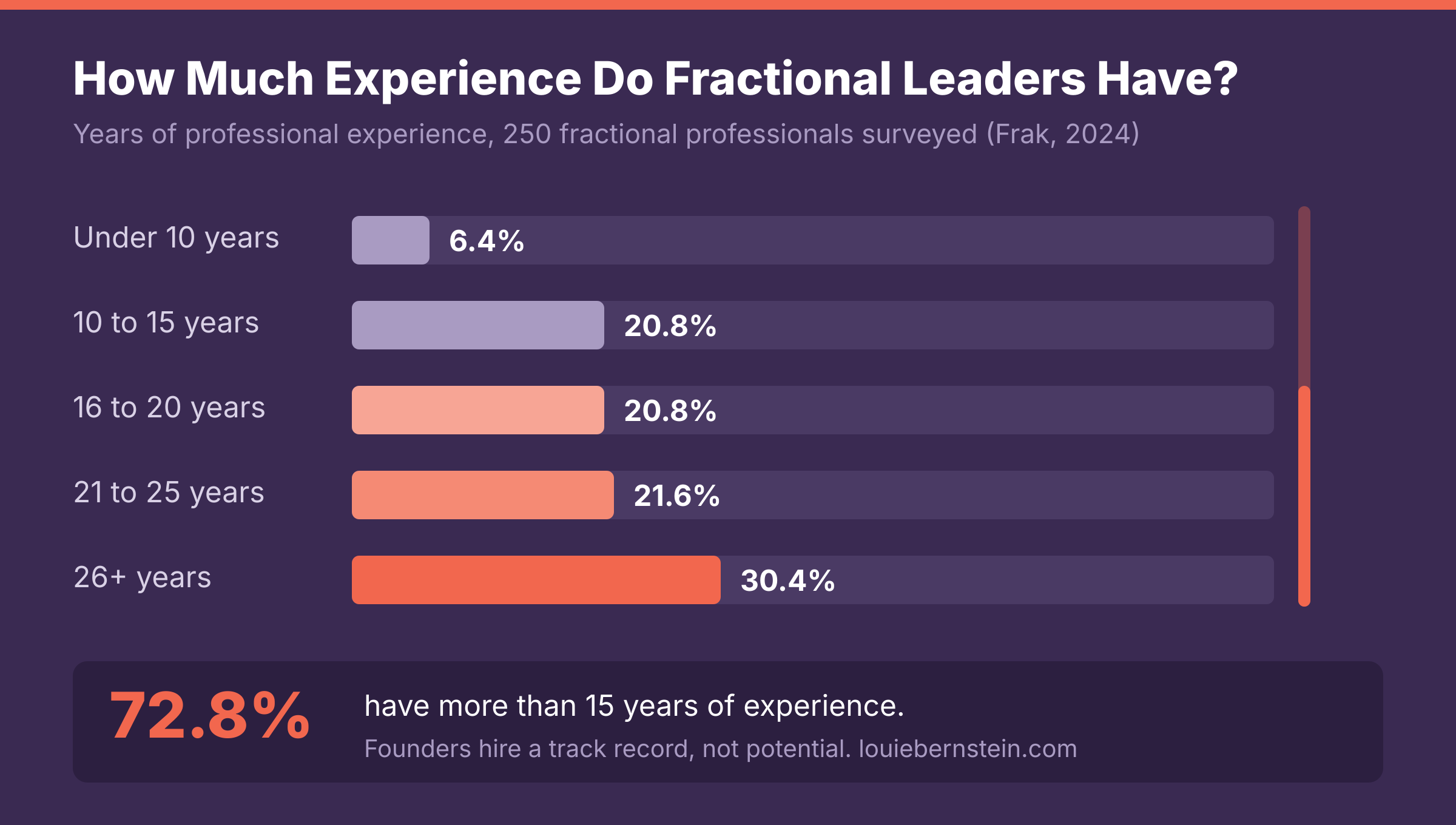
The numbers back this up. In Frak's 2024 State of the Fractional Industry survey of 250 fractional professionals, 72.8% had more than 15 years of experience and 30.4% had 26 years or more. Only 6.4% had fewer than 10 years. Fractional work is mostly a second act for people with long careers behind them.
Is being a top salesperson enough to become a Fractional Sales Leader?
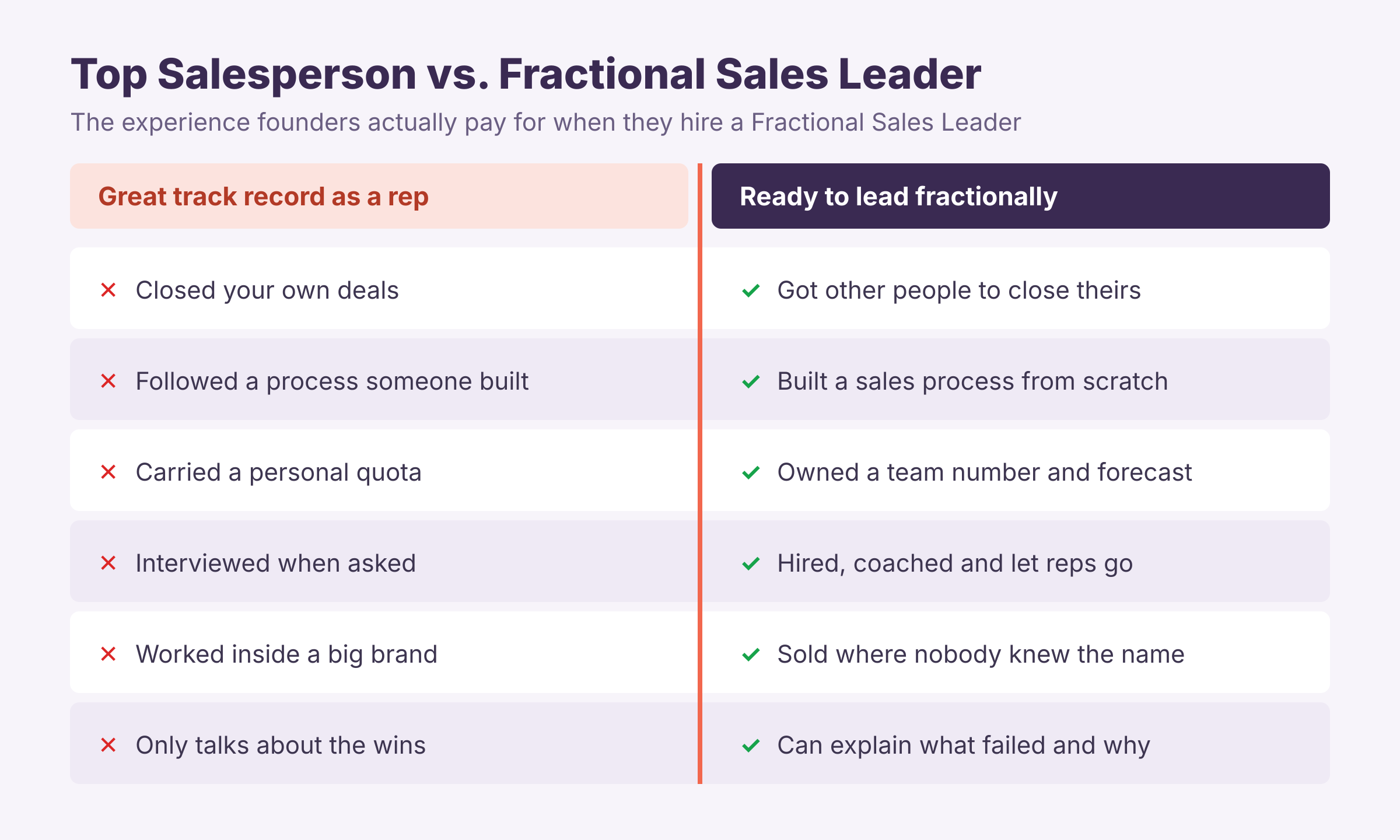
No. Being a top salesperson isn't enough to become a Fractional Sales Leader, because the job is getting other people to sell, not selling yourself. A founder already has one great closer: the founder. What the founder lacks is someone who can turn that closing ability into a process other people can follow.
This is where a lot of strong reps get caught. They've been the top performer for years, and they assume leadership is the next rung. Some of them make great leaders. Many don't, and they don't find out until they're responsible for six people who sell differently than they do.
Smaller companies are a different sport
Selling for a known brand and selling for a company nobody has heard of are two different skills. At a $3M ARR company, there's no marketing engine, no brand recognition and no sales ops team. If your career has been inside large organizations, get some time in a smaller one before you try to lead one part-time.
Accountability without authority
As a Fractional Sales Leader, you lead a team you didn't hire, in a company you don't own, for a founder who can overrule you. You get results through clear expectations, not a title. That's why I put every salesperson's job in an Accountabilities Document: when the expectations are written and agreed, the conversation is about the work, not about who's in charge.
Why do failures matter when you become a Fractional Sales Leader?
Failures matter because founders buy a Fractional Sales Leader's hard lessons as much as the successes. A founder wants someone who can say, "I've seen this break, here's why, and here's what we do instead." That answer only comes from having been there when things went wrong.
What I've seen in real sales teams
I ran MindIQ for 22 years and took it through four recessions. For a long stretch I was my own best salesperson, and I made most of the mistakes I now help founders avoid: hiring reps who interviewed well and couldn't sell, holding on to deals too long, waiting too long to write the process down. Those mistakes cost real money. They're also the reason founders listen when I tell them what's about to happen.
When people ask me about going fractional, I tell them the same thing: build the track record first, and include the failures. If you've only ever been part of winning teams, you haven't seen what a founder is living through right now. You'll recognize the problems late.
Your wins get you the meeting. Your failures, and what you did about them, get you the engagement.
Where new fractionals usually get this wrong
The most common mistake I see is treating the work like a smaller version of a full-time VP of Sales job. It isn't. A full-time VP has time to learn the company. A Fractional Sales Leader has 12 weeks to show progress, so you need a repeatable way to diagnose a sales team fast. Mine is the SCALE Framework. Yours can be different, but you need one before your first client, not after.
How do I land my first clients as a Fractional Sales Leader?
You land your first clients as a Fractional Sales Leader the same way you'd tell a founder to build pipeline: pick a narrow ideal customer, make a clear offer, and show up where those buyers already look. Most new fractionals start too broad and end up competing on price with everyone else.
Pick who you serve
"I help B2B companies grow sales" describes thousands of people. "I help B2B founders at $1M to $10M ARR get out of founder-led sales" describes a buyer who knows they have the problem. Pick the stage, industry or situation where your experience is deepest, and say it plainly.
Package a defined offer
Founders want to know what they're buying, how long it lasts and what it costs. My engagements are 12 weeks, renewable, and most fractional clients renew for 6 to 12 months total. Other Fractional Sales Leaders, Fractional VPs of Sales and Fractional CROs typically charge $10K to $20K a month. That's roughly half the cost of a full-time VP of Sales at $250K to $400K a year, which is the comparison every founder makes.
Do the capacity math before you set a price. At 20 to 35 hours a week per client, you can't take on many clients at once. Go Fractional's 2026 State of Fractional Work report found most fractional professionals work with two or three clients at a time.
Build a reputation founders can find
Most of my clients find me through LinkedIn. I write about the problems founders face every week, and founders reach out when the problem is theirs. Referrals from your old network can get you started, but a public record of how you think is what keeps the calendar full. You're doing founder-led sales for your own practice now, so do it the way you'd coach someone else to.
How do I know if I'm not ready to become a Fractional Sales Leader yet?
You're not ready to become a Fractional Sales Leader if you can't point to a sales team you built or turned around, a forecast you owned, and a failure you can explain. Those gaps don't mean never. They mean one more leadership role first, ideally at a small company where you have to build from scratch.
Run this test on yourself before you print business cards:
- Name three times you built something in sales from nothing: a process, a team or a forecast.
- Name two salespeople you hired who succeeded, and one you had to let go.
- Explain one quarter you missed, why it happened, and what you changed.
- Describe the type of company you'd serve in one sentence a founder would repeat.
- Write the first 30 days of a 12-week engagement from memory.
If you can do all five, you're closer than most of the people trying. If you get stuck on two or more, go get that experience as a full-time leader first. Founders use the same questions to vet a Fractional Sales Leader, so you'll hear them in your first sales calls anyway.
What Is a Fractional Sales Leader? The Capital-Efficient Model for Scaling Out of Founder-Led Sales
Frequently Asked Questions
Do I need to have been a VP of Sales to become a Fractional Sales Leader?
You don't need the VP title, but you need the VP experience: building a process, hiring, coaching and owning a team forecast. A sales director who built a team from zero at a small company can be better prepared than a VP who inherited a large, well-run organization.
Can I start fractional work while I still have a full-time job?
Usually not well. A Fractional Sales Leader working 20 to 35 hours a week per client can't do that on nights and weekends, and founders notice when you're not available. Check your employment agreement, and plan a clean break once you have a first client signed.
Is there a certification for Fractional Sales Leaders?
There's no required license or certification to become a Fractional Sales Leader. Training programs exist, and some can help with packaging and pricing. Founders hire on track record and references, though. No certificate replaces having built a sales team.
Should I join a fractional firm or go out on my own?
Joining a fractional firm can give you deal flow and structure while you learn the model, in exchange for a share of the fee and less control. Going solo means you keep the fee and your brand, but you have to find every client yourself. Pick based on how strong your network and reputation already are.
How long does it take to land the first fractional client?
It depends on your network and reputation more than anything else. Someone with a visible LinkedIn presence and founders who already trust them can sign a first client quickly. Someone starting from zero visibility should plan for months of consistent writing and outreach before the inbound conversations start.
Need this experience in your company, not just on a résumé?
If you're a founder at $1M to $10M ARR who's still doing all the selling, a Fractional Sales Leader brings 12 weeks of hands-on leadership to build your sales process and coach your team. Learn more at LouieBernstein.com, or let's talk.
Schedule a 30-Minute CallAbout the Author
Louie Bernstein is a Fractional Sales Leader with 50 years of sales experience and has provided fractional sales leadership since 2017. He founded and ran MindIQ for 22 years, earning a place on the INC 500, and now helps B2B founders at $1M to $10M ARR build Sales Playbooks, defined sales processes and teams that sell without the founder in every deal.