Key Takeaways:
- Competitive differentiation is not your feature list. It's the reason a buyer picks you when your product and your competitor's product look the same on paper.
- 64% of B2B buyers can't tell one brand's experience from another (Gartner). When you don't differentiate, you get sorted by price. That's a race you don't want to win.
- Differentiation is built in five steps, in order: nail your ICP, map the field, build your case, prove it, then out-listen and out-explain the competition.
- The biggest differentiator you own is the experience of buying from you. Previous experience with the company is the number-one B2B purchase driver, ahead of price (Forrester).
- Never bad-mouth a competitor. Explain why you're the better choice instead. Buyers trust that, and they don't trust mudslinging.
- If differentiation lives only in the founder's head, you don't have a differentiator. You have a bottleneck. It has to be written down and repeatable by your team.
Here's a question I get from founders more than almost any other: "How do I establish competitive differentiation?" Usually it comes right after they've lost a deal to a competitor they think is worse than they are.
And here's the hard truth. Gartner found that 64% of B2B customers can't tell one brand's experience from another. Not the product. The whole experience. Your prospects are sitting across from you and your three competitors, and to them, you all sound the same.
When buyers can't tell the difference, they default to the one thing they can measure: price. That's how good companies with better products end up discounting their way to a deal, or losing it outright.
I've been in sales for fifty years. I've watched inferior products beat superior ones over and over, and it's almost never because the winner had better technology. It's because the winner was easier to understand, easier to trust, and easier to buy from. That's what differentiation actually is. And the good news is, it's built, not born. Here are the steps your team needs to take right now.
Differentiation Is Not Your Product. It's the Experience of Buying From You.
Most founders answer the differentiation question by listing features. "We're faster." "We have better integrations." "Our AI is smarter." I understand why. You built the thing. You know every advantage it has. But your buyer doesn't experience your feature list. They experience the process of trying to figure out whether to trust you.
And that process is miserable for them. Gartner found that 77% of B2B buyers describe their most recent purchase as "very complex or difficult." Your prospect isn't lying awake comparing your API to your competitor's. They're overwhelmed, they're afraid of making the wrong call, and they're looking for the vendor who makes the decision feel safe.
This is why Forrester found that the number-one driver of B2B purchase decisions isn't price. It's previous experience with the company, which came in at roughly double the next factor and well ahead of price. People buy from the company that made them feel understood. As I've said for decades, prospects aren't looking for someone to sell them something. They can order a product from anyone. They're looking for a resource that helps them succeed.
"I out-listen and out-explain my competition." That's a differentiator no competitor can copy off your website, because it lives in how your team sells, not in what you sell.
So when you sit down to establish differentiation, don't start with the product. Start with the buyer, and work backward to the handful of things that make choosing you the obvious, low-risk decision. Here's how to do that in five steps.
The Five Steps Your Team Needs to Take Right Now
Differentiation isn't a tagline you write in an afternoon. It's a sequence of work, and the order matters. Skip a step and the ones after it fall apart. Here's the sequence I take founders through.
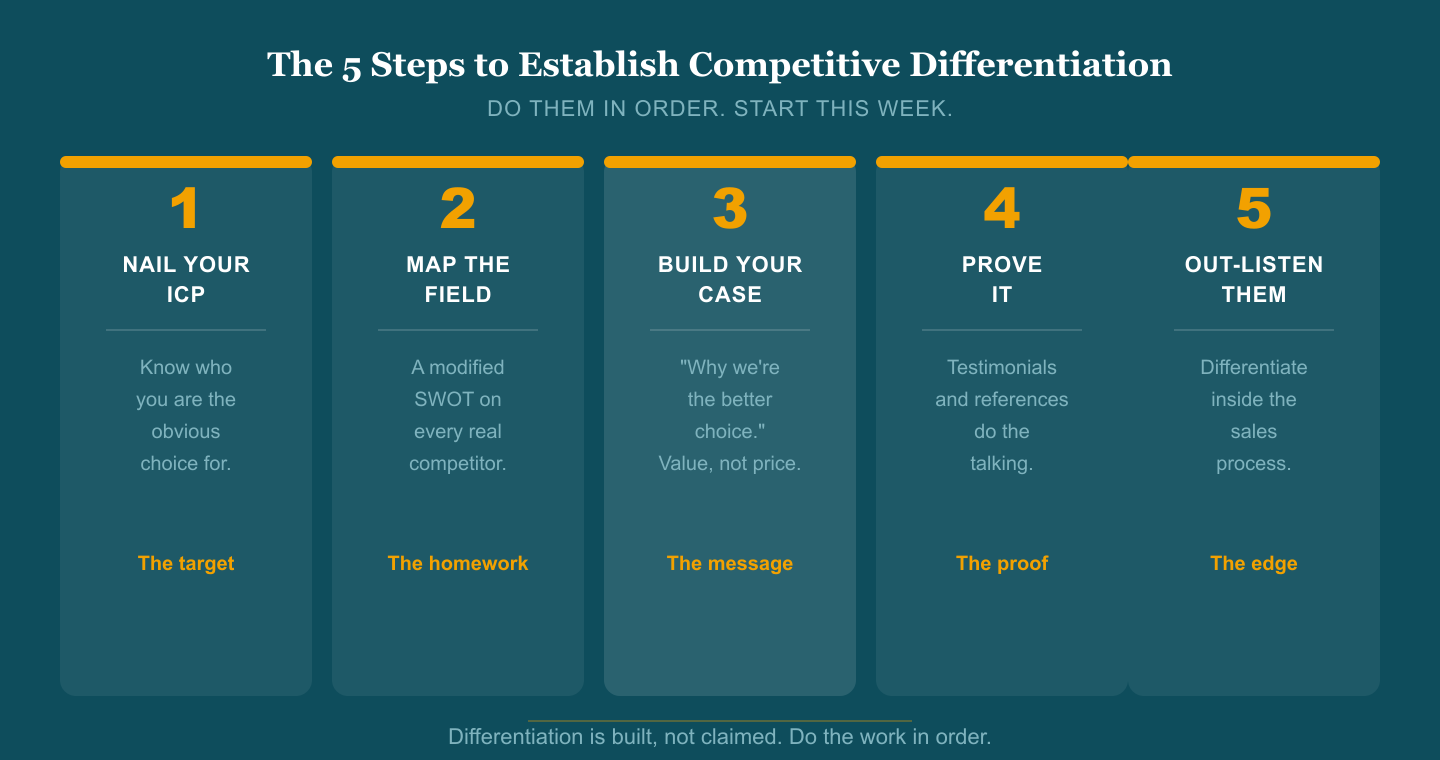
Step 1: Nail Your ICP
You can't be different for everyone. Differentiation only means something to a specific buyer with a specific problem. The tighter your Ideal Customer Profile, the sharper your differentiation gets, because you're no longer trying to be a little bit better for the whole market. You're trying to be the obvious choice for one kind of company.
Get specific. What size company? What stage? What problem are they feeling badly enough to spend money on? When you know exactly who you're the right answer for, your differentiators stop being generic ("we're reliable") and start being pointed ("we're the only option built for a $3M ARR team that just lost its founder-seller"). If you're not sure who yours is yet, that's step zero, and it's worth reading what to do when you don't know who your ICP is before you go further.
Step 2: Map the Field
You can't differentiate against competitors you don't understand. Build a simple, honest map of who you're really up against. I use a modified SWOT: list each competitor, their genuine strengths, and their real weaknesses. Not the strengths and weaknesses you wish they had. The ones your buyers actually talk about.
Assume your competition is doing the same thing to you right now. You need to know their pricing, their positioning, and where they consistently let customers down. That last column, the weaknesses, is where your differentiation lives. If a big competitor has a huge support staff but is expensive and slow, your opening is speed and value. Every deal you lose is free market research. Do a quick loss review and you'll see the patterns.
Step 3: Build Your Case
Now you take what you learned in steps one and two and write it down: three to five reasons a buyer in your ICP should choose you over the specific alternatives they're considering. This is your case, and it has to be framed in value, not price and not features.
The difference between a feature and a value statement is the difference between "we have real-time reporting" and "you'll walk into your Monday meeting already knowing your number instead of chasing it." Buyers don't buy the feature. They buy the outcome the feature produces. Your real leverage in any deal is the value of your product relative to how badly your buyer needs it. That's a much stronger position than price, because a competitor can always cut price at the last minute. They can't cut the value you've helped the buyer see.
Step 4: Prove It
Anybody can claim to be different. Your buyer has heard every claim, from you and from everyone you compete with. Proof is what breaks the tie. And the strongest proof you own is the voice of a happy customer, because your prospect is far more likely to believe what someone else says about you than what you say about yourself.
Get testimonials and references, and make the process easy for the customer. The best time to ask is right after they've had a win with your product, while they're proud and grateful. Then use that proof where it counts: on your site, in your proposals, and on your sales calls. A customer in your buyer's exact industry saying "this is why we picked them" does more differentiating than any deck you'll ever build.
Step 5: Out-Listen and Out-Explain Them
This is the step almost everyone forgets, and it's the one no competitor can copy. Your final differentiator is how your team sells. Gartner studied this directly. Sellers who take a "sense-making" approach, meaning they help the buyer cut through the noise and understand their own situation, closed high-quality, low-regret deals 80% of the time. The sellers who just dumped information did far worse.
Out-listening the competition means your reps ask better questions and actually hear the answers. Out-explaining them means your reps make a complex decision feel clear. When your competitor's rep is pitching features and your rep is helping the buyer make sense of the whole decision, you win, even when the products are close. This is differentiation you can't be undercut on.
The Trap Everybody Falls Into: Competing on Price
When you haven't done the five steps, there's only one lever left to pull, and it's price. This is the trap. You discount to win, your margin bleeds, and you've trained that customer to expect a discount forever. Worse, you've taught your own team that the way to close is to give something away.
Average salespeople think their only leverage is a lower price. They never get to the point in the conversation where they fully understand the buyer's pain, so price is all they've got. Differentiated salespeople never have to go there, because they've made the value obvious. Here's what the two conversations actually look like side by side.
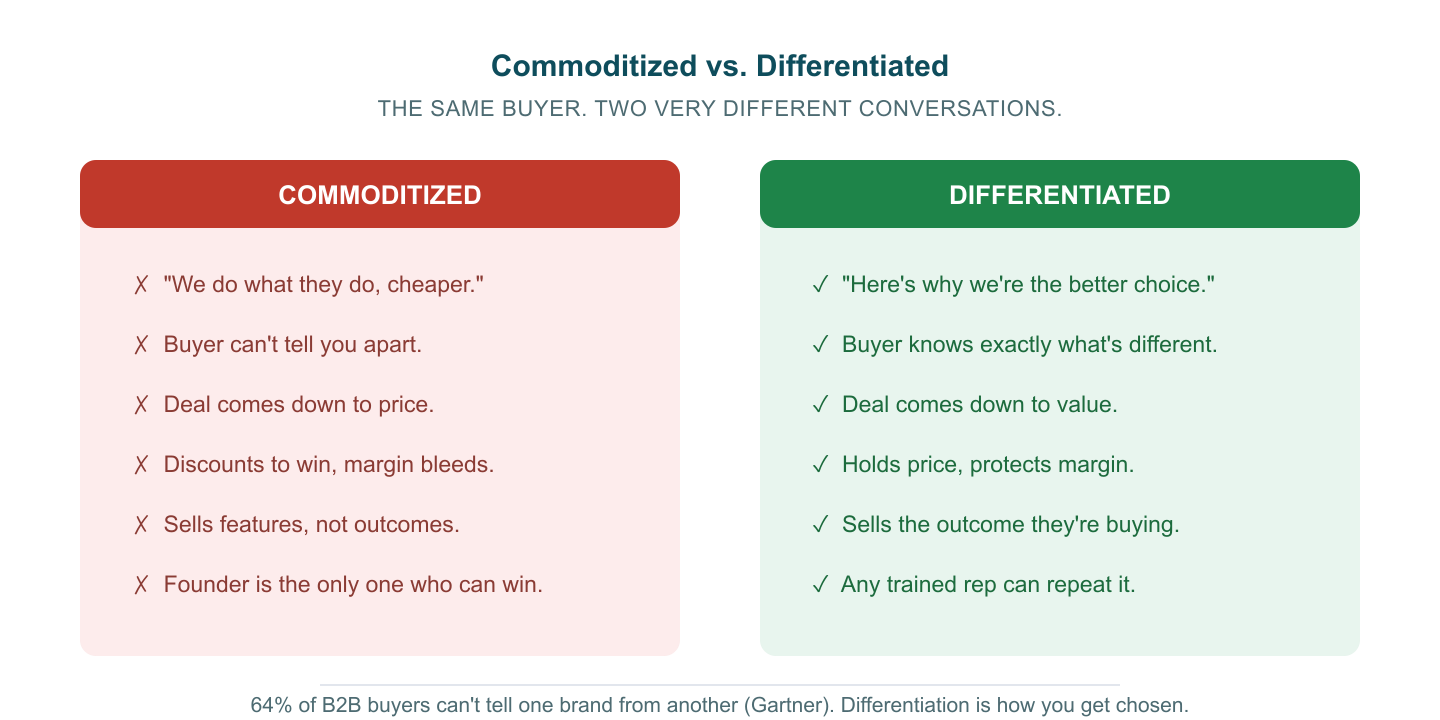
There's one more piece of this that founders get wrong, especially when a deal gets competitive. When a prospect brings up a rival, don't take the bait and start knocking them. It never works. It makes you look small and it makes the buyer defensive, because they're the one who put that competitor on the shortlist.
When a buyer asks about a competitor, I say: "I can't really speak to them. But I can explain exactly why we're the better choice for you." Then I do. Every time.
That single move differentiates you before you've said a word about your product. You've just shown the buyer you're confident, you're fair, and you're focused on them instead of your competition. That's the posture of a company worth trusting.
Why Founders Can't Build This Alone
Here's the part that stings. Most founders between $1M and $10M ARR already have great differentiation. It's just trapped inside their own head. You can out-listen and out-explain any competitor in the room, because you know the product and the customer better than anyone. The problem is that none of it is written down, and none of it is repeatable. So every differentiated conversation depends on you being in the room.
That's not a differentiator. That's a bottleneck. And it's the exact thing that keeps you stuck in founder-led sales, unable to hire a rep who can win the way you win. Establishing competitive differentiation, the real kind, means pulling it out of your head, writing it into your sales process, and training a team to run it without you. That's the work I do as a Fractional Sales Leader: I turn the thing you do on instinct into a system anyone on your team can repeat.
One honest caveat. If you don't have paying customers yet, if you're still hunting for product-market fit, this work is premature. You can't differentiate a product the market hasn't validated. Differentiation is for founders who are already winning some deals and want to win a lot more of them, predictably, without being the only person who can close. If that's you, we should talk.
Frequently Asked Questions
Q: What is competitive differentiation in B2B sales?
Competitive differentiation is the specific, believable reason a buyer chooses you over the alternatives when the products look similar. In B2B it's rarely the product itself. It's the combination of a tightly defined ideal customer, a value-based case for why you're the better choice, proof from happy customers, and a sales team that helps the buyer make a hard decision feel clear. It's the answer to the buyer's real question: "Why should I pick you and not them?"
Q: Why isn't my product a good enough differentiator?
Because your buyer can't see it the way you do. Gartner found 64% of B2B buyers can't distinguish one brand's experience from another, and 77% say the purchase itself is very complex or difficult. To an overwhelmed buyer comparing four vendors, everyone's features blur together. A better product only wins if the buyer can clearly understand why it's better and trust that it's true. That understanding and trust is the differentiator, and it's built in the sales process, not in the spec sheet.
Q: How do I differentiate when a competitor is cheaper?
You move the conversation off price and onto value. Your leverage is the value of your product relative to how badly the buyer needs the problem solved, not your price tag. Help them quantify the cost of the problem and the outcome you'll deliver, and price becomes one factor instead of the only factor. A competitor can drop their price at the last minute. They can't drop the value you've helped the buyer see. And don't run from price when they ask. Give a range and tie it to the outcome.
Q: Should I mention my competitors by name on a sales call?
You can acknowledge them, but never bad-mouth them. It backfires. When a buyer names a competitor, the honest move is to say you can't really speak to them, and then explain exactly why you're the better choice for this buyer's situation. That shows confidence and fairness, which are differentiators in themselves. You should absolutely know your competitors cold internally, so you can position against their real weaknesses. Just don't trash them out loud.
Q: How long does it take to establish competitive differentiation?
You can draft the five steps in a week or two of focused work. Making it real, meaning written into your sales process and repeatable by every rep, takes longer, usually a few weeks to a couple of months depending on how much of it currently lives only in the founder's head. The draft is fast. The discipline of getting your team to run it consistently is where most companies stall, and it's the part that actually protects your margins.
Q: What if I'm the only one who can sell our differentiation?
That's the most common situation I see, and it's the real problem hiding behind the differentiation question. If only you can explain why you're better, you don't have a differentiator, you have a dependency. The fix is to extract what you do on instinct, write it into an ICP, a competitive map, a value-based case, and a repeatable call structure, and then train your team on it. That's exactly the work a Fractional Sales Leader does, and it's how you finally get out of the room without deals falling apart.
Your differentiation is probably trapped in your head. Let's get it out.
If you're a founder between $1M and $10M ARR who can out-sell any competitor but can't hire anyone who can, that's exactly what my 12-week CEO program fixes. We build your ICP, your competitive edge, and a sales system your team can run without you. See how it works.
See the CEO Program →About the Author
Louie Bernstein
Fractional Sales Leader with 50 years of sales experience helping $1M–$10M ARR companies build scalable, repeatable sales systems. Founder of MindIQ (INC 500). LinkedIn Top Voice in Sales Management, Sales Operations, and Sales Coaching.