How Do You Avoid the Enterprise-Rep and Pure-Network Hire Traps?
Build a sales hiring scorecard around the work your company needs done now: finding buyers, qualifying deals, advancing decisions, and keeping usable records with the support you actually provide. Define observable evidence for each skill, then use the same interview questions and work sample for every candidate. Test enterprise reps without their former company's support system. Test network hires beyond their existing relationships. Hire for repeatable execution in your environment.
Key Takeaways
- A stage-fit hiring scorecard measures whether a salesperson can do your current job with your current resources.
- Write down your buyer, deal size, sales cycle, lead sources, and available support before interviewing candidates.
- Enterprise experience and industry relationships are useful evidence only when the candidate can explain how those advantages translate to your sales motion.
- Use one realistic work sample, give specific feedback, and repeat part of the exercise to observe whether the candidate applies coaching.
- In LinkedIn's 2025 recruiting report, 93% of surveyed talent acquisition professionals said accurate skills assessment matters for improving quality of hire. Agreement isn't proof of hiring success.
The candidate sold to names you recognize. Or the candidate knows everybody in your market. Either can make an interview feel finished before you've tested the job.
For a B2B founder at $1M to $10M ARR, the question is more specific: Can this person create and advance qualified opportunities when your logo doesn't open the door and you aren't available to rescue every call?
Don't hire the support system on somebody else's resume. Hire the work they can repeat in your company.
Your scorecard should make that distinction visible before you make an offer.
How Do You Define the Sales Job for Your Stage?
Define the sales job by the selling conditions a new hire will face, rather than your ARR alone. Two companies at the same revenue can need different salespeople because their buyers, lead sources, deal complexity, and support differ. Write those conditions down before choosing interview questions or assigning scorecard weights.
Write a one-page reality brief
Describe the buyer and buying trigger, typical contract size, normal sales cycle, and where opportunities come from. Separate founder introductions from inbound interest, partner referrals, and prospecting. Name who handles demonstrations, technical questions, proposals, and implementation scoping. A resource you plan to hire later isn't available support today.
Use recent comparable deals to build the brief. Include a loss and a stalled opportunity. Otherwise, you'll describe how selling works when everything goes right and hire someone for a job that rarely exists.
Then choose the main assignment. Are you asking a rep to execute a documented motion, help refine an emerging motion, or manage people already executing it? Those are different jobs. A first salesperson can contribute learning, but shouldn't secretly be responsible for inventing your market, positioning, process, and forecast.
Name what the founder will still own
Write the handoffs: when you'll join, what you decide, and what the rep must handle independently. Put the outcomes in an Accountabilities Document that changes with the role. Candidates deserve to know the job they're accepting.
If you have no defined buyer, no written process, and no repeatable way to explain value, pause the search for an independent executor. Build a minimum Sales Playbook first. A scorecard can reveal a missing foundation. It can't supply one.
What Should a Stage-Fit Hiring Scorecard Measure?
A stage-fit hiring scorecard should measure the few behaviors that produce your required outcomes under your actual constraints. Start with prospecting, discovery, deal advancement, coaching response, and operating discipline. Adjust their importance to the assignment, and define what acceptable evidence looks like before meeting anyone. Keep essential requirements separate from the total score.
Use a practical starting scorecard
For an early rep expected to generate pipeline, try these illustrative weights: prospecting 30%, discovery 25%, deal advancement 20%, coaching response 15%, and operating discipline 10%. Those weights total 100%. They're a starting design, not a validated hiring formula or an industry benchmark.
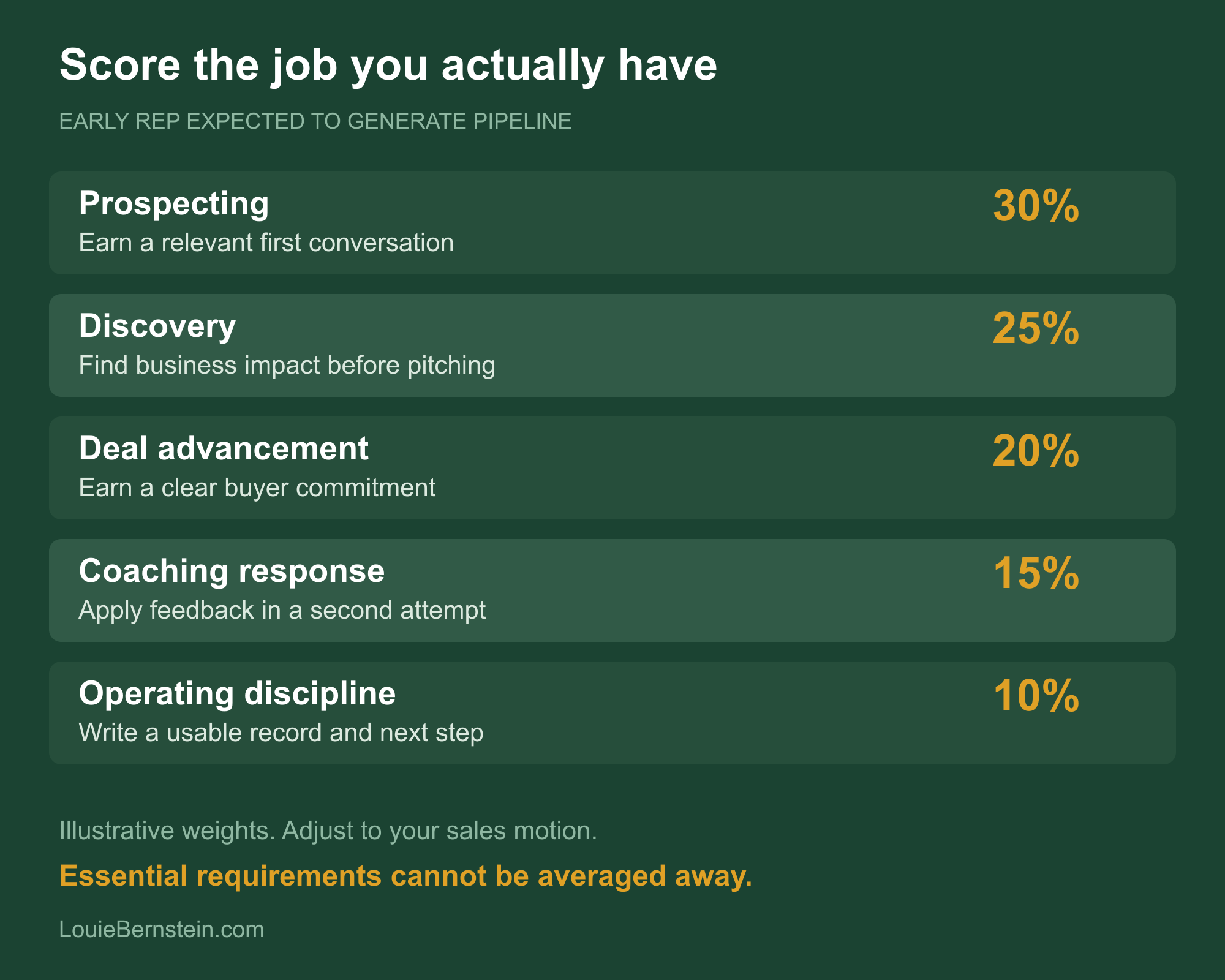
For each behavior, record the question or exercise, the evidence observed, the rating, and any unresolved gap. "Strong communicator" is too loose. "Asked about business impact before offering a demonstration" describes something you can evaluate and coach.
Use clear anchors. On a suggested five-point scale, 1 means the candidate couldn't demonstrate the behavior, 3 means the candidate met the defined requirement, and 5 means the candidate handled added complexity while explaining the judgment. Define 2 and 4 as intermediate performance. Mark missing evidence as untested rather than guessing a score.
Set the conditions that a total cannot override
If the job requires generating opportunities without warm introductions, require acceptable prospecting evidence. A high discovery score can't erase that gap. Don't let a weighted average turn an essential failure into an offer.
The broader reason for skills assessment is well established. LinkedIn's 2025 report found that 93% of talent acquisition professionals viewed accurate skills assessment as crucial to improving quality of hire. The report surveyed 1,271 recruiting professionals at management level or above across 23 countries in September 2024. That's recruiting opinion, not a measured sales-hire success rate (LinkedIn, 2025).
How Do You Avoid the Enterprise-Rep and Pure-Network Hire Traps?
Avoid both hiring traps by separating a candidate's selling ability from advantages supplied by a former employer or existing relationships. Ask how opportunities started, what the candidate personally did, and which resources helped. Then test the work your company needs when brand recognition, specialist support, or familiar buyers aren't available.
Test enterprise experience against your resources
An enterprise rep may be exactly right if your deals involve complex buying groups and the candidate has relevant execution skills. The trap is assuming a large quota proves the candidate can build pipeline at an unfamiliar company.
Ask for a detailed deal reconstruction: Who sourced the opportunity? Who ran discovery? Who built the business case? Who handled technical validation? What did the candidate do when the buyer stopped responding? Protect former employers' confidential information; anonymized examples are enough.
Then change the conditions. "We don't have an SDR or a dedicated sales engineer. Which parts would you own, and where would you need help?" A clear answer can establish fit. A list of resources you cannot provide establishes a mismatch, regardless of the logo.
Test relationships as a channel
A network can open useful doors. Knowing someone doesn't establish buyer fit, a funded problem, purchasing authority, or timing. Ask which types of contacts match your buyer and what happens after the introduction. Don't count promised introductions as qualified pipeline.
Give the candidate an unfamiliar target account and ask how they'd earn a relevant conversation. Follow with: "What would your plan be after your warm introductions are used?" You're testing whether relationships supplement a repeatable process or replace one.
What I've learned to separate
In my work on avoiding the wrong sales hire, I distinguish the logo on a resume from what the person actually did. A polished interview can hide that difference. My practical extension is simple: name the help that made the previous result possible, then compare that help with what your company can provide.
A relationship earns an introduction. The salesperson still has to earn the next step.
What Interview Process Gives You Useful Evidence?
Use a short, structured interview process that moves from comparable past work to a realistic work sample, then checks the remaining questions through references. Give candidates the same core questions, materials, time, and scoring criteria. Score independently before discussing the evidence so the founder's enthusiasm doesn't become everybody else's rating.
Use four deliberate steps
- Reality screen. Share the role brief. Ask the candidate to describe comparable buyers, lead sources, support, and deal cycles. Discuss the actual work, including prospecting and CRM responsibilities.
- Evidence interview. Reconstruct a win and a loss using the same core questions for every candidate. Separate personal actions from team contributions. Record what remains unverified.
- Work sample and coaching. Run a fictional discovery call, ask for a follow-up note, give one specific coaching point, and repeat the relevant portion.
- References and decision. With the candidate's permission, check the work and constraints with people who observed them. Resolve essential gaps before making an offer.
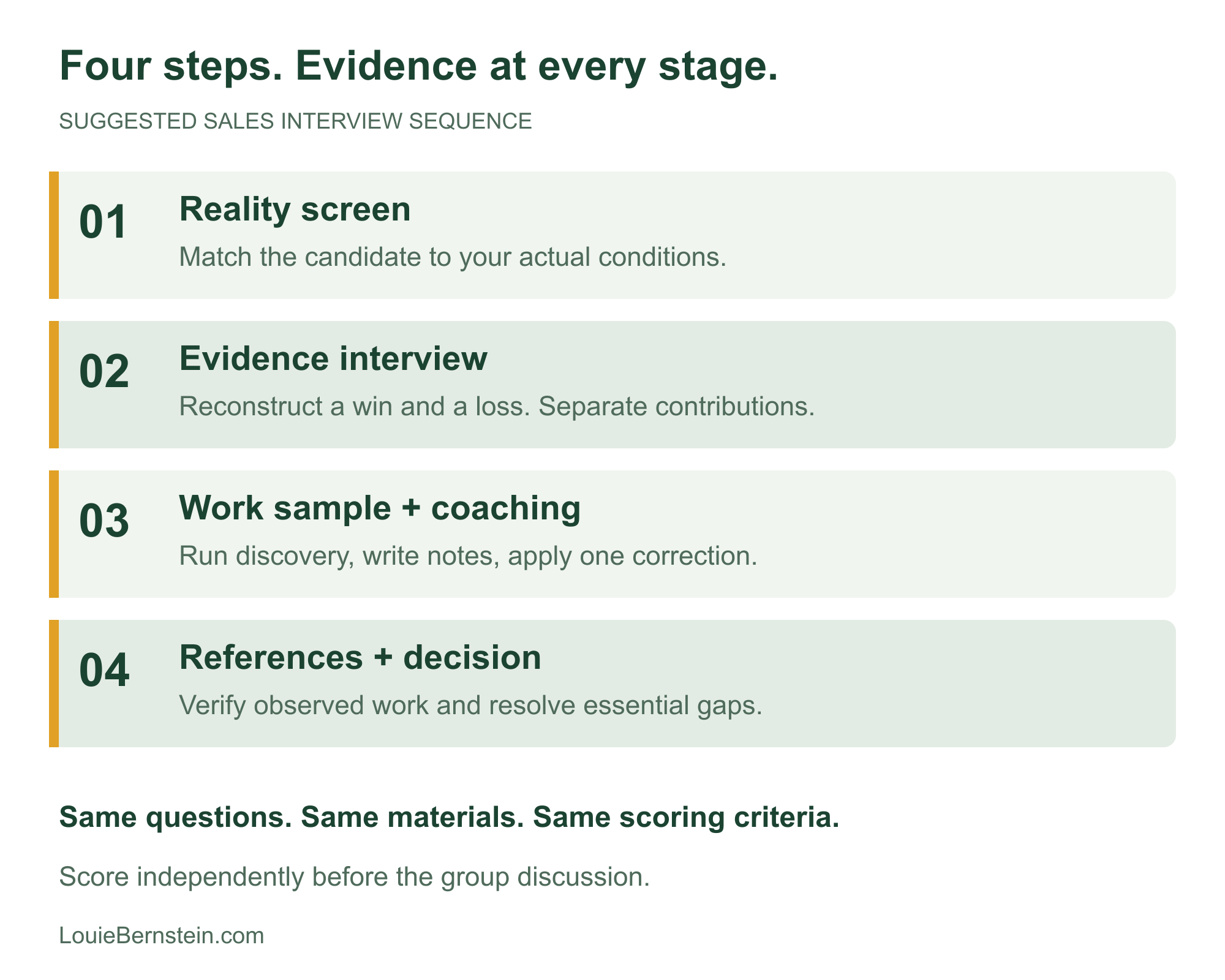
The U.S. Office of Personnel Management describes structured interviews as using predetermined questions and common rating standards. Its guidance supports comparing evidence consistently; it doesn't establish that these particular four steps guarantee sales performance (OPM).
Watch decisions, not theater
Use a fictional buyer who sounds interested but hasn't established a business problem. Does the candidate explore impact, check fit, and earn an appropriate next step? Or does the candidate race to a demonstration and call enthusiasm qualification?
A suggested 45-minute work sample can include 10 minutes to review materials, 15 for discovery, 5 for a written follow-up, 5 for feedback, and 10 to repeat and debrief. These are proposed exercise limits, not research benchmarks. Keep the task narrow and provide what the candidate needs to succeed.
Evaluate the follow-up separately. Can another person understand the buyer's problem, the evidence, the open questions, and the next action? If you still have to translate everything, the candidate hasn't demonstrated the independence you're hiring for.
How Do You Make the Decision and Check Your Scorecard?
Make the hiring decision by comparing documented evidence with requirements set before the interviews, then check those predictions during onboarding. Resolve missing evidence instead of averaging uncertainty into a total. After the hire, compare observed work with the scorecard and distinguish a candidate assessment mistake from missing training, tools, or management.
Discuss disagreements before totals
If one interviewer rates discovery highly and another rates it poorly, ask what each observed. Different standards call for a clearer scoring anchor. Different evidence may call for one focused follow-up. Neither problem gets solved by averaging the ratings and moving on.
LinkedIn's 2025 report found that 89% of talent acquisition professionals expected quality-of-hire measurement to become more important, while only 25% felt highly confident their organizations could measure it effectively. The gap is a reason to document your predictions and check them, rather than treat an offer acceptance as proof of success (LinkedIn, 2025).
Carry the scorecard into onboarding
For each assessed skill, name the early behavior you'll observe and the support you'll provide. Review prospecting quality, discovery notes, buyer commitments, and response to coaching. Set revenue expectations around your actual sales cycle and starting pipeline. A new rep can't close an opportunity that hasn't had time to move.
Use a new-rep performance scorecard to carry those observations forward. If the rep struggles, compare the promised job with the delivered job before blaming the interview. You may have changed the territory, removed support, or failed to teach the process.
A Fractional Sales Leader can help turn your current sales motion into the role brief, scorecard, work sample, and coaching plan. That's useful when the founder knows how to sell but hasn't yet made that judgment teachable to someone else.
Frequently Asked Questions
Q: Should I give candidates the scorecard before the interview?
Share the competencies, job conditions, and exercise expectations. Candidates should know what the job requires. Keep the scoring anchors consistent and evaluate demonstrated behavior rather than rewarding somebody for guessing what you wanted.
Q: Can a junior salesperson fit an early-stage company?
A junior salesperson can fit a documented job with real training and coaching. Don't use a junior title to disguise an unsupported job that requires senior judgment. Match the candidate's current ability to the work and the support you'll deliver.
Q: Should I use a personality assessment?
A personality assessment may provide another discussion point, but it shouldn't replace relevant evidence. Before buying one, ask what the tool measures, how it relates to this role, and what evidence supports its use for your decision.
Q: What if the candidate can't share past sales numbers?
Accept anonymized examples, ranges when appropriate, and explanations of the work. Don't ask for confidential customer data. Use the work sample and permission-based references to investigate the candidate's contribution without requiring proprietary records.
Q: Should a work sample produce usable work for my business?
Use a fictional or sanitized scenario that tests the job without asking for free customer prospecting or a finished business plan. Explain the time commitment in advance. Keep the exercise proportionate to the decision you're making.
Hire for the company you're running today
If your next sales hire still depends on your judgment for every deal, let's examine the job before you make the offer. I'll help you identify what belongs in the scorecard and what belongs in the sales system.
Schedule a 30-Minute CallAbout the Author
Louie Bernstein is a Fractional Sales Leader with 50 years of sales experience and has worked as a Fractional Sales Leader since 2017. He helps B2B founders at $1M to $10M ARR build repeatable sales systems, hire against clear expectations, and coach salespeople to work with greater independence.