What Changes When the Role Shifts From Individual Contributor to Player-Coach or Manager?
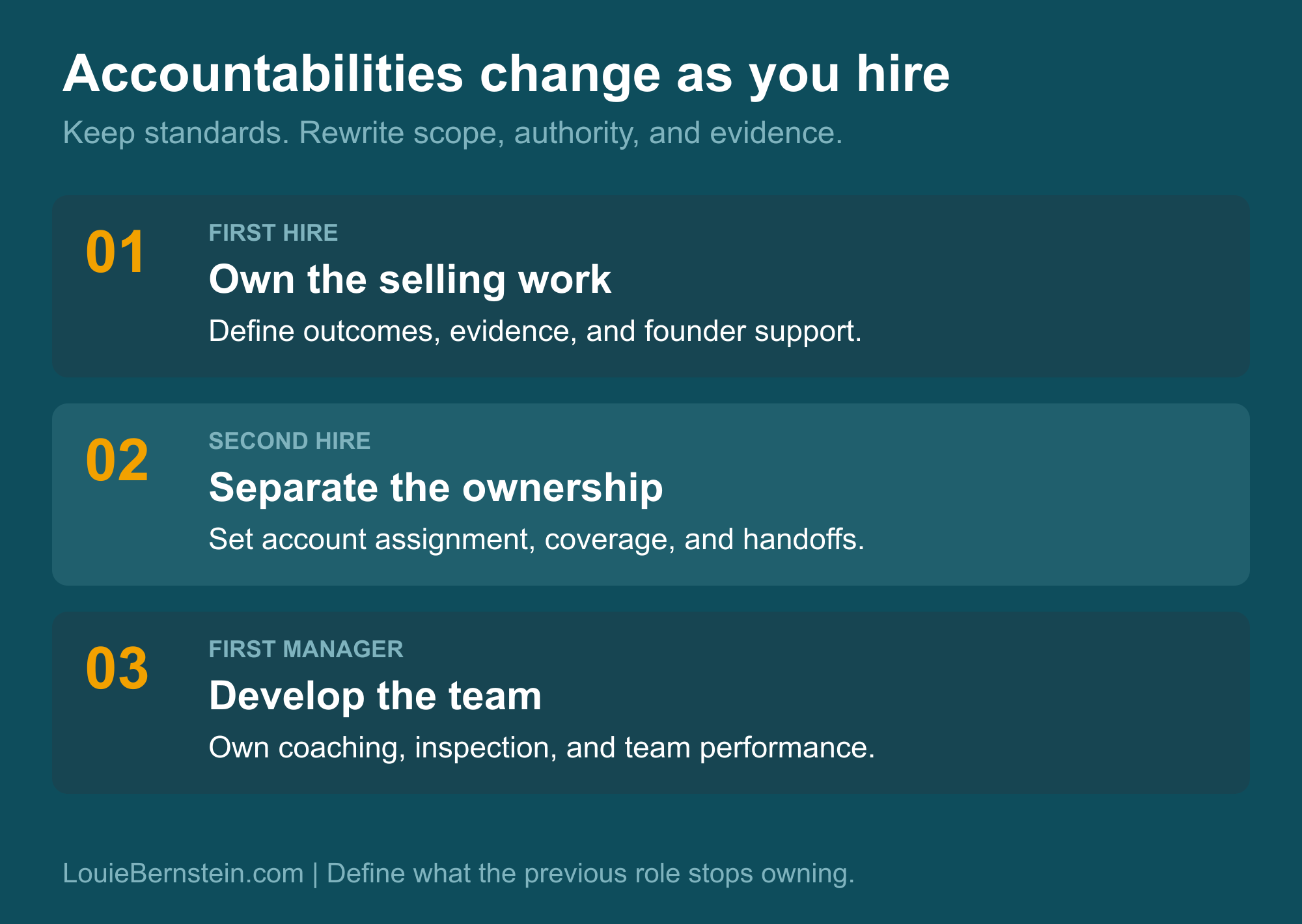
Accountabilities Documents should evolve from defining one rep’s results, to separating two reps’ ownership, to defining how a manager produces results through other people. Keep the sales standards consistent, but rewrite scope, authority, evidence, and founder commitments at each transition. Before adding the next person or promoting a seller, name what the existing role stops owning. Otherwise, growth adds people while leaving the founder responsible for every unresolved decision.
Key Takeaways
- The first hire needs a clear selling role. The second hire needs clear boundaries. The first manager needs accountability for team performance and development.
- Adding a second rep should trigger a review of both reps’ documents, including account ownership, lead assignment, and handoffs.
- A player-coach needs a defined personal book, protected coaching time, and authority that matches the team outcomes they own.
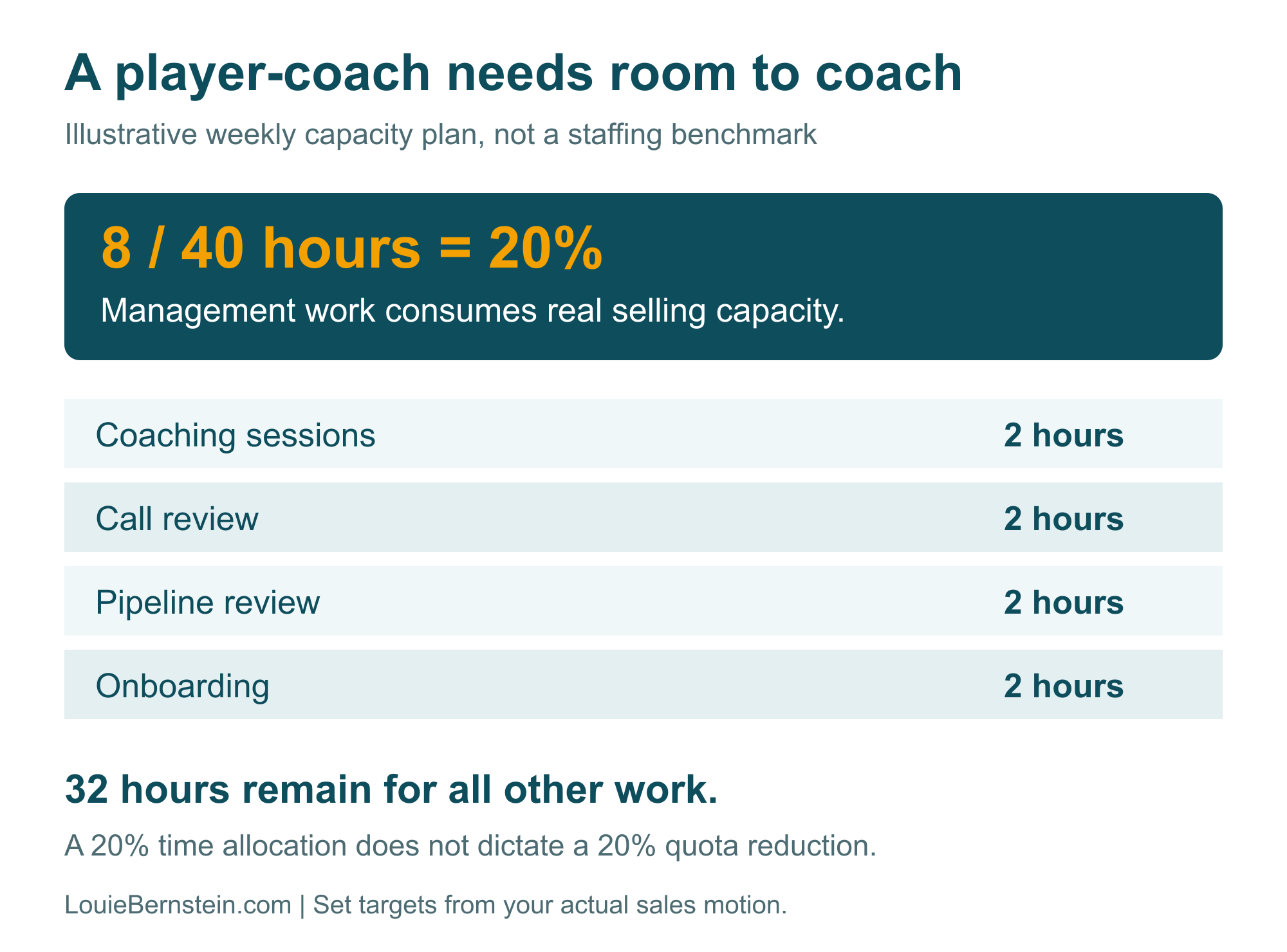
- In an illustrative 40-hour week, eight hours of management uses 20% of available time. A full selling workload cannot simply stay untouched.
- Before a promotion takes effect, write the work the promoted seller stops doing and the decisions the founder stops making.
Your first salesperson sits beside you. Questions get answered in a conversation. A lead comes in, and you know who should take it.
The second salesperson changes the arrangement. Now a conversation with one person can quietly become a different rule for the other. Your best rep starts helping the new hire, but nobody agrees on whether helping is optional or part of the job.
Every new layer needs a clearer handoff, not just a longer list of duties.
For a B2B founder at $1M to $10M ARR, the goal is to grow selling capacity without becoming the permanent referee. An Accountabilities Document needs to change when the way work gets assigned, reviewed, and approved changes.
What should the first sales hire own?
The first sales hire should own a defined piece of a sales process you can explain and support. Write the target customer, expected outcomes, evidence standards, and decisions the rep can make. Also state which work stays with the founder, so hiring a seller doesn’t quietly become hiring an unsupported sales department.
Separate selling from building the entire function
A first rep might own prospecting, discovery, follow-up, standard proposals, and CRM records for an agreed market. The founder might retain pricing exceptions, strategic accounts, product commitments, and coaching. Those boundaries should be visible before the offer.
If you expect the rep to build the Sales Playbook, choose the CRM, develop messaging, and close a full quota, write those expectations down together. Reading the whole job often exposes the capacity problem. A good seller cannot fix an undefined role by working harder.
The practical foundation is a written sales role agreement: what the person owns, what acceptable performance looks like, what evidence counts, and what support the business provides.
Use standards the next hire can inherit
Write qualification and CRM expectations as company standards, even with one rep. An opportunity should enter a stage because buyer evidence supports the move, not because the rep feels optimistic. A forecast should use agreed definitions.
You can change an initial target as you learn. Record the assumptions and review date so a learning target doesn’t become an unexplained moving target. Keep the current version available to both the founder and the rep.
For example, the first hire could own new-business opportunities in one customer segment, while the founder retains existing strategic accounts. That is a scope decision, not a universal hiring model. Choose a boundary that fits your actual customers and sales cycle.
What changes when you hire the second salesperson?
The second salesperson adds a need for explicit boundaries between roles. Keep shared selling standards, but define account ownership, lead assignment, coverage, and handoffs for both reps. Update the first hire’s document as well as the second hire’s document, because the new role changes the operating agreement of the existing role.
Write the rules between the desks
Two reps can each understand their own job and still disagree about the same account. Decide how inbound leads are assigned, who owns related companies, when an inactive account can be reassigned, and who resolves exceptions.
Choose one accountable owner for an opportunity. Other people can help, but the CRM should make clear who owns the next action and buyer follow-up. “We’re both working it” is not a useful answer when the buyer receives two different proposals.
The second hire might share the first rep’s role, or might cover a different segment. Either arrangement can work. The mistake is letting the territory model emerge through arguments after hiring.
Don’t turn the first rep into a manager by accident
Helping a colleague doesn’t automatically create management responsibility. If the first rep demonstrates discovery calls during onboarding, specify the assignment, expected time, and end date. The founder still owns onboarding unless responsibility and authority have actually moved.
Review lead assignment alongside your compensation plan. An Accountabilities Document should point to the approved plan rather than quietly promise different commission credit. Resolve disagreements before the reps start pursuing overlapping accounts.
Have both reps explain a sample handoff: a prospect changes segment, a buyer asks for a second product, or an owner takes leave. If their answers differ, the documents need another pass. Don’t wait for a real customer to become the test.
What changes for a player-coach or first manager?
A player-coach owns a defined personal sales contribution plus specific team responsibilities. A manager primarily owns team performance through coaching, inspection, and decisions. Rewrite the document around the actual job, including time and authority, rather than adding management duties to the same selling target and hoping the person finds spare hours.
Make the capacity tradeoff visible
Consider an illustrative 40-hour week. Two one-hour coaching sessions, two hours of call review, two hours of pipeline review, and two hours of onboarding total eight hours. Eight divided by 40 is 20%. Those hours are unavailable for personal selling.
The example is a planning exercise, not a recommended schedule or research benchmark. A 20% time allocation also does not prove that quota should fall exactly 20%. Deal mix, selling efficiency, support, and the sales cycle affect capacity. Use the math to force a workload decision, then set targets from your business.
For a player-coach, name the personal accounts they keep and the team duties they own. For a manager, remove routine personal prospecting and deal ownership unless a limited exception is intentional. Otherwise the manager will face a predictable choice: protect their own commission or invest in someone else’s development.
Define evidence of management work
“Coach the team” needs observable evidence. A better agreement says the manager reviews selected calls, identifies a skill gap with each rep, practices the skill, and checks later calls for improvement. Completing a meeting is evidence of activity. Improved execution is evidence that the coaching is working.
The manager also needs authority to assign work, enforce CRM standards, and resolve ordinary ownership disputes. Define approval limits for discounts, hiring, and formal performance actions separately. Don’t make a manager accountable for decisions you still reserve entirely for yourself.
Your Sales Playbook should describe how the team sells. The manager’s Accountabilities Document should say who maintains those standards and how gaps get addressed.
How should you measure the first manager fairly?
Measure the first manager using team results, operating discipline, and evidence of rep development. Define the starting conditions and review dates before the role begins. Revenue matters, but early evaluation also needs to show whether the manager is improving execution and removing constraints within their control rather than inheriting credit or blame for old pipeline.
Separate inherited pipeline from new work
Record the pipeline the manager inherits, the stage evidence behind it, current rep capability, and known coverage gaps. Otherwise, an early close can make a weak manager look strong, while an inherited empty pipeline can hide useful management work.
Use a small set of agreed measures. Examples include team revenue against plan, qualification consistency, forecast accuracy using a stated calculation, and progress on specific rep skills. Choose measures your CRM and review process can support. More fields don’t create better judgment.
Set an initial review after 30 days to check whether the operating rhythm is in place. Use later reviews to evaluate results as opportunities move through your actual sales cycle. Thirty days is an example checkpoint, not a promise that a manager can repair revenue in a month.
Keep the founder accountable too
If you retain hiring approval, say how quickly you’ll make decisions. If the manager needs you on a strategic call, agree on when your involvement is appropriate. A manager cannot own team capacity while every hiring decision sits unanswered in your inbox.
Review team performance without silently taking management back. Ask the manager for their diagnosis, proposed action, and follow-up date. Your role is to hold the manager accountable for managing, not bypass them whenever a rep asks you a question.
How do you rewrite the documents before a promotion?
Rewrite Accountabilities Documents by mapping ownership before and after the change, then reviewing the new agreement with everyone affected. Start with work that moves or stops, not the new title. Give the revised documents an effective date and a review date so the promotion becomes a clear operating change rather than an informal announcement.
The lesson from Louie’s role-change example
In my published example of a salesperson put on a performance plan after hitting 135% of quota, the important lesson is the role transition. Strong performance against the old job doesn’t tell someone what the new job requires. Written expectations need to change before you evaluate the person against a different role.
The practical question I want a founder to answer is simple: what will this person now accomplish through other people? If the answer is only “keep selling and help when needed,” you haven’t defined a management job.
Run a joint ownership review
- List current ownership. Include informal work such as approving discounts or answering every new rep’s question.
- Assign the future owner. Name the rep, manager, or founder for each outcome and decision.
- Remove transferred duties. Reduce the old role’s scope where the work has genuinely moved.
- Agree on evidence and support. State what will be reviewed and which inputs the founder must supply.
- Test an ordinary week. Walk through lead assignment, a stuck deal, a coaching need, and an exception request.
Keep version history and acknowledge the changes together. Don’t quietly edit the document after a disagreement and treat the new wording as an old promise. If compensation or employment terms change, handle those changes through the appropriate agreement too.
The test of the new manager layer is whether routine work can move without your interpretation. When reps know their owner, managers know their authority, and you know your remaining commitments, the documents support a team that can operate without asking you to settle everything.
Frequently Asked Questions
Do two reps in the same role need different documents?
Use the same core standards for reps doing the same job, with individual scope and target details where needed. Separate territory or account assignments can sit in an attached schedule. Avoid creating different definitions of qualified pipeline for otherwise identical roles.
Should an Accountabilities Document include compensation?
Reference the approved compensation plan and identify where it lives. Keep payout rules, crediting terms, and formal changes consistent with that plan. A role document should not create a second, conflicting version of how someone gets paid.
What if my best rep doesn’t want to manage?
Keep a strong individual-contributor path available. Selling well and wanting to develop other sellers are different things. Discuss the actual management work before offering the title, and assess coaching ability rather than treating sales rank as proof of management readiness.
Can I try a player-coach arrangement before a permanent promotion?
You can define a time-limited assignment with clear scope, authority, workload, compensation arrangements, and a review date. Tell the team who makes which decisions during the trial. Avoid an open-ended test that adds responsibility without changing expectations.
When should the documents change again?
Update the documents when ownership, authority, sales motion, or evaluation standards materially change. A new customer segment, a dedicated onboarding role, or a separate renewal team can trigger another revision. Routine coaching feedback usually belongs in review notes rather than a rewritten role.
Build the next role before you fill it.
If your next sales hire or promotion still leaves every decision with you, I can help you define the handoffs, expectations, and management rhythm. Learn about Fractional Sales Leadership at LouieBernstein.com, or schedule a 30-minute conversation.
About the Author
Louie Bernstein is a Fractional Sales Leader with 50 years of sales experience and has worked in Fractional Sales Leadership since 2017. He helps B2B founders build repeatable sales systems, develop their teams, and reduce dependence on founder-led selling.