For a growing B2B subscription company, use gross-profit CAC payback and start with a target near 12 months, then adjust for customer segment, retention, and available cash. Longer payback can work, but only when the business can fund the wait and customers stay long enough. For project or service businesses, track cumulative gross profit instead. Never judge recovery using revenue alone or assume founder selling time is free.
Key Takeaways
- A roughly 12-month starting target can guide subscription businesses, but healthy payback must fit retention, customer segment, and cash capacity.
- CAC payback divides acquisition cost by monthly gross profit per customer, not monthly revenue.
- In the illustrative example, $12,000 CAC and $1,000 monthly revenue at 80% gross margin produce 15-month payback.
- Annual prepayment improves cash timing; it doesn't erase the cost of delivering the service.
- Review payback by customer segment and track founder hours alongside the financial calculation before increasing sales spending.
You signed the contract. The team celebrates. Then payroll comes around again, and the new customer hasn't earned back what you spent to win the business.
A founder running a $1M to $10M ARR company needs more than a growing bookings report. You need to know how long each new customer ties up the money required to win the next customer.
The useful question isn't whether your number looks good beside someone else's benchmark. The useful question is whether your sales process produces customers who repay their acquisition cost before your cash or their patience runs out.
What Is a Healthy CAC Payback Period for a Growing B2B Company?
A healthy CAC payback period recovers acquisition spending well before customers leave and within a timeframe your business can finance. For subscription companies, begin near 12 months and examine longer periods carefully. Customer size matters, but a larger contract alone doesn't justify a longer wait if retention or delivery margins are weak.
Use segment targets as a reference
Bessemer's 2021 cloud-company guidance recommends gross-margin-adjusted CAC payback below 12 months for SMB customers, below 18 months for mid-market, and below 24 months for enterprise. These are targets for cloud businesses, not a current market median or a rule for every B2B company.
| Cloud customer segment | Bessemer's 2021 target | Founder's next check |
|---|---|---|
| SMB | Under 12 months | Will customers stay beyond recovery? |
| Mid-market | Under 18 months | Can cash support the acquisition pace? |
| Enterprise | Under 24 months | Are implementation and retention proven? |
A bootstrapped business may need a shorter target than a funded business selling to the same buyers. Financing changes how long you can wait. Financing doesn't change whether the customer produces enough gross profit to recover the cost.
Set a limit your company can support
Use your actual gross margin, customer history, collection terms, and cash forecast to set an internal limit. If most customers leave before recovery, the acquisition model needs repair. If the business cannot finance the wait, even customers with attractive long-term economics can create an immediate problem.
For a consulting, manufacturing, or project business, don't borrow a SaaS target without checking the revenue pattern. A single project may recover acquisition cost quickly, slowly, or never. Follow its cumulative gross profit and the cost of any additional selling needed to win repeat work.
How Do You Calculate CAC Payback Without Fooling Yourself?
For a steady subscription customer, divide fully loaded new-customer acquisition cost by monthly revenue per customer multiplied by gross margin. Use consistent cost boundaries and comparable customers. The result estimates months of gross profit needed to recover acquisition cost; it does not measure company-wide profitability or predict when invoices will be collected.
Work through the gross-profit calculation
CAC payback in months = CAC ÷ (monthly revenue per customer × gross margin). Include the sales and marketing costs required to win new customers, including salaries, commissions, tools, and unsuccessful acquisition work. Allocate shared expenses consistently. Keep renewal and expansion costs separately identified when measuring new-customer payback.
Assume CAC is $12,000, monthly customer revenue is $1,000, and gross margin is 80%. Monthly gross profit is $800. Payback is $12,000 divided by $800, or 15 months. Dividing by revenue would show 12 months and understate the recovery period by three months. All figures in this example are illustrative.
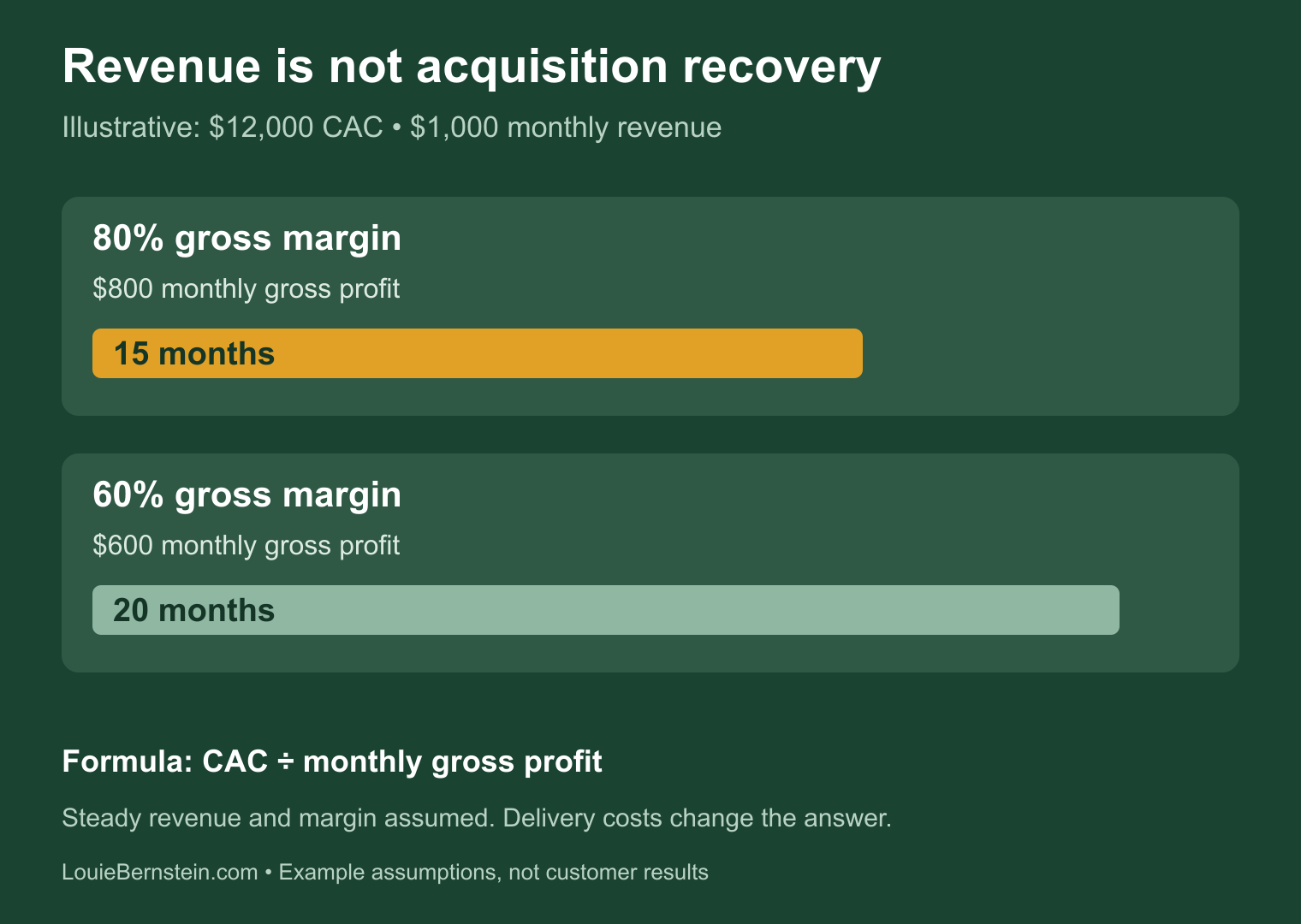
At 60% gross margin, the same customer produces $600 monthly gross profit and needs 20 months to repay $12,000 CAC. Neither the price nor acquisition spending changed. Delivery economics changed the answer. Ask finance which hosting, support, implementation, and service costs belong in the margin calculation for your business.
Check what the average leaves out
The simple formula assumes stable monthly revenue and margin. If revenue ramps slowly, usage varies, or onboarding creates large early costs, track the actual cumulative gross profit for customers acquired together. A cohort is simply that group of customers, such as accounts that started in the same quarter.
For cohort recovery, keep the original acquisition cost and original customer group visible. Include lost customers and their actual contribution. Removing churned accounts from the analysis makes the survivors look better while hiding money the business never recovered.
Match spending and wins sensibly. A long sales cycle can put acquisition effort in one quarter and contracts in another. Review a rolling period that covers typical sales cycles, explain timing differences, and show the number of customers behind each calculation. One large contract can move a small-company average sharply.
Why Can a Good Payback Number Still Leave You Short of Cash?
A good gross-profit payback number can still leave you short of cash because acquisition spending starts before the sale and collections may arrive after service begins. Annual prepayment changes collection timing, while hiring and delivery create additional cash needs. Pair the payback estimate with a dated cash forecast before committing to faster growth.
Start the cash timeline before the signature
Sales salaries, campaigns, and proposal work usually precede the customer's first payment. A 15-month operating payback estimate starting with customer revenue doesn't show every week your cash was already committed. Add the actual spending dates and collection dates to the cash plan rather than treating contract signature as day one of every expense.
Suppose you spend $12,000 acquiring a customer who prepays $12,000 for the first year. At an 80% gross margin, that year contributes $9,600 of gross profit under the steady-margin assumption. The payment helps near-term liquidity, but the first year still falls $2,400 short of gross-profit acquisition recovery.
The full advance payment is not spare cash. You still owe the service. Model delivery payments, commissions, tax obligations, other operating costs, and the next acquisition cycle. Keep cash recovery and economic recovery as two labeled views.
Model growth as overlapping commitments
A company adding customers every month has many acquisition investments waiting to recover at once. Faster sales can increase that outstanding balance. Existing customers may help finance the wait, but only if their cash contribution remains available after the rest of the business is paid.
Build a base case and a slower case. Delay wins and collections, reduce margin, and remove assumed expansion. Ask whether the business can meet its obligations under the slower case. A ratio alone cannot answer that question, and a new sales hire adds ramp time before the expected productivity appears.
What Should You Fix First When CAC Payback Is Too Long?
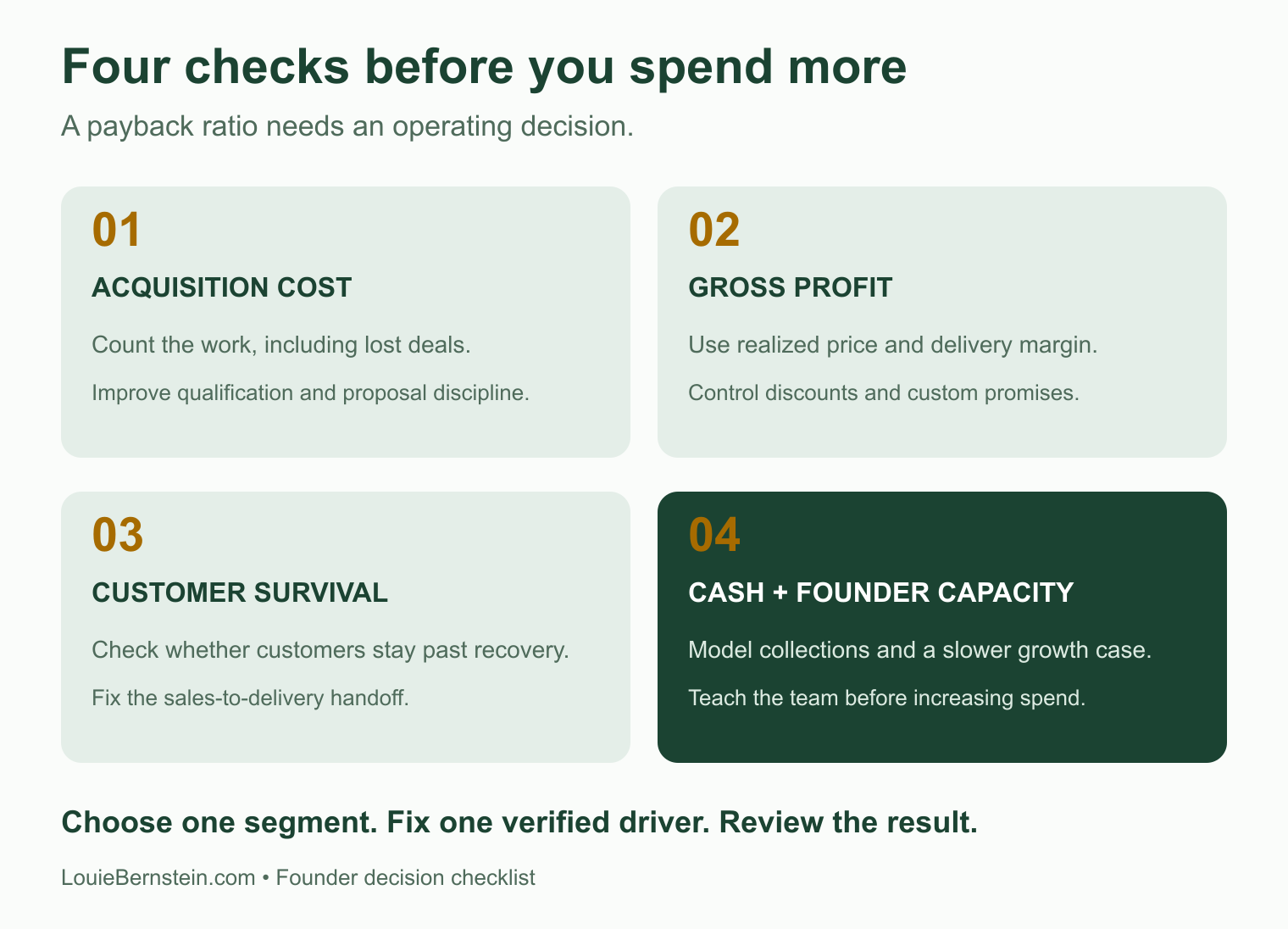
Fix the weakest verified driver of CAC payback first: acquisition cost, realized revenue, delivery margin, or customer survival. Break the calculation down by segment and channel before cutting spending across the board. The goal is to recover cost from customers who fit your business, rather than improve a dashboard by sacrificing future pipeline.
Find where the money waits
Separate referrals, outbound, and paid acquisition where the data supports the split. Compare customers of similar size and needs. A blended number can hide an expensive channel behind founder referrals or hide low-margin custom deals behind standard contracts.
Look at qualification and stage exits. Are reps preparing proposals before they know the business problem, decision process, and next commitment? Unqualified opportunities consume labor without providing a reasonable path to a sale. Clear exit criteria can stop wasted work earlier.
Then examine price and scope. Discounting may win the signature while lengthening recovery. Custom promises can reduce margin after the sale. Coach reps to connect price to a defined outcome and document delivery commitments before promising exceptions.
Make one change you can measure
Choose one segment and one process change. For example, require a confirmed decision process before a custom proposal. Record the owner, start date, and expected effect. Review proposal hours, conversion, deal value, gross margin, and cycle length together.
A shorter sales cycle can reduce the waiting time before revenue starts. It only reduces formula-based CAC payback if acquisition cost or monthly gross profit also changes. Don't claim an automatic improvement from moving a close date forward.
Retention deserves equal attention. A customer who leaves before recovery may never repay acquisition cost. Improve the handoff from sales to delivery, confirm promised outcomes, and inspect early customer problems. Don't assume future upsells rescue a weak starting contract. Show expansion as a separate scenario until earned.
How Do You Know Whether Payback Will Survive the Founder Handoff?
Payback is ready for a founder handoff only when the acquisition model includes the work other people must perform and the team can repeat the process. Track founder selling hours alongside costs, conversion, and margin. A low recorded CAC supported by unpriced founder rescue does not establish what a staffed sales process will cost.
What building MindIQ taught me
When I built MindIQ, I was the sales engine. My knowledge helped win business, but a process living in my head wasn't something another salesperson could simply repeat. The same lesson applies to payback: a founder's personal selling efficiency doesn't automatically transfer to a new hire.
Before expanding the team, write down the discovery questions, qualification standards, proposal rules, and next-step requirements. Put them in the Sales Playbook. Role play the conversations. Let the salesperson lead and review the work. Teaching creates a path to independence; taking over every difficult call keeps the cost hidden.
A healthy payback number should describe a sales process your company can afford to repeat.
Use a monthly review with named owners
Keep recorded acquisition costs and any estimated founder-labor adjustment clearly separated. Avoid counting payroll twice. Track founder hours per new customer as an operating measure even when you don't attach a dollar estimate.
Give finance ownership of cost and margin inputs. Give sales leadership ownership of customer fit, stage discipline, and coaching. Put responsibilities in the Accountabilities Document. Review the customer groups monthly and use a longer rolling view when deal counts are small.
Before adding spending, ask three questions: Are comparable customers recovering cost within our limit? Can cash support the slower case? Can the team win those customers without increasing founder rescue? If the answers are unclear, fix the evidence and the process before treating last quarter's ratio as permission to scale.
Frequently Asked Questions
Is CAC payback the same as recovering every company expense?
No. CAC payback measures recovery of acquisition cost from customer gross profit. The business still has other expenses, including general administration and product development. Recovering CAC does not mean the whole company or customer relationship has reached net profitability.
What should I report if we win no new customers?
Report acquisition spending and zero wins directly. A per-customer CAC calculation has no meaningful finite result when the customer count is zero. Use a longer, clearly labeled reporting window when appropriate, without hiding the period that produced no customers.
Should setup fees count toward payback?
Include the gross profit from a setup fee when measuring actual cumulative recovery, after subtracting the cost of setup. Keep one-time fees separate from recurring revenue. Putting the full fee into monthly recurring revenue overstates ongoing customer economics.
Can two companies compare payback if they use different cost definitions?
Only after reconciling their definitions. Acquisition-only costs, total sales and marketing spending, and methods that include expansion effort can produce different results. Compare the cost boundary, gross-margin treatment, timing, and customer segment before deciding which company is more efficient.
How should I handle a new channel with little history?
Treat the new channel as a limited experiment with a spending cap and explicit assumptions. Show observed acquisition cost separately from projected customer gross profit. Early wins do not establish retention, and a handful of accounts should not justify a large spending increase.
Does a three-year contract guarantee a safe payback period?
No. Contract length does not guarantee collection, successful implementation, or the assumed margin. Examine cancellation rights, payment schedules, delivery obligations, and customer risk. A long commitment can support recovery, but its cash and operating terms still matter.
Build a sales process worth reinvesting in.
If your $1M to $10M ARR B2B company still needs you to close most deals, Fractional Sales Leadership can help build the Sales Playbook, qualification standards, and coaching your team needs. Learn more at LouieBernstein.com.
Schedule a 30-Minute CallAbout the Author
Louie Bernstein is a Fractional Sales Leader and founder of MindIQ. He helps B2B founders build Sales Playbooks, defined sales processes, and teams that can sell without constant founder involvement.