Yes, founder time should be included in a clearly labeled management view of customer acquisition cost when the founder helps win new customers. Count acquisition work, value the hours using a defensible replacement-cost assumption, and avoid counting compensation twice. Keep recorded acquisition costs separate from estimated founder-time adjustments. The purpose is to understand what your sales process would cost without relying on your unpaid or underpaid labor.
Key Takeaways
- Founder selling time belongs in a founder-adjusted CAC view, even when no extra paycheck leaves the business.
- Add only founder acquisition cost missing from the starting calculation. Already allocated compensation must not be counted twice.
- In the illustrative example, 150 founder hours at $100 an hour raise CAC from $5,000 to $6,250, a 25% increase.
- Track ten working days of acquisition activity, including preparation, lost deals, follow-up, and internal interruptions.
- Keep speculative missed revenue outside CAC. Use opportunity cost to decide what you will do with the hours you recover.
Your salesperson brings you a deal. You run discovery, explain the product, rewrite the proposal, and help negotiate the agreement. The salesperson gets the win. Your calendar gets the bill.
If you're running a B2B company at $1M to $10M ARR, founder selling can make acquisition look cheaper than the process really is. The work still exists. Your spreadsheet simply gives some of it a zero-dollar price.
The useful question is whether another person can perform that work at a cost your business can support. Measuring founder time helps you answer the question before you hire.
What Is Your Time Really Costing the Business When You Sell?
Your selling time costs the business the labor required to acquire customers and the other work you postpone. Replacement cost puts a practical price on acquisition labor. Opportunity cost describes the tradeoff. For a founder-led company, measure both, but keep them separate so an estimate of missed opportunities doesn't become invented acquisition spending.
A salary doesn't tell you what the sales work costs
You might pay yourself a small salary to conserve cash. You might take distributions. Neither choice tells you what someone else would charge to perform discovery, prepare proposals, and manage follow-up.
Your compensation arrangement and the cost of replacing your sales work are different questions. A founder who takes no salary can still spend half the working week acquiring customers. Treating those hours as free hides a dependency.
Fully loaded CAC commonly includes salaries, commissions, tools, and advertising, according to ChartMogul's September 2026 definition. A founder-time adjustment extends the management analysis to labor that recorded acquisition expenses may not fully capture. The adjustment isn't a universal reporting standard, so name the method.
Your next-best use of time needs a real plan
Suppose selling takes the hours you intended to spend recruiting a delivery leader. The opportunity cost is the delayed work and its consequences. Don't automatically price those hours at the revenue you hope that leader might create.
Write down the specific work you would do instead, the owner, and the next milestone. “Focus on strategy” is too vague. “Interview three qualified delivery-leader candidates next week” gives recovered time a job.
You also need to distinguish useful founder involvement from routine rescue. An executive conversation with a major prospect may deserve your attention. Rewriting every follow-up email probably deserves a training plan.
Your time doesn't become free because the business doesn't write you another check.
Which Founder Hours Belong in Acquisition Cost?
Include founder hours spent attracting, qualifying, and winning new customers, including work on opportunities you lose. Separate delivery, renewals, general company leadership, and product development. For mixed activities, allocate the acquisition portion consistently. A short activity log is more reliable than remembering only the calls that ended in signed agreements.
Track the work around the customer call
A one-hour demo can require research, internal preparation, a custom presentation, follow-up, and several questions from the rep. Record the full acquisition effort. Calendar invitations alone miss much of the work.
Include prospecting, discovery, demonstrations, proposals, commercial negotiations, and acquisition-related CRM updates. Record internal deal reviews and sales coaching separately so you can allocate their new-business portion without treating every leadership meeting as acquisition.
Count work on lost opportunities and prospects who never respond. Acquisition labor doesn't disappear because the buyer chose someone else. Counting only winning deals makes your process look more efficient than the team's total effort supports.
During a ten-working-day audit, use four simple fields: activity, minutes, opportunity or purpose, and who could own the work. Keep the logging light enough that you will actually finish it.
Draw a clear boundary around mixed work
A product discussion prompted by a prospect can become general product planning. Separate the time spent helping win the account from the time spent building the product. Don't assign an entire engineering meeting to CAC because a prospect started the conversation.
After-sale onboarding and service belong in your delivery analysis. Expansion and renewals deserve their own cost view. When one meeting covers a new prospect and an existing customer, make a reasonable split and document it.
Sales Playbook development and training can support acquisition across many future deals. Show those costs clearly rather than burying them in a single customer's record. Apply a consistent management allocation and explain one-time work when comparing periods.
How Do You Calculate Founder-Adjusted CAC Without Double Counting?
Calculate founder-adjusted CAC by adding the missing value of founder acquisition labor to your recorded acquisition costs, then dividing by new customers won. Subtract founder compensation already included for that same work before adding a replacement-cost estimate. Document the hours, rate, customer count, and reporting period so someone else can reproduce the calculation.
Start with a labeled example
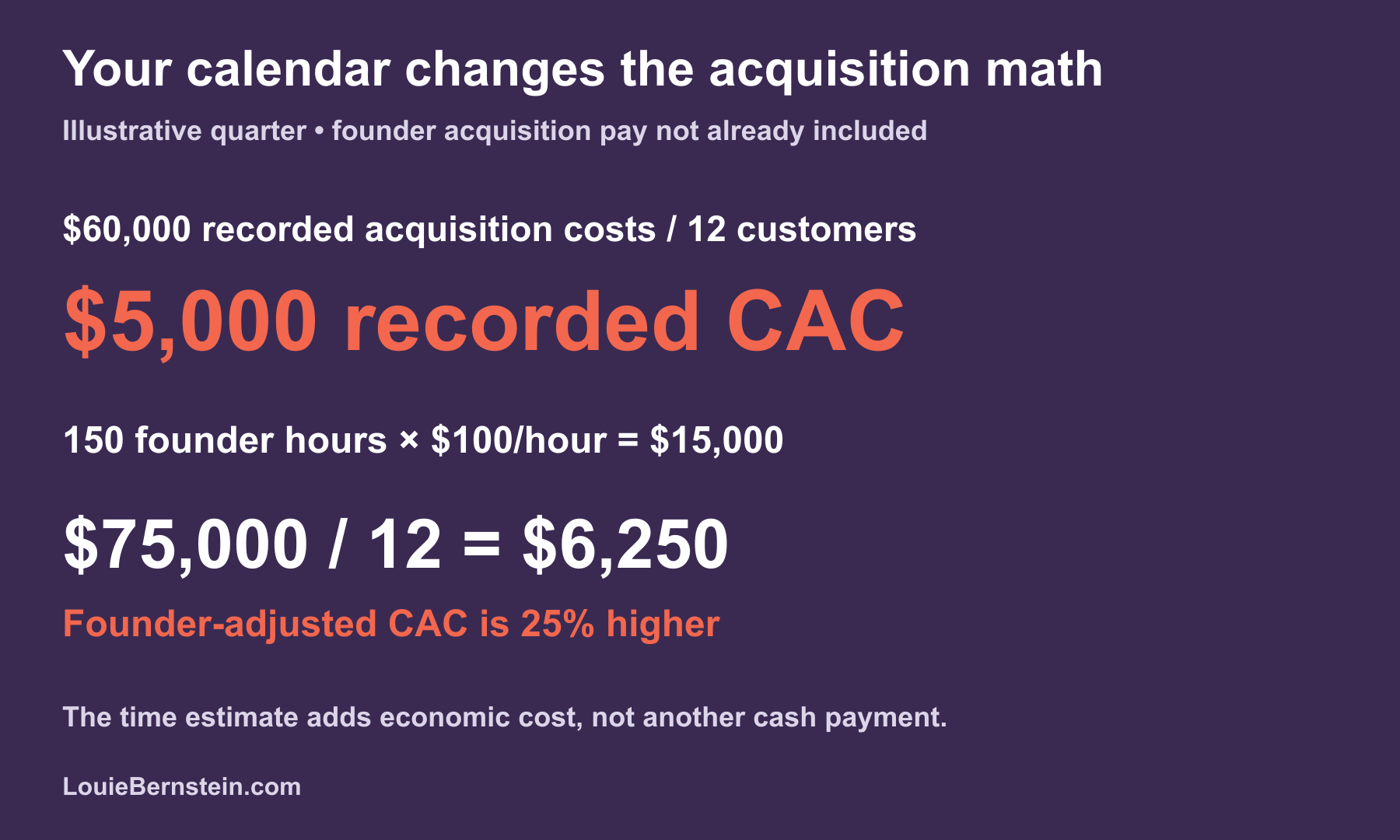
Assume a quarter has $60,000 in recorded new-customer acquisition costs and 12 new customers. Recorded CAC is $5,000. Also assume the founder spent 150 hours on acquisition and none of that founder labor was included in the $60,000.
At an illustrative replacement rate of $100 an hour, founder labor adds $15,000. Founder-adjusted CAC becomes $75,000 divided by 12, or $6,250 per customer. That's 25% higher than the recorded figure. These are example assumptions, not market rates or client results.
Now assume $6,000 of founder compensation for those acquisition hours was already included in recorded costs. The missing adjustment is $15,000 minus $6,000, or $9,000. Adjusted CAC becomes $69,000 divided by 12, or $5,750. Adding all $15,000 would count the included $6,000 twice.
Keep the inputs aligned
Use hours and acquisition spending from a consistent period. Long sales cycles can separate effort from wins, so inspect a rolling view covering several typical cycles. Show customer counts alongside the ratio. A small denominator can make one delayed contract move CAC sharply.
If a period produces no new customers, report the spending and hours directly. CAC has no meaningful finite value when the customer denominator is zero. Don't replace zero customers with one just to fill a dashboard cell.
For internal decisions, show recorded CAC, the founder adjustment, and adjusted CAC together. Your finance team should reconcile the starting expenses and their timing. An estimated labor adjustment shouldn't be presented as an additional cash payment or silently mixed into external reporting.
What Hourly Rate Should You Use for Founder Selling Time?
Use a documented replacement-cost rate based on the work another person would need to perform, rather than dividing company revenue by your working hours. Separate administrative tasks from skilled selling and executive involvement where useful. Test a reasonable range because an uncertain hourly assumption should not decide a major hiring commitment by itself.
Price the role, then check the workload
Research the actual roles required in your market. Include salary, expected incentive compensation, employer costs, and relevant support. Explain the working-hour assumption used to convert the estimate into an hourly rate. Don't claim more precision than the inputs support.
A sales assistant, an account executive, and a senior leader don't have the same responsibilities. Use task groups if one rate hides too much. You may discover that much of the founder's calendar needs clearer ownership rather than an expensive executive hire.
An hourly estimate also isn't a staffing quote. Hiring someone generally means paying for a role with a full workload, ramp time, and management needs. Replacing 150 quarterly founder hours doesn't prove you can buy exactly 150 equally productive hours from a new employee.
Test whether the decision survives a different assumption
Using the same 150 hours and 12 customers, an illustrative $75 rate adds $937.50 per customer. A $125 rate adds $1,562.50. With the $5,000 starting CAC, adjusted CAC ranges from $5,937.50 to $6,562.50, assuming no founder labor was already counted.
If both ends show that a segment consumes too much effort, investigate that segment. If the hiring decision changes entirely between the two rates, gather better role and workload evidence before committing.
Don't price every hour at the founder's highest possible consulting rate. Your business needs a credible cost for the work being performed. A dramatic assumption may make a chart persuasive while making the decision worse.
How Do You Use Founder-Time CAC to Build a Sales Handoff?
Use founder-time CAC to identify repeatable acquisition work the team can own, then test the handoff against customer outcomes and founder hours. Prioritize recurring tasks before rare executive conversations. A handoff succeeds when capable salespeople win suitable customers with less founder intervention, while margin, deal quality, and acquisition economics remain acceptable.
The lesson from building MindIQ
When I built MindIQ, I was the sales engine. That experience informs how I approach founder-led sales today: the founder's knowledge has to become something other people can use. A salesperson can't repeat a process that lives only in the founder's head.
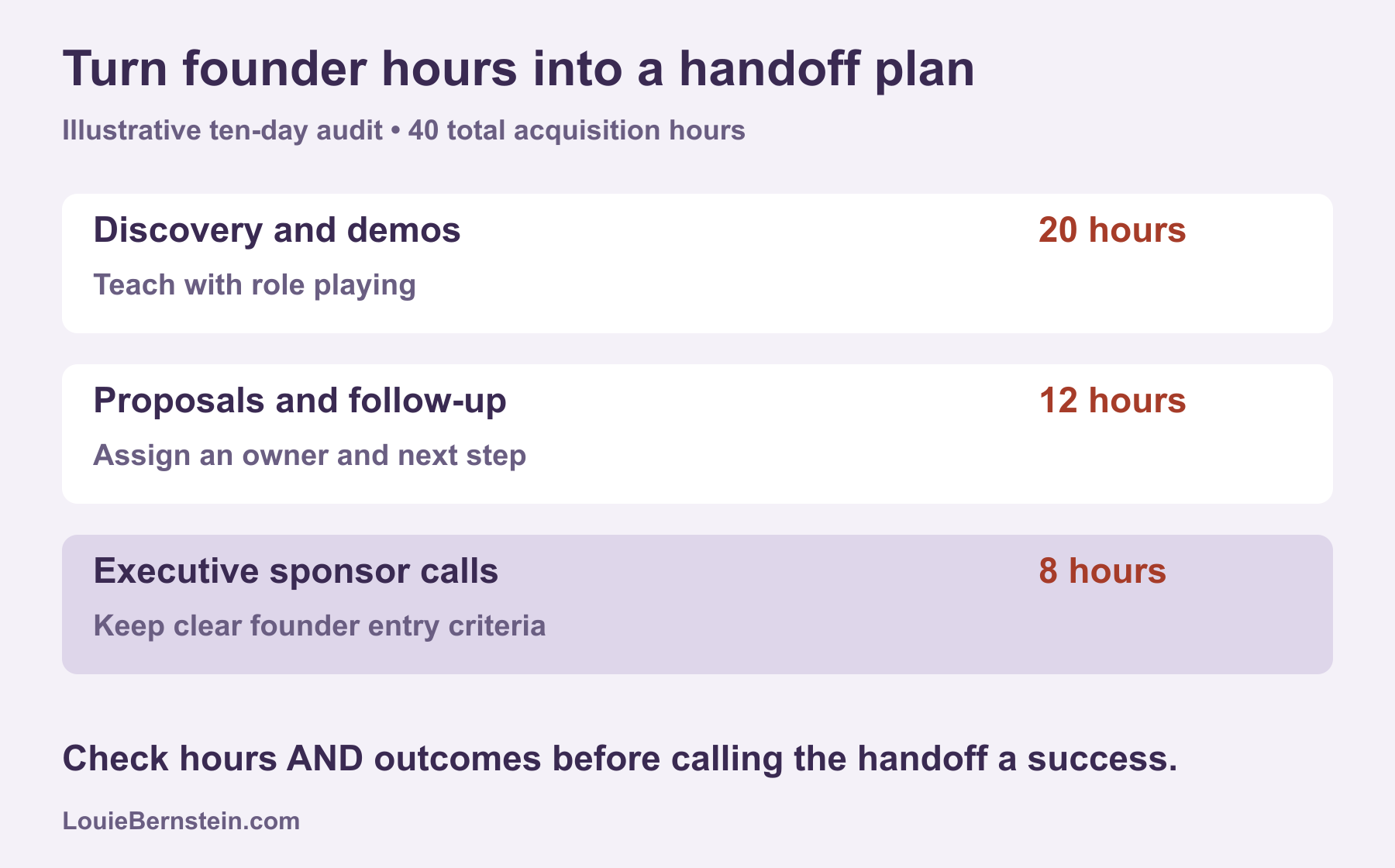
Counting founder time gives that lesson a practical starting point. If discovery consumes the largest block, document the questions, qualification standards, and next-step requirements. Role play the conversation. Let the salesperson lead, then review what happened.
Doing the rep's work can make today's deal easier. Teaching the rep creates the possibility of less founder involvement in the next deal. Track both the immediate effort and the capability you are building.
Give the team ownership with clear limits
Choose one recurring activity for the next month. Name its owner in the Accountabilities Document. Add examples and standards to the Sales Playbook. Define when the founder should join, such as a specific executive-sponsor conversation or a commercial exception requiring approval.
Review founder acquisition hours, hours per new customer, conversion, sales-cycle length, and customer fit together. Lower founder hours aren't progress if deals collapse or the team discounts heavily to compensate. Compare similar segments and note changes in pipeline quality.
Training may temporarily increase effort. Budget for that transition instead of pretending a new hire removes founder work on day one. The goal is a repeatable sales process the business can afford, with a founder role chosen deliberately.
Frequently Asked Questions
Does founder-adjusted CAC belong in my financial statements?
Founder-adjusted CAC is an internal management analysis. An assumed replacement cost doesn't create a booked expense by itself. Ask your finance professional to reconcile the calculation with your actual accounting and clearly explain the adjustment in any investor presentation.
Should I include unpaid cofounder selling time too?
Yes, include each cofounder's acquisition work in the management analysis when recorded costs omit that labor. Track hours separately and prevent duplicate entries for shared meetings. Two founders attending a call use two people's time.
Can I calculate founder time by acquisition channel?
Yes, assign directly traceable founder work to its channel and allocate shared work consistently. Keep the blended total as a check. Avoid giving several channels full credit for the same customer or assigning all founder hours only to the least successful channel.
What if founder referrals require very little selling time?
Report the observed effort, but recognize that another salesperson may not inherit your relationships. A low current referral CAC doesn't establish the cost of building a new outbound channel. Model the new acquisition route separately before scaling it.
Should I stop joining sales calls once I measure the cost?
No. Use the measurement to choose where your presence earns its place. Keep valuable executive involvement, and transfer teachable work through practice and review. Abruptly removing founder support before the team is ready can put current revenue at risk.
Build a sales team that can use what you know.
If your B2B company is at $1M to $10M ARR and every deal needs your time, Fractional Sales Leadership can help turn founder knowledge into a Sales Playbook, clear accountabilities, and practical coaching. Learn more at LouieBernstein.com.
Schedule a 30-Minute CallAbout the Author
Louie Bernstein is a Fractional Sales Leader and founder of MindIQ. He helps B2B founders build Sales Playbooks, defined sales processes, and teams that can sell without constant founder involvement.