What Hidden Costs Are You Missing When You Only Count Your Time?
Founder-led sales costs your business the concessions, unpriced work, and operating dependence required to keep the founder closing deals. There's no honest universal annual total. In the illustrative audit below, discounts and custom delivery consume $66,000 before founder time is counted. Start with signed agreements and delivery records, then track team dependence and delayed hiring separately. Add only costs you can support without counting the same loss twice.
Key Takeaways
- The annual cost of founder-led sales includes discounts and unpriced delivery, not just the hours the founder spends selling.
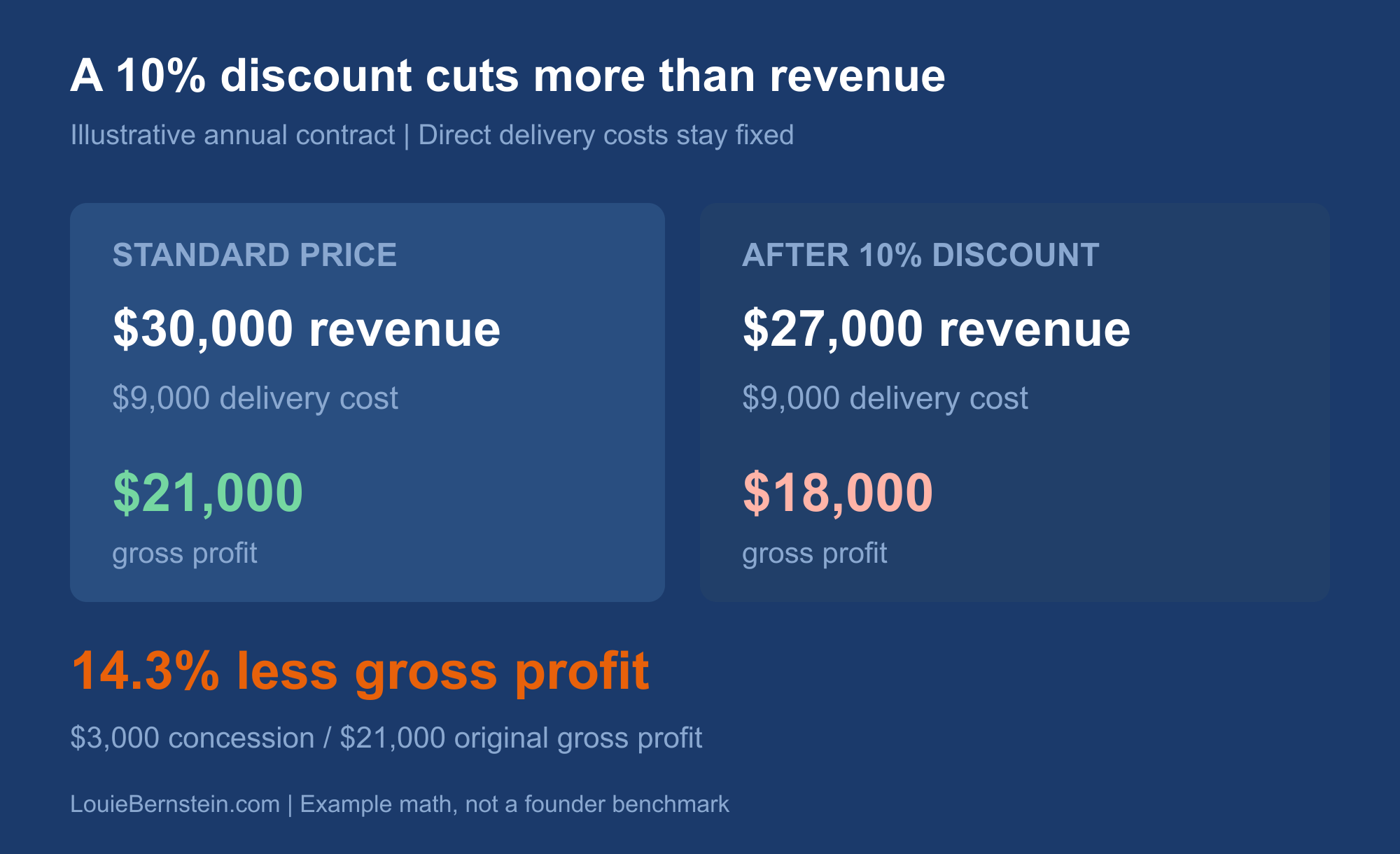
- In an illustrative $30,000 deal with $9,000 of direct delivery costs, a 10% discount reduces gross profit by 14.3% if delivery costs stay fixed.
- A founder's custom promise needs a delivery owner, a cost estimate, and written scope before the agreement is signed.
- Review your last ten wins for concessions, extra delivery work, and founder approvals that another person could have handled.
- Keep measured margin leakage separate from estimated labor capacity and uncertain revenue from a delayed hire.
You signed the customer. Your dashboard shows a win. Then delivery asks who approved the integration, finance notices the lower price, and your salesperson waits for you to answer another routine question.
For a B2B founder at $1M to $10M ARR, the sales bill can arrive in departments that never attended the sales call. Counting your selling hours won't reveal those costs.
The signature tells you the deal closed. It doesn't tell you what the company agreed to give away.
How Do Discounts Hide the Cost of Founder-Led Sales?
Discounts hide the cost of founder-led sales when the founder trades price for a faster decision without measuring the lost contribution. Revenue still appears on the sales report, while the concession reduces what remains to fund the business. Review realized prices against a credible baseline and ask what the customer gave in return.
Compare gross profit, not just the discount percentage
Consider an illustrative annual contract priced at $30,000 with $9,000 in direct delivery costs. Gross profit would be $21,000. A 10% discount reduces revenue to $27,000. If delivery costs remain $9,000, gross profit falls to $18,000. The $3,000 concession cuts gross profit by 14.3%, even though the price fell by only 10%.
Across twelve comparable contracts, those concessions total $36,000. That's arithmetic from stated assumptions, not a benchmark for founders. Your results depend on your pricing, delivery costs, and the number of customers who would actually buy at the higher price.
A discount isn't automatically a mistake. Annual prepayment, less scope, or a longer commitment might justify one. The problem is approving a lower price because you want the deal finished, then treating the concession as proof your selling method works.
Outside research supports checking the tradeoff. In a 2024 McKinsey account-pricing example, an IT distributor reduced prices for 15 large accounts over two months. The volume increase wasn't enough to offset the value lost through discounts. That example concerns one distributor, not a forecast for your business.
Give the team a negotiation rule
Record the normal price, final price, reason for the concession, and what changed in return. Compare similar customers and scopes. An inflated list price nobody pays isn't a useful baseline.
If every negotiation ends with “let me ask the founder,” your team hasn't learned how to defend value. Use the discussion to teach tradeoffs. Your Sales Playbook should explain approved concessions and when an exception needs review.
What Do Custom Promises Cost After the Deal Closes?
Custom promises cost the business the additional delivery and support required to fulfill commitments outside the standard offer. A founder can authorize work in seconds that takes another team weeks to finish. Price the promise before signing, document the boundaries, and make the delivery owner part of the decision.
Find the work hidden inside “we can do that”
Look for special integrations, extra onboarding sessions, custom reports, unusual service hours, and features with promised dates. Some commitments belong in a profitable offer. Others are unpaid work attached to an otherwise ordinary contract.
Suppose ten customers each receive 30 hours of unpriced implementation work. At an illustrative loaded delivery cost of $100 an hour, the work consumes $30,000 of labor capacity. If contractors or overtime deliver the work, reconcile the actual spending. If existing employees deliver it, identify the work they postponed. Don't call all $30,000 an additional cash payment.
Thirty hours may sound manageable for one account. Ten separate exceptions can leave your delivery team running ten different versions of the product. Include ongoing support in the review, not just the initial build.
Approve scope before enthusiasm becomes an obligation
Before promising an exception, answer four questions: Who owns delivery? How much work will it take? What will the customer pay? What gets delayed if we accept?
Put the answers into the proposal or statement of work. A delivery team shouldn't discover a commitment through a customer complaint. Ask the salesperson to summarize the customer's need and propose an option before you join the discussion.
A larger contract can justify additional work. The discipline is to make that choice deliberately, with costs visible. “Strategic customer” isn't a cost estimate.
How Does Founder Dependence Make the Team More Expensive?
Founder dependence makes the team more expensive when paid employees repeatedly wait for decisions, redo work, or escalate tasks they should own. The founder's calendar captures only part of the disruption. Track the team's active rework and blocked decisions, then teach repeatable decisions instead of becoming the permanent approval desk.
Count the work around the interruption
A ten-minute founder call may require a rep to assemble notes, stop another task, and rewrite a proposal afterward. Measure the actual preparation and rework. Don't assume every hour between the question and your answer was idle time.
For an illustrative capacity estimate, three employees spending two hours a week on avoidable rework over 48 working weeks use 288 hours. At $50 an hour, that's $14,400 of labor capacity. Salaries may already include those hours. The number helps prioritize a process fix; it isn't automatically another expense to add to payroll.
Separate necessary review from preventable rescue. A new legal risk may deserve executive attention. A rep asking how to respond to an objection covered last Tuesday needs coaching and practice.
What my sales training routine was designed to do
In my course, I describe our company's routine of sales training every business day at noon, usually no longer than 33 minutes. I've written about that routine in building a team's desire to learn. The useful lesson here is that teaching belongs on the operating calendar.
When a rep brings you a problem, ask for the rep's recommendation and reasoning. Review the answer, practice the conversation, and add the lesson to the Sales Playbook. Solving the immediate problem without teaching the decision leaves the next problem waiting for you.
Use an Accountabilities Document to define which decisions the rep owns. Then inspect the outcome. Independence needs clear boundaries and coaching, not a founder who suddenly stops answering questions.
What Does Delaying a Sales Hire Really Cost?
Delaying a sales hire costs the business capacity when proven sales work has no available owner. The financial effect depends on qualified demand, the role, and the time required to become productive. Keep the estimate separate from measured losses, and compare the delay with the salary and ramp costs you avoid.
A vacant seat isn't automatically lost revenue
If you have no repeatable offer, no qualified pipeline, and no documented process, hiring faster may only create a new expense. A salesperson can't reliably replace a founder's undocumented judgment on day one.
But “we're not ready” can become a habit. If qualified prospects wait for discovery while you rewrite proposals, identify the missing role and the evidence that the work exists. You may need a capable rep, a sales leader, or better use of the people you already employ.
Start preparation before recruiting. Define the buyer, sales stages, handoff rules, and Accountabilities Document. Write the onboarding plan. Delaying those decisions pushes the start of productive selling further away even after someone accepts the job.
Use a range and state what could go wrong
Suppose a planning scenario assumes a productive rep could eventually add $20,000 in monthly bookings. A three-month hiring delay doesn't prove $60,000 was lost. Ramp time, available opportunities, win rates, and the founder's own selling capacity all affect the comparison.
Model a low, middle, and high case using your sales cycle and hiring history. Show avoided compensation and onboarding costs alongside possible missed contribution. Label the result a scenario until you have evidence.
A Fractional Sales Leader can help build the process and coach the team when sales leadership is the missing work. Hiring help should follow the diagnosis. Recoverable costs aren't guaranteed savings, and a retainer doesn't remove every founder dependency.
How Do You Audit the Annual Cost Without Double Counting?
Audit the annual cost of founder-led sales by separating price concessions, incremental fulfillment costs, existing labor capacity, and uncertain opportunities. Use contracts and operating records to support each line. Annualize only patterns you can defend, then choose a specific change and measure whether the cost actually falls.
Build three separate views
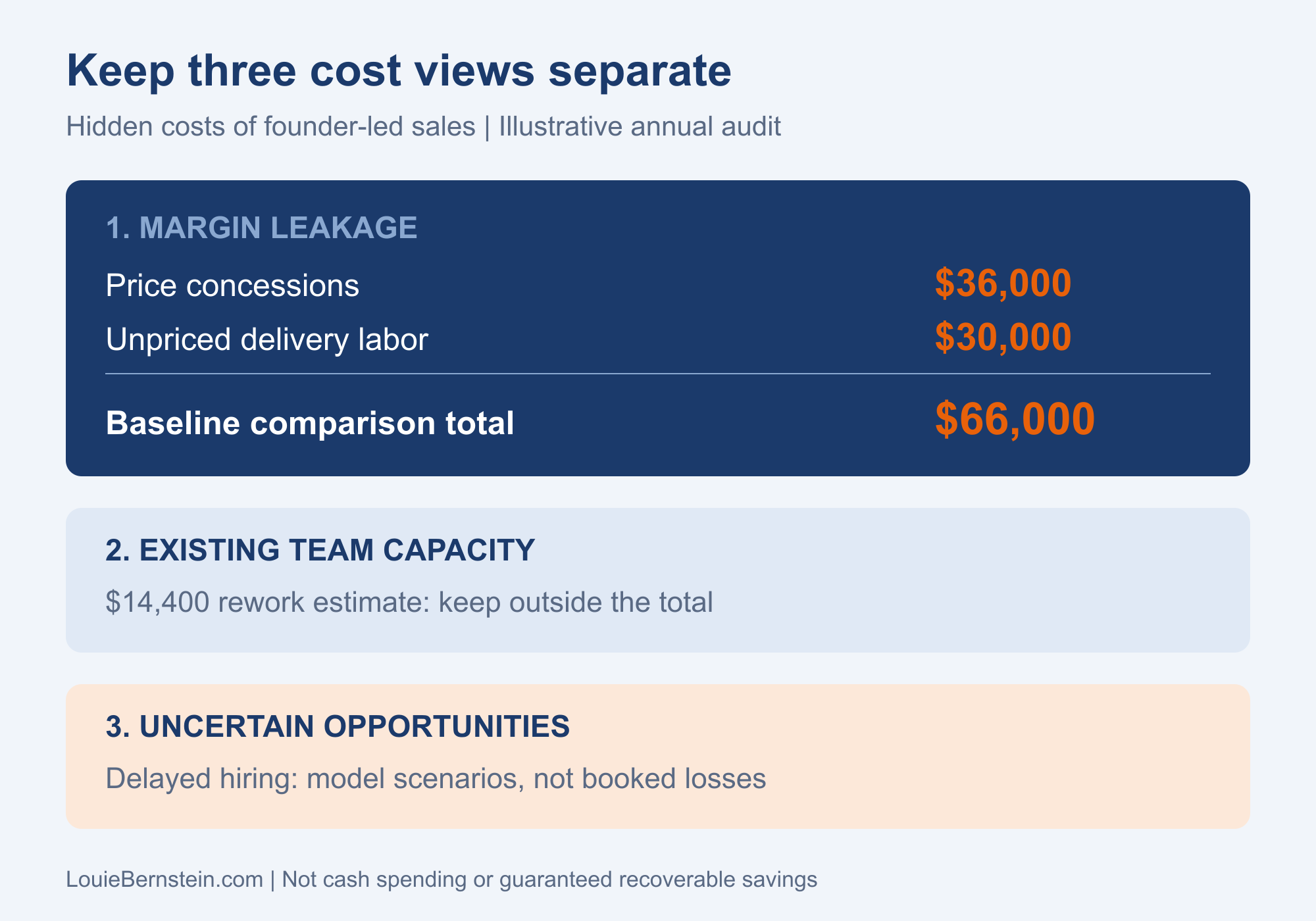
The first view measures margin leakage. Our illustrative annual audit combines $36,000 of price concessions with $30,000 of unpriced delivery labor, totaling $66,000. That is a comparison with the stated baseline price and standard scope, not a cash-flow statement or guaranteed recoverable profit.
The second view measures team capacity. The $14,400 rework estimate stays here unless you can show incremental expense not already counted. Keep founder hours here too, using the approach in the Related Reading article.
The third view records uncertain opportunities, including delayed hiring. Never add a hoped-for future sale to a documented cost and present the sum as an established annual loss.
Run a ten-deal review, then test one fix
- Pull the last ten signed agreements and compare actual price and scope with your standard offer.
- Ask delivery to identify unpriced commitments, hours used, and additional cash spending.
- Ask salespeople which decisions stalled, what rework occurred, and which answers required you.
- Check whether the sample represents the year. Separate one-off exceptions from recurring patterns.
- Choose one rule to change, assign an owner, and review the next ten comparable deals.
Don't multiply a difficult month by twelve just because the result makes a compelling hiring argument. Use a full year where possible. When records are incomplete, report what you know and start collecting the missing evidence.
The goal isn't the biggest possible hidden-cost number. The goal is to stop paying for the same avoidable decision every month.
Frequently Asked Questions
Should I remove every discount from our sales process?
No. Keep discounts that produce a worthwhile trade, such as reduced scope or useful payment terms. Review whether the concession changes customer behavior enough to justify the margin you give up.
What if a custom feature could become part of our standard product?
Treat the feature as a product investment decision. Document likely reuse, development cost, maintenance, and what gets postponed. Don't assign all development cost to one deal or assume future buyers will pay for it.
Can commissions encourage the wrong kinds of deals?
Yes, incentives can reward bookings without reflecting discounts or delivery burden. Review compensation with finance and sales leadership so the measures reflect profitable, deliverable business and remain understandable to the team.
What if we don't track delivery hours by customer?
Start with a short prospective review of custom work, using consistent categories. Reconstruct older costs only when records support the estimate. An incomplete but honest audit is more useful than a precise-looking guess.
Should I count an estimated reduction in company value?
Keep a possible valuation effect outside the annual operating-cost total. Buyer concerns about founder dependence may matter in an exit discussion, but a hypothetical valuation discount isn't money spent during the year.
Can founder-led sales still be the right choice?
Yes. Founder involvement can be valuable when testing an offer, learning from customers, or handling selected strategic conversations. Make involvement intentional and teach the routine work so every customer doesn't require your personal intervention.
Find the costs hiding behind your wins
Bring a few recent deals and the work they created. We'll discuss where Fractional Sales Leadership could help you build a Sales Playbook, coach the team, and reduce routine dependence on you.
Schedule a 30-Minute ConversationAbout the Author
Louie Bernstein is a Fractional Sales Leader with 50 years of sales experience and has worked as a Fractional Sales Leader since 2017. He helps B2B founders at $1M to $10M ARR build repeatable sales systems and teams that can sell without the founder in every conversation.
Subscribe to The Sunday Starter for practical sales leadership advice.