Key Takeaways:
- Hiring, onboarding, and managing salespeople aren't three separate events. They're one system. Skip a step in any of them and the whole thing leaks money.
- Most founders hire before they've defined the job. Write the Accountability Document first, then interview every candidate against the same scorecard. You're testing them against the role, not your gut.
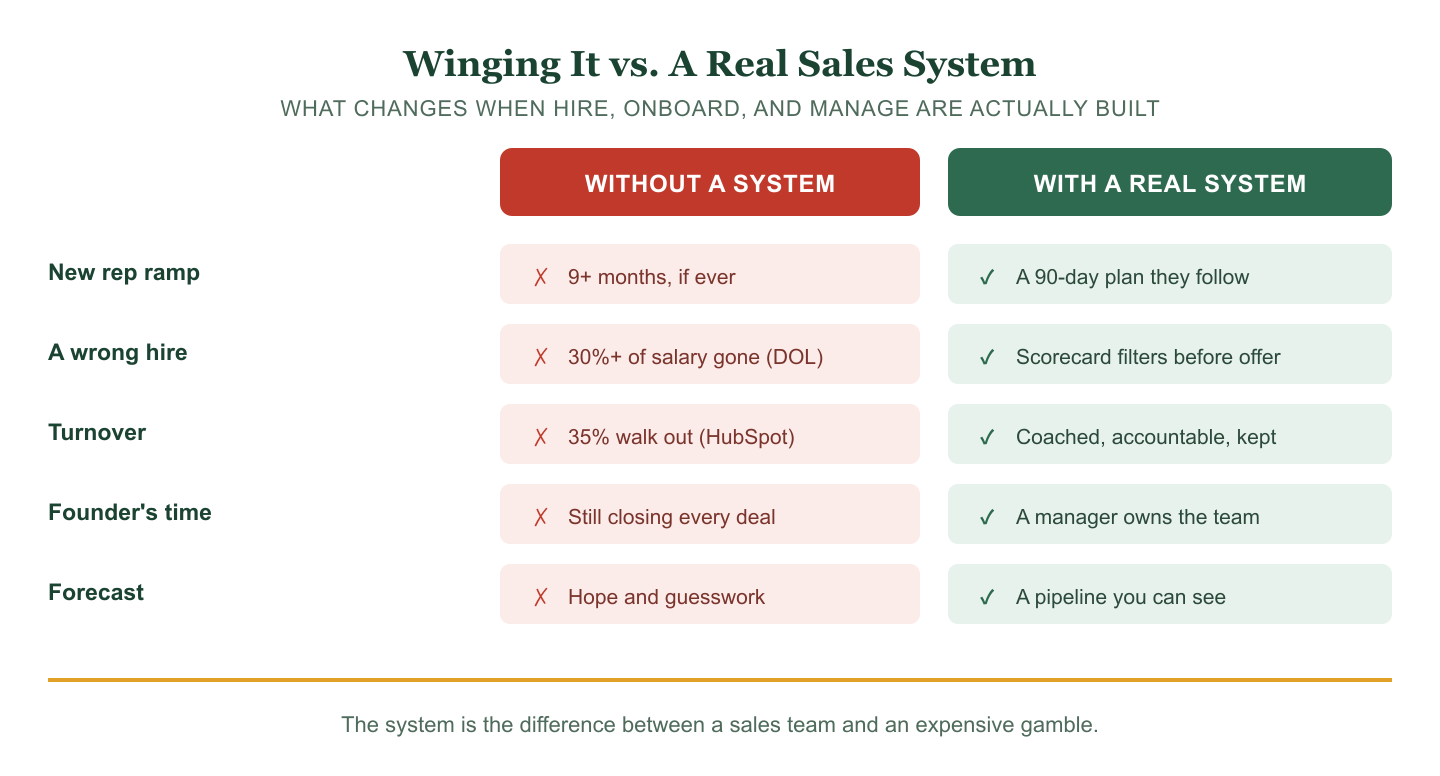
- A new rep takes about five months to reach full productivity (Bridge Group). Without a 30/60/90 plan tied to a real playbook, that ramp stretches to nine months, or never.
- Strong onboarding raises new-hire retention by 82% and productivity by over 70% (Brandon Hall Group). It's the highest-return thing most founders skip.
- Managing isn't "checking in." It's a weekly pipeline review, coaching the skill instead of the deal, and holding a clear number.
- If you don't have a repeatable way to sell yet, don't hire salespeople. You'll just pay more people to be confused. Fix the motion first.
Here's a number that should stop every founder before they post a job opening. The average new sales rep takes about five months to reach full productivity (Bridge Group), and there's roughly a 35% chance they quit within the year, more than three times the turnover of most other roles (HubSpot).
So you're about to spend five months of salary and your own time betting on someone who has a one-in-three shot of walking out before they pay you back. That's not a people problem. That's a system problem.
I've watched founders at $1M–$10M ARR do this over and over. They hire a rep in a panic because they're drowning. They hand that rep a laptop, a login, and a "go get 'em." Then they wonder why nothing happens. The rep flounders because there's no playbook, no talk tracks, no ramp plan, and no clear expectations. Six months later the founder decides "salespeople don't work here" and goes back to closing every deal themselves.
I've built and run sales teams for fifty years. Hiring, onboarding, and managing aren't three separate projects. They're one connected system. Below are the three steps that matter most for each. Get these nine right and you'll build a team that ramps fast, sells on its own, and stays.
Treat It As One System, Not Three Panic Moves
The reason most first sales hires fail has almost nothing to do with the person you picked. It's that each stage gets handled in isolation, usually under stress.
You hire without a defined role. So onboarding has nothing to onboard them into. So managing becomes you jumping onto their calls to save deals, which isn't managing at all. Each broken stage makes the next one worse. A great hire poured into a broken onboarding still fails, and a great onboarding wasted on the wrong hire still fails.
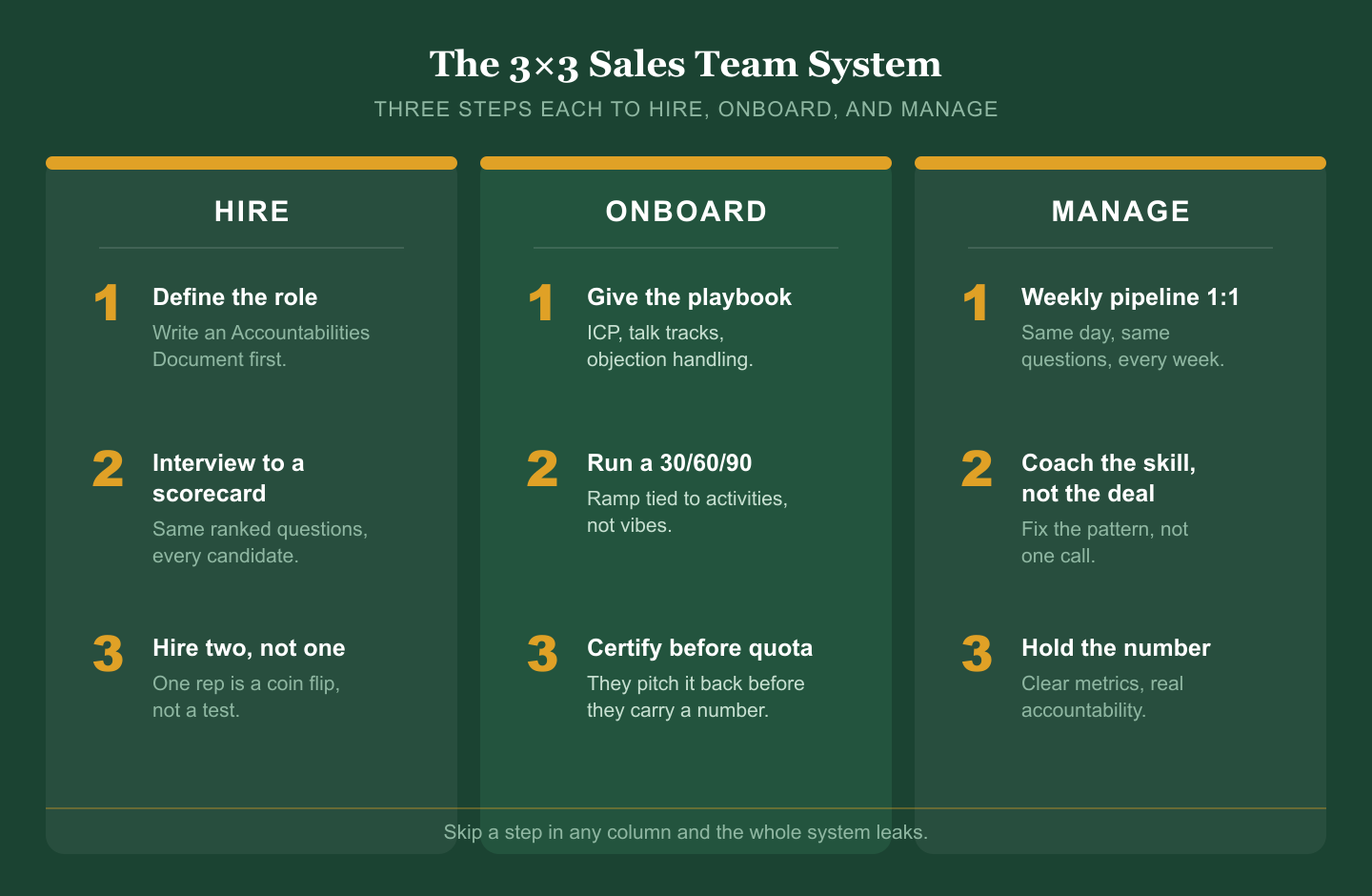
Here's the whole thing on one page. Three phases, three steps each.
How Do I Hire Salespeople?
A bad hire isn't just a wash. The U.S. Department of Labor puts the cost of a bad hire at a minimum of 30% of that person's first-year salary, and SHRM's fuller accounting runs 50% to 200% once you add lost productivity and the deals that never closed. On a $120,000 rep, you're risking $36,000 on the low end. Hiring is where you either buy yourself a problem or filter it out. Three steps decide which.
Step 1: Define the role before you post it
Most founders write a job description full of adjectives. "Hungry." "Self-starter." "Hunter." None of that is measurable, so none of it filters anyone. Before you post anything, write an Accountability Document: the specific outcomes this person owns, the activities that produce them, and the numbers they're accountable to by day 90 and beyond.
Are you hiring a hunter to open new logos, or a closer to work inbound demos? An AE who runs full cycle, or a BDR who only books meetings? These are different humans with different comp plans. If you can't write down exactly what the role owns, you're not ready to hire it. You're ready to think harder about it.
Step 2: Interview to a scorecard, not a gut feel
Salespeople sell for a living, and the thing they sell hardest is themselves in an interview. That's exactly why "I just had a great feeling about her" is how founders talk themselves into the wrong hire. Great storytellers interview beautifully and sell nothing.
Build a scorecard. Pick the five or six traits the role actually requires, write one or two questions for each, and score every candidate on the same scale. Ask them to walk you through a real deal they lost and what they'd do differently. Ask them to sell you something. Watch whether they ask questions or just pitch. The scorecard turns a vibe into a comparison, and it forces you to interview the fifth candidate as rigorously as the first.
Step 3: Hire two, not one
This is the one founders fight me on, and it's the one that matters most. When you hire a single rep, you have no idea whether a bad result is the rep or the market, the product, or your process. One rep is a coin flip, not a test.
Two reps give you a baseline. If one hits and one doesn't, you learned it's the person. If both struggle in the same spot, you learned it's your playbook or your positioning, and no third hire would've fixed it. Two reps also compete, cover for each other, and keep a single quit from wiping out your entire sales function overnight.
"You don't hire one salesperson to find out if sales works. You hire two so the data can actually tell you something."
How Do I Onboard Salespeople?
Onboarding is the highest-return work most founders skip, and the numbers aren't close. Organizations with a strong onboarding process see 82% better new-hire retention and over 70% better productivity (Brandon Hall Group). The rep you almost fired in month four is often just a rep you never actually onboarded. Here's how to do it right.
Step 1: Hand them the playbook
A new rep should not have to reverse-engineer how you sell by shadowing you for three months. Write it down. At minimum, your playbook covers:
- Your ICP: exactly who to call and, just as important, who to skip
- Talk tracks: how you open, the discovery questions that work, how you frame value
- Objection handling: the five objections you hear every week and the honest answers
- Your sales stages: what has to be true to move a deal from one stage to the next
You already have this. It's in your head. Onboarding is the act of getting it out of your head and onto a page a new person can run.
Step 2: Run a real 30/60/90
"Ramp" without a plan is just hoping. A 30/60/90 ties the first three months to specific milestones, and it's built on activities the rep controls, not on results they can't yet produce.
First 30 days: learn the product, the ICP, and the playbook well enough to pass a certification. Days 30 to 60: run live calls with you listening, own a small pipeline, hit activity targets. Days 60 to 90: carry a ramped number and run deals mostly on their own. When a rep knows exactly what "on track" looks like in week three, they either get there or they show you early that they won't. Both are useful. Vague ramps hide problems until month six.
Step 3: Certify before they carry a number
Before a rep talks to a real prospect, they should have to sell it back to you. Have them deliver the pitch, run a mock discovery call, and handle your toughest objections while you play the buyer. It feels formal. It's the cheapest insurance you'll ever buy.
Certification catches the gap between "sat through training" and "can actually do it," and it catches it before that gap gets spent on your real pipeline. A rep who can't pass a mock call was never going to win a real one. Better to find out in a conference room than in your CRM.
The rep you're about to give up on in month four is usually a rep you never actually onboarded. You hired them. You didn't equip them.
How Do I Manage Salespeople?
Managing is where founders either build a team or slowly become the bottleneck again. And it matters more than most realize, because reps spend less than 30% of their week actually selling (Salesforce). The rest disappears into admin, confusion, and chasing the wrong deals. Good management is largely the work of pointing that scarce selling time at the right things. Three habits do most of it.
Step 1: Run a weekly pipeline 1:1
Same day, same time, same questions, every single week. Not "how's it going." A structured review of their actual pipeline: What moved since last week? What's stuck and why? What's the next step on every real deal, and is it on the calendar?
The consistency is the point. A weekly rhythm catches a stalling deal while you can still save it, not at the end of the quarter when it's already lost. It also trains the rep to think about their pipeline the way you do, which is the whole goal.
Step 2: Coach the skill, not the deal
When a rep is stuck, the founder's instinct is to jump on the call and close it for them. That saves the one deal and teaches the rep nothing. Do it enough and you're not managing a team, you're doing everyone's job while paying them to watch.
Coach the pattern instead. If discovery is thin across three different deals, you don't fix three deals. You fix how they run discovery. Coaching the repeatable skill compounds. Rescuing the individual deal doesn't. This is the single hardest habit for a founder to build, and it's the one that decides whether you ever get your calendar back.
Step 3: Hold the number
Accountability isn't a personality trait, it's a structure. Reps need a clear number, a clear picture of the activity that produces it, and a manager who notices, quickly and kindly, when either one slips. No surprises at review time.
Most founders swing between two failures here. They either avoid the hard conversation until they're furious, or they hover so closely the rep never develops judgment. Holding the number is the middle path: clear expectations, real consequences, and enough room for the rep to own the outcome.
What This Looks Like With a Fractional Sales Leader
Here's the honest problem. Everything above is a full-time job you've never done. Learning to hire, onboard, and manage a sales team on the fly, while still running the company, is how most founders lose a year and $100,000 figuring it out the hard way.
That's the exact gap I fill as a Fractional Sales Leader. I design the first sales roles and write the Accountabilities Document. I build the scorecards and the interview process so you stop hiring on a feeling. I write the 30/60/90 onboarding plan and tie it to a real playbook. Then I act as the temporary sales manager, running the weekly 1:1s, coaching the reps, and holding the number, so you don't have to become a sales manager overnight.
You get an experienced operator building the system for a fraction of a full-time VP of Sales, which you're almost certainly not ready for yet anyway. And the goal is always to work myself out of a job by leaving you with a team and a system that runs without me.
When This Won't Work
I'd rather tell you the truth than take your money. Hiring salespeople will not fix a sales problem that lives underneath the salespeople.
If you don't yet have product-market fit, or you can't personally close deals with any consistency, or you have no repeatable motion to hand a rep, then hiring reps just multiplies the confusion. You'll pay two more people to fail at something that isn't figured out yet. Reps execute a system. They don't invent one. If the system doesn't exist, the first job is building it, not staffing it.
So be honest with yourself. If you can reliably win deals and you're simply out of hours to do it all, you're ready to build a team, and the nine steps above are your blueprint. If you're still guessing at how to sell your own product, start there first. Everything else is built on that foundation.
Frequently Asked Questions
Q: Should my first sales hire be an AE, a BDR, or an SDR?
It depends on where your bottleneck is, and that's exactly why you define the role before you post it. If you have more inbound interest than you can work, hire a closer (an AE). If you have a product that sells but not enough conversations, hire someone to create pipeline (a BDR or SDR). Hiring the wrong one is common: founders bring on a hunter when what they actually needed was a closer, then wonder why the pipeline is full and nothing closes. Get clear on the specific gap first.
Q: How long before a new salesperson should be producing?
Plan for about five months to full productivity for a B2B rep (Bridge Group), longer for larger, more complex deals. But you shouldn't be flying blind for five months. A real 30/60/90 gives you activity milestones every few weeks, so you can tell by day 45 whether a rep is on track. If they're hitting the leading indicators, results follow. If they're not, you'll know long before you've burned half a year.
Q: I don't have a playbook. Can I still hire?
You have a playbook, it's just trapped in your head. If you've been closing deals yourself, you already know your ICP, your best questions, and the objections you hear every week. The work is writing it down before the rep starts, not after they've floundered. If you genuinely can't articulate how you win, that's a signal you're not ready to hire yet. You're ready to document your own motion first.
Q: Do I really need to hire two salespeople at once?
If the budget allows it, yes. One rep gives you no signal: if they fail, you can't tell whether it was the person, the product, or your process. Two reps give you a comparison, and one person quitting doesn't take your entire sales function down with it. If you truly can only afford one, tighten your onboarding and management even further. You have no margin for a bad read.
Q: How much of my own time will managing a sales team take?
Done right, less than you think, but only after an intense start. The first 90 days are heavy: certification, live-call coaching, tight feedback. After that, a well-run team needs a structured weekly 1:1 per rep plus ad-hoc coaching, not you on every call. Done wrong, it eats your whole week, because you're rescuing deals instead of coaching skills. If you don't have the hours for that heavy start, that's exactly when a Fractional Sales Leader acting as your temporary sales manager earns their keep.
Q: Why do so many founders' first sales hires fail?
Because they treat hiring as the finish line instead of step one. They find someone, feel relieved, and hand off with no role definition, no playbook, no ramp plan, and no management rhythm. The rep was set up to fail before day one. With sales turnover already running near 35% a year (HubSpot), a shaky setup almost guarantees a churn. Fix the system around the hire and the same caliber of person suddenly "works."
You're about to hire, or you already hired and it's not working.
Either way, the fix is the same: a real system to hire, onboard, and manage. Let's spend 30 minutes on how you're building your team and where it's leaking. See how a Fractional Sales Leader can help at louiebernstein.com.
Schedule a 30-Minute CallAbout the Author
Louie Bernstein
Fractional Sales Leader with 50 years of sales experience helping $1M–$10M ARR companies build scalable, repeatable sales systems. Founder of MindIQ (INC 500). LinkedIn Top Voice in Sales Management, Sales Operations, and Sales Coaching.