One fills an empty seat while you search. The other builds the seat so your next hire can succeed.
An interim sales leader works full-time for a short period to cover a vacant sales leadership role. A Fractional Sales Leader works part-time over months to build the sales system, often before any full-time hire. If your VP of Sales just quit, find out why the seat failed before you fill it. If there was no playbook, an interim sales leader just keeps the problem warm. Use the gap to build the system, then hire.
Key Takeaways
- An interim sales leader is a full-time, short-term placeholder for an empty seat. A Fractional Sales Leader is a part-time builder who installs the sales system over months.
- When a VP of Sales quits, the founder's instinct is to fill the seat fast. First find out why the seat failed: no written playbook, no clean pipeline and no clear accountabilities are the usual reasons.
- Replacing the person without fixing the system repeats the failure. The average VP of Sales lasts about 19 months (Gong), and SaaStr's Jason Lemkin claims 70% of first-time VPs of Sales don't make it a year.
- Interim leaders bill near full-time hours, so they cost close to a full-time salary for the period. Fractional Sales Leaders generally run $10K to $20K a month.
- If your VP of Sales just left, spend the first two weeks covering the reps and the deals in flight, then use the gap to build what the next VP will inherit.
The call often starts the same way. "Our VP of Sales just gave notice. What do we do?"
The founder is already halfway to a decision. Get someone in the seat. Call a recruiter. Maybe bring in an interim so the reps aren't leaderless. All of that feels responsible.
I understand it. But when a sales leader leaves, the most expensive mistake isn't leaving the seat empty for a few weeks. It's filling it with the next person before you know why the last one couldn't make it work.
An interim fills the seat. A Fractional Sales Leader builds the seat. Before you pick one, find out why the seat failed.
What is the difference between an interim and a fractional sales leader?
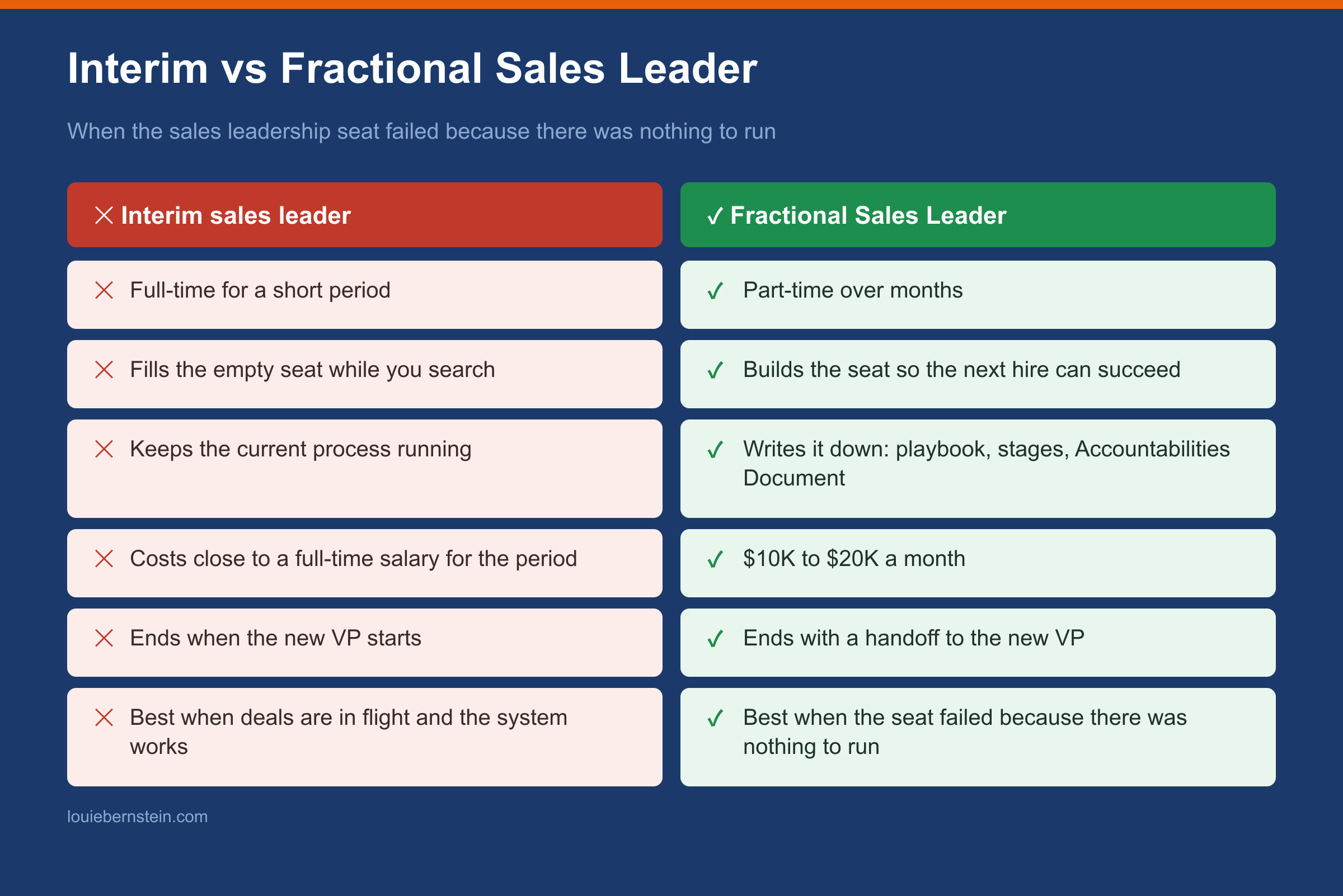
An interim sales leader works full-time for a short period to cover a vacant sales leadership role while the company searches. A Fractional Sales Leader works part-time over months to build the sales system, often before any full-time hire. The interim keeps the current process running. The fractional leader changes the process so the next hire can succeed.
Platforms describe the interim model plainly. Go Fractional lists its interim retainer as best for "full-time coverage during a hiring gap." That's exactly what interim is: coverage. It's the right tool when the system works and you just need someone in the chair.
My VP of Sales just quit. Do I need an interim sales leader?
You need an interim sales leader only if deals are in flight and your reps have nobody to report to tomorrow. Otherwise, take two weeks to learn why the role failed before you fill it. Covering the reps is urgent. Replacing the VP of Sales is not, and rushing it is how founders hire the same failure twice.
The first two weeks after a sales leader leaves
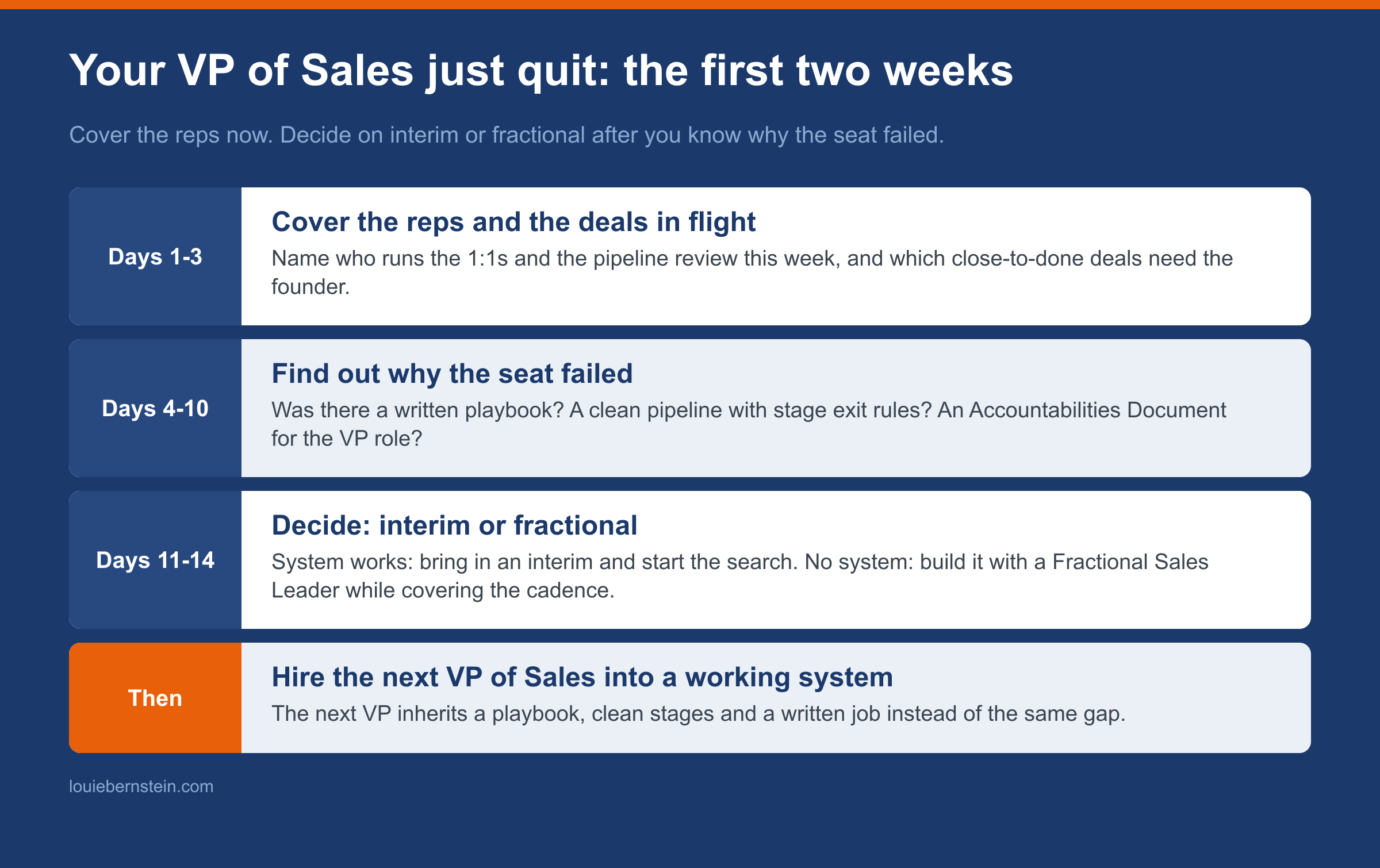
Days one to three are triage. Somebody has to run the rep 1:1s and the pipeline review this week, and the founder may need to step into two or three deals that are close to closing. That's fine for a few weeks. Just don't let triage turn into a permanent job.
Why did the sales leader's seat fail in the first place?
A VP of Sales seat usually fails because there was nothing to run: no written playbook, no clean pipeline and no clear accountabilities. The VP was hired to scale a sales process that only existed in the founder's head, and spent the job building basics while everyone expected growth. Replacing the person without fixing that repeats the failure.
The numbers back this up. The average VP of Sales tenure is about 19 months, down from 26 (Gong's 2018 analysis). SaaStr's Jason Lemkin claims 70% of first-time VPs of Sales don't make it one year; that's his estimate, not a survey. I cover what to get right before the next search in how to hire a VP of Sales for a B2B startup.
Three questions to ask before you replace a VP of Sales
- Was the sales process written down? Could the VP hand a new rep a playbook on day one, or was the process in the founder's head?
- Was the pipeline clean? Did the CRM stages have exit rules, or did deals sit in the same stage for months?
- Were the accountabilities clear? Did the VP have an Accountabilities Document that said what the job owned and how it was measured, or did the job change every quarter?
If the answer to all three was yes, the seat may have failed because of the person, and an interim plus a fast search can make sense. If the answers were no, the seat failed because of the system.
Where founders usually get this wrong
Here's the pattern I've seen over and over in turnarounds. The sales leader leaves. The founder feels exposed, so the founder rushes the replacement and hires someone who interviews well. The new leader walks into the same missing playbook, the same messy pipeline and the same vague job. A year or so later, the founder is making the same call again.
When I stepped in as Sales VP at a struggling company, during the worst economy in 30 years, I didn't start by hiring. I started by writing down how we sold and teaching it every day, 20 minutes a day. In the first year, sales went up 10% and profits went up 321%. The people didn't change much. The system did.
If you replace the person and keep the missing system, you've hired the same failure twice.
Can a Fractional Sales Leader cover a gap and build at the same time?
Yes. Covering the gap and building the system at the same time is the strongest use of a Fractional Sales Leader after a VP of Sales leaves. The fractional leader runs the weekly cadence so reps aren't leaderless, and builds the playbook, pipeline stages and Accountabilities Document the next VP will inherit.
That's how I'd run it. Rep 1:1s and the pipeline review keep happening every week, so the team has someone to report to. In between, we write the playbook from what actually closes deals, clean up the stages, and write the job for the next VP from what now exists. I describe the signs it's time in when to hire a Fractional Sales Leader.
What the next VP of Sales should inherit
- A written Sales Playbook the reps already use, built from the deals you actually win.
- CRM pipeline stages with exit rules, so the new VP can trust the forecast in week one.
- An Accountabilities Document for the VP role and every sales role under it.
- A weekly cadence of 1:1s and pipeline reviews that's already running.
A new VP who inherits those four things starts by growing the business. A new VP who inherits none of them starts by rebuilding it.
How long should an interim or fractional engagement last after a VP leaves?
An interim or fractional engagement after a VP of Sales leaves should last long enough to install the system and hire well, not just long enough to fill the seat. My standard is a 12-week engagement, renewable, and most of my fractional clients renew for 6 to 12 months total.
The search itself takes time too. Go Fractional's own comparison puts a full-time sales hire at 3 to 6 months. That's a platform's estimate, not survey data, so treat it as a rough guide. Either way, the gap is long enough to do something useful with. Spend it building instead of waiting.
What does an interim sales leader cost compared with a Fractional Sales Leader?
An interim sales leader bills near full-time hours, so an interim costs close to a full-time salary for the period. A Fractional Sales Leader generally runs $10K to $20K a month. For context, a full-time VP of Sales costs $250K to $400K a year, roughly $21K to $33K a month in salary alone.
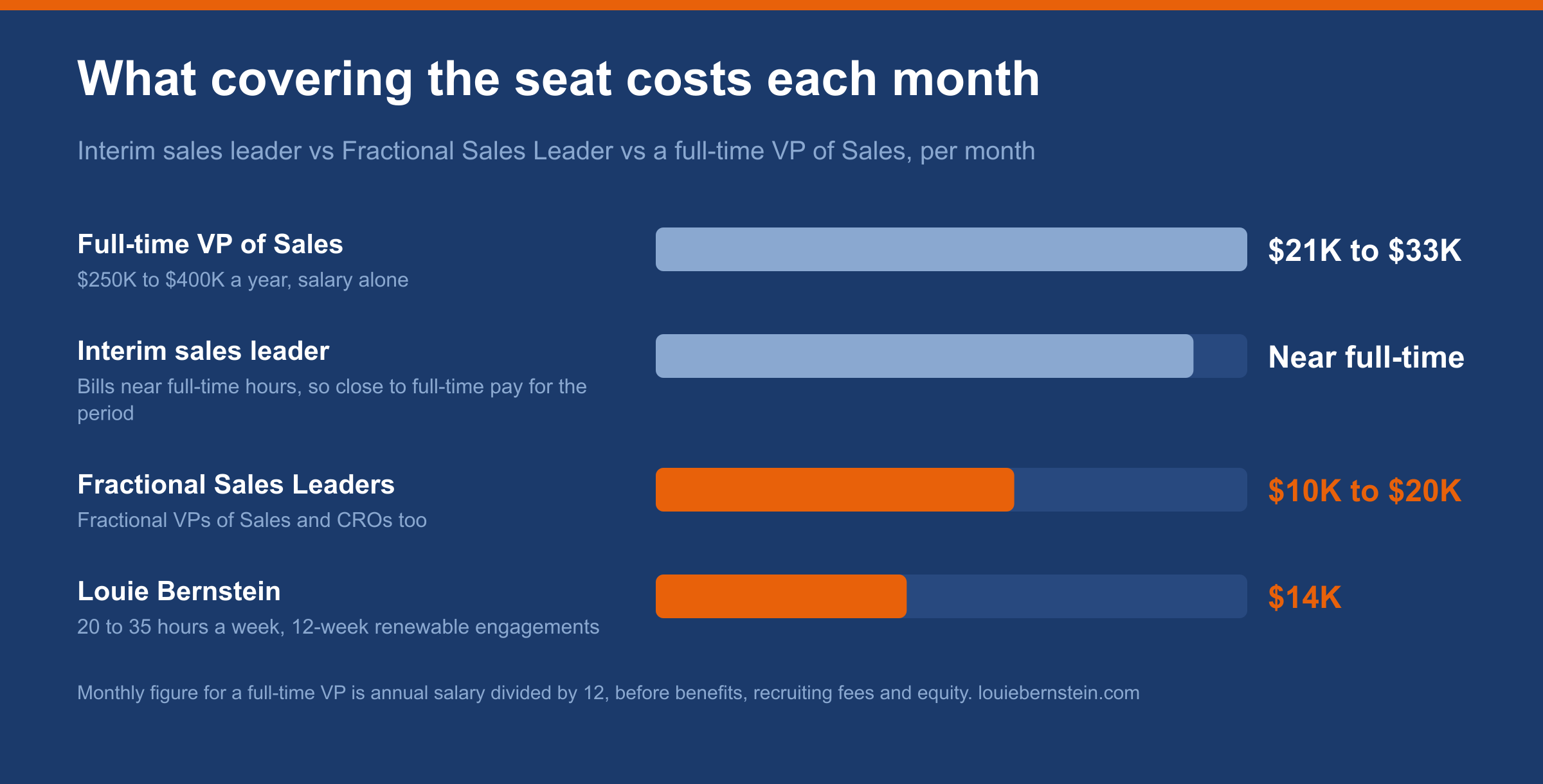
My fee is $14K a month for 20 to 35 hours a week, roughly half the cost of a full-time VP of Sales. The bigger difference isn't the monthly number. When an interim leaves, you keep the seat warm and little else. When a Fractional Sales Leader finishes, you keep the playbook, the stages and the Accountabilities Document. I break down the full-time comparison in VP of Sales vs Fractional Sales Leader.
Frequently Asked Questions
What is an interim VP of Sales?
An interim VP of Sales is a sales executive who works full-time in the VP role for a set period, usually while the company searches for a permanent hire. The interim keeps the team and the pipeline running. The job is coverage, not building a new sales system.
Should the founder step back into sales leadership when a VP quits?
For a few weeks, yes. Run the 1:1s and help close the deals in flight. Don't let it last. A founder who takes the seat back for six months is back in founder-led sales, and the business stalls again whenever the founder is busy.
Should I promote my top rep to cover for the VP of Sales?
Usually not. Your top rep is your best closer, and sales leadership is a different job. Promoting a top rep into an empty seat with no playbook often costs you a closer and doesn't give you a leader. Cover the cadence another way.
Can an interim sales leader become the permanent VP of Sales?
Sometimes. If the interim knows your market, wants the job and the system already works, converting can make sense. Decide what the role needs to be first. If the seat failed because nothing was written down, build that before you make anyone permanent.
What should I tell my sales team when the VP of Sales leaves?
Tell them the same day, plainly. Say who runs their 1:1s and the pipeline review starting this week, and that their deals and comp plans are covered. Reps can handle change. What scares them is not knowing who they report to.
Your sales leader left. Build the seat before you fill it.
If you're a B2B founder at $1M to $10M ARR and your VP of Sales just walked out, let's figure out why the seat failed, keep your reps covered, and map what the next VP should walk into. Learn about Fractional Sales Leadership at LouieBernstein.com.
Schedule a 30-Minute CallAbout the Author

Louie Bernstein Fractional Sales Leadership
Louie Bernstein is a Fractional Sales Leader with 50 years of sales experience and has worked as a Fractional Sales Leader since 2017. He built and ran MindIQ for 22 years. He helps B2B founders at $1M to $10M ARR build repeatable sales systems so selling doesn't depend on the founder.