How Do You Know When Growth Depends Too Much on Existing Customers?
Yes, expansion revenue often hides a new-customer sales problem. When upsells, add-ons and price increases from customers you already have keep total growth looking healthy, nobody notices that new-customer revenue is flat or falling. Split your growth every quarter into new-customer revenue and expansion revenue. If new-customer revenue drops for two quarters in a row while total growth holds, you've got a selling problem, and your existing base can't cover it forever.
Key Takeaways
- Expansion revenue hides a new-customer sales problem when strong upsells keep total growth steady while new-customer revenue shrinks.
- B2B SaaS companies got 40% of total new ARR from existing customers in 2024, up from a 25% median in 2022 (Benchmarkit 2025 report).
- At the 2025 medians of 101% net revenue retention and 24% growth (SaaS Capital), roughly 23 of the 24 points of growth have to come from new customers.
- Net revenue retention mixes price increases, upsells and cross-sells with losses, so a rising NRR can sit right next to a failing new-customer engine.
- This month, report new-customer revenue, new-customer count and new-customer pipeline created as their own lines, separate from expansion.
Your revenue grew 20% last year. The board is happy. Your net revenue retention went up. Every chart on the dashboard points the right way.
Then you ask a different question: how much of that growth came from customers who'd never bought from you before? The answer is a lot smaller than it was a year ago.
Expansion revenue tells you your customers like you. New-customer revenue tells you whether anyone else will.
For a B2B founder at $1M to $10M ARR, that gap matters more than it does for a big company. You don't have thousands of accounts to keep upselling. You have a few dozen, maybe a few hundred, and they only have so much room to grow.
How Can Expansion Revenue Hide a New-Customer Sales Problem?
Expansion revenue hides a new-customer sales problem because most growth reports show one total. Upsells to happy customers fill the gap left by fewer new wins, so total growth looks the same. For a founder-led B2B company, that blended number can stay flat for a year while the new-customer engine quietly stalls.
The blended number covers the gap
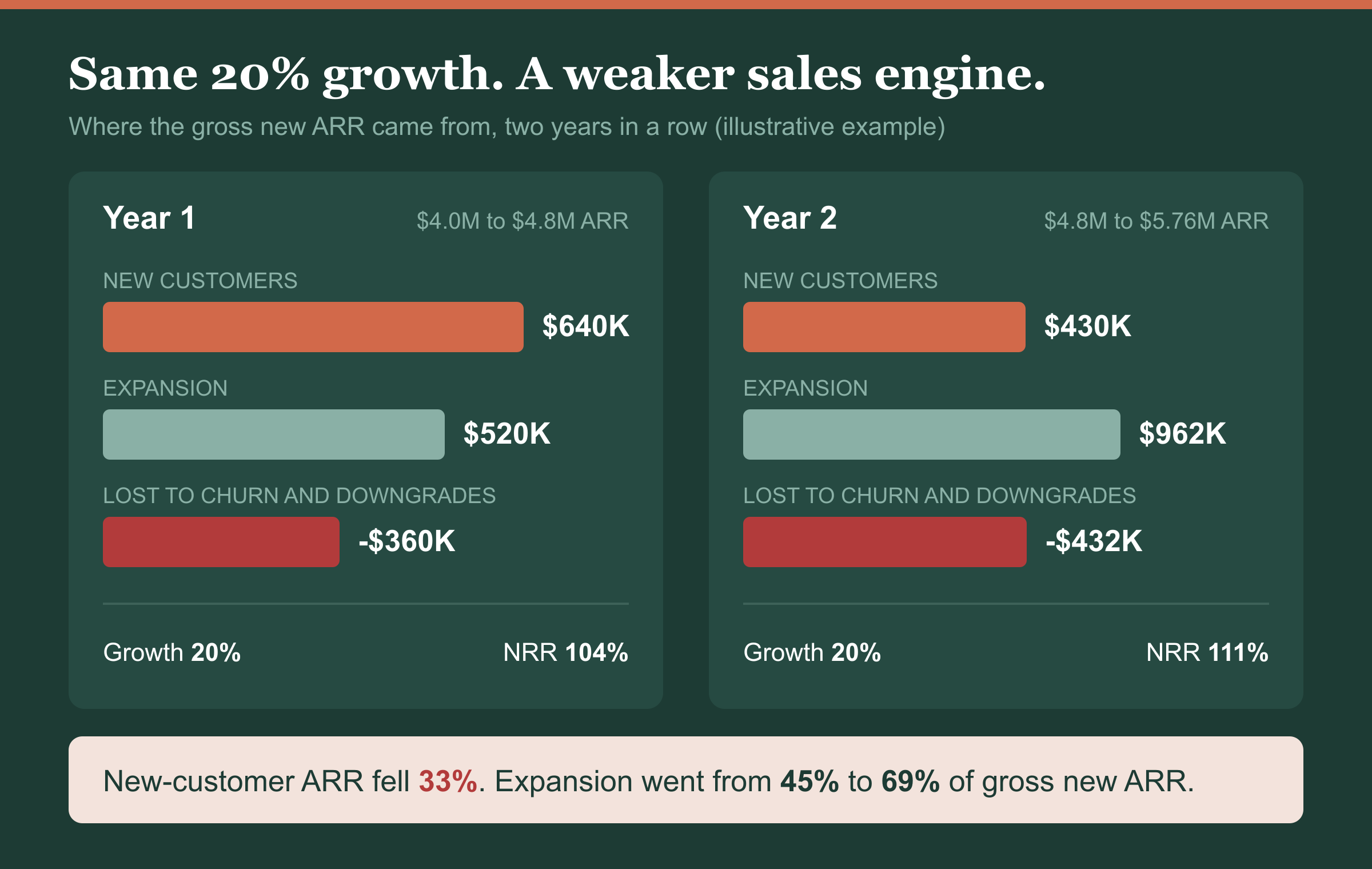
Look at the illustrative company below. It grows 20% two years in a row. Net revenue retention rises from 104% to 111%. On a single slide, Year 2 looks better than Year 1.
Now split the growth. New-customer ARR fell from $640K to $430K, a 33% drop. Expansion went from 45% of gross new ARR to 69%. Same growth rate, much weaker sales engine.
The market is pushing founders this way
Winning new customers is getting more expensive. Benchmarkit's 2025 report found the New CAC Ratio rose from $1.76 of sales and marketing spend per $1 of new-customer ARR in 2023 to $2.00 in 2024. In the same report, existing customers produced 40% of total new ARR, up from a 25% median in 2022 (Benchmarkit via Maxio).
That shift makes sense. Selling more to a happy customer is faster and cheaper. The risk is that the easier revenue becomes the only revenue your team knows how to win.
How Do You Know When Growth Depends Too Much on Existing Customers?
You know growth depends too much on existing customers when new-customer revenue, new-customer count or new-customer pipeline falls for two or more quarters while total revenue keeps growing. The trend matters more than any single percentage. A falling new-customer line means your future customer base is shrinking, even if this year's number looks fine.
Run the growth split test
- Pull every revenue change for the last eight quarters from your billing system or CRM.
- Tag each change as new customer, expansion (upsell, cross-sell, added seats, price increase), or loss (churn and downgrades).
- Chart new-customer revenue and new-customer count by quarter, by themselves.
- Calculate expansion as a share of gross new revenue for each quarter.
- Check how much of the expansion came from your five biggest accounts.
This works for services businesses too. Use contracted annual revenue instead of ARR and keep one-time project fees in a separate line.
Warning signs to look for
| Signal | Healthy | Hiding a problem |
|---|---|---|
| New-customer revenue | Steady or rising | Down two or more quarters in a row |
| New customers won | Count grows with the team | Fewer wins, bigger upsells |
| New-customer pipeline created | Enough to hit next year's target | Thinner each quarter |
| Where expansion comes from | Spread across many accounts | Mostly three to five big accounts |
| Type of expansion | Customers buying more product | Mostly price increases |
| Who closes new customers | The sales team | Still the founder |
Pay attention to that fifth row. A price increase counts as expansion in net revenue retention. It isn't a sign that anyone is out selling.
Does Strong Net Revenue Retention Prove Your Sales Engine Works?
Strong net revenue retention doesn't prove your sales engine works because NRR only measures customers you already have. It includes price increases, upgrades, upsells and cross-sells, and it excludes new customers completely. A company can post 110% NRR and still be losing its ability to win new business.
What the median company actually looks like
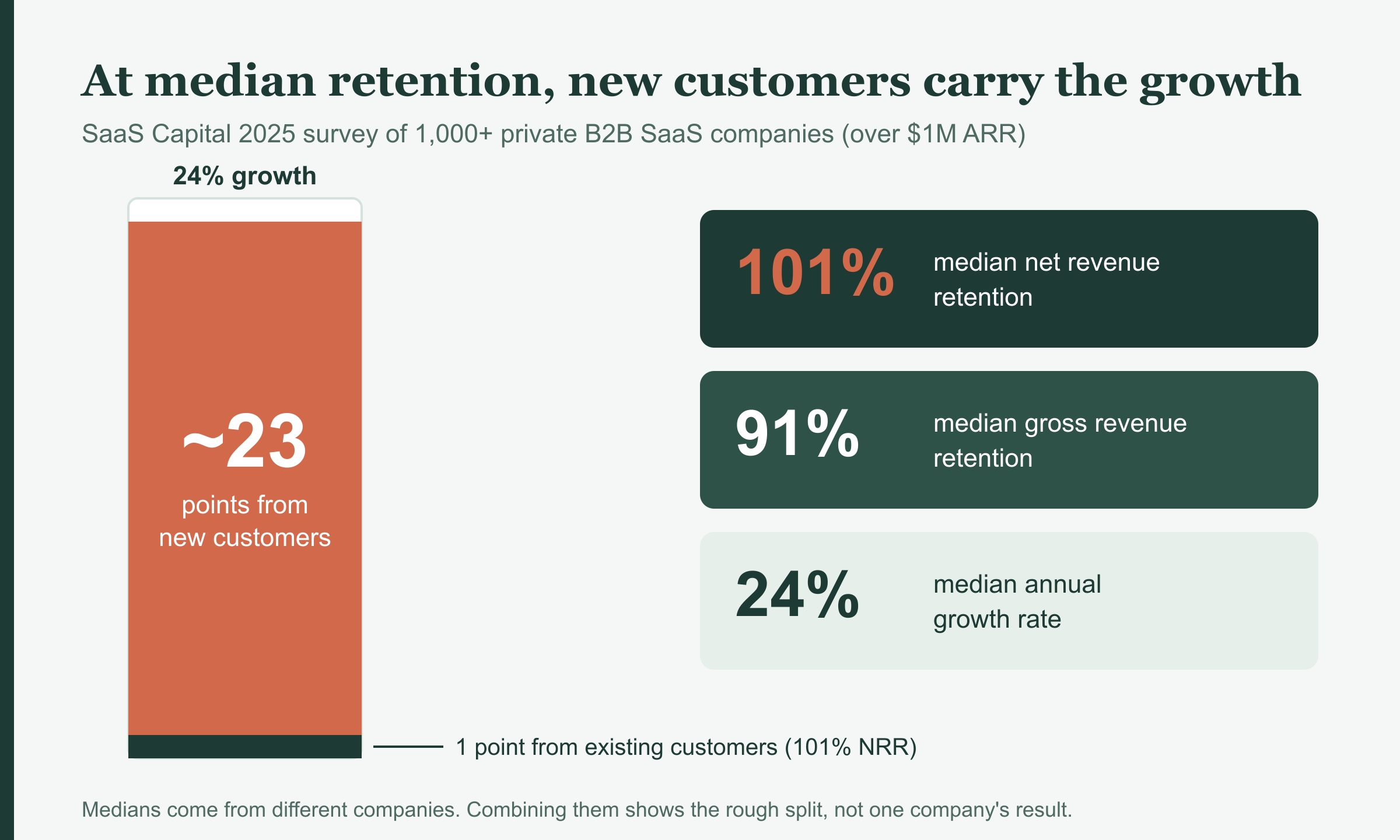
SaaS Capital surveyed more than 1,000 private B2B SaaS companies with over $1M ARR in early 2025. The median net revenue retention was 101%. Median gross revenue retention was 91%. Median growth was 24% (SaaS Capital).
Do the math. At 101% NRR, your existing customers add about one point of growth after losses. If you want to grow 24%, roughly 23 points have to come from new customers. Those medians come from different companies, so treat the split as a rough guide, not a law.
The same survey found that higher NRR goes with faster growth. Expansion matters. I'm not telling you to ignore it. I'm telling you not to let it be the only number you read. If you want the full formula, here's how to calculate and read net revenue retention.
Watch gross retention too
Median gross retention of 91% means a typical company loses about 9% of its starting revenue every year to churn and downgrades. Expansion has to replace that first. New customers are the only revenue that grows your base instead of refilling it.
Why Do Sales Teams Drift Toward Existing Customers?
Sales teams drift toward existing customers because expansion deals are easier, faster and usually pay the same commission. A rep who can close an upsell in two weeks won't spend that time cold calling strangers unless someone makes new-customer selling a separate job. Without that, the path of least resistance wins every time.
What I've seen managing sales teams
In 50 years of sales I've managed both kinds of salespeople. Account Managers grow and protect customers you already have. Account Executives go find new ones. They're different sales personalities, and I've learned not to force one into the other.
I once heard from a salesperson who'd hit 100%+ of quota every year as an Account Manager. He moved to an Account Executive role at a new company and struggled with cold calling, booking meetings and closing. Same person, same work ethic, different job.
Here's where founders get it wrong. They hire one rep, give that rep the existing accounts "to start," and expect new-customer revenue to follow. It rarely does. The rep stays busy and hits quota on upsells, and the founder keeps closing the new customers at night. On paper, the sales team is working. In reality, the founder is still the new-business engine.
Comp plans make the drift worse
If a dollar of upsell pays the same as a dollar from a new customer, your reps will chase the upsell. You've told them, with money, that both are equal. Split the quota, or pay a different rate, so new-customer revenue has its own target and its own reward.
How Do You Fix a New-Customer Sales Problem Without Hurting Expansion?
Fix a new-customer sales problem by giving new-customer selling its own owner, its own target and its own protected time, separate from account growth. Keep expansion going with a clear account owner. The goal isn't to choose between the two. The goal is to stop letting easy expansion revenue use up the hours meant for winning new customers.
Five moves to make this quarter
- Report the split. New-customer revenue, count and pipeline created go on their own lines in every monthly review.
- Set a separate new-customer target. Work backward from your growth goal, your expected NRR and your average new-customer deal size.
- Name an owner for each job. One person owns account growth. One person owns new customers. In a small company, write each role in an Accountabilities Document so nothing falls between them.
- Protect prospecting time. Put new-customer selling on the calendar and don't let account fires cancel it every week.
- Document how you win new customers. Your team needs a Sales Playbook with your ideal customer profile, qualification, discovery and stage exit criteria. Without one, only the founder knows how to close a stranger.
When to bring in help
If you're still the only person who can win a new customer, hiring another rep won't fix it. You'll just have another person upselling your existing accounts. A Fractional Sales Leader can build the new-customer process, split the roles, set the targets and coach the team for 20 to 35 hours a week, at roughly half the cost of a full-time VP of Sales.
Don't wait until expansion slows down to start. By then, the new-customer pipeline you needed should have been built two or three quarters earlier.
Related Reading
How Do You Reduce Customer Concentration? →
Frequently Asked Questions
Q: What percentage of my growth should come from new customers?
No universal percentage fits every company. In Benchmarkit's 2025 report, existing customers produced 40% of total new ARR, which means new customers produced about 60%. At $1M to $10M ARR, your base is still small, so a falling new-customer share deserves a closer look than it would at a large company.
Q: Should price increases count as expansion revenue?
Price increases count in net revenue retention, but track them on their own line. A price increase tells you customers will pay more. An upsell tells you they want more. Only one of those shows that your team is selling.
Q: Can my Account Manager also go after new customers?
An Account Manager can prospect, but it's usually a different skill set and a different personality. If you combine the roles, give the person a separate new-customer target and protected time, or the existing accounts will win every week.
Q: How long before a new-customer problem shows up in total revenue?
A new-customer problem usually shows up in pipeline about one full sales cycle before it hits revenue. If your average deal takes six months, the pipeline you didn't create this quarter becomes a revenue gap two quarters from now, often right when expansion starts to slow.
Q: Is a heavy reliance on expansion revenue ever fine?
Heavy reliance on expansion can work for a while if you have many accounts with lots of room to grow and low churn. It gets risky when a few big customers drive most of the expansion, because losing one of them removes both the base revenue and the growth.
Find out what your growth is really made of
If you're a B2B founder at $1M to $10M ARR and you're still the one closing new customers, let's split your growth and see what's really driving it. Fractional Sales Leadership can build the new-customer engine your team needs without taking anything away from the customers you already have.
Schedule a 30-Minute CallAbout the Author
Louie Bernstein
Louie Bernstein is a Fractional Sales Leader with 50 years of sales experience and has provided Fractional Sales Leadership since 2017. He helps B2B founders build repeatable sales systems so their teams can sell without depending on the founder.