Without a marketing team, an MQL is a contact who fits your ideal customer profile and took one clear action toward you, like a reply, a question, or a pricing request. An SQL is an MQL who named a problem you solve and agreed to a sales conversation about it. Write both definitions down as buyer actions, not scores. That keeps your selling hours on real buyers and gives your first sales hire rules they can follow.
Key Takeaways:
- An MQL is a right-fit contact who took one action toward you. An SQL is an MQL who named a problem you solve and booked a conversation about it.
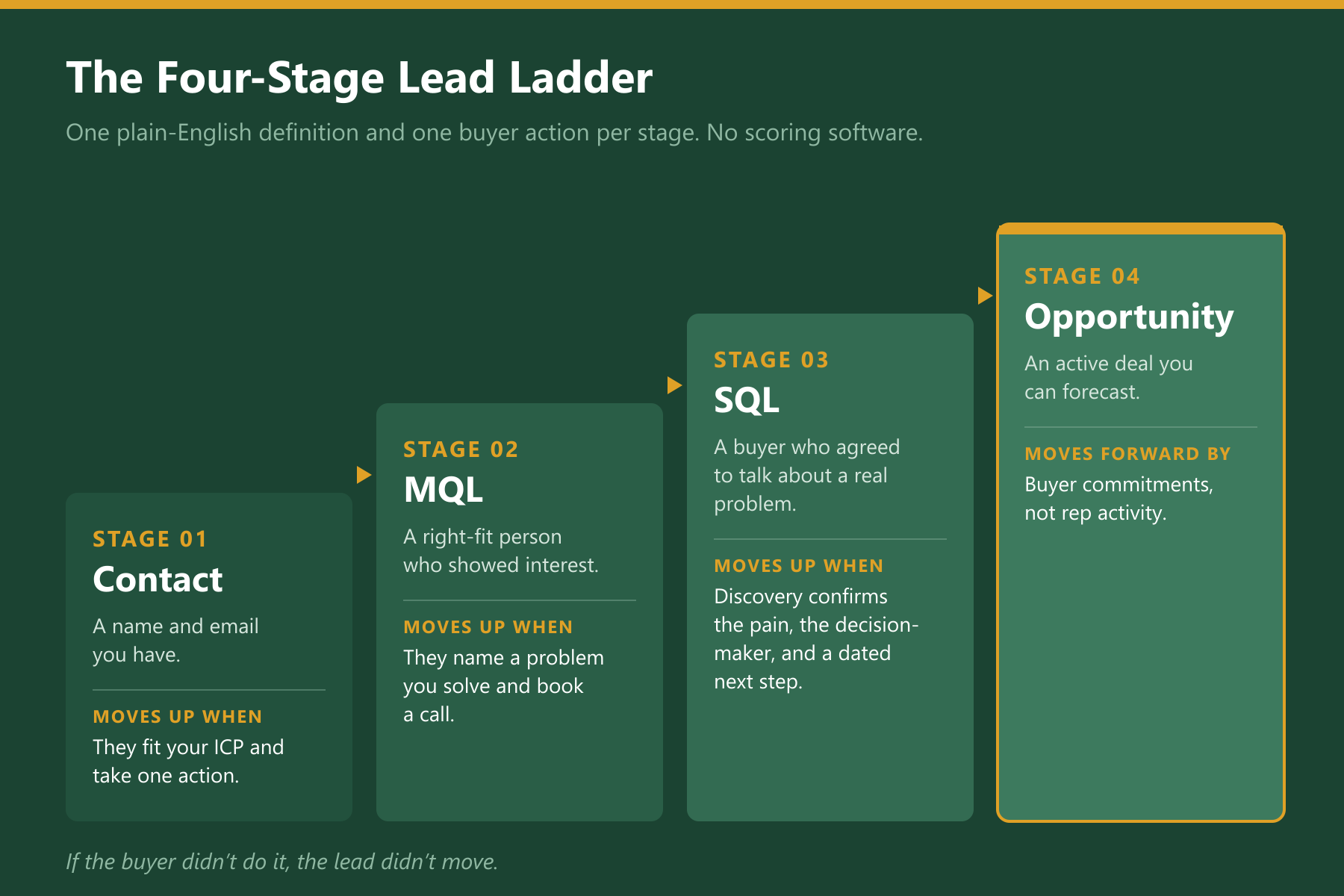
- A founder doesn't need lead scoring software or a marketing department. A founder needs four written stages, Contact, MQL, SQL, and Opportunity, each with one buyer action that moves a lead up.
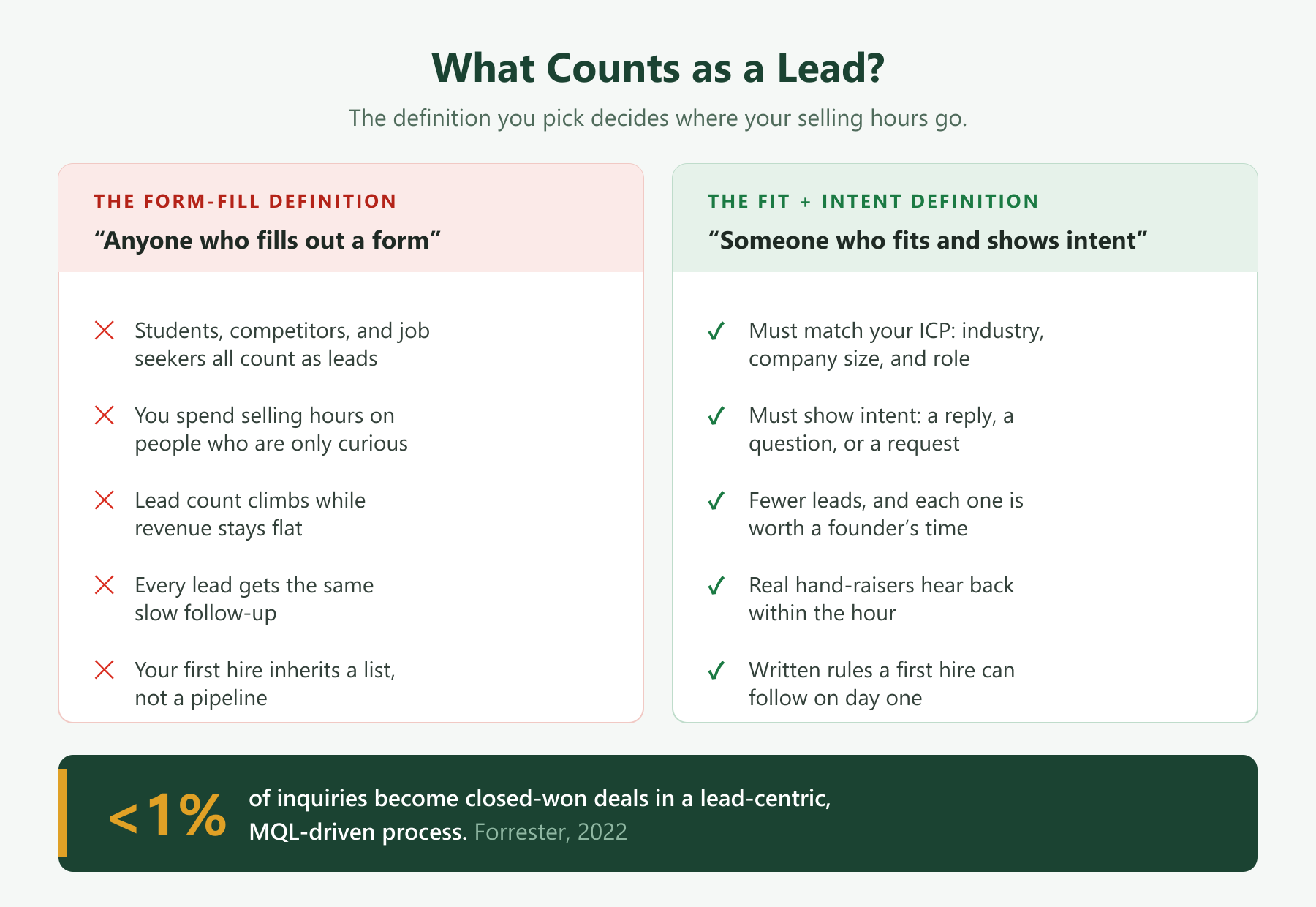
- Forrester's 2022 benchmarks put inquiry-to-closed-won at less than 1% in lead-centric, MQL-driven processes. Counting every form fill as a lead sends your time to people who won't buy.
- Speed matters once a lead is real. Firms that tried to reach a web lead within an hour were nearly 7 times as likely to qualify it as firms that waited longer (HBR, 2011).
- Do this week: pull your last 20 inbound leads, sort them against a written fit test and intent test, and count how many were real SQLs.
Your CRM says you have 140 leads. Your gut says you have maybe six real buyers. Your gut is probably right, and that gap is costing you more than you think.
Big companies solve this with a marketing department, a scoring model, and a handoff meeting. You don't have any of that. You're at $1M to $10M ARR, you still close most of the deals yourself, and "marketing" is you, a newsletter, and a contact form on the website. So every name that comes in gets called a lead, and you decide who's real on instinct.
Instinct works until you want to hand selling to someone else. Your first salesperson can't copy your gut. They can only follow what you write down. The good news: you don't need the big-company machinery to fix it. You need two definitions and the discipline to use them.
“A lead isn't someone who found you. A lead is someone who fits and did something about it.”
What's the difference between an MQL and an SQL at a small B2B company?
At a small B2B company, an MQL (marketing qualified lead) is a person who fits your ideal customer profile and has shown interest, and an SQL (sales qualified lead) is a person who has named a problem you solve and agreed to talk about it. The difference matters because an MQL earns follow-up, while an SQL earns your selling time.
The terms come from larger companies, where marketing hands qualified names to sales. With no marketing team, the founder plays both roles. The handoff still happens inside one person's head, which is why it gets skipped. When nobody draws the line, a webinar signup and a buyer asking about pricing sit in the same list with the same label.
| MQL | SQL | |
|---|---|---|
| What it means | Fits your ICP and showed interest | Has a problem you solve and agreed to talk about it |
| Proof in the CRM | Fit fields filled in, plus one logged action | The problem written in their words, plus a meeting on the calendar |
| Who owns it without a marketing team | Whoever runs content and outreach, usually the founder | The founder or the first salesperson |
| What happens next | Useful follow-up that invites a conversation | A discovery call |
| How fast you respond | Within a business day | Within the hour when they ask for a conversation |
Do I need lead stages if I don't have a marketing team?
Yes. A founder without a marketing team needs lead stages more than a big company does, because the founder's calendar is the only sales capacity the company has. Without written stages, every contact looks like a lead, and the loudest names get your hours instead of the best-fit buyers.
Keep the labels, skip the scoring machine
Here's the part most MQL advice gets wrong for your size of company. The big-company version, with point-based lead scoring, nurture tracks, and service-level agreements between two departments, is under fire even at big companies. Forrester reported in 2022 that the typical conversion from inquiry to closed-won in a lead-centric, MQL-driven process is less than 1%, and it has pushed large B2B companies toward tracking opportunities and buying groups instead.
So don't build a scoring model. You don't have the volume to make one accurate, and you don't have the staff to maintain it. Keep the two words because your first hire, your CRM, and every sales book use them. Then define each one with a plain sentence about what the buyer did.
What written lead stages give a founder
- Your time back. You stop taking calls with people who were never going to buy.
- A clean handoff. A new salesperson can sort leads the way you would, on day one.
- A number worth watching. The share of MQLs that become SQLs tells you whether your outreach and content attract the right people.
How do I define each lead stage without lead scoring software?
Define each lead stage by one thing the buyer did, write it as a single sentence, and check it by hand. Buyer actions are easy to verify and hard to fake, while scores built on page views and email opens reward activity that says nothing about buying. Four stages are enough for a company under $10M ARR.
Contact: anyone whose name you have
A Contact is a name and an email address. A newsletter subscriber, a trade show badge scan, a LinkedIn connection. Contacts are an audience, not a pipeline. Don't call them anything else.
MQL: fits your ICP and took one action
An MQL passes two tests. The fit test is three lines you write once: the industry, the company size, and the role you sell to. If you can't write those three lines yet, stop here and work out who your ICP is first. The intent test is one action that took some effort: replying to an email with a real answer, asking a question, requesting pricing, or attending a live session and asking something.
Same founder, same contact form, two definitions. One fills your calendar with curiosity. The other fills it with buyers.
SQL: named a problem and agreed to talk
An MQL becomes an SQL when the buyer does two things. They describe a problem you solve, in their own words, and they accept a meeting with a date and time. Both matter. A problem without a meeting is a conversation. A meeting without a problem is a demo for a tourist.
Opportunity: discovery confirmed a real deal
An SQL becomes an Opportunity after discovery confirms the pain, who makes the decision, and a dated next step. From here, the lead is a deal, and deals should move by what the buyer commits to. If your pipeline stages still move when a salesperson sends something, give your stages real exit criteria.
How do I tell a real buying signal from curiosity?
A real buying signal costs the buyer something, like time, information about their business, or a commitment to a next step. Curiosity costs nothing. A like, a download, or a webinar registration takes seconds. A reply describing their situation, or a question about price and timing, takes effort, and effort is the tell.
Sort the signals you see into two groups:
- Cheap signals, usually curiosity: email opens, page views, content downloads, event registrations, social likes, a follow.
- Expensive signals, often intent: a thoughtful reply, a pricing or timeline question, a request for a call, a buyer who brings a colleague, a buyer who shares numbers about their own problem.
When a right-fit buyer contacts you first, move fast
A buyer who reaches out on their own is often much further along than a founder assumes. In 6sense's 2024 survey of 2,509 B2B buyers, buyers were nearly 70% through their purchase process before engaging sellers, they initiated first contact more than 80% of the time, and 81% already had a preferred vendor at first contact.
So when a right-fit buyer asks for a conversation, treat them as an SQL candidate the same day. Speed has been measured here too. In a Harvard Business Review study published in 2011, firms that tried to contact a web lead within an hour were nearly 7 times as likely to qualify it as firms that tried even an hour later. The same research audited 2,241 U.S. companies and found an average response time of 42 hours. The data is old. Buyers haven't gotten more patient.
“Curiosity costs the buyer nothing. Intent costs them something. Qualify on what it cost them.”
Where do founders usually get lead stages wrong?
Founders usually get lead stages wrong by naming them after what the seller did instead of what the buyer did. "Emailed," "Called," and "Demo sent" describe effort, not buying. A lead stage built on seller activity lets a company feel busy while its pipeline stays empty, and no forecast built on it can be trusted.
What I see when I audit sales teams
When I open a founder's CRM, I see the same patterns over and over. Every name is labeled a lead. The stages describe the salesperson's to-do list. Qualification lives in the founder's head, so it changes with the founder's mood and how the quarter is going. And half the conversations never made it into the CRM at all. If it isn't in the CRM, it never happened.
I wrote a while back that sales and marketing need one set of definitions for MQL, SQL, and pipeline, with exit criteria based on what the prospect does. I also wrote that I wish I'd done it at the start of MindIQ, the business I bootstrapped and ran for 22 years. Shared, written definitions are what finally let a team scale without the founder as referee.
The one qualifier I trust most
After 50 years in sales, the test I trust most is simple. Will the buyer give you their time? If a prospect won't schedule time to talk through their problem, or won't schedule time to review your proposal, they aren't qualified yet. Their pain isn't urgent enough. That's why an SQL, in my definition, requires a meeting on the calendar, not a promise to "circle back."
The other mistake is the opposite one: making the SQL bar so high that nothing passes. If you demand budget, authority, need, and timeline before a first call, you'll turn away buyers who are still figuring out what the problem costs them. Discovery is where you confirm those. The SQL test only asks for a real problem and a real meeting.
How do I hand these lead stages to my first salesperson?
Hand lead stages to a first salesperson by writing them on one page, building them into the CRM as required fields, and reviewing MQL-to-SQL movement together every week. A new salesperson can follow written rules on day one. A new salesperson can't follow a founder's instincts, no matter how good those instincts are.
- Write the one-page lead definition. Your three-line fit test, the list of actions that count as intent, and the two-part SQL test.
- Build the definition into the CRM. One stage field with four values. Make the fit fields and a "problem in their words" field required before a lead can move up.
- Set response times. Hand-raisers who ask for a conversation hear back within the hour. Other MQLs hear back within a business day.
- Review every week. How many new MQLs, how many became SQLs, and why the rest didn't. Fifteen minutes is enough.
- Adjust once a month. If good buyers keep failing the fit test, fix the fit test. If SQLs keep dying in discovery, raise the intent bar.
Don't chase a published MQL-to-SQL conversion benchmark. Sources disagree widely because every company defines an MQL differently. Track your own rate for a quarter, then work to improve it. Systems before people: once the stages work for you, they'll work for the person you hire.
If you'd rather not build this alone, this is the kind of work a Fractional Sales Leader does in the first weeks of an engagement: define the stages, set up the CRM, and run the weekly review until your team can run it without you.
Frequently Asked Questions
Q: Is a demo request an MQL or an SQL?
A demo request from a right-fit buyer is an SQL candidate, not an MQL, because the buyer is asking for your time. Before you run the demo, confirm the problem in one reply or a short call. If they can't name a problem, they're still an MQL and the demo can wait.
Q: Can an outbound prospect be an MQL if marketing didn't create it?
Yes. At a company without a marketing team, many MQLs come from outbound replies. The stage describes fit and buyer action, not the channel the lead came from. Track the source in a separate field so you can see which channel produces the most SQLs.
Q: What do I do with a buyer who wants to buy but doesn't fit my ICP?
Take the call if they're ready to buy, but label them as outside your ICP. Watch how those customers do after the sale. If several turn out well, update your fit test on purpose. If they churn or eat support time, you've learned why the fit test exists.
Q: How long should a lead stay an MQL before I stop following up?
Set a time limit and write it down. A reasonable starting rule is 90 days without a new buyer action, after which the lead goes back to Contact and stays on your newsletter. Stale MQLs make your pipeline look bigger than it is and hide the leads that deserve attention.
Q: Do I need a CRM for this, or can I use a spreadsheet?
A spreadsheet works for a few weeks while you test your definitions. Move to a CRM before you hire your first salesperson, because the stage rules need to live where the work happens. Even a simple, low-cost CRM beats a spreadsheet nobody updates.
Not sure which of your leads are real?
Let's spend 30 minutes defining your lead stages so your time, and your first salesperson's time, goes to buyers who can actually buy.
Schedule a 30-Minute CallAbout the Author
Louie Bernstein
Fractional Sales Leader with 50 years of sales experience helping $1M–$10M ARR companies build scalable, repeatable sales systems. Founder of MindIQ (INC 500). LinkedIn Top Voice in Sales Management, Sales Operations, and Sales Coaching.