Why Do the Playbook, Accountabilities Document, 30-60-90 Plan, and Raw Deal Evidence Matter Most?
A new sales hire needs four documents finished before Day 1: a Sales Playbook, an Accountabilities Document, a 30-60-90 Day Plan, and a folder of raw deal evidence (recorded calls, real email threads, sent proposals and win/loss notes). The first three tell the rep what you believe works. The raw deal evidence shows what actually happened with real buyers, so it keeps the other three honest and lets the rep learn your market in weeks instead of guessing for months.
Key Takeaways
- The four non-negotiable documents before a new sales hire's Day 1 are the Sales Playbook, the Accountabilities Document, the 30-60-90 Day Plan, and a raw deal evidence folder.
- Each document answers one question for the rep: how do we sell, what do I own, what's due when, and what does selling here really sound like.
- Raw deal evidence matters because founder memory is a weak source: buyer and seller reasons for a lost deal line up only 15% of the time (Clozd win-loss research).
- Before the start date, pull together recorded won and lost calls, a set of real email threads, sent proposals and short win/loss notes on your recent deals, and put them in one shared folder.
- If you can't produce a one-page version of all four documents, push the start date back. Average AE ramp is already 6.2 months at companies with sales leadership in place (Bridge Group, 2026).
Most founders I work with have heard they need a playbook before they hire. Fewer have an Accountabilities Document. Almost none have thought about the fourth document, which is the one that does the most teaching.
The fourth document isn't really a document. It's the evidence: the calls, the emails, the proposals, and the honest notes on why each deal was won or lost. Founders skip it because it already exists in a dozen inboxes and a Zoom folder, and gathering it feels like busywork. It isn't busywork. It's the closest thing a new rep will ever get to sitting in your chair for the last 50 deals.
Your Playbook is what you think you do. Your call recordings are what you actually do. A new hire needs both on Day 1.
What documents does a new sales hire need before Day 1?
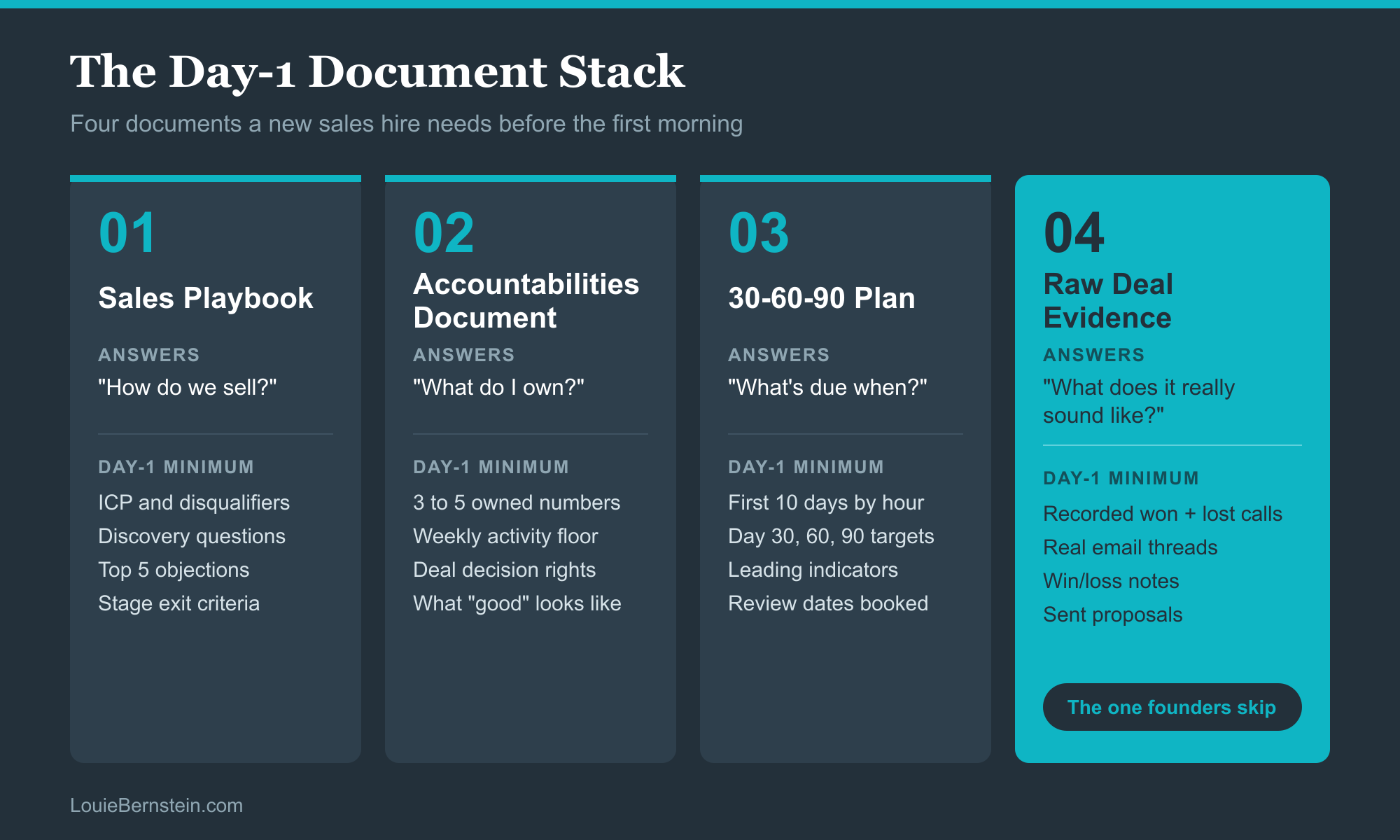
A new sales hire needs four documents before Day 1: the Sales Playbook, the Accountabilities Document, the 30-60-90 Day Plan, and raw deal evidence. Together they tell the rep how your company sells, what the rep personally owns, what's expected by each milestone, and what real selling conversations at your company sound like.
Each of the four documents answers a different question the rep will otherwise ask you, over and over, for six months:
- Sales Playbook: "How do we sell?" Your ideal customer profile, the buyers you walk away from, your discovery questions, your top objections with answers, and the exit criteria for each pipeline stage.
- Accountabilities Document: "What do I own?" The three to five numbers the rep is responsible for, the weekly activity floor, which deal decisions the rep can make alone, and what "good" looks like at this company.
- 30-60-90 Day Plan: "What's due when?" The first ten business days planned by the hour, then targets for days 30, 60 and 90, measured on leading indicators like meetings held and qualified opportunities, not closed revenue.
- Raw deal evidence: "What does it really sound like?" Recorded won and lost calls, real email threads, sent proposals, and short win/loss notes on recent deals.
Clarity is the reason these four documents matter. Just 46% of U.S. employees clearly know what's expected of them at work, down from 56% in March 2020 (Gallup, 2024, 79,087 employees). A new sales hire with nothing in writing starts in the confused half.
Why isn't a Sales Playbook enough without raw deal evidence?
A Sales Playbook isn't enough without raw deal evidence because the playbook is the founder's summary of how deals go, and founder summaries miss things. Recorded calls and real email threads show the new hire what buyers actually said, which questions moved deals forward, and where deals really died.
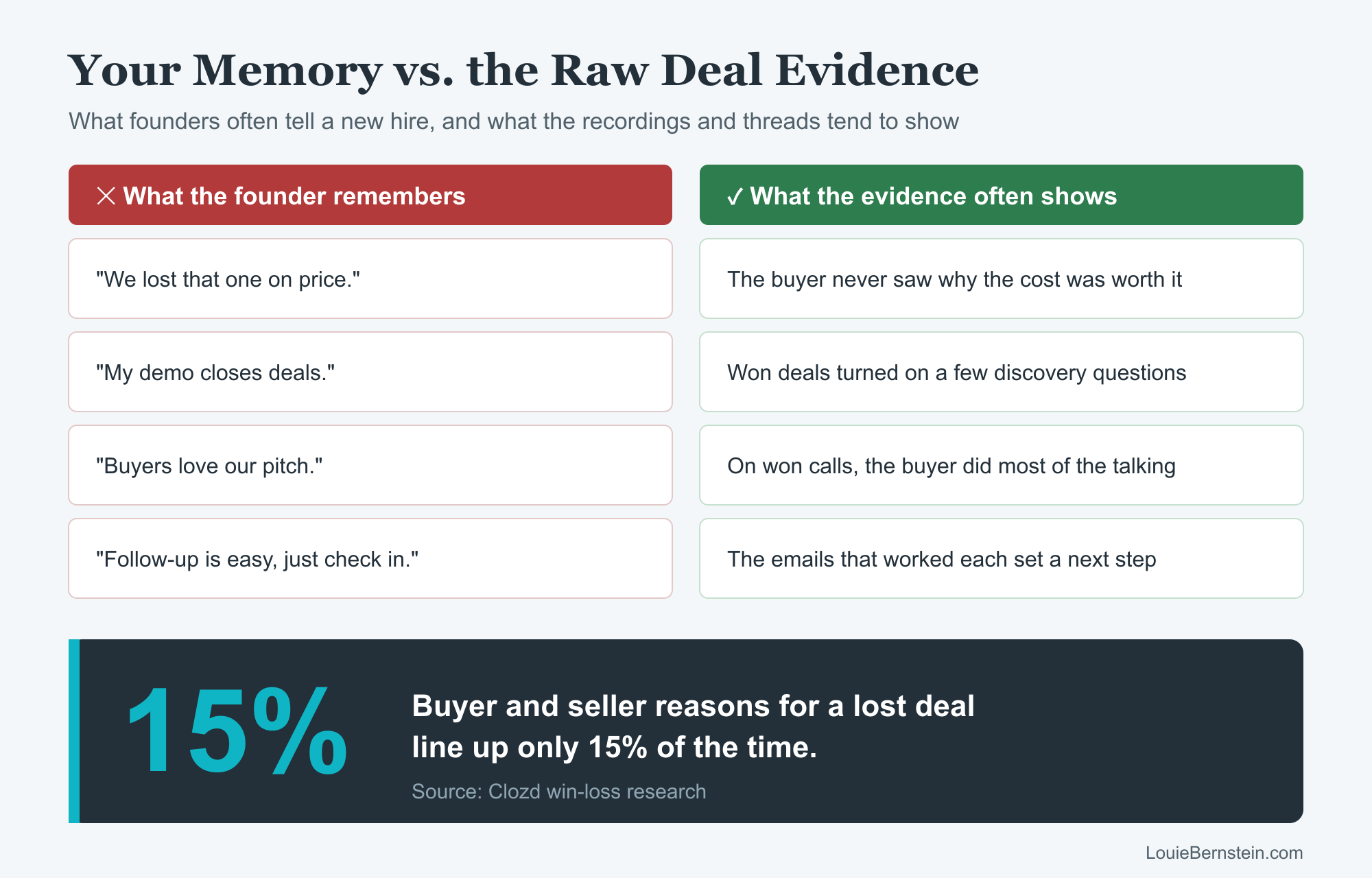
Founders don't leave things out on purpose. Memory edits. You remember the deal you lost "on price." You don't remember the discovery call where the buyer told you the problem wasn't urgent this quarter. The research backs this up: buyer and seller reasons for a lost deal align only 15% of the time, according to Clozd's win-loss research. Clozd sells win-loss interview programs, so treat the exact figure as directional, but the pattern matches everything I've seen in 50 years of B2B sales.
If your own explanation of why deals are lost is wrong most of the time, the playbook you wrote from that explanation is partly wrong too. Raw deal evidence lets the new rep check your playbook against reality. It also lets the rep hear your best buyers in their own words, which is how a rep learns the language of your market faster than any training deck can teach it.
What goes in a raw deal evidence folder?
A raw deal evidence folder holds the unedited record of your recent deals: call recordings, email threads, proposals and win/loss notes. The folder should cover both won and lost deals, because a new sales hire learns as much from the deals that died as from the deals that closed.
Recorded won calls ("Gold Calls")
Pick a handful of discovery and closing calls from deals you won with buyers who match your ideal customer profile. I call these Gold Calls. A new rep should listen to them in the first week and write down the questions that changed the conversation.
Recorded lost calls
Include a few calls from deals you lost or that stalled into "no decision." These are the calls founders least want to share. They're also the ones that show a new rep where your pitch runs into trouble.
Real email threads
Export a set of full email threads from first reply to signed contract, plus a few that went silent. The new rep sees how you followed up, how long buyers took to respond, and which emails earned a next step.
Sent proposals and pricing conversations
Add the proposals you actually sent, including the ones that lost. A rep who sees how you framed price on a real deal will handle the first pricing question far better than a rep who has only read your price sheet.
Short win/loss notes
For each recent deal, write three or four lines: who the buyer was, why they bought or didn't, and what you'd do differently. Even better, call a few recent buyers and ask. If you've never done this, the steps in how to run a win/loss analysis take an afternoon to learn.
One practical note: check the call recording consent rules in the states and countries where your buyers sit before you record or share calls. Some require every party on the call to agree.
How finished does each document need to be on Day 1?
Each Day-1 document needs to be finished enough that the new rep can act on it without asking you, which usually means one or two pages, not a binder. The rep and the founder will improve all four documents together during the first 90 days, so a usable first version beats a perfect one that arrives in month three.
| Document | Must exist on Day 1 | Can be built in the first 90 days |
|---|---|---|
| Sales Playbook | ICP and disqualifiers, discovery questions, top five objections, stage exit criteria | Full talk tracks, competitor battle cards, vertical-specific versions |
| Accountabilities Document | Three to five owned numbers, weekly activity floor, deal decision rights | Quota once ramp data exists, territory expansion rules |
| 30-60-90 Day Plan | First ten business days by the hour, targets for days 30, 60 and 90, review dates booked | Months four to six scorecard |
| Raw deal evidence | Won and lost call recordings, email threads, proposals, win/loss notes | Buyer interviews, a running library of the rep's own best calls |
If you're starting from nothing, the guide to what a sales playbook is covers the playbook sections in more depth, and the Accountabilities Document page walks through the one-page format I use with clients. Write the Accountabilities Document first. It's the shortest of the four, and it forces you to decide what the job actually is.
What I see when founders say "It's all in my head"
When a founder tells me the sales process is "all in my head," the raw deal evidence almost always shows a better process than the founder can describe. The founder's best calls follow a pattern the founder has never noticed, and that pattern is what the new sales hire needs to copy.
Here's what happens when I audit a founder-led sales team. We listen to the call recordings nobody has had time to review. The founder describes the winning formula as a strong demo. The recordings usually show that the founder won by asking two or three sharp questions early, then letting the buyer talk. That's not a criticism. Founders sell on instinct, and instinct doesn't write itself down.
The second thing I see: founders hand a new rep a laptop, a CRM login and a list of names, and call that onboarding. I've written for years that the first ten business days should be planned hour by hour, from 8:30 to 5:00, with who the rep meets, which calls they listen to, and what they practice. A rep with a plan that detailed doesn't sit around on Day 3 wondering what to do. In my experience, a rep with a written playbook gets productive in weeks instead of months, because they're learning from the system instead of from the founder's calendar.
Don't hand a new rep a laptop and a list of names. Hand them the last 20 deals, the good and the bad.
The third pattern is the one that costs founders the most money. A founder who skips the evidence ends up becoming the evidence. The rep can't hear how you sell, so the rep asks to join your calls, and three months later you're still on every call. That's how founder-led sales survives a hire it was supposed to end.
When should a founder push back a sales hire's start date?
A founder should push back a sales hire's start date when the four Day-1 documents can't be produced in usable form, because a rep who starts without them spends the first months guessing. A few extra weeks of preparation costs far less than a ramp that stalls or a hire who leaves.
Ramp is already long with good preparation. Average AE ramp time reached 6.2 months in 2026, the highest in the study's history, across 158 B2B companies (Bridge Group, 2026). Those companies also want more experience: the average required at hire rose to 3.7 years, from 2.7 years in 2022. Experience doesn't replace your documents. A seasoned rep knows how to sell. They don't know how your buyers buy.
| ✕ Push the start date back | ✓ Ready for Day 1 |
|---|---|
| Your ICP lives only in your head | A written ICP with clear disqualifiers |
| The job is a job description with "carry quota" | A signed Accountabilities Document with owned numbers |
| Week one is "shadow me and get set up" | First ten business days planned by the hour |
| No calls have ever been recorded | A folder of won and lost call recordings |
| Loss reasons in the CRM say "price" or are blank | Short win/loss notes on recent deals |
| Success will be judged on "how it feels" at month three | Day 30, 60 and 90 targets on leading indicators |
If most of your rows sit in the left column, you have two options. Spend the next month building the documents yourself while you keep selling, or bring in someone who builds them for a living. A full-time VP of Sales costs $250K to $400K a year, which is a lot to spend before there's a system to run. A Fractional Sales Leader typically runs $10K to $20K a month. My fee is $14K a month for 20 to 35 hours a week, in renewable 12-week engagements, and the Day-1 documents are usually the first thing we build.
Frequently Asked Questions
How long does it take to build the four Day-1 documents?
Building the four Day-1 documents takes several weeks of part-time work, so start when you post the job, not when you make the offer. The raw deal evidence is fastest because the calls and emails already exist. The Sales Playbook takes longest because you have to decide what you actually believe.
What if I've never recorded a sales call?
If you've never recorded a sales call, start recording your next calls today with the buyer's consent, using the recording feature already in Zoom or Teams. Until you have recordings, fill the raw deal evidence folder with full email threads, sent proposals and written win/loss notes from short calls with recent buyers.
Does an experienced sales rep still need all four documents?
An experienced sales rep still needs all four documents, because experience covers how to sell, not how your buyers buy. Even with the average AE hired at 3.7 years of experience, ramp still runs 6.2 months (Bridge Group, 2026). The documents shorten the part experience can't.
Is the 30-60-90 Day Plan the same as an onboarding plan?
The 30-60-90 Day Plan and the onboarding plan aren't the same thing. The onboarding plan covers the first ten business days hour by hour: meetings, call listening and practice. The 30-60-90 Day Plan sets the targets the rep is measured against at each milestone after that.
Should the new rep help write the documents?
The new rep should help improve the documents, not write them. Hand over finished first versions on Day 1, then ask the rep to mark what's unclear or wrong after the first 30 days. A founder who asks the new hire to write the playbook is asking the person who knows the least to do the most important job.
Hiring a salesperson in the next 90 days?
Let's check which of the four Day-1 documents you already have, which ones are missing, and what it takes to finish them before your new hire's first morning. Book a 30-minute call and we'll map it out.
Schedule a 30-Minute CallAbout the Author
Louie Bernstein is a Fractional Sales Leader with 50 years of sales experience and has provided Fractional Sales Leadership since 2017. He helps B2B founders at $1M to $10M ARR build repeatable sales systems, coach their teams, and reduce dependence on founder-led selling.