Key Takeaways:
- 40 to 60% of B2B deals are lost to "no decision," not to a competitor (The Jolt Effect, Dixon & McKenna, from 2.5 million sales conversations). Inaction is the rival you're not selling against.
- Most no-decision losses aren't about the buyer loving the status quo. They're about fear of making the wrong call. That changes how you create urgency: you lower the risk, you don't crank up the pressure.
- The move founders skip is making the cost of inaction concrete. Ask early: "What happens if you do nothing about this for the next twelve months?" Most buyers have never said that number out loud.
- Manufactured urgency (fake deadlines, discount clocks, "just sign today") backfires. An anxious buyer under pressure retreats further into no decision. Real urgency comes from their numbers and their deadline, not yours.
- Put a time limit on every stage so zombie deals die, and turn every "let me think about it" into a specific next step. A deal with no next step isn't thinking. It's already gone.
Every founder I talk to obsesses over the competition. Who else is the buyer looking at? How do we beat them on features, on price, on the demo? It's the wrong worry.
Your biggest competitor doesn't have a logo. It's the buyer choosing to do nothing. The Jolt Effect, a study of 2.5 million recorded sales conversations by Matt Dixon and Ted McKenna, found that 40 to 60% of qualified deals are lost to "no decision." Not to a rival. To inaction.
And here's the twist that changes everything: most of those losses aren't buyers who love their current situation. They're buyers who are afraid of making the wrong choice. Which means the old playbook, crank up the pressure, invent a deadline, push for the close, is exactly backward. Pressure makes a scared buyer freeze. This is how you create real urgency instead.
Why You Lose More to Inaction Than to Rivals
Look at where your lost deals actually go. Founders assume the deals they lose went to a competitor. The data says otherwise: inaction wins far more of your pipeline than any rival does.
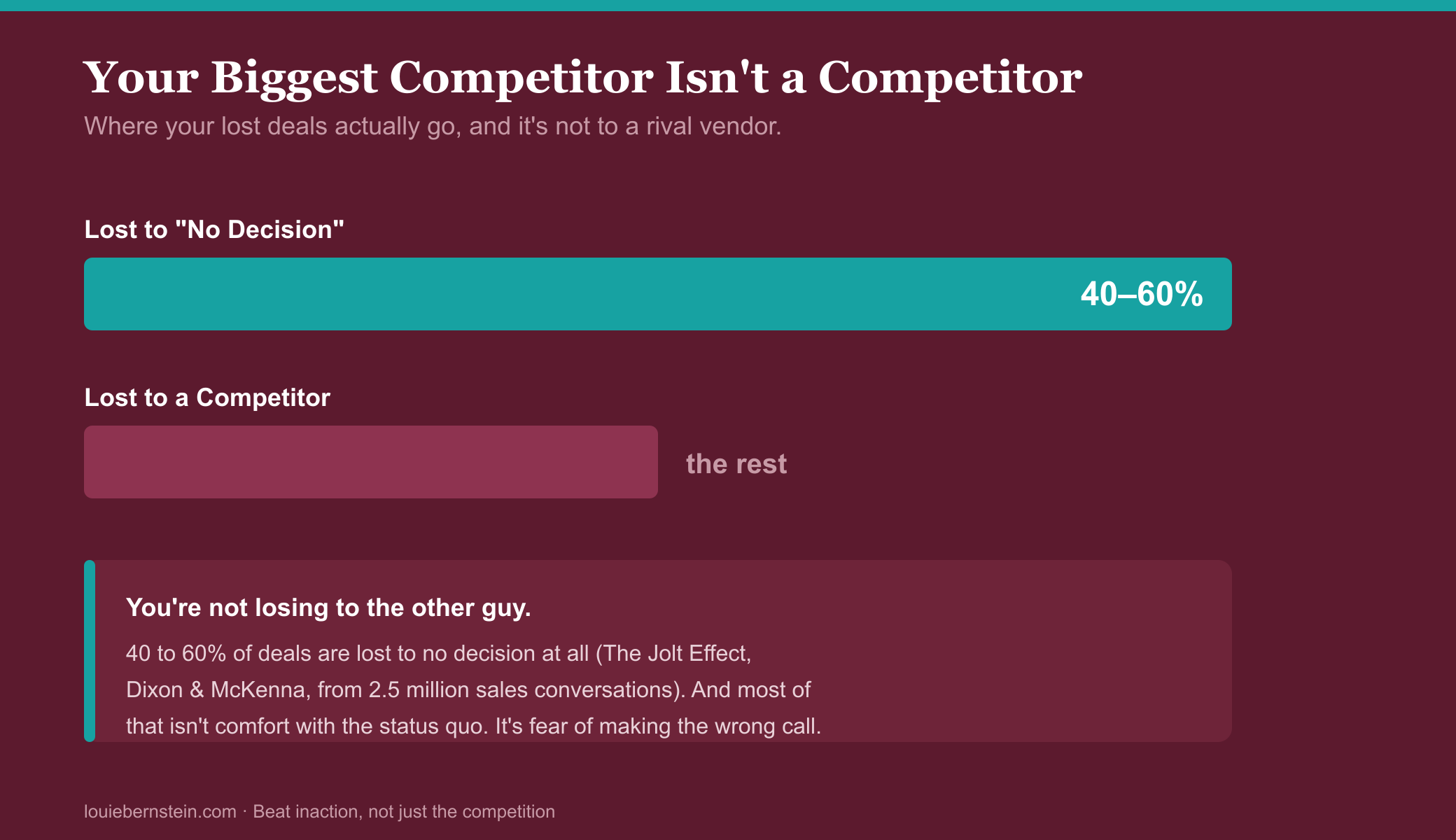
This reframes your whole sales problem. If you're spending all your energy differentiating from other vendors, you're fighting for the minority of deals. The bigger fight is against the buyer's own hesitation. And you can't win that fight by being 10% better than a competitor. You win it by making the decision feel safe and the cost of waiting feel real. This is the same "decision" break point I covered in why 86% of your deals stall, and it's where the most revenue leaks out.
The Cost-of-Inaction Case Most Founders Never Make
Here's the mistake I see constantly. Founders build a beautiful case for why their solution is great. They almost never build the case for why doing nothing is expensive. And that second case is the one that actually moves deals, because it attacks the real competitor.
The single most useful question in my entire playbook is one I ask early, during discovery, not at the close: "What happens if you do nothing about this for the next twelve months?" Nine times out of ten the buyer's first answer is "eh, we'll be okay." That's fine. Expect it. Then you gently press: "Walk me through that. What does another year of this problem actually cost you, in time, in money, in people?"
Most buyers have never done the math on doing nothing. When you make them do it out loud, the urgency they've been faking either turns real, or you find out fast that it was never there. Both answers are gold.
Asking this early does two things. It qualifies the deal, if there's genuinely no cost to inaction, this was never a real opportunity and you just saved yourself six months of chasing. And it plants a seed the buyer will water themselves, because now they can't un-see the cost.
Quantifying the Problem in the Buyer's Own Numbers
A cost of inaction only creates urgency if it's the buyer's number, in the buyer's words. Your estimate of their pain is a sales pitch. Their own estimate is a business case they'll defend to their boss. Get them to quantify it with you:
- Time: "How many hours a week does your team lose to this? What's that across a year?"
- Money: "What's this costing you in lost revenue, churn, or overtime right now?"
- Risk: "What's the worst case if this problem gets bigger before it gets fixed?"
- Opportunity: "What could your team do instead, if they weren't fighting this?"
Write their answers down and reflect them back. "So by your own math, doing nothing costs roughly $180,000 and about ten hours a week of your best people's time. Is that right?" Now the cost of inaction isn't your claim. It's theirs. And theirs is the only number that survives contact with a nervous buying committee.
Manufactured Urgency vs. Real Urgency (Buyers Can Tell)
Now the trap. Once founders realize they need urgency, they reach for the cheap version: the fake deadline, the expiring discount, the "we only have one onboarding slot left." Buyers see through all of it, and worse, on an already-anxious buyer, pressure makes the freeze deeper.
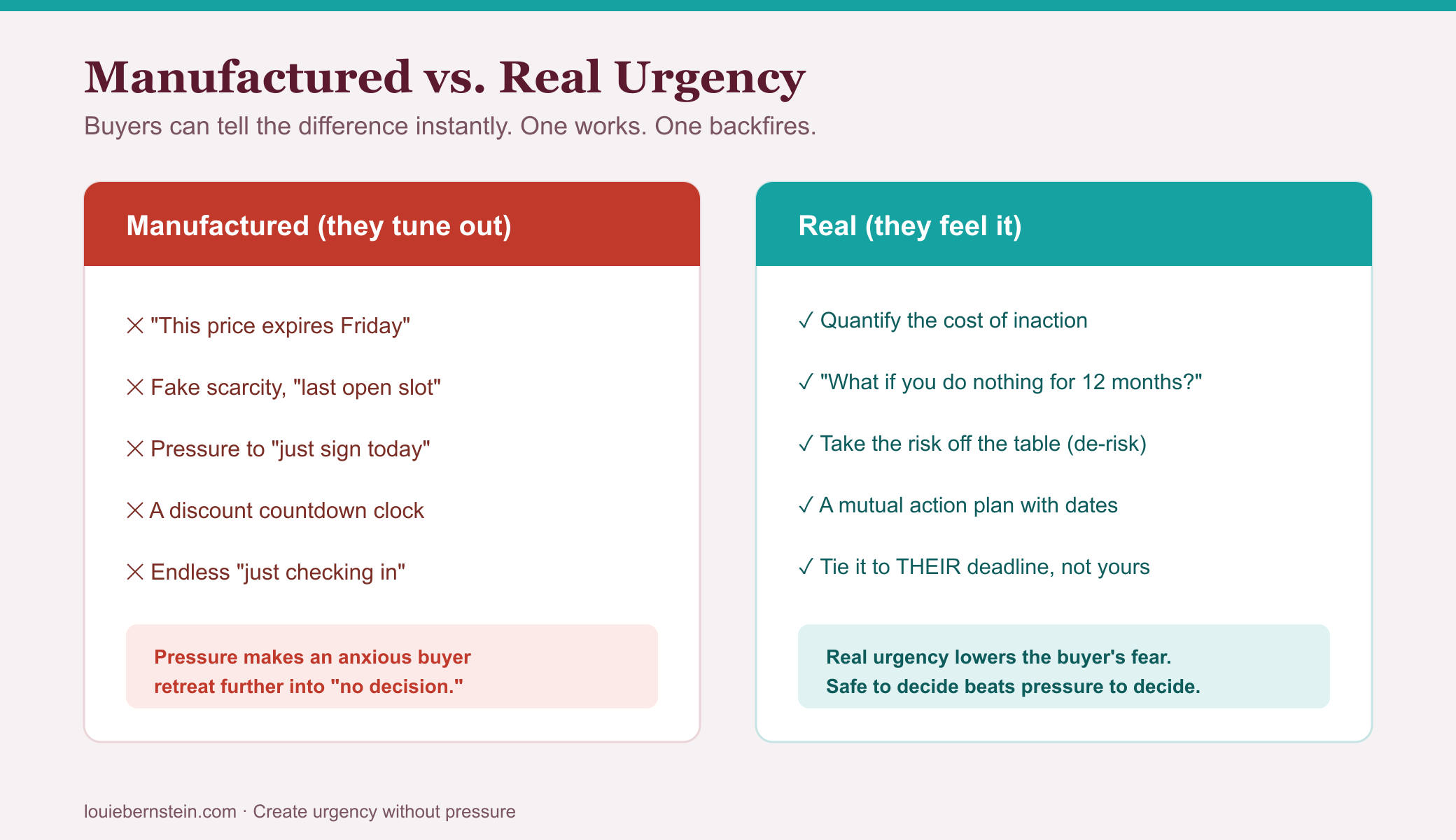
Because the real problem is fear, not comfort, the antidote is safety, not pressure. Take the risk off the table. Offer a pilot, a phased rollout, a clear rollback plan, a reference customer who was just as nervous. The Jolt Effect calls this "taking risk off the table," and it's the move that separates reps who close indecisive buyers from reps who lose them. Pair a real cost of inaction (waiting is expensive) with a de-risked decision (choosing is safe), and you've created urgency the buyer feels without a single fake deadline.
Pressure to decide pushes a scared buyer away. Permission to decide safely pulls them forward. Same goal, opposite move.
The Time-in-Stage Limit That Kills Zombie Deals
Here's the discipline that keeps no-decision deals from quietly eating your quarter: put a time limit on every stage. A deal that's been "thinking about it" for three months past your normal cycle time isn't thinking. It's a zombie, and zombies rot your forecast and drain your team's time.
Set a rule: if a deal sits in a stage beyond its normal window with no agreed next step, it gets a decision forced, either it advances with a real reason or it's marked closed-lost. This pairs naturally with giving your stages real exit criteria. Marking a deal closed-lost isn't giving up. It's often what wakes the buyer up, because now the safe default of "wait" is off the table, and inaction finally has a cost.
Turning "Let Me Think About It" Into a Next Step
"Let me think about it" is where deals go to die. Not because thinking is bad, but because most reps accept it and leave. The fix is simple: never leave a conversation without a specific, calendared next step the buyer agreed to.
When you hear "let me think about it," respond with curiosity, not pressure: "Totally fair. What specifically do you want to think through? Let's put time on the calendar to work through it together next week." A real deal will book the time. A dead deal will dodge it. Either way, you've converted a vague stall into a clear signal. My old sales playbook rule still holds: don't leave without formalizing the next step in the buyer's process, and after every step ask, "then what happens?"
If you're a founder with no process for any of this, no cost-of-inaction question, no de-risking offer, no time limits on your stages, you're leaving 40 to 60% of your winnable deals on the table. Building that process is exactly what a Fractional Sales Leader does for $1M to $10M ARR companies, without the cost of a full-time VP of Sales. And if you've got no sales system at all yet, be honest about that first: you can't systematize urgency until you have a pipeline to run it through.
Frequently Asked Questions
Q: What does "no decision" mean in sales?
A "no decision" deal is one where the buyer doesn't choose you or a competitor, they just don't decide at all. They keep the status quo. It's the single largest category of lost deals: 40 to 60% of qualified opportunities end this way (The Jolt Effect). Critically, most of these losses come from the buyer's fear of making a mistake, not from genuine satisfaction with how things are. That's why lowering perceived risk beats adding pressure.
Q: How do I create urgency without being pushy?
Create urgency from the buyer's reality, not from artificial pressure. Quantify the cost of inaction in their own numbers, tie the timeline to a deadline they actually care about, and take the risk out of choosing you with a pilot, phased rollout, or rollback plan. Fake deadlines and discount clocks do the opposite: they make an anxious buyer freeze. Real urgency makes waiting feel expensive and deciding feel safe.
Q: What's the best question to surface the cost of inaction?
"What happens if you do nothing about this for the next twelve months?" Ask it early, in discovery, not at the close. The buyer will usually shrug it off at first, so follow up: "Walk me through that, what does another year of this cost you in time, money, and people?" Getting them to put a real number on inaction is what turns a nice-to-have into a must-solve, and it qualifies out deals that were never real.
Q: Is losing to "no decision" really worse than losing to a competitor?
It's more common and more fixable. You lose to a competitor on fit, price, or timing, factors partly out of your control. You lose to no decision because the buyer was too uncertain to move, which is something your process can directly address. Since 40 to 60% of deals die here (The Jolt Effect), improving how you handle indecision moves more revenue than out-featuring rivals ever will.
Q: How do I handle "let me think about it"?
Don't accept it and walk away, that's how deals quietly die. Get specific: "What exactly do you want to think through? Let's book time to work through it together next week." A real deal will schedule it; a dead one will dodge. Never end a conversation without a specific, calendared next step the buyer agreed to. A deal with no next step isn't thinking, it's already gone, you just haven't marked it yet.
Q: I'm a founder selling solo. How do I stop losing to no decision?
Start with two habits this week. First, ask every prospect the cost-of-inaction question early and write down their number. Second, never end a call without a booked next step. Those two alone will cut your no-decision losses. Then add a de-risking offer, a pilot or rollback plan, so nervous buyers feel safe choosing you. Systematizing all of it across a real pipeline is the core of what a Fractional Sales Leader builds for founders not ready for a full-time VP of Sales.
Losing deals to "no decision"? Let's change that.
In 30 minutes I'll show you how to build a cost-of-inaction case and de-risk the decision on your stuck deals, so you create real urgency without the fake deadlines buyers ignore. See how a Fractional Sales Leader can help at louiebernstein.com.
Schedule a 30-Minute CallAbout the Author
Louie Bernstein
Fractional Sales Leader with 50 years of sales experience helping $1M–$10M ARR companies build scalable, repeatable sales systems. Founder of MindIQ (INC 500). LinkedIn Top Voice in Sales Management, Sales Operations, and Sales Coaching.