Where Should the Product Stop Selling and a Salesperson Take Over?
A B2B SaaS company should combine product-led and sales-led growth when customers can prove value independently but some purchases need help with approval, risk, or rollout. Keep simple purchases self-serve. Give sales responsibility for complex buying decisions, with one named account owner. Use a hybrid model only where the added gross profit justifies the people and coordination costs. Don't build two separate sales systems that compete for the same buyer.
Key Takeaways
- A hybrid product-led and sales-led model fits buyers who can experience value alone but need people to complete a larger purchase.
- The product doesn't stop proving value when sales gets involved. Sales takes responsibility for the buying decision.
- In a January 2026 survey of 200 B2B software products, 80% of free-trial products included human touchpoints for enterprise users. Human touchpoints weren't necessarily sales calls.
- Define three buying routes: self-serve, sales-assisted, and sales-led. Give each active account one accountable owner.
- Measure added gross profit after added sales costs. Sales-assisted revenue alone doesn't show what the salesperson caused.
- Review ten recent accounts and write down the buying task that required a person before adding another routing tool.
A user loves your product. Three teammates join. Then someone asks whether the company can use one contract for several departments.
The product has done useful selling. The next obstacle is a company decision. If nobody owns that decision, the founder usually gets the call.
The product can prove the value. Somebody still has to help the company approve the purchase.
For a founder at $1M to $10M ARR, hybrid growth should reduce that dependence. A free tier plus a salesperson won't accomplish that on its own. You need clear responsibilities, a shared account record, and a reason each conversation exists.
When does a hybrid model make sense for B2B SaaS?
A hybrid model makes sense when your B2B SaaS company serves both straightforward purchases and purchases that need coordination. Buyers must be able to get useful product evidence without a full sales process. Larger or more complicated accounts must also generate enough gross profit to pay for the help they need.
Start with buying work, not a company label
A small team might buy your standard plan with a card. A larger account might use the same product but need security approval, consolidated billing, and a rollout plan. Those are different buying tasks. They don't necessarily require different products or separate businesses.
Offer self-service where the customer can complete the job. Add a person where a real decision needs coordinating. A sales-led account can still use a product tour. A self-serve customer can still request help. Keep the routes flexible without making ownership vague.
Human help already exists inside self-service
A January 2026 survey of 200 B2B software products found that 80% of free-trial products had human touchpoints when an enterprise user entered a trial. The figure was 70% among freemium products. These are shares of surveyed products, not shares of users needing a salesperson (Growth Unhinged, 2026).
The evidence supports keeping people available. It doesn't prove that a hybrid model beats other models, or that calling every enterprise signup improves results. Your buyer's work and your economics still decide.
If users can't reach value without custom implementation, start with a clear sales-led process. Don't promise an independent buying experience that your product can't deliver. Fixing onboarding may be more valuable than adding another selling route.
Where should the product stop selling and sales take over?
The product should keep demonstrating value while sales takes over responsibility for a buying decision that needs human coordination. The handoff belongs at a change in the buyer's task, such as securing budget or planning a company rollout. A signup date, famous company name, or usage spike alone isn't enough.
Use three routes with clear entry conditions
| Route | Buyer situation | Accountable for the next step |
|---|---|---|
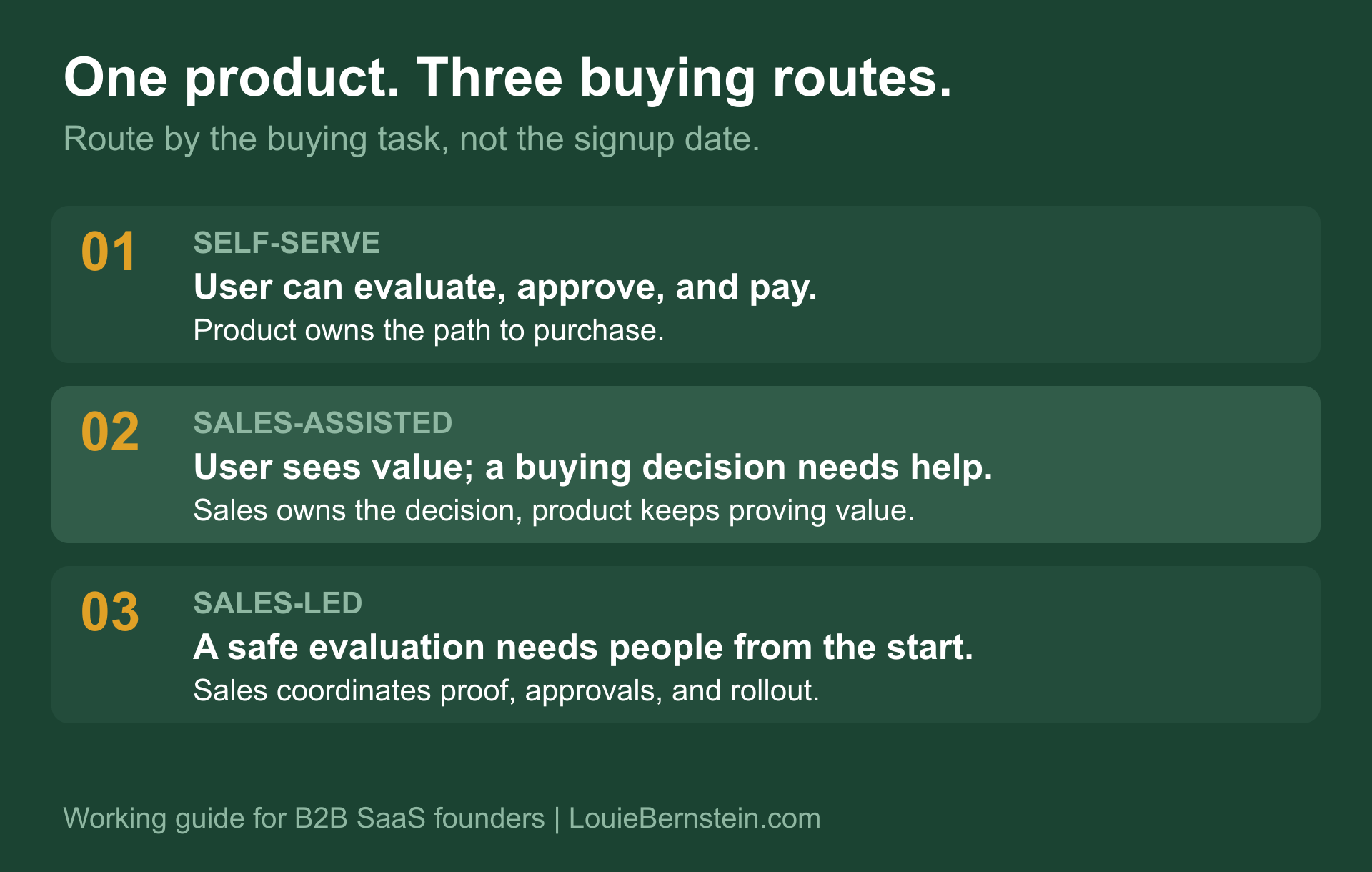
| Self-serve | The user can evaluate, approve, and pay on standard terms. | Product or growth owns the purchase experience. |
| Sales-assisted | The user has useful evidence but needs help completing a buying decision. | A named salesperson coordinates the decision. |
| Sales-led | Evaluation itself requires a coordinated business or technical plan. | A named salesperson coordinates proof and approval from the start. |
Account ownership doesn't mean one person performs every task. Support still fixes defects. Technical staff answer technical questions. Sales coordinates the purchase without making a meeting the price of getting basic help.
Make the change visible to the buyer
Imagine a reporting product. An analyst creates a useful report alone, then asks how finance can approve access across departments. The salesperson's job is to clarify the rollout, the approvers, and the evidence finance needs. Repeating a generic demo would add little.
Say what the buyer gets: “I'll help you map the approval steps and confirm the requirements for the wider rollout.” Keep the working product available. The user shouldn't lose an independent evaluation just because sales accepted responsibility for the purchase.
For the detailed distinction between product activity and buying readiness, use the product-qualified lead definition. The hybrid operating decision comes next: who accepts the account, what changes, and how the buyer continues.
How do you keep product and sales from fighting over accounts?
Keep product and sales from fighting over accounts by agreeing on ownership, revenue definitions, and compensation before launching the hybrid process. Record one account and one revenue outcome, even when several teams contribute. Give sales credit for agreed responsibilities without rewarding unnecessary intervention in purchases that would have happened independently.
Write the rules before the first disputed deal
Separate acquisition source from buying route. An account may originate through a product signup and later become sales-assisted. Keep both facts. Overwriting the source as “sales” hides how the account arrived. Calling the entire contract “self-serve” hides the work needed to close it.
Use one account record with the original source, current route, named owner, reason for assistance, next buyer action, and actual rep time. Link users and workspaces to that account. Otherwise, two reps can approach different people at the same company without realizing they're working one purchase.
Define commission treatment before an account upgrades during an open sales conversation. A rep shouldn't need to block checkout to protect a commission. Product shouldn't need to hide active accounts to protect a conversion metric. Choose a compensation rule your team can explain and your reporting can verify.
What my sales experience adds to the handoff
In my published account of a second sales call, an unresolved support request interrupted a planned closing conversation. The decision-maker hadn't known about the request. We spent time handling a problem that should have been clarified before asking for the business.
The lesson I take into hybrid selling is about continuity. A new commercial owner must know what the product experience and the rest of the team have already promised. Changing owners doesn't reset the buyer's history. Before a rep presents terms, confirm unresolved issues and who owns resolving them.
Put that check into your Sales Playbook. Then role play the conversation. Ask the rep to explain the buyer's remaining decision and the next action without asking you to take over. Teach the judgment, not just the CRM fields.
How do you know whether sales assistance pays for itself?
Sales assistance pays for itself when the added gross profit it produces exceeds the added cost of providing it over a defined period. Compare similar eligible accounts and include customers who would have purchased without help. Revenue touched by sales is a workload measure, not proof that sales created the revenue.
Calculate the improvement, not the whole contract
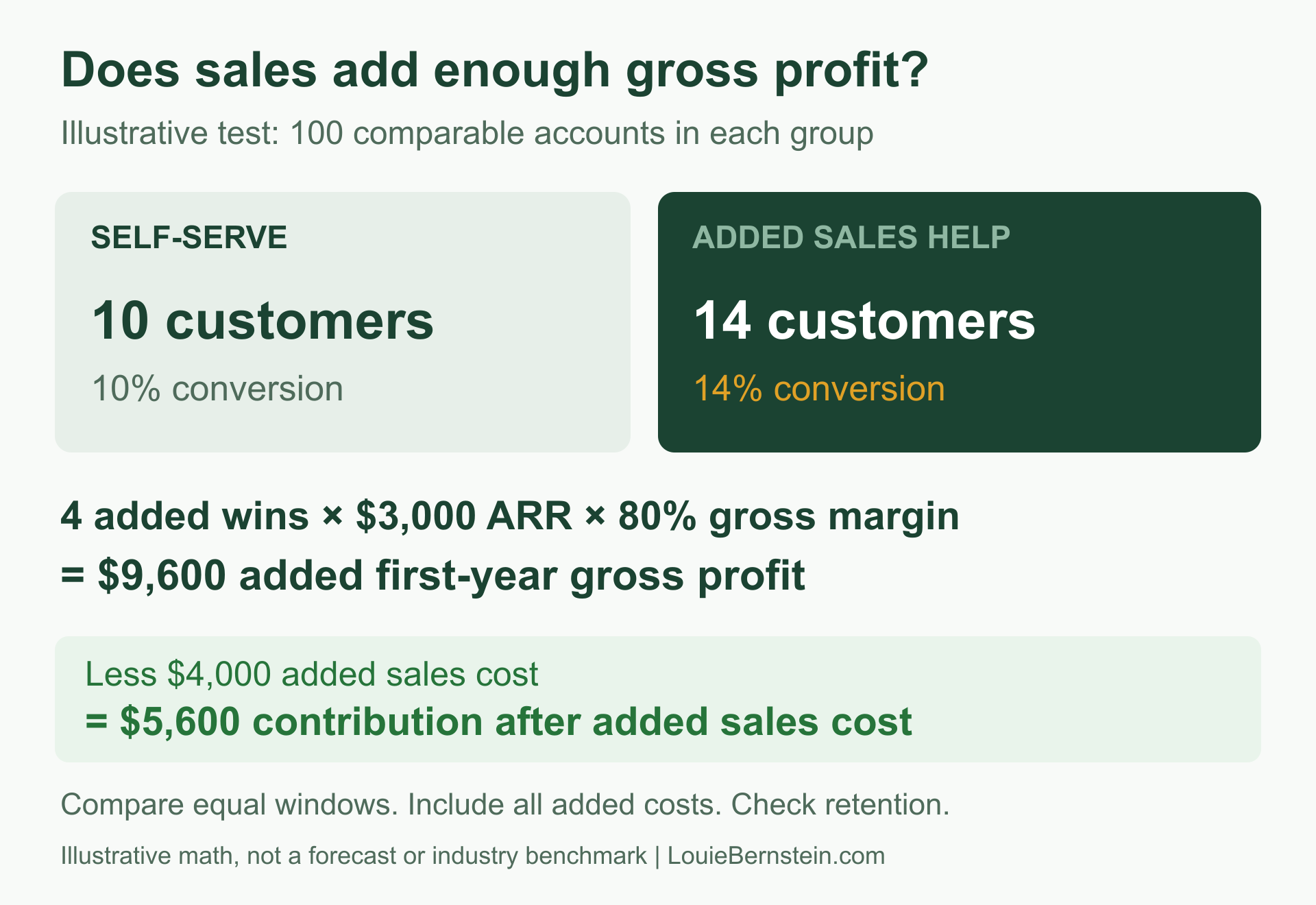
Here's an illustrative example, not a benchmark or forecast. Suppose 100 comparable accounts get the standard self-serve experience and 100 receive an added offer of sales help. Over the same observation window, ten self-serve accounts buy and fourteen assisted accounts buy. That's 10% versus 14%, a four-percentage-point difference.
If each additional customer produces $3,000 ARR at 80% gross margin, four added wins produce $9,600 in first-year gross profit. If the added sales effort costs $4,000, the contribution after that sales cost is $5,600. Counting all fourteen contracts as sales-created revenue would exaggerate the result.
The $4,000 must include the relevant loaded labor and tools. Also subtract any added implementation or customer costs not already included in gross margin. If assisted deals receive discounts or create extra churn, use the actual results. A signed contract doesn't guarantee a year's profit.
Keep the comparison honest
Where volume permits, randomly assign eligible accounts to the normal experience or the added offer of help. Keep requested service available. Review customer size, intent, pricing, and retention. A small sample can suggest a useful next test, but four extra wins alone don't establish a reliable causal result.
Use an observation window that covers the buying cycle, then continue checking retention. For expansion, count added revenue over the existing contract rather than the entire account. Separate new purchases from expansion so one strong customer doesn't disguise a weak acquisition process.
How can a founder start without building two sales teams?
A founder can start a hybrid model with one customer segment, one defined reason for sales help, and an existing employee accountable for the next decision. Document the route before buying tools or hiring specialists. Expand only after the team can run the process and the economics show a useful improvement.
Run a focused 30-day setup
- Review ten recent accounts. Include independent purchases, assisted wins, and losses. Identify the exact work a person performed.
- Choose one boundary. For example, sales accepts cross-department rollout requests from suitable accounts. Treat the rule as a test.
- Name the owner and backup. Put their response responsibility in an Accountabilities Document. Explain what happens when the owner is unavailable.
- Record one next buyer action. “Finance reviews the rollout proposal Friday” is more useful than “follow up.”
- Review weekly. Examine handoff quality, unresolved issues, rep time, buyer progress, and founder involvement.
Thirty days can establish the process. It may not be long enough to judge revenue, retention, or payback. Keep measuring through your sales cycle. Start with a spreadsheet and the CRM you already use if volume is modest.
Make founder independence part of the test
Track how often the founder must rescue a handoff or close an assisted account. If every larger purchase still reaches your desk, the company has added a signup route while keeping the same dependency.
Use coaching to address the missing skill. A rep who struggles with approval conversations needs practice identifying decision-makers and building a business case. More product alerts won't teach those skills. A Fractional Sales Leader can help define the process, coach the team, and make those decisions repeatable.
Frequently Asked Questions
Q: Can we be hybrid without a free plan?
Yes. A self-serve paid entry plan, trial, or independent evaluation can sit alongside sales-led contracts. A permanent free plan is a packaging choice, not a requirement for combining product-led and sales-led buying routes.
Q: Should both routes use the same prices?
Use consistent pricing principles and explain differences in scope, support, or contract terms. Unexplained discounts from sales can teach customers to avoid checkout and negotiate. Broader enterprise requirements may justify a different package.
Q: Should customer success or sales own expansion?
Name the owner based on the buying work and your team's skills. Customer success can identify unmet needs and support adoption. Assign commercial responsibility explicitly when expansion requires negotiation, new approvers, or a separate contract.
Q: When should an account return to self-serve?
Return an account to self-serve when no coordinated purchase remains and the buyer can proceed independently. Record the reason and keep a clear route back to a person. Don't keep an account in active pipeline merely because a conversation occurred.
Q: Does a hybrid model require a larger sales forecast?
No. Forecast only opportunities with evidence supporting the buying stage, amount, and timing. Product activity can justify investigation without supporting a revenue commitment. Report the self-serve run rate separately from named opportunities and avoid double counting.
Build a hybrid sales process your team can run
If you're a B2B founder at $1M to $10M ARR and every complex purchase still needs you, I can help define account ownership, build the Sales Playbook, and coach the people responsible. Learn about Fractional Sales Leadership at LouieBernstein.com.
Schedule a 30-minute conversationAbout the Author
Louie Bernstein is a Fractional Sales Leader with 50 years of sales experience and has worked in fractional sales leadership since 2017. He helps B2B founders build Sales Playbooks, coach salespeople, and create repeatable sales processes that reduce dependence on the founder.