How Is a Product-Qualified Lead Different From a Marketing-Qualified Lead?
A product-qualified lead (PQL) is a free-trial or freemium user whose actions inside your product show buying intent, such as inviting teammates, hitting a usage limit, or connecting real data, at a company that fits your ideal customer. A marketing-qualified lead (MQL) has only shown interest in your marketing. You need PQLs only if prospects can use your product before they buy. If they can't, sharpen your MQL definition instead.
Key Takeaways
- A product-qualified lead is a prospect whose actions inside your product, not your marketing, show they're likely to buy, at a company that fits your ideal customer profile.
- An MQL measures interest, like a download or a webinar. A PQL measures value the user has already experienced. Forrester analysts wrote in 2023 that fewer than 1% of leads make it from the top of the funnel to the bottom.
- You only need PQLs if buyers can use your product before paying, through a free tier, trial or sandbox. A B2B company that shows the product only in demos should fix its MQL and SQL definitions instead.
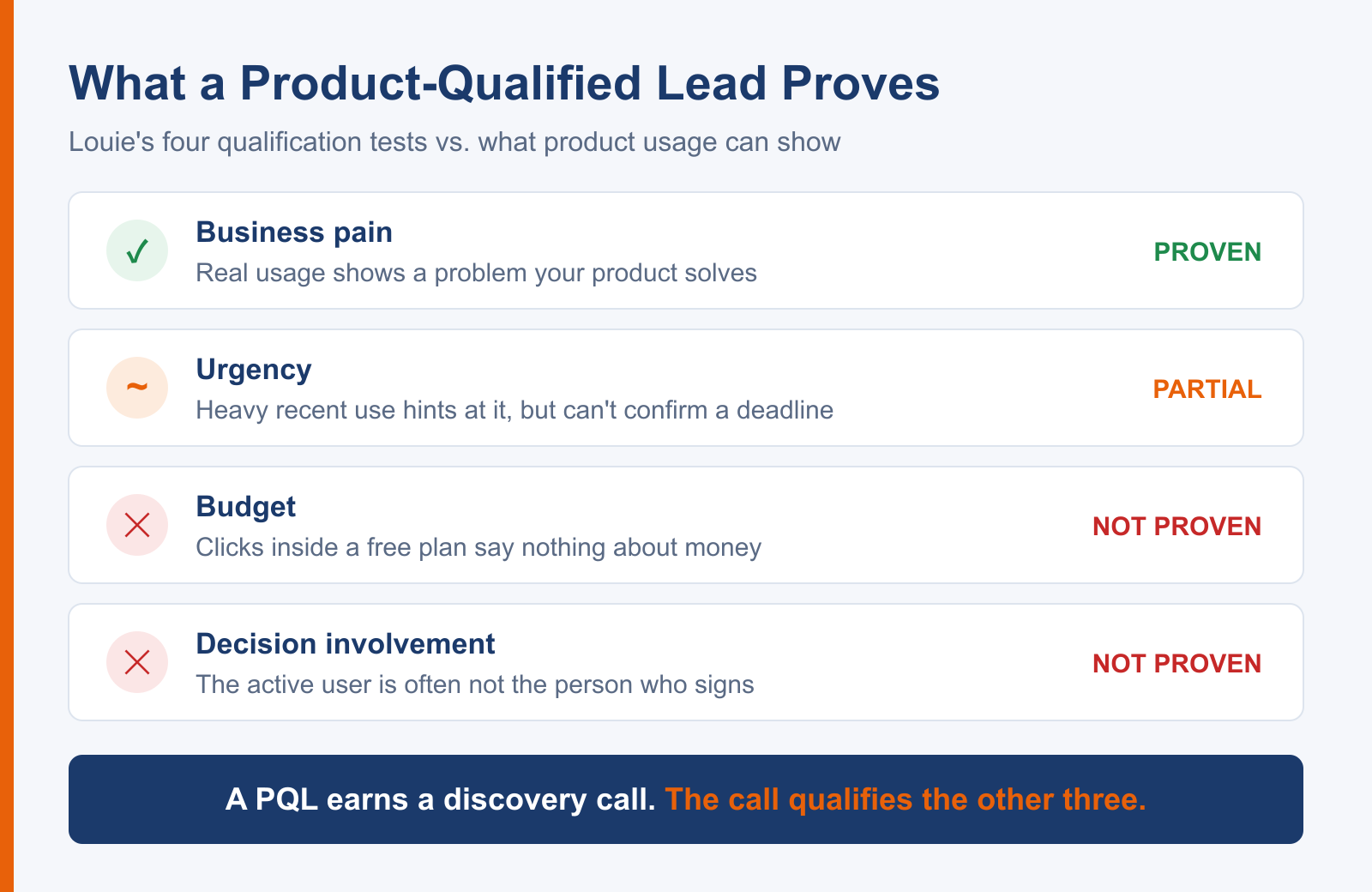
- A PQL proves business pain. It doesn't prove budget, urgency or who signs, so treat a PQL as a reason to start qualifying, never as a qualified deal.
- This week, list your last 10 customers who started on a free plan or trial and write down the one action each took before paying. That shared action is your first PQL definition.
Picture a founder at $3M ARR who just launched a free trial. Two weeks later the CRM shows 300 new leads. The new salesperson calls every one. Most are students, competitors and people who logged in once.
Now picture one account in that pile. Three people from the same company signed up, connected their real data, and hit the plan limit on day four. Nobody called them first, because they looked like every other row in the CRM.
A download tells you someone was curious. Usage tells you someone got value. Only one of those deserves your salesperson's afternoon.
That's the case for product-qualified leads. It's also why most founders at $1M to $10M ARR either don't need PQLs yet or are defining them wrong.
What is a product-qualified lead?
A product-qualified lead is a prospect who has used your product, usually in a free trial or freemium plan, and taken actions that predict a purchase. The idea exists because what people do inside a product is a stronger buying signal than what they click in an email or download from a website.
Common product-qualified lead signals
- Inviting teammates. One curious user turns into a team.
- Hitting a usage limit on seats, projects, records or API calls in the free plan.
- Connecting real data or a core integration. Nobody wires up their CRM to kick the tires.
- Coming back to the feature your paid plan is built on, week after week.
- Asking buying questions from inside the product, such as pricing, security, contracts or invoicing.
None of these signals means much alone. A product-qualified lead is a combination: the right behavior at the right kind of company. A student who invites five classmates is active, but isn't a lead.
Product-qualified leads vs. product-qualified accounts
Many product-led companies now qualify accounts instead of individual users. A product-qualified account (PQA) rolls up activity from everyone at one company. In the 2022 Product-Led Sales Benchmarks survey of 200+ companies, 58% reached out once a user became a PQL, and 17% of product-led organizations tracked PQAs (Pocus, 2022). For B2B deals with more than one approver, the account view is usually the more honest one.
How is a product-qualified lead different from a marketing-qualified lead?
A marketing-qualified lead has shown interest in your marketing, like downloading a guide or attending a webinar. A product-qualified lead has gotten value from your product. The difference matters because interest is cheap to give, while real product usage takes time, effort, and usually a real business problem.
PQL vs. MQL side by side
| Question | Marketing-qualified lead (MQL) | Product-qualified lead (PQL) |
|---|---|---|
| What triggers it? | Content: downloads, webinars, form fills | Product actions: invites, limits, integrations |
| What does it prove? | Interest in a topic | The user got value from the product |
| Where does it come from? | Marketing campaigns | A free tier, trial or sandbox |
| Who acts first? | A salesperson follows up | Product prompts, then a salesperson when signals stack up |
| Biggest risk | Calling people who are only researching | Calling users who can't sign the contract |
| Who needs it? | Any B2B company running marketing | Only companies whose buyers can use the product before paying |
What the conversion numbers say, and don't say
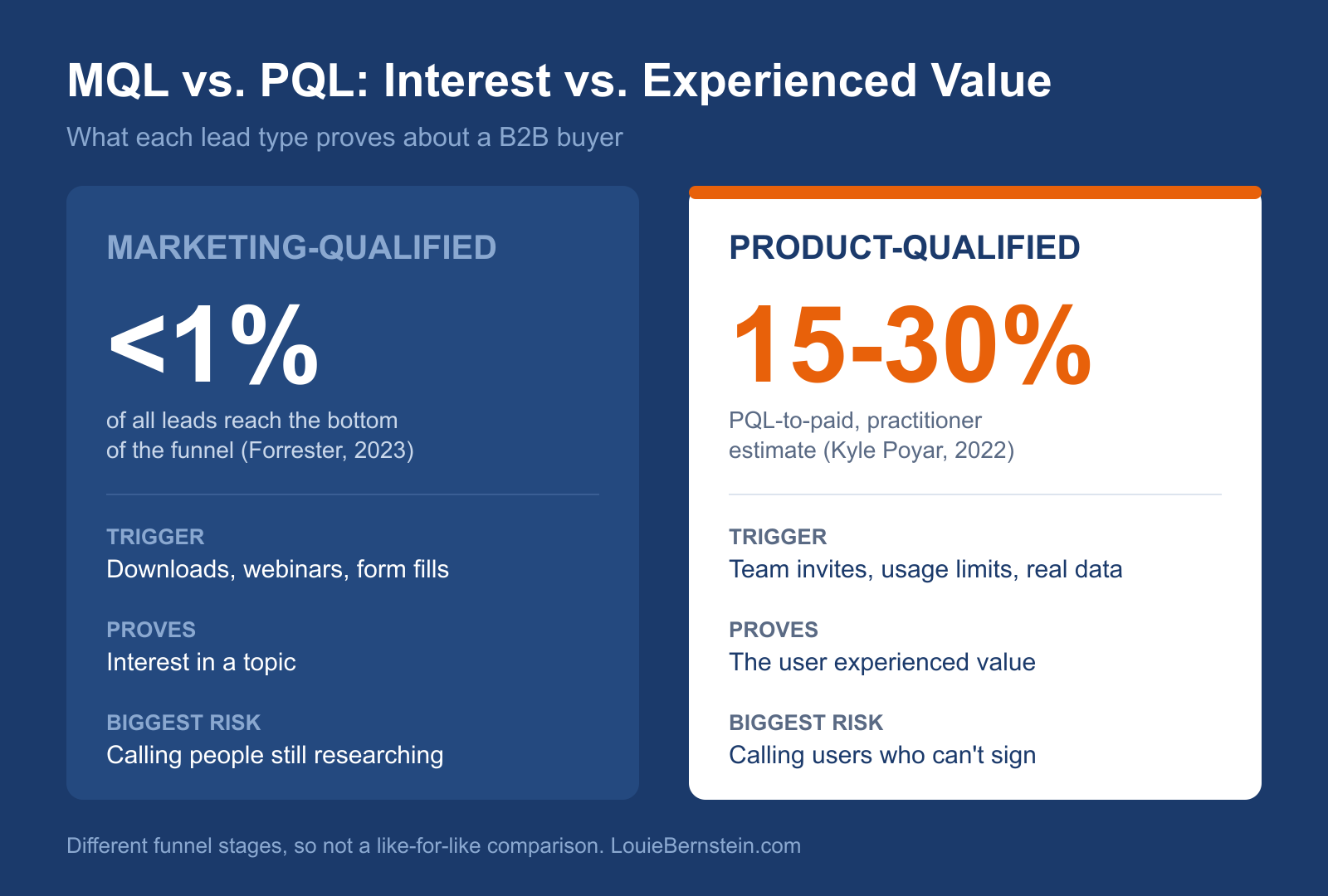
Forrester analysts wrote in October 2023 that fewer than 1% of leads make it from the top of the funnel to the bottom (Forrester, 2023). On the product side, Kyle Poyar, then a partner at OpenView, wrote in 2022 that PQLs often convert at 15% to 30% (Growth Unhinged, 2022).
Be careful with that comparison. Forrester's figure covers every lead from the top of the funnel. Poyar's is a practitioner's estimate for a later, narrower stage. The honest takeaway isn't "PQLs convert 30 times better." It's that a product usage signal sits much closer to a purchase than a content download does.
Your MQL definition still matters
If your buyers can't use the product before a demo, the line between a marketing lead and a sales lead is still the most important definition in your funnel. My article on MQL vs. SQL without a marketing team shows how to set those stages when the founder is also the marketing department.
Do you need product-qualified leads at $1M to $10M ARR?
A B2B company needs product-qualified leads only if prospects can use the product before they pay, and more sign-ups arrive than one person can review by hand. If buyers only see your product in a demo, there are no PQLs to find. If sign-ups are few, someone should simply look at every account.
The three-question PQL test
- Can a prospect use the real product without talking to you? That means a free tier, a free trial, a sandbox or a self-serve pilot. If not, stop here. You don't need PQLs.
- Do more sign-ups arrive each week than one person can review in an hour? If not, review every account by hand and skip the scoring.
- Do larger accounts need a sales conversation to buy? If every customer upgrades with a credit card, you need in-product prompts, not salespeople. If larger accounts need contracts, security reviews or approvals, PQLs tell your salesperson which accounts to call.
Three yeses mean PQLs are worth defining. Anything less means your time is better spent elsewhere. The one-hour line is my rule of thumb, not an industry benchmark.
Most SaaS companies haven't built PQLs yet
Only one in four SaaS companies had rolled out a PQL strategy in OpenView's 2021 Product Benchmarks, unchanged from 2020, according to Kyle Poyar, who led that research (Growth Unhinged, 2022). That's not a reason to rush. A PQL program needs product analytics, clean data and an agreed definition, and plenty of companies never get all three.
Sales help still moves the number
A 2023 study of 1,000+ mostly B2B products by Lenny's Newsletter and OpenView rated 3% to 5% free-to-paid conversion as good for self-serve freemium, and 5% to 7% as good when sales assisted (Lenny's Newsletter, 2023). PQLs decide where that sales help goes. My article on when a salesperson should step into a SaaS free trial covers the handoff itself.
Is a product-qualified lead ready to buy?
No. A product-qualified lead is ready for a conversation, not ready to buy. Product usage proves a user has a problem your product solves. Usage doesn't prove the company has budget, urgency or a decision-maker involved, and a person still has to qualify those.
What 50 years in sales has taught me
In my sales playbook, a qualified prospect passes four tests: a business pain that makes buying a priority, a budget or a way to get one, a sense of urgency, and involvement in the final decision. I used those four tests for decades before anyone said "product-led." Run a PQL through them and it usually passes one. The product proves pain. It says almost nothing about the other three.
Here's the mistake I see when a founder adopts the PQL label. The salesperson starts treating every PQL alert as a deal. The pipeline fills with active users who love the product and have no authority to buy it. The forecast goes up. Closed deals don't.
I like the expression "accelerate the inevitable." A PQL alert followed by four good qualifying questions gets you to a yes or a no fast. A PQL alert followed by a demo and a proposal gets you a stalled deal three months later.
A PQL earns a conversation. The conversation earns a place in the pipeline.
The user is rarely the only buyer
Slightly more than half of global business buyers purchase in complex buying scenarios with more stakeholders and departments involved, according to Forrester's 2023 Buyers' Journey Survey (Forrester, 2023). The user who triggered your PQL is often one of those stakeholders, not the one who signs. On the first call, ask who else will be involved in the decision.
How do I define my first product-qualified lead?
Define your first product-qualified lead by working backward from customers who already paid. Find the actions they took in the product before buying, add your ideal customer fit, and write the definition as one sentence your salesperson can apply without a scoring tool.
Seven steps to a working PQL definition
- Pull your last 10 to 20 customers who started on a free plan or trial.
- List what each did before paying: who invited whom, which limit they hit, what they connected, and how many days it took.
- Find the one or two actions most of them share. Ignore vanity activity like logins.
- Add a fit filter: company size, industry and buyer role, the same ideal customer profile your sales team uses.
- Write it as one sentence. An illustrative example: "A company with 20 to 500 employees where two or more users connected their CRM within 14 days."
- Decide who acts and how fast: an in-product prompt, support, or a salesperson within one business day.
- After 60 to 90 days, count how many PQLs became opportunities and how many became customers.
Step seven is where you learn the most. If PQLs aren't turning into opportunities, the definition is too loose. If good customers keep arriving without ever triggering it, the definition is too tight.
Write the PQL into your sales process
A PQL definition that lives only in a product dashboard won't change how your salesperson spends the day. Put it in your sales process next to your qualifying questions, and say what happens after the first call. If you're still deciding whether your company is product-led at all, start with whether your B2B SaaS company should be sales-led or product-led.
Frequently Asked Questions
Q: What's the difference between a PQL and an SQL?
A sales-qualified lead (SQL) is a lead a salesperson has vetted and accepted as worth pursuing. A product-qualified lead comes before that: product behavior flagged it. A PQL becomes an SQL after a salesperson confirms budget, urgency and who's involved in the decision.
Q: Do I need special software to track product-qualified leads?
No, not at first. The product analytics you already have, plus a weekly export or a field in your CRM, is enough while volume is low. In the 2022 Pocus benchmark, 73% of companies were still using traditional CRMs adapted to track PQLs and PQAs.
Q: Can a sales-led company with no free trial use PQLs?
Yes, with existing customers. Product usage inside current accounts can flag expansion, such as a customer near its seat limit or a new department logging in. That expansion signal is often the easiest place for a sales-led company to start using product data.
Q: How fast should a salesperson follow up on a product-qualified lead?
Within one business day, because a PQL reflects what the user is doing right now. The first touch should help, not pitch. Ask what the user is trying to accomplish and who else is involved, then decide together whether a real conversation makes sense.
Q: Should product-qualified leads replace MQLs?
Not for most B2B companies at $1M to $10M ARR. If you run both marketing and a free tier, keep both lead types and report them separately. A webinar sign-up and a team that hit its plan limit shouldn't look the same in your pipeline.
Turn product signals into a sales process that doesn't need you
If you're still deciding which accounts get a call, and still closing every meaningful deal yourself, the PQL definition is only the start. As a Fractional Sales Leader, I help founders define who's qualified, build the process for those deals, and get the team selling without the founder on every call.
Schedule a 30-minute conversationAbout the Author
Louie Bernstein is a Fractional Sales Leader with 50 years of sales experience and has worked in fractional sales leadership since 2017. He helps B2B founders build repeatable sales systems, coach their teams, and reduce their dependence on founder-led selling.
LouieBernstein.com