If your sales manager isn't working out, write down what the role must produce, separate the manager's failures from gaps you created, and test the fix against observable work over a defined period. Review coaching, pipeline quality, forecast accuracy, and whether reps can sell without you. Then decide whether to retain, change the role, or part ways. Waiting for one more quarter of revenue won't give you a cleaner answer.
Key Takeaways:
- If your sales manager isn't working out, diagnose the gap, set written expectations, review actual management work, and make a dated decision.
- Separate a manager who can't lead from a manager who lacks a defined process, authority, or a team that can realistically hit the plan.
- Inspect four outputs each week: rep coaching, qualified pipeline, forecast evidence, and decisions the team makes without the founder.
- Give a fixable gap a documented improvement period with measurable actions. Don't treat an arbitrary calendar deadline as proof of better sales leadership.
- Gallup found managers explain 70% of the variance in team engagement across business units. That is a broad workplace finding, not a sales quota benchmark.
You hired a sales manager so the team could stop bringing every deal and every decision to you. Instead, you're still the closer, the forecast editor, and the person coaching reps after a bad call.
The manager may be busy. The team may even have a decent month. Neither tells you whether you're building a sales organization that can work without your daily rescue.
For a B2B founder at $1M to $10M ARR, the question is urgent because one management seat may be the whole layer between you and the salespeople. Here's how I'd make the decision without turning a hunch into a firing or letting an avoidable problem drag on.
How do I tell whether the manager or the system is failing?
Compare the sales manager's work against a written role, then inspect the conditions you gave them. A manager cannot own a forecast without agreed sales stages, reliable CRM records, and authority to coach the team. Yet missing infrastructure does not excuse a manager who never surfaces the gap or proposes a way to fix it.
Start with the Accountabilities Document
Write one page stating what the manager owns, what decisions they can make, which decisions stay with you, and what good work looks like. Include weekly pipeline review, coaching, hiring input, forecast submission, CRM standards, and the way they escalate risks. If you never defined these duties, say that openly. Clarify the job before judging someone against it.
Ask for artifacts, not impressions: the last four forecast submissions, notes from rep coaching, a sample pipeline review, current opportunities by stage, and the manager's plan for two struggling reps. Can they explain the evidence behind each forecasted deal? Can a rep describe what they practiced and improved? Do team decisions still wait for the founder?
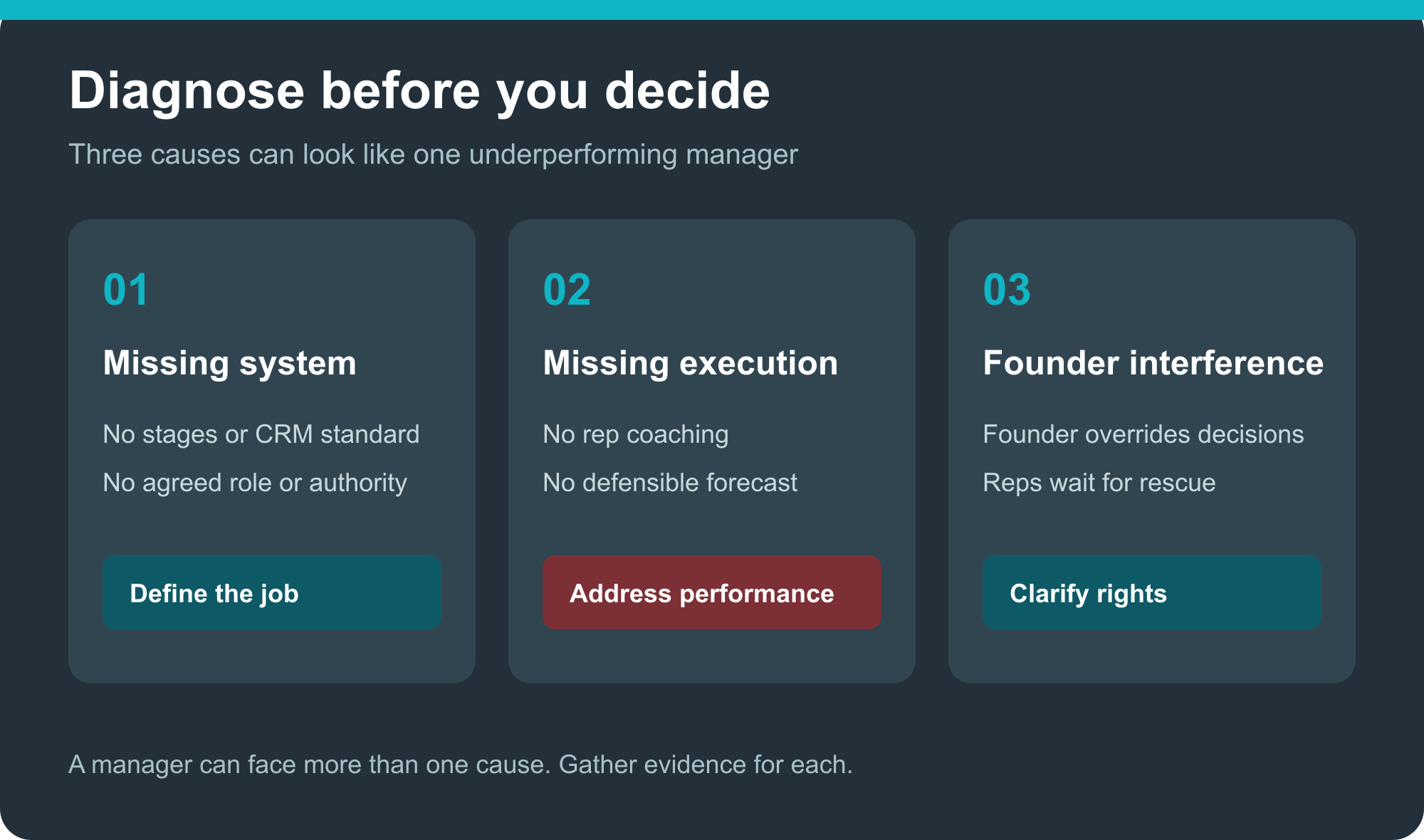
Classify the gap before you prescribe a fix
| What you see | Likely first move |
|---|---|
| No agreed stages or CRM standard | Define them together, then assess execution |
| Clear standards, no coaching or honest forecast | Address the manager's performance directly |
| Manager owns outcomes but you override every call | Clarify decision rights and step back |
Those categories can overlap. The purpose is to identify what each person can change. A weak manager can hide behind a weak system; a strong manager can be handcuffed by one. Gather enough evidence to tell which is happening in your company.
What should I say to a sales manager who isn't performing?
Tell the manager which expectations are unmet, show specific examples, ask for their assessment, and agree on what must change. Don't start with a verdict disguised as a conversation. A direct discussion gives the manager a fair chance to explain constraints, while making your standard and the possible consequences unmistakable.
Use evidence instead of adjectives
“You're not strategic enough” gives the manager nothing useful to change. Try: “Three deals in last Friday's commit forecast had no buyer-confirmed decision date. The CRM still shows the old stage, and the reps couldn't explain the next step. I need you to run a forecast review that catches that before it reaches me.”
Ask what the manager sees. They may point to a stage definition that no one uses, a rep you keep shielding from coaching, or a capacity problem you missed. Check the facts. Then state which issue the manager owns and which issue you will solve. Write down both commitments.
“Busy” isn't a management result. Ask what the team can now do reliably without you.
Protect the team while you decide
Don't announce uncertainty to the salespeople or ask them to choose sides. Keep customer commitments, approvals, and coaching covered. If a forecast or major deal needs immediate review, assign a temporary owner and tell the manager what you're doing. Document the reason. A founder can protect revenue without quietly reclaiming the entire sales department.
For an employee performance process, involve your HR adviser or counsel on your company's policies and local requirements. The sales test should be specific, fair, and documented; employment decisions have their own rules.
What should I measure during an improvement period?
Measure management behaviors and the evidence they produce, not revenue alone. Revenue can lag the work by months and may reflect deals the founder created. A useful improvement period checks whether the manager runs the cadence, coaches reps, improves CRM truth, and brings a defensible forecast without you rebuilding it.
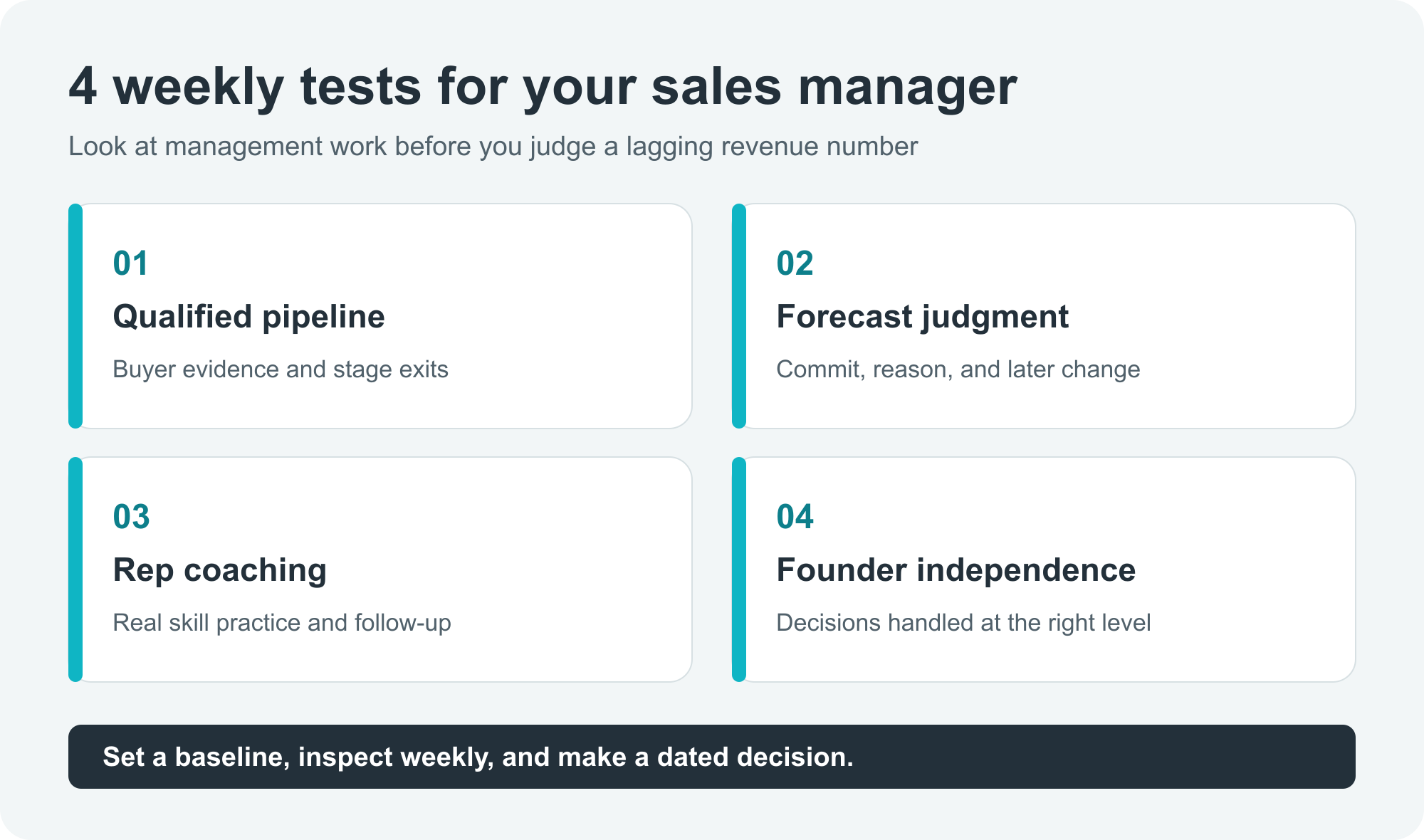
Choose a few tests the manager controls
- Pipeline quality: Review a defined sample of opportunities each week for buyer problem, decision process, next step, and stage exit evidence.
- Forecast judgment: Record what the manager commits, why, and what later changed. A miss should produce a better method, not a revised story.
- Coaching: Review notes and one real example per rep. Ask the rep what skill they practiced and what changed on the next call.
- Founder independence: Count decisions escalated to you that the manager had authority to make. Discuss the exceptions, not just the total.
Set the baseline from your own team. “Improve forecast accuracy by 20%” sounds precise but means little if the current forecast is based on guesses or the sales cycle is longer than the review period. Define what you will inspect, when, and what acceptable work looks like. You can track conversion and revenue as context, but don't make a manager accountable for buyer timing they cannot control.
Set a fair clock
For a fixable management gap, choose a review period long enough to observe repeated work. The Society for Human Resource Management says formal performance improvement plans should allow at least 30 days, with 60 or 90 days more customary. That's HR guidance across roles, not a sales-manager success rate. Match the window to the gap, your sales cycle, and company policy.
Agree on a weekly check-in. Each one should answer: What was done? What evidence changed? What support did the founder promise? What remains below standard? Don't move the standard after the fact. Don't extend the period simply because the final conversation is uncomfortable.
When should I keep, change, or replace the manager?
Keep the manager when the agreed management work improves and the team needs less founder intervention. Change the role when the person contributes strongly as a seller or specialist but cannot lead others. Replace the manager when the same documented failures continue despite clear expectations, authority, support, and a fair review period.
Make the decision from the job, not the relationship
A manager may be liked, loyal, and effective on their own deals. Those strengths don't prove they can coach, hire, forecast, and hold a team to standards. If their best work is selling, discuss a seller role only when there is a real role, a clear compensation plan, and no confusion about who manages the team. Don't invent a title to avoid an honest decision.
If you replace the manager, decide who owns the weekly cadence on day one. Write down active deals, hiring decisions, forecast assumptions, coaching commitments, and customer promises. Tell the team who makes decisions now. Otherwise you may remove a weak manager and leave the same weak operating system in place.
What I've seen in real sales teams
In my work as a Fractional Sales Leader, I look for the moment a founder has become the hidden sales manager again. The warning isn't only a missed number. It's a weekly forecast the founder rewrites, reps who wait for the founder to tell them the next step, and coaching that happens only after a deal is in trouble. A replacement hire won't solve that pattern unless the work and decision rights are made explicit.
Gallup reported in 2026 that managers account for 70% of the variance in team engagement across business units. That does not mean a manager controls 70% of sales results. It does reinforce how much the management seat can shape the team's day-to-day experience. Treat the seat as a real operating role, not a promotion for your best closer.
How do I prevent this with the next sales manager?
Define the management job before recruiting, interview candidates against the same work samples, and give the hire a clear operating system to lead. A founder who hires a strong closer and hopes management will appear is testing the wrong skill. Prevention means specifying the team's needs and watching the candidate coach, diagnose, and make tradeoffs.
Hire for the work you need done
Write the Accountabilities Document first. If the team has no Sales Playbook, qualification rule, CRM stage definitions, or coaching rhythm, say which pieces the manager must build and which support you will provide. A small team may need a hands-on builder. A larger team with working systems may need a coach and operator. Those are different jobs.
Use a consistent interview exercise. Give each finalist an anonymized pipeline with three questionable deals. Ask which deals belong in the forecast, what evidence is missing, and how they would coach the reps without taking over the calls. Then have them run a brief mock coaching conversation. Listen for questions, diagnosis, and a clear next action, not polished management slogans.
Build a review rhythm from day one
Agree on the first month of pipeline reviews, rep one-on-ones, and forecast submissions before the manager starts. Set decision rights in writing. Review early work with the manager so they can learn your market and you can see whether they can lead without becoming your assistant. A 30/60/90 plan is useful when it names observable deliverables, not when it lists meetings attended.
Some founders aren't ready to hire a full-time sales manager because the sales process exists mainly in the founder's head. In that case, build the process and role first. A Fractional Sales Leader can help define stages, coach the team, and install the management cadence while you determine the permanent seat you actually need.
Related Reading
Sales Management Accountability Without Micromanaging →What else should founders ask before making the call?
Founders often need to sort out a few practical issues after the main diagnosis: who owns urgent deals, whether the manager can move to a seller role, and how to assess a successor. Answer those questions explicitly so the team has clear leadership while you make a fair decision.
Should I take back every deal while the manager is under review?
No. Name which deals need founder involvement and why. Leave routine coaching and decisions with the manager when safe, or appoint a temporary owner. Taking over everything makes the manager impossible to assess and keeps the team dependent on you.
Can a great salesperson become a good sales manager?
Yes, but closing skill alone does not establish coaching skill. Test whether the person can diagnose another rep's work, teach a skill, handle a hard accountability conversation, and judge a forecast. Give a new manager training and a clear role.
What if the manager says the quota is unrealistic?
Check the pipeline math, territory, capacity, sales cycle, and lead quality. A credible manager should show the assumptions and a plan, not merely reject the number. If the target is unsupported, revise the plan and continue assessing the manager's work against fair expectations.
Should I tell the sales team their manager is on a performance plan?
Keep individual employment matters private. Tell the team about any change in operating cadence, approval rights, or temporary coverage they need to do their jobs. Give them a clear person to go to, without inviting speculation about the manager.
What if I have no sales process to hand a new manager?
Define your buyer, qualification standard, stages, exit criteria, CRM rules, and weekly review before expecting consistent management. You can build these with the current manager if they have the skill, or bring in help to install them. Another hire into the same ambiguity may fail for the same reason.
Need a clear read on your sales leadership?
At LouieBernstein.com, I help B2B founders build the sales process, management cadence, and team accountability that make the next decision clearer. A Fractional Sales Leader can help when you need that work done before hiring a full-time VP of Sales.
Schedule a 30-Minute CallAbout the Author
Louie Bernstein is a Fractional Sales Leader who helps founders of $1M to $10M ARR B2B businesses build repeatable sales systems, coach their teams, and reduce their dependence on founder-led selling.