The 5 things every top salesperson wants from a founder-led B2B company before they'll join, and before they'll stay.
Top salespeople look for five things in a company, and not necessarily in this order: a good, realistic, and fair to both sides, comp plan = Money; a level playing field, where everyone is treated equally; a good product or service to sell; a pat on the back for a job well done, preferably in front of their peers; and being part of an organization doing something special or big. Get all five right and the best reps join and stay.
Key Takeaways
- Every top salesperson is looking for five things: a fair comp plan, a level playing field, a good product, public recognition and a company doing something special or big.
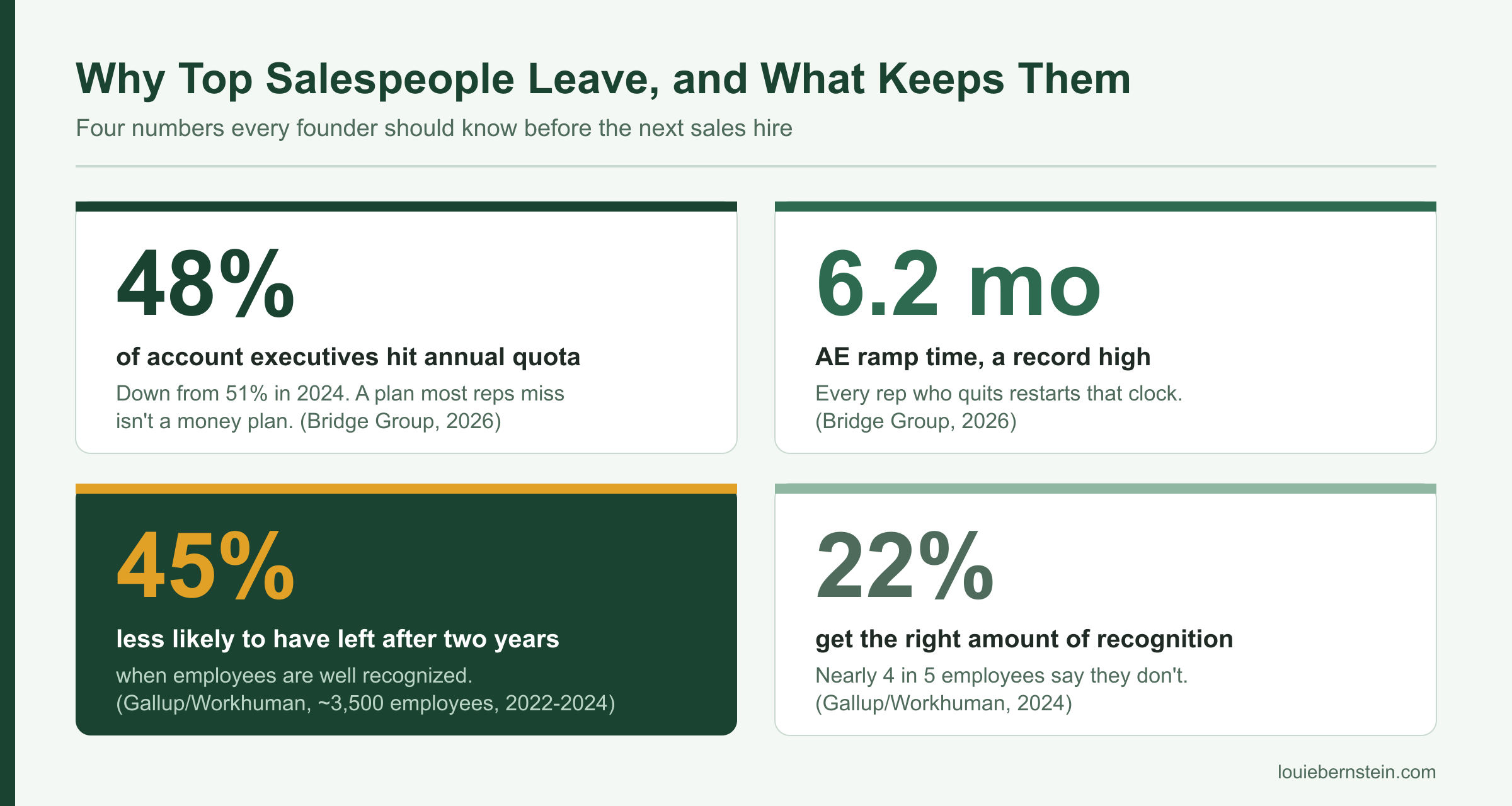
- A comp plan only means money if reps can hit it. In 2026, 48% of account executives hit annual quota (Bridge Group, 158 B2B companies), so top candidates will ask how many of your reps made their number.
- Recognition is the cheapest retention tool a founder has. Well-recognized employees were 45% less likely to have left after two years (Gallup/Workhuman, 2022 to 2024).
- Your product doesn't have to be great. Top salespeople need a good product that customers renew and refer, plus honest proof of it.
- Before your next interview, write down your answer to each of the five. Then put an example of each one in the job description.
Founders ask me all the time how to find a great salesperson.
Wrong question. The great salespeople are already employed. They're making money somewhere else. The real question is what would make one of them walk away from that and come work for you.
After 50 years in sales, I can tell you the answer isn't complicated. It's five things. A $3M company can get every one of them right. Most don't, and then they wonder why the only people applying are the ones who need a job.
Get these five right and recruiting and retaining the best becomes a lot easier. And your revenue will look a lot better.
What are the 5 things every top salesperson is looking for?
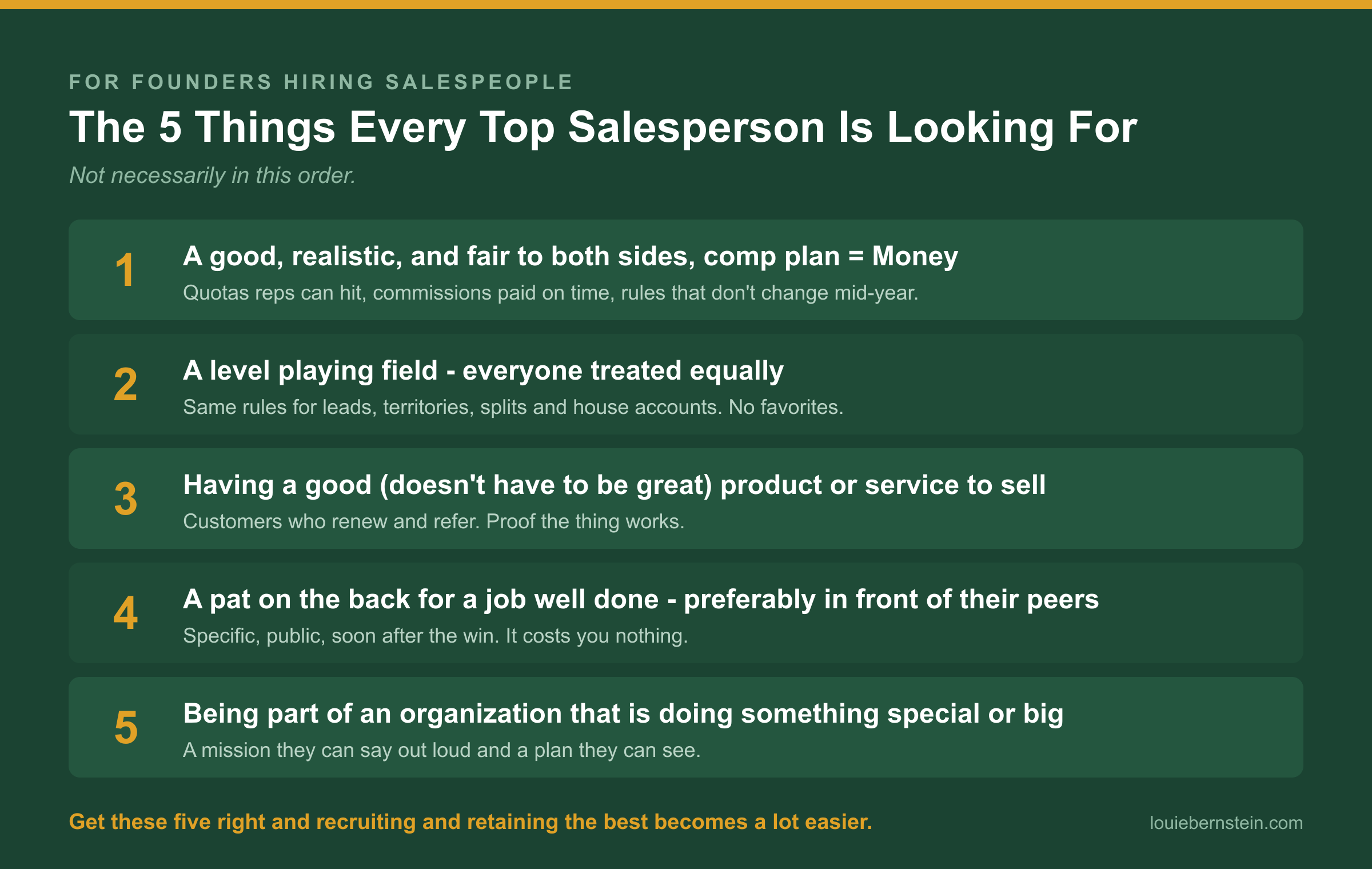
Every top salesperson is looking for five things when they choose a company: money from a fair comp plan, equal treatment, a good product, public recognition and a bigger purpose. The order changes from rep to rep, but a top performer weighs all five before saying yes, and keeps weighing them every month after.
Here they are, the way I've written them for founders for years. Not necessarily in this order:
- A good, realistic, and fair to both sides, comp plan = Money
- A level playing field - everyone treated equally
- Having a good (doesn't have to be great) product or service to sell
- A pat on the back for a job well done - preferably in front of their peers
- Being part of an organization that is doing something special or big
Notice what's missing. Ping pong tables. Free lunch. Unlimited PTO. A fancy title. Top salespeople don't care much about any of it. They care about whether they can win, whether the game is fair, and whether winning means something.
What makes a sales comp plan fair to both sides?
A sales comp plan is fair to both sides when a solid rep can realistically hit quota, the company can afford to pay at quota and above, and the rules don't change after the deal closes. Top salespeople judge the plan by what reps actually earn, not by the on-target earnings in the job posting.
"Realistic" is the word founders skip
The median AE on-target earnings reached $200K in 2026, and the median quota hit $960K (Bridge Group, 158 B2B companies). The same study found only 48% of reps hit their annual quota, down from 51% in 2024.
Think about what that means to a top candidate. If half your reps miss, your OTE is a coin flip. A top salesperson knows this, so they'll ask how many of your people made quota last year, last quarter and last month. If you don't know the answer, they'll take that as your answer.
"Fair to both sides" means the company wins too
Fair doesn't mean rich at any cost. A comp plan that pays reps well on deals that lose money for the company won't last. The best reps know that, and they get nervous around plans that look too good. They've seen those plans get rewritten in month seven.
Here's what a fair plan looks like at a $1M to $10M ARR company:
- A quota most of your solid reps can hit with the leads and support you actually give them.
- Commissions paid on time, every time, with the math written down.
- No caps on what a rep can earn on good deals.
- No rule changes after a rep has earned the money.
If you're building or fixing a plan, start with these comp plan mistakes founders make before you write a number down.
What does a level playing field look like on a small sales team?
A level playing field on a small sales team means every rep gets leads, territories, accounts and credit by the same written rules. Top salespeople don't need special treatment. They need to know nobody else is getting it, because favoritism tells them their results won't decide their pay.
Where favoritism hides in founder-led companies
Founders rarely play favorites on purpose. It creeps in. The rep you hired first gets the best inbound lead. A friend of the family gets the easy territory. A deal you helped close gets split in a way nobody can explain. The house accounts quietly grow.
A 2023 WorldatWork article on sales incentives lists territories that make no sense, unobtainable quotas and the feeling that the game is rigged among the reasons salespeople leave. Top performers are the first to notice, because they're the ones keeping score.
Write the rules down
The fix is boring, and it works. Write down how leads are routed, who owns which accounts, how splits work and what each role is accountable for. A Sales Accountabilities Document does a lot of this for you. When a rep asks why a deal went to someone else, you point to the page, not to your mood that day.
Does your product have to be great to attract top salespeople?
No. A top salesperson needs a good product or service, not a perfect one. Good means it solves a real problem, customers renew, and some of them will take a reference call. Top reps can sell around missing features. They can't sell around a product that doesn't work or customers who won't vouch for it.
Founders get stuck here in two ways. Some wait for the product to be great before hiring a salesperson, and they wait too long. Others oversell a shaky product in the interview, and the rep finds out in week three.
Be honest about where you are. Tell candidates your year-over-year growth, your renewal rate and your three happiest customers. A top salesperson can work with "good and getting better." They walk away from "great" when the numbers say otherwise.
Why does a pat on the back keep top salespeople from leaving?
A pat on the back keeps top salespeople because recognition tells them the company sees their work, and public recognition tells their peers too. Well-recognized employees were 45% less likely to have left after two years (Gallup/Workhuman, about 3,500 employees, 2022 to 2024). It's the cheapest retention tool a founder has.
Most founders under-recognize
The same research found only 22% of employees say they get the right amount of recognition for their work (Gallup/Workhuman, 2024). Well-recognized employees were also 65% less likely to be looking or watching for another job.
Founders under-recognize salespeople for an understandable reason. You think the commission check is the thank-you. It isn't. The check pays them. The pat on the back tells them you noticed how they won.
Why "in front of their peers" matters
Salespeople are competitive. A private "nice job" is good. The same words said on the Monday sales call, with the deal named and the hard part described, are a lot better. The rep hears it, and so does everyone who wants to be that rep next month. Be specific, do it soon after the win, and make sure it goes to whoever earned it, which ties right back to the level playing field.
Why do top salespeople want to join a company doing something special or big?
Top salespeople want to join a company doing something special or big because they want their wins to add up to something they can talk about. A clear mission and a believable growth plan make every call easier to make and every deal worth more to the rep's career. A $3M company can offer this as well as a public one.
What 50 years in sales has taught me
I built and ran MindIQ for 22 years, and we earned a spot on the Inc. 500. We didn't win salespeople by outspending bigger companies. We couldn't. We won them by being able to say what we were building and why it mattered, and then letting them see it happen.
Here's the pattern I've seen over and over since then. The founders who struggle to hire good reps usually aren't short on money. They're short on a story. Ask them why the company exists and you get a feature list. Ask a candidate to repeat it and you get nothing. Top salespeople join founders who can tell them where the company is going in two sentences, and believe it.
"Special or big" doesn't mean giant
Big can mean you're the first to fix a problem in a niche. Special can mean customers who say your product saved their business. You don't need a billion-dollar vision. You need a true one you can say out loud in an interview.
How do you show a sales candidate you have all five?
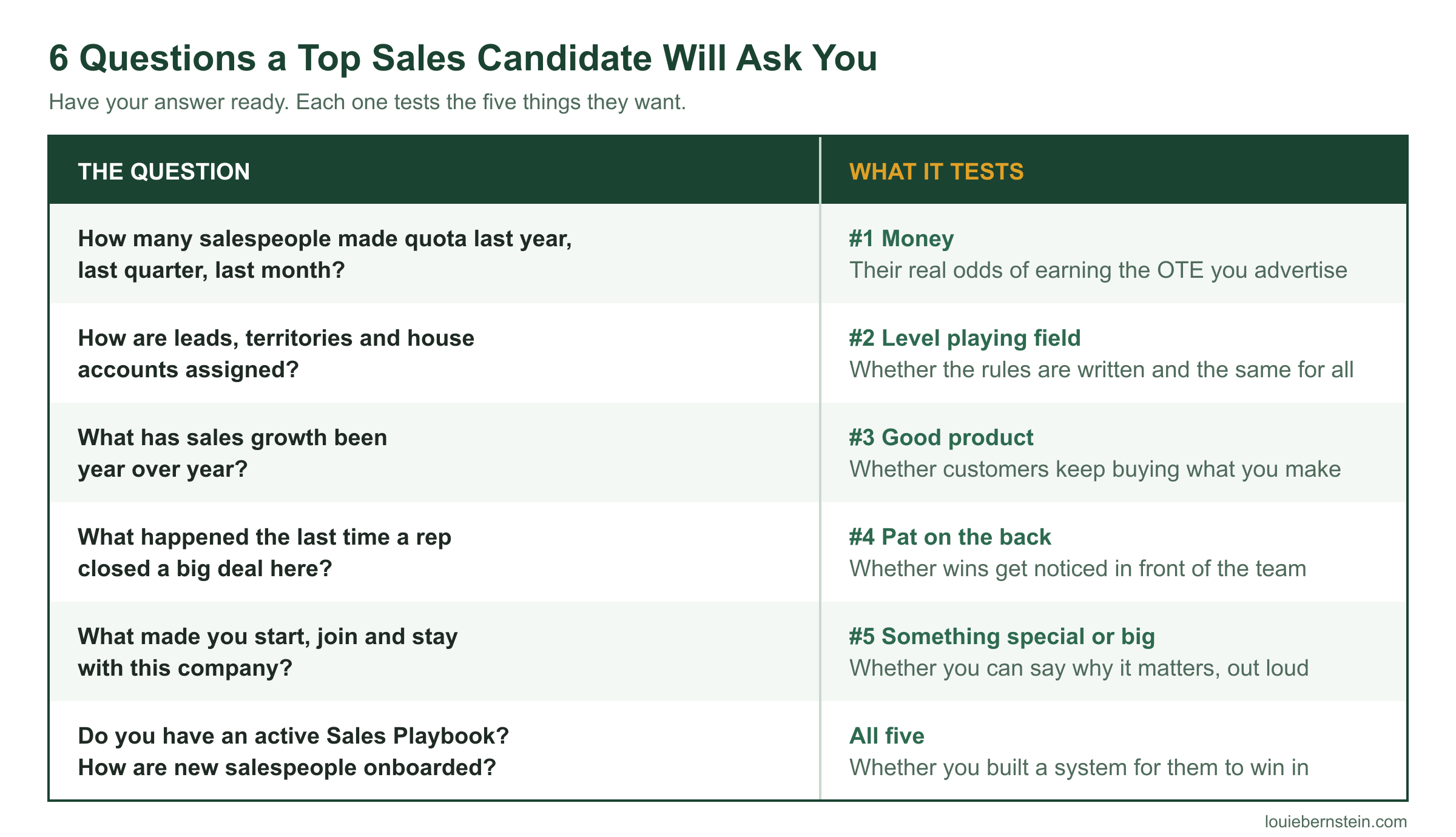
Show a sales candidate you have all five by answering their questions with numbers and examples, not adjectives. The best candidates will ask how many reps made quota, how leads are assigned, how fast sales are growing and why you started the company. Write your answers before the interview and put examples in the job description.
The best salespeople interview you as hard as you interview them. I've written before about the interview questions you need to be prepared for from a salesperson. Each of them really tests one of the five things.
Where founders usually get this wrong
The most common mistake I see is a founder who answers all five with enthusiasm and no evidence. "Our comp plan is great." "Everybody's treated the same." "We're changing the industry." Top salespeople hear that from every company. What they don't hear often is a founder who can say something like, "Four of our six reps made quota last year, here's the plan, here's how leads get routed, and here's the customer who'll tell you why they renewed."
The rep you want will hear the difference in about two minutes.
Top salespeople don't believe adjectives. They believe numbers, rules and stories they can check.
Turn the five into your job description
Put one real example of each of the five in your next job description. Your OTE and what percentage of reps hit it. How leads are assigned. Your growth rate. How wins get celebrated. Why the company exists. That one page will filter in the salespeople you want and quietly filter out the rest.
If you're still the one closing most of the deals, this is hard to do alone. That's often where a Fractional Sales Leader comes in, building the comp plan, the rules and the playbook so the next great rep has something worth joining. It's roughly half the cost of a full-time VP of Sales.
Frequently Asked Questions
Is money the most important thing to top salespeople?
Money matters a lot to top salespeople, but it's rarely enough on its own. A top rep will leave a well-paying job over favoritism, a product that doesn't work or a boss who never notices a win. Pay competitively, then get the other four right so money isn't the only reason to stay.
Can a $1M to $10M ARR company compete with big companies for top salespeople?
Yes. A smaller company can't always match big-company base salaries, but three of the five things cost almost nothing: a level playing field, a pat on the back in front of peers and a company doing something special. Many top reps want the visibility and impact a smaller company gives them.
How do I find out which of the five my current reps think I'm missing?
Ask them, one at a time, in their next 1:1. Read them the five and ask which one you're doing best and which one you're doing worst. Then fix the worst one first. Your reps already know the answer, and they'll usually tell you if you ask plainly.
Should I share quota attainment numbers with sales candidates?
Yes. Top candidates will ask how many reps made quota, and dodging the question tells them the answer is bad. If attainment is low, say so, explain why and tell them what you're changing. Honesty about a hard number builds more trust than a vague promise about earnings.
What should I do if one of the five is weak right now?
Name the weak one in the interview and show your plan to fix it. A top salesperson can accept a company that's working on one of the five. What drives them away is a founder who pretends all five are fine and lets them find the gap after they start.
Make your company the one top salespeople want to join.
If you're a $1M to $10M ARR B2B founder still closing most of the deals, let's look at your comp plan, your rules and your hiring pitch, and find which of the five is costing you good reps. Learn about Fractional Sales Leadership at LouieBernstein.com.
Schedule a 30-Minute CallAbout the Author

Louie Bernstein Fractional Sales Leadership
Louie Bernstein is a Fractional Sales Leader with 50 years of sales experience and has worked as a Fractional Sales Leader since 2017. He built and ran MindIQ for 22 years. He helps B2B founders at $1M to $10M ARR build repeatable sales systems so selling doesn't depend on the founder.