How Do You Build a Sales Plan That Can Survive Losing a Major Account?
If you lose your largest customer, your cash runs short long before new revenue can replace it. Losing a customer that's 30% of a $3M company takes about $675K of gross profit a year, and replacing that revenue takes roughly 20 new customers and a year of selling. You survive by building the replacement pipeline before the loss: know your runway, set your replacement number, and get someone other than the founder selling new customers every week.
Key Takeaways
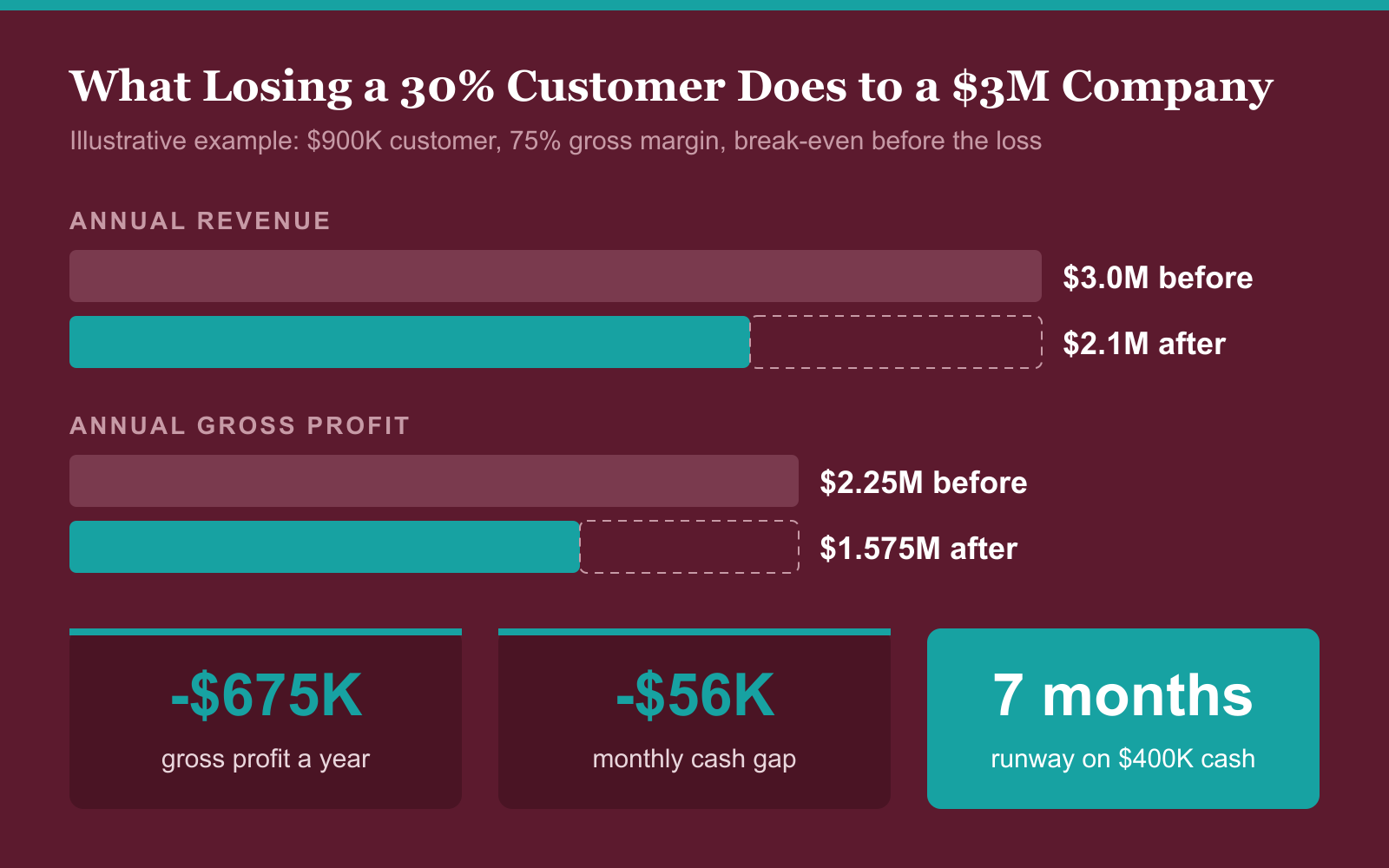
- Losing your largest customer hits cash first. In an illustrative $3M company with a $900K customer and 75% gross margin, the loss opens a $56K monthly cash gap and leaves about 7 months of runway on $400K in the bank.
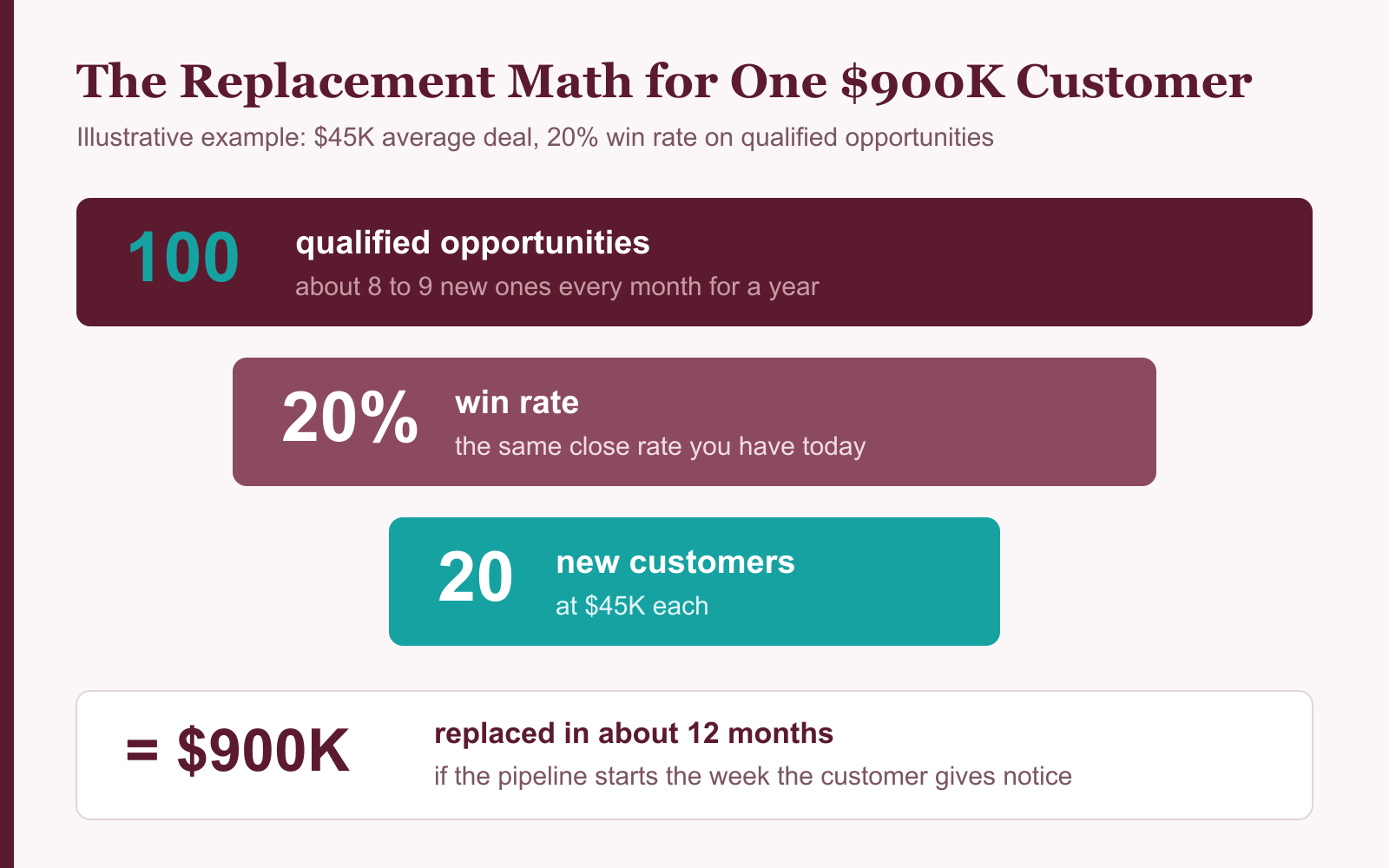
- Replacing a lost major account takes a specific amount of selling. At a $45K average deal and a 20% win rate, a $900K customer takes 20 new customers and about 100 qualified opportunities to replace.
- Running out of money is usually the last step in a company's failure. CB Insights found 70% of 385 failed VC-backed startups ran out of capital (2026), and called it the final cause of death rather than the root problem.
- Your champion will probably change jobs before your relationship ends. The median management or professional worker has been with their current employer 4.9 years (BLS, January 2026).
- Do this week: write down your biggest customer's gross profit, your runway without it, and how many new customers it would take to replace it. Then build the pipeline for that number now.
Most founders I talk to can tell me exactly where they're going on vacation next summer. Very few can tell me what happens to payroll the month after their biggest customer leaves.
They care. The big customer has just been there for years, the relationship feels solid, and thinking about losing it feels like bad luck. Then a merger, a new CFO or a champion's retirement makes the decision for them.
Your biggest customer doesn't owe you a renewal. Your sales plan has to work whether they sign or not.
For B2B founders between $1M and $10M ARR, losing a major account is one of the few events that can turn a healthy company into a cash emergency inside one quarter. Here's what actually happens, and how to build a sales plan that survives it.
What Actually Happens in the First 90 Days After You Lose Your Largest Customer?
In the first 90 days after you lose your largest customer, your cash position gets worse faster than your revenue line shows. The customer's gross profit disappears, but your payroll, rent and software bills don't. Your bank line can shrink too, and the founder usually stops selling to manage the crisis.
The cash gap arrives before the revenue report does
Revenue is a lagging number. If the customer gives 60 days' notice, your income statement looks fine for two months while you're already short on next quarter. The number that matters is gross profit, because that's what pays your fixed costs.
Take an illustrative $3M company whose largest customer pays $900K a year, 30% of revenue, at a 75% gross margin. That customer produces $675K of gross profit a year. If the company was breaking even before the loss, it's now short about $56K every month. With $400K in the bank, it has roughly 7 months to fix the problem.
Your bank line can shrink at the same time
If you borrow against receivables, losing a major account cuts your collateral right when you need cash most. Bank examiners note that lenders normally consider receivables concentrated when a single account is 10% or more of the portfolio (OCC, Accounts Receivable and Inventory Financing). Your biggest customer's invoices may have been a large part of your borrowing base. When they stop, so does that borrowing capacity.
Running out of cash is the last step
CB Insights studied 431 VC-backed companies that shut down since 2023. "Ran out of capital" topped the list at 70% of the 385 with an identifiable reason, and the report notes it's almost always the final cause of death, not the root problem (CB Insights, 2026). Those were venture-backed startups, not bootstrapped $3M companies, but the lesson travels. Losing your largest customer is a root cause. Cash is the symptom that kills you if nothing replaces the lost revenue.
How Many New Customers Does It Take to Replace Your Largest Account?
To replace your largest account, divide its annual revenue by your average new-customer deal size. That's how many new customers you need. Then divide that number by your win rate to get the qualified opportunities your team has to create. For most founder-led companies, the answer is far more selling than they're doing today.
The replacement math, step by step
- Start with the lost revenue. In the illustrative example, that's $900K a year.
- Divide by your average deal. At $45K per new customer, you need 20 new customers.
- Divide by your win rate. At 20% of qualified opportunities, you need 100 qualified opportunities.
- Spread it across your timeline. To replace the revenue in 12 months, your team has to create 8 to 9 qualified opportunities every month and close about 2 new customers a month.
- Compare it to today. If you're closing one new customer a month now, you have to double your new-customer selling without the founder's time growing.
Why the timeline is longer than it looks
The math assumes the pipeline starts the week the customer gives notice. It rarely does. Founders spend the first month trying to win the account back, the second month cutting costs, and only then start building new pipeline. Every month of delay comes straight out of your runway.
It also assumes your deals close as fast as they did last year. If your sales cycle is four to six months, a deal that starts in month three may not close until month nine. That's why the replacement pipeline has to exist before the loss, not after it.
You can't build a year of pipeline in the 60 days between the notice and the last invoice.
How Do You Know Your Largest Customer Is About to Leave?
Your largest customer is most likely to leave when the people, the money or the ownership on their side changes. A new executive, a merger, a budget freeze or a champion who leaves the company can end a relationship that looked solid for years. Watch for these changes at least 12 months before renewal.
Six warning signs a major account is at risk
- Your champion changes jobs. The median management or professional employee has been at their current employer 4.9 years (BLS, January 2026). Over a five-year customer relationship, plan on your champion leaving.
- The customer gets acquired or acquires someone. The new parent often has its own vendor, and consolidating vendors is an easy way to show savings.
- Procurement shows up at renewal. When a buyer you've never met joins the renewal conversation, price and alternatives are on the table.
- Usage or order volume drops. Fewer users, smaller orders or skipped meetings usually show up months before a cancellation notice.
- Your executive sponsor goes quiet. If the person who approved the budget stops taking your calls, someone else may be making the decision.
- The customer asks for an RFP or a "market check." That's often a sign the decision has already started, with or without you.
Every one of these signs is easier to catch if more than one person on your team knows the account. If you want the numbers on when one customer becomes too big a risk, I covered the thresholds in how much revenue your biggest customer should be.
How Do You Build a Sales Plan That Can Survive Losing a Major Account?
A sales plan that survives losing a major account has a new-customer pipeline big enough to replace that account within your cash runway, and it doesn't depend on the founder to run it. Build it before you need it: know the gap, set the replacement number, and make new-customer selling a weekly habit.
What 50 years in sales has taught me: buy survival insurance
I've watched this happen to good companies for five decades. The ones that survive planned for the bad day while things were good. I call it buying survival insurance, and the policy doesn't cost you a penny.
Make a simple sheet with three columns:
- What I have now. List your largest customers, their revenue, their gross profit and their renewal dates.
- What if it goes away? Write down the monthly cash gap, the runway and the people you'd have to let go.
- My plan to replace or fix it. This column is where the work happens: the replacement number, the pipeline it takes and who's going to sell it.
Most founders fill in the first column in five minutes and never get to the third. The third column is the sales plan.
Five parts of a survivable sales plan
- A replacement number with a date. For example: enough new customers to replace your largest account within your runway, tracked monthly.
- A pipeline target built from that number. Use the replacement math above to set a monthly qualified-opportunity goal.
- A written sales process. A documented sales playbook lets someone other than the founder find, qualify and close new customers.
- Clear ownership. An Accountabilities Document says who owns new-customer pipeline, who owns the big account and what each person is measured on.
- Wider relationships in the big account. Get three or more people on your side talking to three or more people on theirs, so one job change doesn't end the relationship.
| Without a survival plan | With a survival plan |
|---|---|
| ✕ Pipeline starts after the notice | ✓ Pipeline is already running |
| ✕ Founder is the only closer | ✓ A documented process others can run |
| ✕ Runway is a guess | ✓ Runway is calculated without the big account |
| ✕ One champion at the customer | ✓ Three or more relationships |
| ✕ Sales gets cut first | ✓ New-customer selling is protected |
| ✕ Months lost to panic | ✓ A plan you pull out of the drawer |
What Should You Do the Week Your Largest Customer Gives Notice?
The week your largest customer gives notice, calculate your real runway, protect your new-customer selling and talk to the customer about why they're leaving. Don't cut sales first. Cost cuts buy you time, but only new customers replace the lost revenue, and a cut sales effort makes the hole permanent.
The first-week checklist
- Get the facts from the customer. Ask why they're leaving, when the last order or invoice will be and whether any part of the business can stay.
- Recalculate runway on gross profit. Use the cash-gap math above with your real numbers.
- Set the replacement number. Revenue to replace, new customers needed, qualified opportunities per month.
- Cut costs that don't create revenue first. Protect the people and programs that generate new pipeline.
- Tell your team the plan, not just the news. People handle bad news better when they know what's being done about it.
Where founders usually get this wrong
The mistake I see founders make most often is treating the loss as an account-management failure and spending the next three months trying to win the customer back. Sometimes that works. Usually the decision was made weeks before you heard about it, and every month spent chasing it is a month not spent building new pipeline.
The second mistake is cutting sales and marketing to stretch runway. It feels responsible, and it's the one cut that guarantees you won't replace the revenue. In my experience, the companies that came out of a major account loss stronger were the ones that doubled down on finding new customers while they still had cash to do it.
That's often the moment founders realize they need a sales system that works without the founder closing every deal. A Fractional Sales Leader builds that system without the cost of a full-time hire: my fee is $14K a month for 20 to 35 hours a week, roughly half the cost of a full-time VP of Sales at $250K to $400K a year, in a renewable 12-week engagement.
Cost cuts buy you time. Only new customers buy you a future.
Related Reading
How Do You Reduce Customer Concentration? →
Frequently Asked Questions
Q: Can my company survive losing a customer that's 30% of revenue?
Most B2B companies can survive losing a customer that's 30% of revenue if they have at least 6 to 12 months of runway and a working new-customer pipeline. Without both, the loss usually forces layoffs. Calculate your runway on lost gross profit, not lost revenue, to know where you stand.
Q: Should I offer a big discount to keep my largest customer?
Offer a discount only if the customer will still be profitable at the new price and the discount buys a longer term. A deep discount to save a renewal often trades a cash crisis now for a margin problem every year after. Ask what's really driving the decision before you lead with price.
Q: Should I hire salespeople right after losing a major account?
Hire salespeople after a major account loss only if you have the runway to carry them through ramp and a documented process for them to follow. New reps take months to produce, so a hire made in month three of a seven-month runway rarely pays off in time. Build the process first.
Q: How much cash should I keep in case my biggest customer leaves?
Keep enough cash to cover your largest customer's lost gross profit for as long as it takes your team to replace it. If replacing the account would take 12 months of selling, that's the cushion to aim for. Until you have it, treat new-customer pipeline as your insurance.
Q: Can a lost customer come back?
Yes, lost B2B customers sometimes come back, especially when a new vendor disappoints them. Leave on good terms, keep in touch with your remaining contacts and check in after six months. Just don't build your plan around it. Plan as if the account is gone for good.
Would your company survive losing its biggest customer?
If one customer could decide whether you make payroll, and you're still the one closing every new deal, let's talk. We'll run your replacement math and look at what it would take to build a new-customer pipeline that doesn't depend on you.
Schedule a 30-Minute CallAbout the Author
Louie Bernstein
Louie Bernstein is a Fractional Sales Leader with 50 years of sales experience and has provided Fractional Sales Leadership since 2017. He helps B2B founders build repeatable sales systems so their teams can sell without depending on the founder.