Key Takeaways:
- When you take over a sales team, come in with questions, not answers. The people you inherited already know where the deals are and where the process leaks. Your job is to find out fast.
- Ask every salesperson the same four buckets of questions: pipeline reality, the process, the person, and what they need from you. Do it one on one, not in a group.
- Inspect deals, don't accept narration. "Walk me through your top three deals and what has to be true for each to close" tells you more than any forecast spreadsheet.
- Audit what you inherited before you trust the number: is the process written down, does the pipeline generate without the founder, is "good" defined, is the CRM real, can anyone name what's breaking?
- Understanding what you inherited is crucial. For a bit. Give yourself about two weeks to listen, then start building the system. Teams don't respect a leader who's still "getting up to speed" in month three.
Around 40% of new leaders fail within their first 18 months, and it's usually not because they lacked talent (The First 90 Days, Watkins). It's because they either bulldozed what was already working, or they never stopped "listening" long enough to actually build anything.
I've taken over sales teams. I've helped founders hand off the teams they built. And I've watched a lot of new managers get this exact moment wrong.
Here's the trap. You've just been handed a group of salespeople, a pipeline you didn't build, and a forecast you have no reason to trust yet. The instinct is to prove you belong by changing things. Don't. The first move isn't to talk. It's to ask.
But here's the twist most "first 90 days" advice gets wrong: you don't get 90 days of listening. You get about two weeks. After that, the team needs to see you build. This article is the exact set of questions I ask, and what I do with the answers.
Why the First Conversations Decide Everything
You're not inheriting a spreadsheet. You're inheriting people who are already halfway through deals, already forming an opinion of you, and in a lot of cases, already updating their resume. Sales reps stick around about 18 months on average (HubSpot), while peak performance doesn't hit until years two and three. So the person in front of you is often either about to get good or about to leave. Your first conversations tip that either way.
There's a second reason the questions matter more than the answers you think you have. Your reps only spend about 28% of their week actually selling (Salesforce). The rest goes to admin, CRM updates, internal meetings, and hunting for information. When you walk in changing things on day two, you add to that 72% instead of cutting it. When you walk in asking, you find out where the real friction is before you accidentally make it worse.
"The team you inherited already knows what's broken. They're just waiting to see if the new person is smart enough to ask."
What You're Actually Trying to Learn
Underneath all the questions, you're trying to answer three things quickly: What's the real state of the pipeline (not the forecast, the reality)? Who on this team is an asset, who's coachable, and who's a problem? And what's the one thing breaking that, if you fixed it, would move the number the fastest?
Everything below is built to get you those three answers without you having to guess.
The Questions to Ask Each Salesperson
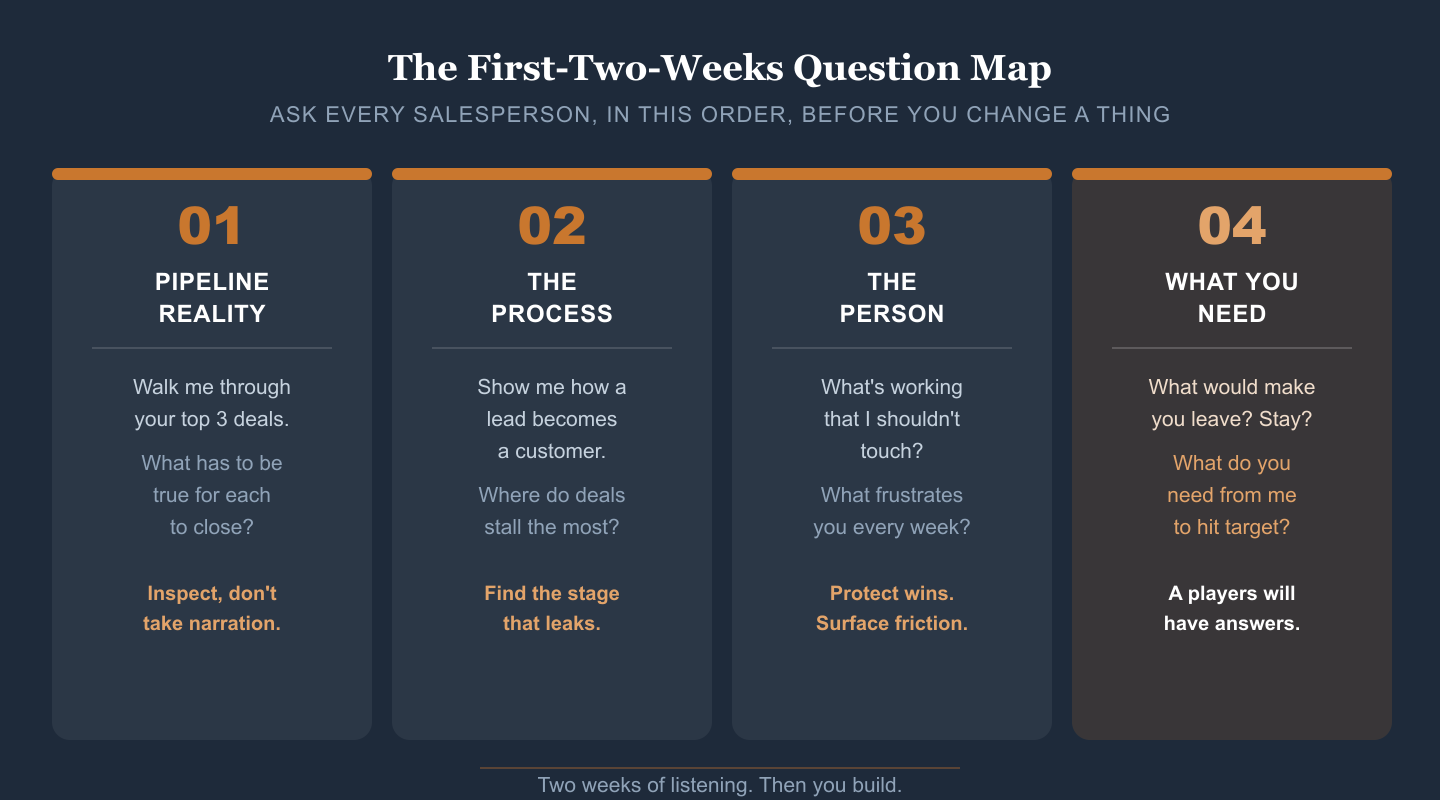
Do this one on one. Never in a group. In a group, everyone performs for each other and you learn nothing. One on one, thirty minutes, no laptop between you, is where the truth lives. I run these in four buckets, in order.
Bucket 1: Pipeline Reality
Start with the deals, because that's where they're most fluent and least defensive. But don't ask "how's your pipeline?" You'll get a status report. Ask them to inspect, not narrate:
- "Walk me through your top three deals. For each one, what has to be true for it to close?"
- "Which of these would you bet your own money on? Which are you hoping on?"
- "What customer action has happened since last week that made a deal stronger or weaker?"
- "What's the last deal you lost, and why did you really lose it?"
That last one is gold. A rep who says "price" every time isn't diagnosing, they're deflecting. A rep who says "I got to the wrong person and never reached the economic buyer" is someone you can coach tomorrow.
Bucket 2: The Process
Now find out if there's a system or just a set of personal habits. Most $1M to $10M teams don't have a real process. They have whatever the founder did, loosely copied by everyone else.
- "Show me how a lead becomes a customer, stage by stage."
- "Where do deals stall the most? Which stage eats the most time?"
- "What do you do that works that nobody taught you?"
- "If a new rep started Monday, what would they have no idea how to do?"
When three reps describe three different processes, you've found your first build project. When they all describe the same broken stage, you've found your fastest win.
Bucket 3: The Person
This is where you separate the assets from the problems, and where you earn trust by asking what to protect, not just what to fix.
- "What's working right now that I shouldn't touch?"
- "What frustrates you every single week that nobody's fixed?"
- "What did the last manager do that you hope I keep? What do you hope I drop?"
- "When you have a great week, what usually caused it?"
Bucket 4: What They Need From You
Close every conversation here. This is the bucket that tells you who your A players are, because A players always have a clear answer.
- "What would make you leave this job? What would make you stay for five years?"
- "What do you need from me to hit your number that you're not getting today?"
- "Where do you want to be in two years, and does this job get you there?"
Your weakest reps will ask you for leads and lower quotas. Your best reps will ask you for clarity, faster decisions, and a way to win bigger. Listen for the difference.
Questions to Ask Yourself About What You Inherited
The reps tell you one story. The system tells you another. Before you trust the forecast you were handed, audit the infrastructure underneath it. This matters because under half of sales leaders have high confidence in their own forecast accuracy (Gartner), and you're inheriting someone else's. Run these five checks.
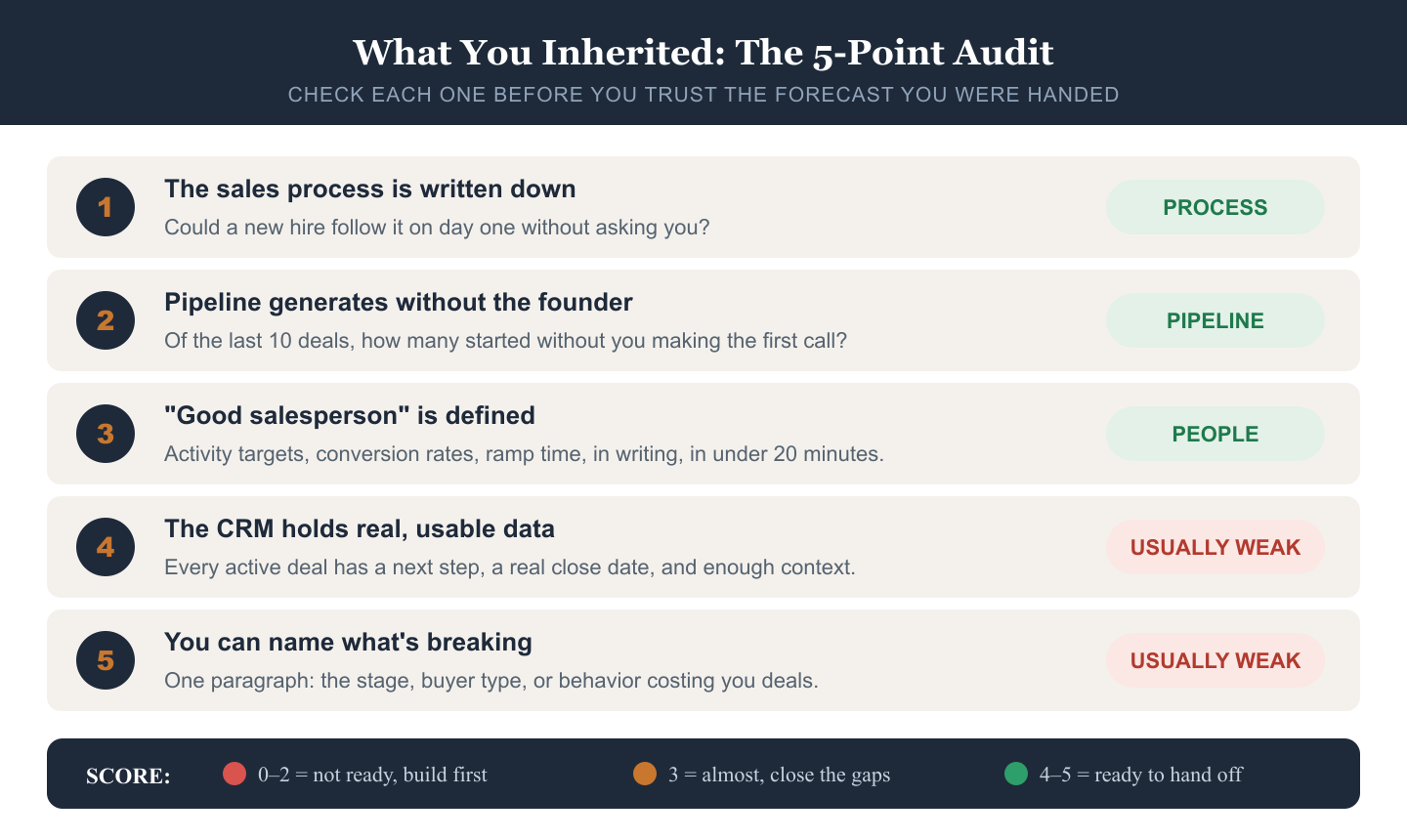
Score four or five and you've inherited something real. You can spend your energy coaching people and closing deals. Score two or less and the truth is harder: you didn't inherit a sales team, you inherited a group of individuals and a founder's memory. That's not a coaching problem. That's a build problem, and it changes what you do next.
The CRM check is the one that catches almost everyone. Open it and look at every active deal. If the "close dates" are all end-of-quarter and the "next steps" are blank, the pipeline you were handed is fiction. That's not the reps being lazy. It's what happens when logging a deal takes 13 hours a week of admin (Salesforce) and nobody built a reason to do it well.
Understanding What You Inherited Is Crucial. For a Bit.
Here's the part nobody tells you. The listening phase has a shelf life. Somewhere around week two, "the new leader is still getting up to speed" turns into "the new leader doesn't know what they're doing." Reps don't respect endless discovery. They respect a leader who listened hard, then made a call.
So set a clock. Two weeks of questions. Then you install the operating system. Here's what I put in first, in order, and none of it takes a big budget:
- An Accountabilities Document for every role. A written, signed list of what each salesperson is responsible for: activity targets, conversion expectations, ramp timeline, and how success is measured. I've watched a rep hit 135% of quota and still get put on a plan because nobody wrote down what the job actually was. Put it in writing and there are no surprises.
- A simple funnel, four stages at most to an opportunity. Consistency beats cleverness. Four clean stages everyone uses the same way will out-forecast a twelve-stage pipeline nobody trusts.
- A cadence that runs without you hovering. A monthly one on one with each person, a weekly pipeline review with your closers, and a short daily coaching huddle. Predictable rhythm, not random check-ins.
- One number, visible to everyone. Pick the metric that predicts revenue earliest in your funnel and put it where the whole team sees it every day.
You're not there to be the smartest person in every deal. You're there to build the system that makes every deal less dependent on any one person, including you.
That's the whole move. Diagnose fast, then build the thing that makes the team less dependent on heroics. A written system also does something quieter and more valuable: it stops you from becoming the micromanager you swore you'd never be. When everyone knows what they're accountable for, you don't have to look over shoulders.
What If There's No Team to Take Over Yet?
I'll be honest, because it's the whole point of this site. If you're a founder still doing all the selling yourself, with no reps, no written process, and no CRM worth the name, then these questions don't apply to you yet. You're not taking over a sales team. You're trying to build one from zero, and that's a different problem.
Handing a green rep a bag and hoping they figure it out is how 18-month tenures and 35% turnover happen (Xactly). You can't take over a system that was never built. You have to build it first, and only then hire into it. If that's where you are, the most useful thing you can do is get the process, the funnel, and the Accountabilities Document in place before you spend a dollar on headcount.
That's exactly the gap a Fractional Sales Leader fills for companies between $1M and $10M ARR. You get someone who's taken over and built sales teams dozens of times, without paying $250k-plus for a full-time VP of Sales you're not ready for.
Frequently Asked Questions
Q: What's the very first question to ask when taking over a sales team?
"Walk me through your top three deals, and tell me what has to be true for each one to close." It's non-threatening, it puts the rep on familiar ground, and it instantly shows you the difference between a salesperson who inspects their deals and one who just hopes. You learn more about both the pipeline and the person from that one question than from any report you'll be handed.
Q: Should I ask these questions in a team meeting or one on one?
Always one on one. In a group, salespeople perform for each other and protect themselves. Nobody tells you the process is broken in front of the person who built it. Thirty private minutes with each rep, no laptop between you, gets you the honest version. Save the group setting for after you've built something to roll out.
Q: How long should I spend listening before I start making changes?
About two weeks. Long enough to run the one on ones, audit the CRM, and sit in on live calls. Not so long that the team decides you don't know what you're doing. Nearly 40% of new leaders fail inside 18 months (Watkins), often because they never converted listening into action. Diagnose fast, then build. You can keep learning while you build.
Q: How do I tell the A players from the underperformers early?
Listen to what they ask you for. Weaker reps ask for more leads, lower quotas, and easier accounts. Stronger reps ask for clarity, faster decisions, air cover, and a path to win bigger deals. Also watch who diagnoses their losses honestly versus who blames price every time. The honest diagnosers are almost always your coachable talent.
Q: What if I inherit a team with no real process or clean CRM?
Then you didn't inherit a sales team, you inherited a group of individuals. That's a build problem, not a coaching problem, and it's actually good news: it means the fastest wins are structural. Install a written Accountabilities Document, a simple four-stage funnel, and a weekly cadence before you touch quotas. Structure first, pressure second.
Q: I'm a founder handing off sales for the first time. Is this the same thing?
Close, but with one addition: a lot of what's "in the process" only lives in your head. Before you hand off, write down how you actually sell, why customers really buy, and what a good deal looks like. The person taking over can only ask good questions if there's something documented to ask about. That handoff is one of the most common reasons founders bring in a Fractional Sales Leader.
Taking over the team, or building one for the first time?
Either way, the questions only matter if you know what to do with the answers. Let's spend 30 minutes on your team, your pipeline, and the first system I'd install. Whether you're inheriting salespeople or hiring your first, you'll leave with a clear next step.
Schedule a 30-Minute CallAbout the Author
Louie Bernstein
Fractional Sales Leader with 50 years of sales experience helping $1M–$10M ARR companies build scalable, repeatable sales systems. Founder of MindIQ (INC 500). LinkedIn Top Voice in Sales Management, Sales Operations, and Sales Coaching.