How Do You Know Your Fractional Sales Leader Is Building a Team That Can Sell Without You?
Fractional Sales Leadership works when an experienced leader builds a sales process your team can use without constant rescue from you. Lower cost and fewer hours explain the arrangement, but they don't prove its value. For a B2B founder at $1M to $10M ARR, the useful test is whether reps improve, pipeline decisions rely on buyer evidence, and sales knowledge stays inside the company.
Key Takeaways
- Fractional Sales Leadership should build your team's ability to sell, not move every important decision from the founder to another person.
- Judge progress through observed rep skills, buyer-supported pipeline stages, and fewer avoidable founder interventions alongside revenue results.
- In Salesforce's 2026 State of Sales report, 46% of surveyed reps said they rarely receive feedback on sales conversations. A written playbook needs practice and feedback to become useful.
- Track why you enter deals before trying to reduce your involvement. Executive sponsorship and rescuing a poorly prepared rep are different activities.
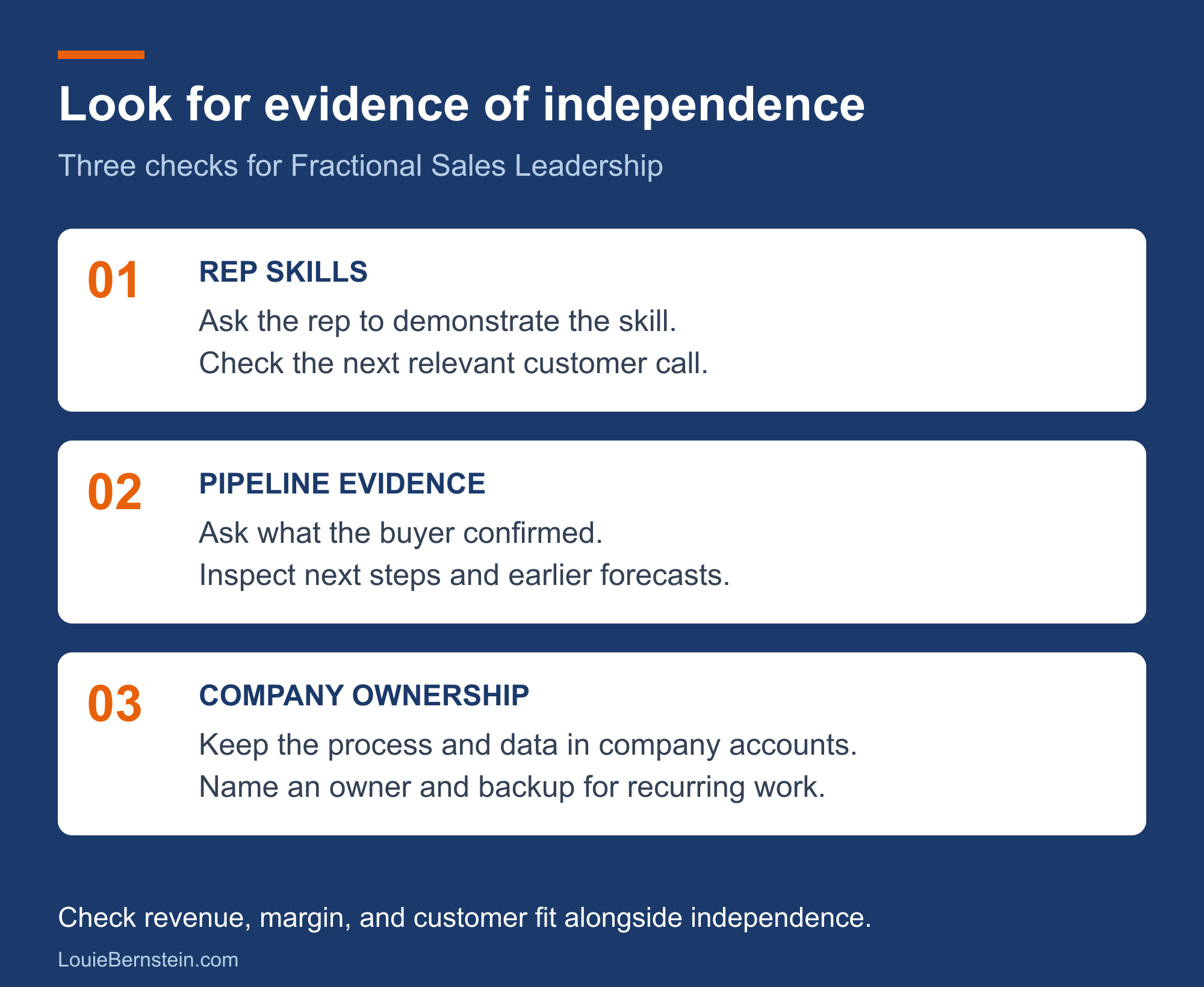
- Before renewing an engagement, ask a rep to demonstrate a skill, inspect a forecast against buyer evidence, and check who owns the process after handoff.
You hire a sales leader because everything runs through you. Three months later, everything runs through the sales leader. Your calendar looks better. But has the company actually learned to sell?
That question gets lost when the conversation starts and ends with the monthly fee. You can buy welcome relief and still leave the business dependent on one person.
If the team still needs someone to rescue every deal, you have moved the bottleneck. You haven't removed it.
The Strategic Pete overview raises useful questions about scope, accountability, and fit. Here's the practical question I'd add: what can your team now do that it couldn't do before?
What should Fractional Sales Leadership leave inside your company?
Fractional Sales Leadership should leave a usable sales process, stronger reps, clear accountabilities, and reliable information inside your company. Those assets matter because a founder needs revenue capability that survives a calendar conflict, a staffing change, or the end of an engagement. A leader's personal deal skills alone don't provide that.
A process people can actually follow
A Sales Playbook should help a rep prepare for the next customer conversation. Who qualifies? What problem matters? Which questions reveal urgency? What must the buyer confirm before the opportunity advances?
Ask a rep to use the playbook on a live opportunity. If the rep can't find the discovery questions or explain the next step, a polished document hasn't solved the problem. The leader needs to revise the document, teach the method, and inspect its use.
Ownership that survives a handoff
Your company should control the CRM, call recordings, templates, reporting definitions, and process documents. Each recurring activity needs a named owner and a backup. A forecast that only the outside leader can produce leaves a gap when that person is unavailable.
That doesn't mean the engagement must end as quickly as possible. Continued leadership can be valuable. It means renewal should buy further improvement rather than continued access to information your business already paid to create.
How can you tell whether coaching is making your reps better?
Coaching is working when reps demonstrate a specific skill in customer conversations and repeat that skill without being prompted. Attendance at training isn't enough. For a founder-led B2B team, the evidence should connect a recorded behavior, focused practice, and a later call where the rep applies the lesson.
Check the next call, not the training calendar
Salesforce's 2026 State of Sales report found that 46% of surveyed reps rarely receive feedback on sales conversations, while 41% don't get enough opportunities to roleplay. The report surveyed 4,050 sales professionals across 22 countries in August and September 2025. These are broad survey findings, not results from Louie's clients.
The figures describe a coaching gap. They don't prove that any particular fractional engagement will close it. Your evidence has to come from your own team's work.
Pick one behavior. For example, a rep accepts “we need better reporting” without asking what poor reporting costs the buyer. Review the recording, practice a follow-up question, and listen for it on the next relevant call. Keep the feedback specific enough that both people know what improvement looks like.
What my SCALE Framework puts last
In my SCALE Framework, “Exit the Deals” follows building the process and locking in accountability. That order reflects how I approach founder independence. Removing yourself from calls before the team has learned the work just leaves a hole.
I want the rep to explain what they heard, what they missed, and what they'll ask next. If I supply every answer, I become faster at solving their deals while they remain dependent on me. Teaching takes a deliberate pause before jumping in.
A useful review ends with the rep stating the next action and the reason for it. The leader then checks the result, rather than assuming a coaching conversation changed the behavior.
What should you measure besides closed revenue?
Measure team capability and process reliability alongside closed revenue: avoidable founder interventions, buyer-supported next steps, demonstrated rep skills, and forecast accuracy. Revenue remains essential, but a long sales cycle can delay the outcome. These operating measures help a founder inspect whether the underlying sales work is getting better while deals develop.
Count interventions by reason
For two weeks, record why you enter sales conversations. Separate executive sponsorship, product expertise, pricing approval, and rescue work. “The buyer wanted to meet the CEO” is different from “the rep couldn't explain the business case.”
Use an illustrative example. You intervene in 12 of 20 comparable opportunities, then later in 5 of 20. The intervention rate falls from 60% to 25%, a 35 percentage-point change. That is sample math, not a promised result or a client case study.
The lower number only means something if the deal mix is comparable and conversion, margin, and customer fit hold up. A rep who stops asking for help while losing good deals hasn't become independent. Also note whether the Fractional Sales Leader simply took over the same rescue work.
Ask what the buyer did
For each forecasted deal, ask for evidence: a confirmed problem, the people involved in deciding, the buyer's timing, and an agreed next step. “Proposal sent” describes your activity. “The buyer scheduled a commercial review with procurement” describes progress you can inspect.
Review the forecast as it existed at the start of the period. Don't let moved close dates erase earlier misses. Compare predicted and actual outcomes, record the reasons, and adjust the qualification rules. With a small pipeline, examine individual deals as well as percentages.
How do you test whether the sales process works without you?
Test independence by letting reps run appropriate sales activities within clear limits while the leader observes and reviews the evidence afterward. Start with routine discovery or follow-up, not your riskiest contract. A useful test preserves escalation rules and checks both the quality of execution and the resulting buyer response.
Use a controlled handoff
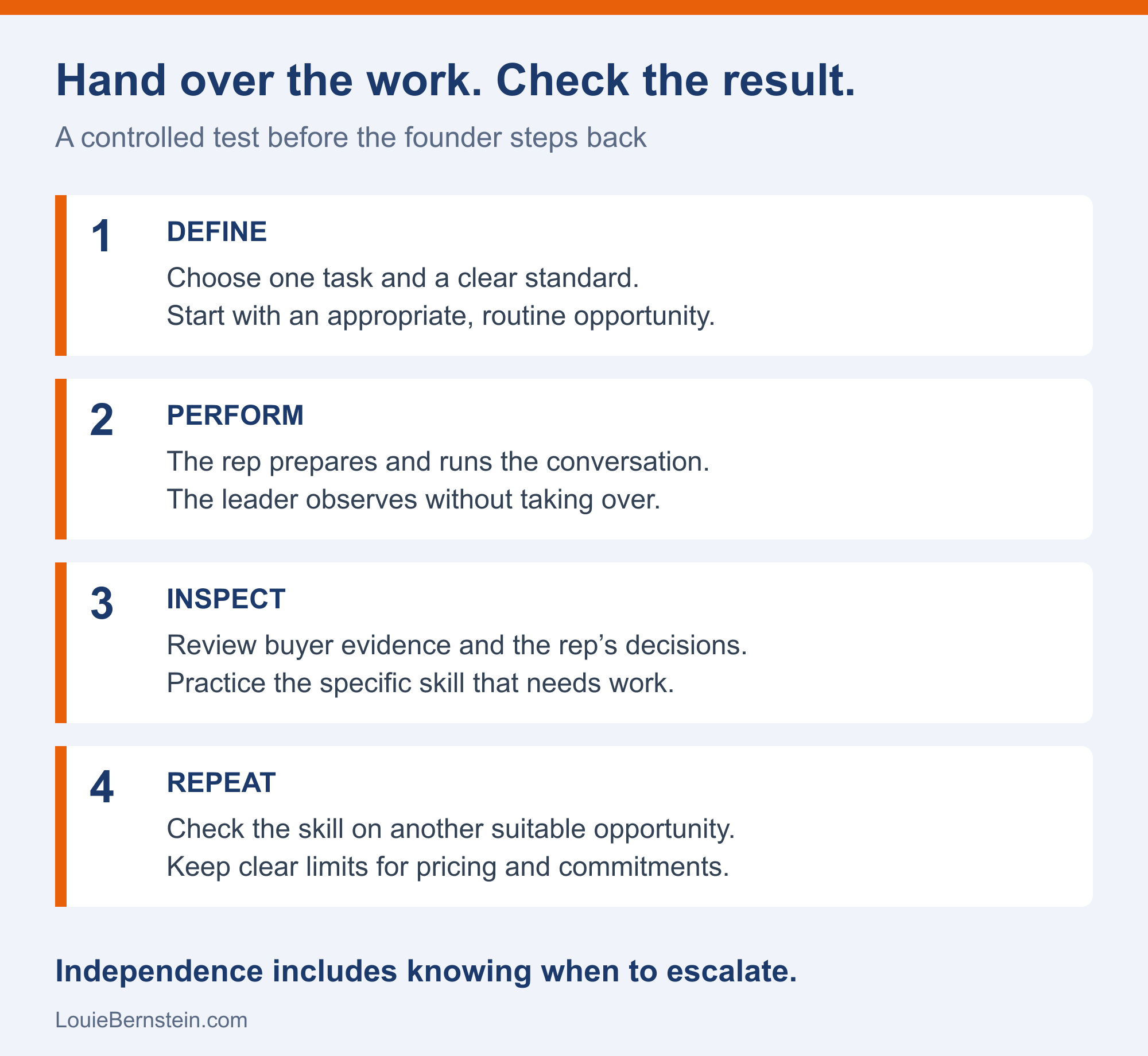
Choose a rep, a task, and a clear standard. For discovery, the standard might include confirming the business problem, understanding the decision process, and agreeing on a next step. The rep prepares using the playbook and runs the conversation.
The leader reviews the recording with the rep. Was the buyer's problem understood? Did the rep ask a useful follow-up? Was the next step mutual? Repeat with another suitable opportunity. One good call can be luck. Repeated evidence gives you a firmer basis for handing over responsibility.
Make escalation part of the process
Independence doesn't mean unlimited authority. Define when reps need help: unusual contract terms, discounts outside policy, commitments about product changes, or an executive relationship that warrants your involvement.
Put those boundaries in the rep's Accountabilities Document and sales process. A capable rep knows when to bring in help and arrives with a recommendation. The goal is sound judgment, not silence.
When is Fractional Sales Leadership the wrong answer?
Fractional Sales Leadership is the wrong answer when the required coverage exceeds the engagement, the company hasn't established that customers will buy, or the founder expects one leader to replace an entire sales team. Match the work, authority, and available capacity before choosing the employment arrangement or comparing monthly fees.
Separate a leadership gap from a capacity gap
If nobody is prospecting and nobody can run customer conversations, leadership alone won't create enough selling capacity. The plan needs people who can execute. A Fractional Sales Leader can help define and hire those roles, but that work and its timing need to be explicit.
A complex organization that needs continuous management across several teams may warrant a full-time executive. Likewise, if customers still won't buy after repeated founder-led tests, hiring sales leadership doesn't establish product-market fit for you.
Agree on the evidence before renewing
My engagements are 12 weeks, renewable, at $14K per month for 20 to 35 hours a week. That's the service scope, not a guarantee that every sales problem disappears in 12 weeks. Starting conditions, hiring needs, and your sales cycle affect what can be demonstrated.
Before renewal, inspect what was built, what the team can use, and what remains dependent on the leader. Continue when there is valuable work to do and the evidence supports the plan. Revise the scope when the original assumptions were wrong.
Don't reject a strong leader merely because a long-cycle deal hasn't closed yet. Don't keep a weak engagement merely because one large deal happened to close. Ask which results reflect better execution and which could have happened anyway.
Related Reading: What Is a Fractional Sales Leader?
Frequently Asked Questions
What should I ask a Fractional Sales Leader for before signing?
Ask for a scope that names the problems to address, working availability, decision authority, deliverables, and how progress will be checked. Clarify what your team must supply. Review relevant references without treating another company's results as a promise for yours.
Who should own the sales documents and CRM access?
Your company should control its customer information and the working materials created for its sales process, subject to the agreed contract. Set up company accounts, access permissions, and handoff expectations at the start. Clarify any provider-owned methods or licensed materials separately.
Can a Fractional Sales Leader help if I have no playbook?
Yes. Building the first usable Sales Playbook can be part of the engagement when you already have evidence that customers buy. Expect the leader to study actual wins and losses, document what works, and test the process with your team.
What if my reps resist recording or reviewing calls?
Explain the coaching purpose, agree on the review standard, and address customer consent and applicable company policies before recording. Where recordings aren't available, use permitted observation, roleplay, and documented call reviews. Avoid turning coaching into a public exercise in finding fault.
Should founder involvement ever reach zero?
No. A founder may still support strategic accounts, executive relationships, and major product or commercial decisions. The aim is to remove routine dependence on the founder while retaining involvement where the founder adds specific value.
Can AI replace the coaching work?
AI can help summarize calls and provide practice, but someone still needs to check accuracy, understand the buyer's situation, and hold reps accountable for applying feedback. Evaluate tools against a defined coaching problem and your company's data requirements.
Build a team that can carry the sale
If you're at $1M to $10M ARR and still rescuing routine deals, let's identify what your team needs to learn and what your sales process is missing. Fractional Sales Leadership should give your company capability you can see and use.
Book a conversation with Louie Bernstein or learn more at LouieBernstein.com.
About the Author
Louie Bernstein is a Fractional Sales Leader with 50 years of sales experience and has served as a Fractional Sales Leader since 2017. He helps B2B founders build Sales Playbooks, clear sales processes, and teams that can sell without the founder in every deal.