Key Takeaways:
- Hire when recurring customer work exceeds available capacity and you can define a job someone else can own.
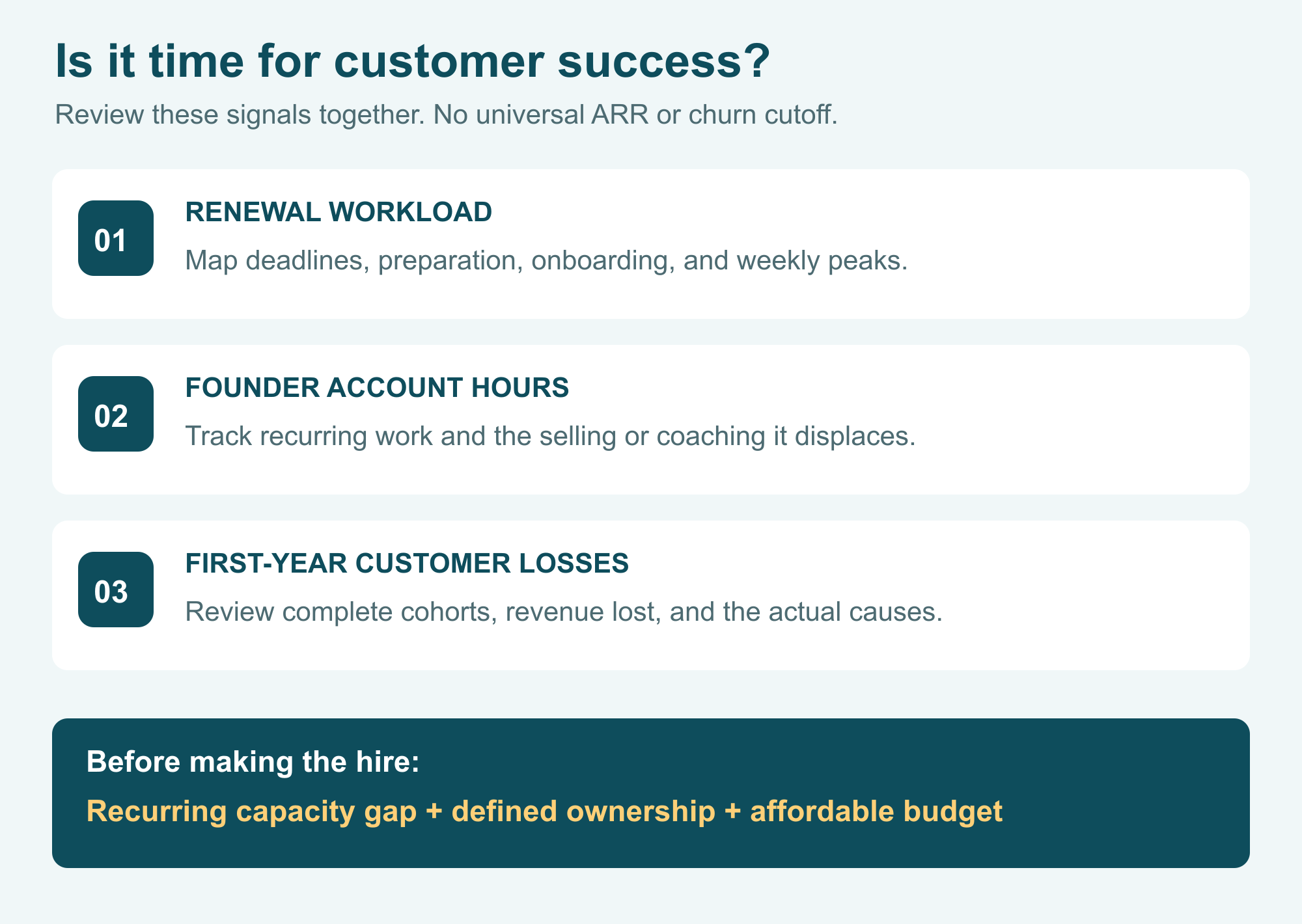
- Track renewal workload, founder account hours, and first-year customer losses together.
- Find out why customers leave before deciding that another employee will fix the problem.
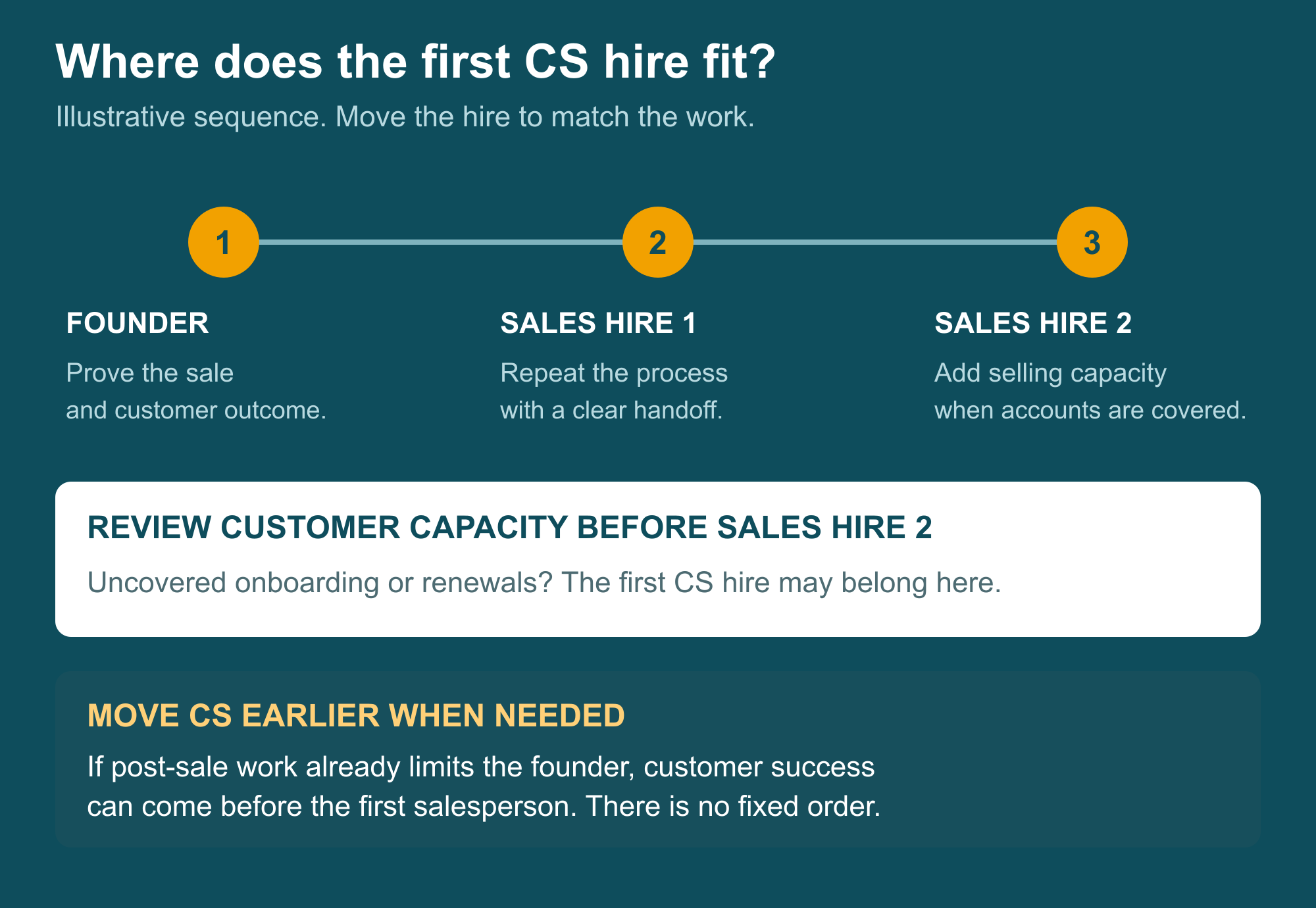
- Your first customer success person may belong before your second salesperson, or even before your first.
- Write an Accountabilities Document and a basic handoff process before you recruit.
- Measure the hire by customer progress and reduced founder dependence, not the number of check-in calls.
You block two hours to follow up with prospects. Then a customer needs help getting started. Another wants to discuss renewal. A third asks why nobody followed up after the last meeting.
By lunch, you've become the account manager again. New business waits while you protect the business you already won.
For a B2B founder at $1M to $10M ARR, this is a hiring decision with two bad extremes. Hire too early and you carry a salary without enough defined work. Wait too long and customer problems keep taking over your selling calendar.
The trigger is recurring customer work that your team can no longer cover, with clear responsibilities you can transfer and a budget that supports the hire. Your revenue number alone can't tell you that. Your calendar, renewal list, and customer results can.
1. Separate a customer success problem from a busy week
Name the work customers need
Customer success helps customers achieve the outcome they bought. That can include getting started, building useful habits, identifying stalled progress, and preparing for renewal before the contract becomes urgent.
Support handles problems customers report. Implementation gets the purchase working. Account management often handles commercial terms and growth. In a small company, one person may cover parts of all four. The title matters less than a clear assignment.
List the work you're doing after a sale. Include scheduled calls, preparation, internal coordination, follow-up, and the minutes spent remembering what you promised. Then label each task. You'll see whether you need customer success, technical support, delivery help, or better administration.
If most of your time goes to fixing broken integrations, a relationship-focused hire may become another person waiting for engineering. If customers can use the product but nobody guides them toward a result, dedicated customer success may fit.
Look for work that repeats
Track the work for two weeks, then compare it with the upcoming quarter. Two weeks is a starting exercise, not proof that your workload is stable. A cluster of renewals or a difficult launch can distort the picture.
Ask what repeats across accounts. Does every customer need a kickoff? Who checks the first milestone? Who notices when the main contact leaves? Who prepares the renewal conversation?
You don't need a perfect process before hiring. You need enough clarity to explain what the person will own on Monday morning. A list of unrelated emergencies isn't an Accountabilities Document.
Systems before people means giving the person a job they can understand, improve, and own.
2. Read three signals together
Renewal volume: count the work behind the dates
Pull the next 90 days of renewals from your CRM. Include contract value, notice deadlines, customer goals, unresolved issues, the decision maker, and the next agreed action. Notice periods may require work well before the renewal date.
Ten simple renewals and ten complex renewals aren't the same workload. Estimate preparation and follow-through for each. Add onboarding commitments from deals already signed and likely near-term starts, keeping assumptions visible.
For an illustrative example, suppose eight upcoming renewals need three hours each, and four new customers need six onboarding hours each. That's 48 hours across the period before routine account work. Those assumptions aren't staffing benchmarks. They show why counting customers alone misses the work.
Spread the hours across actual weeks. Forty-eight hours over three months may fit your current team. Forty-eight hours concentrated in one week may require immediate temporary coverage. Check both the total and the peaks.
Founder time: measure what can leave your calendar
Separate relationship work that requires you from tasks someone else could learn. You may still join a strategic account discussion. You shouldn't need to chase every kickoff date or write every meeting recap.
Record what customer work displaced. Did a discovery call slip? Did sales coaching disappear? Did you postpone hiring interviews? Founder opportunity cost becomes useful when you can name the work that didn't happen.
If ten recurring account hours take over each week, that's a reason to investigate capacity. It isn't an automatic full-time hiring rule. The right response could be a narrower role, protected time for an existing employee, or a dedicated hire with other defined duties.
First-year churn: inspect causes before prescribing headcount
Review customers who left during their first year. For a simple completed-cohort measure, take customers acquired in a defined period who have all had 12 months of observation. Divide those lost within their first 12 months by the original cohort count.
Keep newer customers separate so incomplete observation doesn't make retention look stronger. Also review revenue lost. Losing two small accounts and losing your largest customer have different consequences, even if the customer count is the same.
Read the reasons behind each loss. Missed onboarding, unnoticed inactivity, and absent follow-up may point to an ownership gap. Poor fit, promises you couldn't deliver, or product failures require changes elsewhere too.
Small cohorts produce jumpy percentages. Show the count alongside the rate and review the account history. You don't need to wait for churn to rise if missed milestones already show that customers aren't getting help.
3. Decide when it's time, and which hire comes first
Put customer success where the work requires it
There is no mandatory order of first salesperson, second salesperson, then customer success. HubSpot's startup hiring guide also treats hiring order as a response to the problem limiting the business and notes that customer work may require a hire before sales.
If you can still sell but onboarding keeps swallowing your week, customer success may come first. If your first salesperson is winning business and those accounts lack follow-through, customer success may belong before salesperson number two.
If delivery already owns customer outcomes, renewals are covered, and qualified opportunities exceed selling capacity, a second sales hire may come first. Keep reviewing account capacity as that person starts adding customers.
Make the decision with capacity and affordability
Start recruiting when the recurring gap is clear enough to justify the role, allowing time to find and train someone before your expected workload peaks. Don't wait until the renewal list is already overdue.
Price the full role: pay, benefits, tools, recruiting, and your training time. Check that the operating budget can carry it while the person learns. Don't fund the position with assumed expansion revenue that no customer has agreed to buy.
A useful decision combines three answers: What work is going uncovered? Can this person own it? Can we afford the role through a realistic ramp? If one answer is missing, resolve it before making an offer.
When a full-time role doesn't fit yet, name an interim owner and reduce their other workload. Document the coverage and set a date to review it. Quietly adding customer success to someone's full plate isn't a staffing plan.
4. Define the first role before interviewing
Write the Accountabilities Document
State the purpose in one sentence: help customers reach agreed outcomes while making routine account work independent of the founder. Then define what the person owns and where another team must act.
Include kickoff coordination, customer goals, milestone tracking, risk notes, renewal preparation, and CRM records. Assign pricing, contract negotiation, technical fixes, and expansion selling by name. One person can coordinate the account without doing every task.
Give the hire decision rights. Can they schedule training? Who approves extra delivery work? What issue needs same-day escalation? Customers shouldn't wait while the new person asks you to approve every ordinary next step.
Set capacity expectations around your customer mix. A handful of complex accounts may need more attention than a larger group using a simple service. Avoid importing another company's accounts-per-person target without checking the work behind it.
Look for someone who can do the work and improve it
Your first hire needs to handle customers directly. Experience managing a large department doesn't prove someone can write a useful recap, run onboarding, or maintain account records without a supporting team.
Use a short fictional account scenario in the interview. The buyer expected a result in 30 days, the users haven't started, and renewal is approaching. Ask the candidate what they would investigate, whom they would contact, and how they would record the next action.
Role play the customer conversation. Listen for questions before promises. A strong candidate should clarify the gap and coordinate a response, not offer free work or blame sales to calm the customer down.
Ask for a brief follow-up email. Clear writing is part of the job. The customer and your internal team should both understand who does what next and by when.
5. Use the first 90 days to transfer ownership
Days 1–30: learn the promises and the accounts
Start with a manageable account group. Review why each customer bought, what was promised, what has happened, and what remains unresolved. Bring the hire into customer conversations and explain your decisions afterward.
Create a basic sales-to-customer-success handoff in the Sales Playbook. Capture the buyer's goal, agreed scope, stakeholders, first milestone, owner, and next meeting. The signed contract alone rarely explains why the customer bought.
Introduce the person as the account owner with authority. If you keep telling customers to call you for anything, they'll do exactly that.
Days 31–60: let the person lead
Have the hire run meetings and propose next steps. Coach before and after the call instead of answering every question yourself. Step in for defined escalations, then return ownership.
Review stalled onboarding, missed commitments, renewal risks, and upcoming workload each week. Look for customer evidence: a completed milestone, a confirmed obstacle, or an agreed action. A friendly call without progress isn't enough.
Days 61–90: check customer progress and founder dependence
Compare milestone completion, overdue actions, renewal readiness, and routine founder account hours with the starting point. Review retention as relevant renewals occur, while recognizing that a short period may contain too few decisions to judge the hire fairly.
Keep churn causes visible rather than crediting or blaming one person for everything. The new hire can't fix a bad product promise alone. Sales, delivery, and leadership still have responsibilities.
Ask one final question: Can the customer get the next useful action without waiting for me? If yes, you're building capacity. If every decision still routes through you, inspect training, authority, and workload before assuming you hired the wrong person.
Related Reading
Frequently Asked Questions
Q: At what ARR should I hire my first customer success person?
ARR alone isn't a reliable trigger. Review recurring workload, customer complexity, uncovered responsibilities, and affordability. A business with complex onboarding may need dedicated help earlier than one with a simple offer and strong existing delivery coverage.
Q: Should customer success come before my second salesperson?
It can. If the first salesperson is adding customers your team cannot support, address that capacity gap before increasing sales volume. If customer outcomes are covered and selling capacity is the constraint, the second salesperson may come first.
Q: Can my salesperson handle customer success too?
Yes, if the duties, available hours, priorities, and compensation support both responsibilities. Track whether account work or new business gets neglected. A combined role needs deliberate capacity planning and a clear point for separating the work.
Q: Will a customer success hire reduce churn?
The hire may help when customers leave because onboarding, follow-up, or risk detection is missing. Product failures, poor-fit sales, and unfulfilled promises need their own fixes. Diagnose the losses and give the person support from the teams responsible.
Q: What should the first customer success hire own?
Start with customer goals, onboarding coordination, milestone tracking, risk visibility, and renewal preparation. Define commercial and technical responsibilities separately. Put ownership, decision rights, and escalation rules in an Accountabilities Document.
Build the handoff before adding more sales volume.
Fractional Sales Leadership may help you define sales responsibilities, improve the customer handoff, and coach your team to work without constant founder involvement. Learn how I work at LouieBernstein.com.
Schedule a 30-Minute CallAbout the Author
Louie Bernstein
Louie Bernstein is a Fractional Sales Leader who helps B2B founders at $1M to $10M ARR build repeatable sales systems, develop their teams, and reduce founder dependence.