The founder owns pipeline when serving as both head of sales and marketing. Marketing creates demand, sales converts demand, and the founder sets the shared rules that connect the two. Give every lead a named owner, define what makes an opportunity qualified, and review demand, deal progress, and handoffs each week. You can delegate the work before you delegate accountability for the whole pipeline.
Key Takeaways:
- The founder owns the total pipeline while wearing both hats, even when an agency or rep does part of the work.
- Marketing creates demand and sales converts demand. A shared acceptance rule connects their responsibilities.
- Count each opportunity once. Track its source and contributors without adding the same deal to pipeline twice.
- Start with three weekly reviews totaling 45 minutes: demand, pipeline, and handoffs. Adjust the schedule to your workload.
- This week, write who accepts a lead, what evidence qualifies an opportunity, and who covers the work when the owner is unavailable.
You approve a campaign in the morning and spend the afternoon trying to close a deal. By Friday, marketing looks busy, sales looks busy, and next month's pipeline still looks thin.
At $1M to $10M ARR, the founder is often both department heads. Wearing both hats can hide a basic problem: nobody checks what happens between generating interest and accepting responsibility for a buyer.
The answer isn't another title. Separate the jobs, connect the evidence, and put the decisions on your calendar. You need a process someone else can follow before you can stop being the person who remembers everything.
Owning pipeline doesn't mean doing every task. It means making sure no task falls between owners.
What does owning pipeline actually mean?
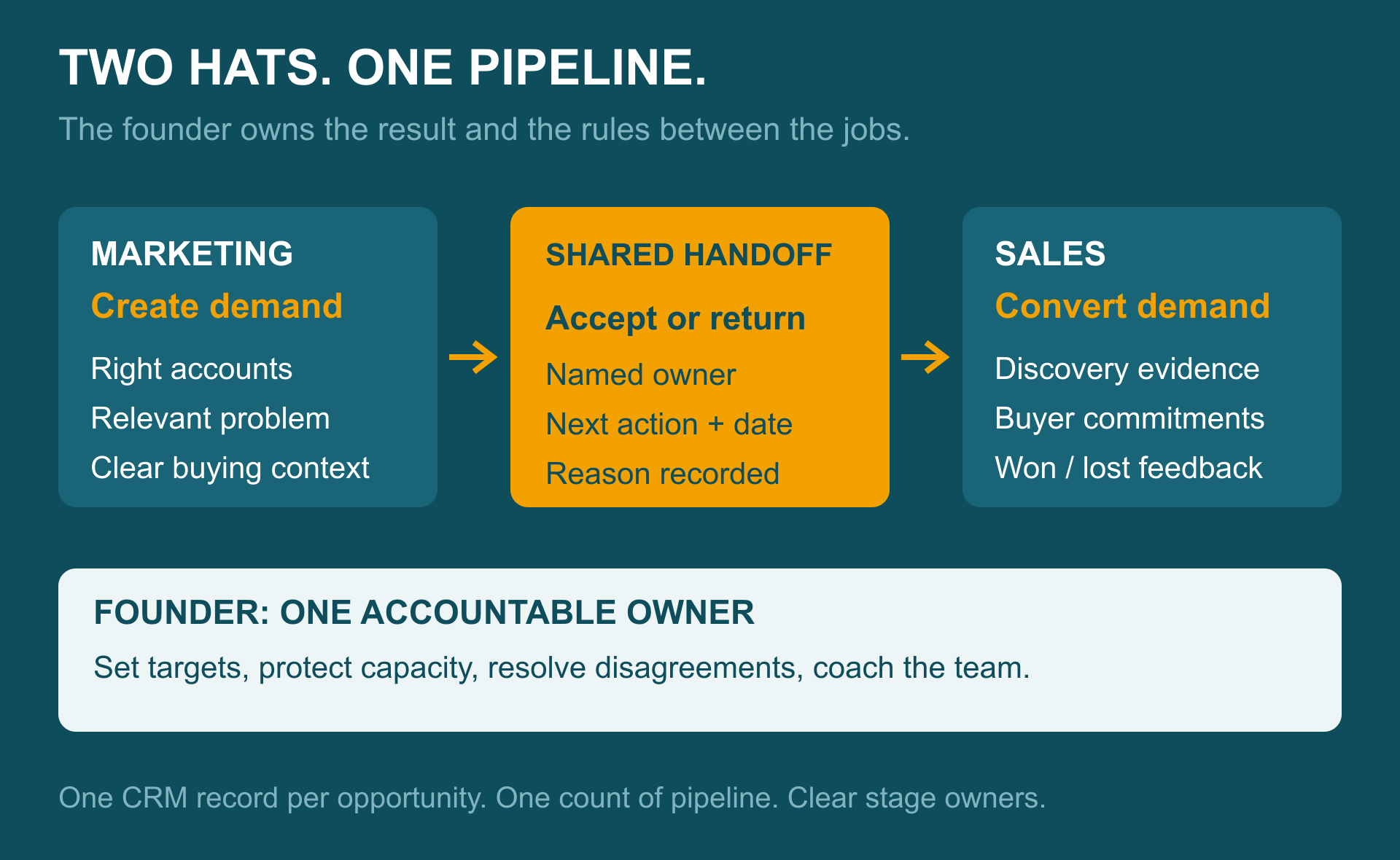
Owning pipeline means being accountable for enough qualified opportunities moving toward revenue, with someone responsible for each step. For a founder leading sales and marketing, ownership includes demand targets, qualification rules, follow-up capacity, and decisions about stalled work. Completing every campaign or joining every sales call isn't the definition of ownership.
Separate the result from the work
Keep one person accountable for the overall result. Under that person, assign marketing work, lead acceptance, discovery, follow-up, and CRM updates. In a small company, your name may appear in several boxes. Write the boxes anyway. You can't hand off a job nobody has defined.
An agency can own campaign delivery. A salesperson can own discovery and agreed next steps. Neither automatically owns the gap between the two. Decide who reviews new interest, who accepts it, and who resolves a disagreement about whether the account belongs in your market.
Give each role an Accountabilities Document
Write the expected result, the evidence required, the review schedule, and the decisions the person can make. A marketing contractor needs to know which accounts matter and what information sales needs. A rep needs permission to return a poor-fit lead with a reason, without turning the return into an argument.
The founder's job is to resolve tradeoffs. If demand exceeds follow-up capacity, decide what gets priority and who covers the rest. If sales has room but few qualified conversations, protect time for demand creation. A crowded calendar doesn't answer either question.
Where should marketing end and sales begin?
Sales responsibility should begin when a named person accepts a lead for a defined next action. Marketing still owns useful demand creation and feedback on targeting. Acceptance does not automatically make the lead qualified pipeline. A founder needs separate rules for assigning follow-up and recognizing a real opportunity in the forecast.
Use two decisions instead of one vague handoff
First, decide who will work the lead. Record the source, buyer's request, account fit, owner, and response deadline. Second, after a conversation, decide whether there is enough buyer evidence to create a qualified opportunity. Don't turn every content download or booked meeting into projected revenue.
A useful opportunity rule might require a problem you can solve, an account you can serve, and an agreed next step with the buyer. Adapt the rule to your sales process. Keep the stage tied to something the buyer did, rather than how excited the salesperson feels.
Return information, not blame
Use a short list of return reasons: wrong account, no relevant need, duplicate, timing, or unable to reach. Timing and lack of a response are different from poor fit. A good future buyer may need a dated follow-up instead of being deleted or left in active pipeline forever.
Sales should also return the questions buyers ask. In Salesforce's 2026 report, 69% of sales professionals said measurable ROI had become more important to customers, and 67% said customers required extensive education. Those findings came from a survey of 4,050 sales professionals across 22 countries, conducted in August and September 2025 (Salesforce, 2026 State of Sales).
Those are broad survey findings, not benchmarks for your company. Use your own calls to decide which cost questions, proof, and explanations marketing should address. A rep's unanswered buyer question can be the next useful article or email.
Which numbers tell me where pipeline is breaking?
Track qualified opportunities created, their value, movement between stages, and unresolved handoffs to locate pipeline problems. Keep demand activity separate from sales outcomes so you can see where progress stops. For a founder, a short report with clear definitions is more useful than two dashboards that count the same deal differently.
Count pipeline once
Suppose a buyer reads your article, answers an outbound email, and books a call. Keep one opportunity record. Record the original source and later touches without claiming three separate opportunities. Source reporting helps you decide where to invest; it should not inflate the amount of business you might win.
Look at new qualified opportunities by source, accepted leads awaiting discovery, opportunities without a dated next step, and closed outcomes. Compare groups that entered during the same period. Dividing this week's wins by this week's brand-new leads mixes buyers at different points in the process.
Work backward from a specific revenue goal
Here's a planning example, not an industry benchmark. Suppose you need $120,000 in new annual recurring revenue, your typical new contract is $20,000 in ARR, and 25% of comparable qualified opportunities become customers. You need six wins and roughly 24 qualified opportunities, representing $480,000 in unweighted potential ARR.
That math does not promise six wins. Check your sales cycle, the age of your opportunities, and whether the historical win rate came from enough comparable deals. If your sales cycle is 90 days, opportunities created in the final week of a quarter won't usually solve that quarter's shortfall.
Now inspect the gap. Too few right-fit conversations points toward targeting or demand creation. Accepted leads with no discovery points toward capacity or follow-up. Discovery calls with no buyer commitment point toward qualification or selling. Fix the step where evidence stops.
A larger lead count won't repair an undefined sales process.
How do I run both jobs without living in meetings?
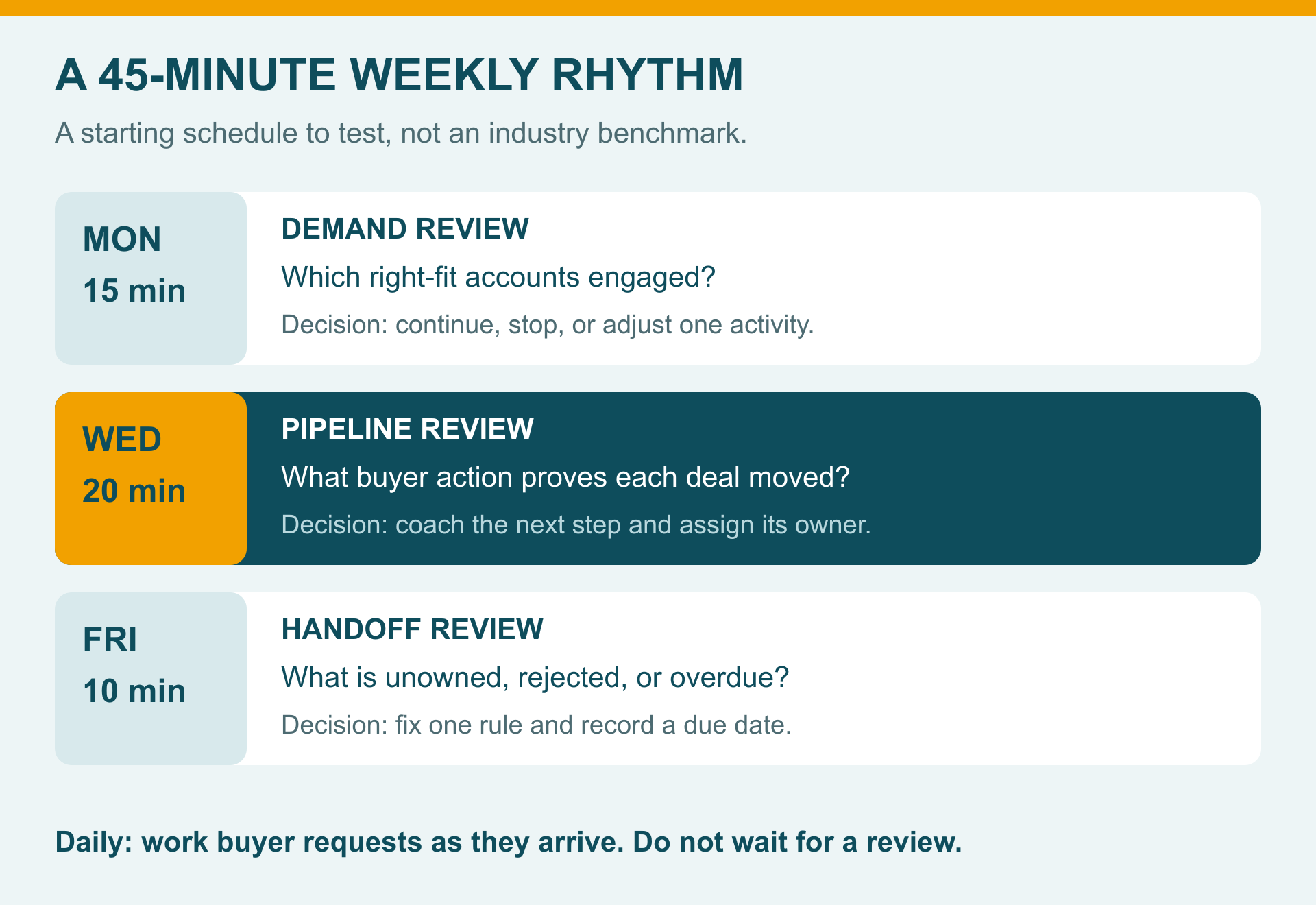
Run three short weekly reviews with different decisions: demand review, pipeline review, and handoff review. Start with 45 minutes total and adjust after you see the workload. The founder should leave each review with a named owner, a next action, and a due date, even when the founder holds every role.
Monday: 15 minutes on demand
Ask which right-fit accounts engaged and which activity produced useful conversations. Review the message buyers responded to, not just clicks or impressions. Choose one activity to continue, stop, or adjust. Protect time to create next month's opportunities before current deals consume the week.
Wednesday: 20 minutes on pipeline
Review buyer evidence, the next commitment, and what could block progress. Don't use the meeting to recite CRM notes. Ask the rep to explain the next action and practice the difficult part. If a deal needs deeper coaching, schedule that separately rather than letting one deal swallow the review.
Friday: 10 minutes on handoffs
Inspect unowned leads, overdue responses, and returned leads with no reason. Sample a few records even when the dashboard looks clean. Pick one recurring failure and repair the rule. The weekly review checks the system; actual buyer requests need attention when they arrive.
Calendar pressure is real. Salesforce's 2026 report says reps spend 60% of their average workweek on nonselling tasks (Salesforce, 2026 State of Sales). That figure covers sales reps, not founders. Treat the proposed 45-minute rhythm as a way to make decisions, not a claim that you can manage all sales and marketing in 45 minutes.
If you're doing both jobs alone, use the same agenda as a private review. Put decisions in the CRM or Sales Playbook. When you hire, the new person inherits a working routine instead of trying to interpret your memory.
When can I hand pipeline ownership to someone else?
Hand pipeline ownership to another leader when the role has written rules, usable data, and authority to make decisions across the work being assigned. A founder can delegate individual tasks earlier. Full ownership requires someone who can manage capacity, coach performance, and resolve disagreements without asking the founder to rescue every decision.
What I've learned about replacing the founder
In my work with founders, I hear a familiar request: find someone who can sell like me. My answer is to get the sales process out of the founder's head first. Hiring a person doesn't transfer the judgment, qualification rules, or follow-up habits that made the founder effective.
The same lesson applies when you run marketing too. If only you know which accounts deserve attention or what makes a lead worth pursuing, two new hires can create two new queues of questions. Write the decisions down. Let people practice making them. Coach their reasoning instead of taking the buyer away from them.
Test the handoff before changing the title
Have the proposed owner run the reviews while you observe. Can they explain a missed target, identify the failing step, and choose a corrective action? Can the team work returned leads and maintain next steps without your reminders? Look for repeated execution, not one polished report.
Keep authority matched to accountability. Don't hold a sales manager responsible for demand generation while refusing them access to marketing plans or budget discussions. If you retain those decisions, remain accountable for the total pipeline and give the manager a narrower, honest responsibility.
A Fractional Sales Leader can help install the Sales Playbook, qualification rules, CRM discipline, and coaching routine before a full-time leadership hire. Define the scope: sales leadership does not automatically include producing campaigns or running every marketing channel. Name the marketing owner and agree how the two roles work together.
Related ReadingThe Lead Handoff That Stops Leads Falling Through the Cracks →
Frequently Asked Questions
Q: Should my marketing agency have a revenue target?
Give an agency a target tied to the work it can control and visibility into downstream outcomes. Define qualified demand and reporting expectations in the agreement. Don't expect campaign delivery alone to guarantee revenue when your team controls response, discovery, proposals, and closing.
Q: Who owns leads from founder referrals?
Assign founder referrals through the same ownership rules as other leads. Record the relationship and buyer context so the rep can follow up well. The founder can make an introduction without remaining the default owner of every later conversation.
Q: What should I do when the lead owner is away?
Name a backup before the absence and give that person access to the records and buyer context. Define which requests need immediate coverage. A shared inbox is a delivery address; the inbox itself cannot accept responsibility for a buyer.
Q: Can I use a spreadsheet before buying a CRM?
A shared spreadsheet can be a temporary starting point if it shows the owner, status, last action, and dated next step. Move to a CRM when missed updates, duplicate records, or multiple sellers make the sheet unreliable. Software cannot replace agreement on the rules.
Q: How soon will clearer ownership increase revenue?
You can inspect ownership and overdue work as soon as the rules are in use. Revenue results take longer and depend on your sales cycle, demand, and execution. Track earlier signs of improvement, such as fewer unowned leads, without treating those signs as guaranteed future wins.
Q: Should I pause marketing when sales is overloaded?
Reduce or redirect demand activity when the team cannot serve incoming buyers well. First identify which sources bring the best-fit accounts and arrange follow-up coverage. Avoid stopping every channel without considering the future pipeline gap that a long sales cycle can create.
Build a pipeline your team can own.
If sales and marketing still depend on your memory, let's define the owners, rules, and reviews. Learn how Fractional Sales Leadership can help you build the system before the next hire.
Schedule a 30-Minute CallAbout the Author
Louie Bernstein
Louie Bernstein is a Fractional Sales Leader with 50 years of sales experience. He founded and ran MindIQ for 22 years, earning a place on the INC 500. He helps founders build sales systems their teams can run.