A lead handoff stops leads falling through the cracks when every new lead leaves it with three things written in the CRM: one named owner assigned by a rule, a response deadline, and the context the buyer already gave you. Set a 15-minute first-response rule during business hours and check one daily report for leads with no owner or no logged touch. Most lost leads aren't rejected. They're never worked.
Key Takeaways:
- Most leads that fall through the cracks were never turned down. They were never owned. A clean lead handoff answers three questions in the CRM: who owns the lead, by when they respond, and with what context.
- Speed decides who gets the conversation. Firms that tried to reach a web lead within an hour were nearly 7 times as likely to qualify it as firms that waited longer (HBR, 2011).
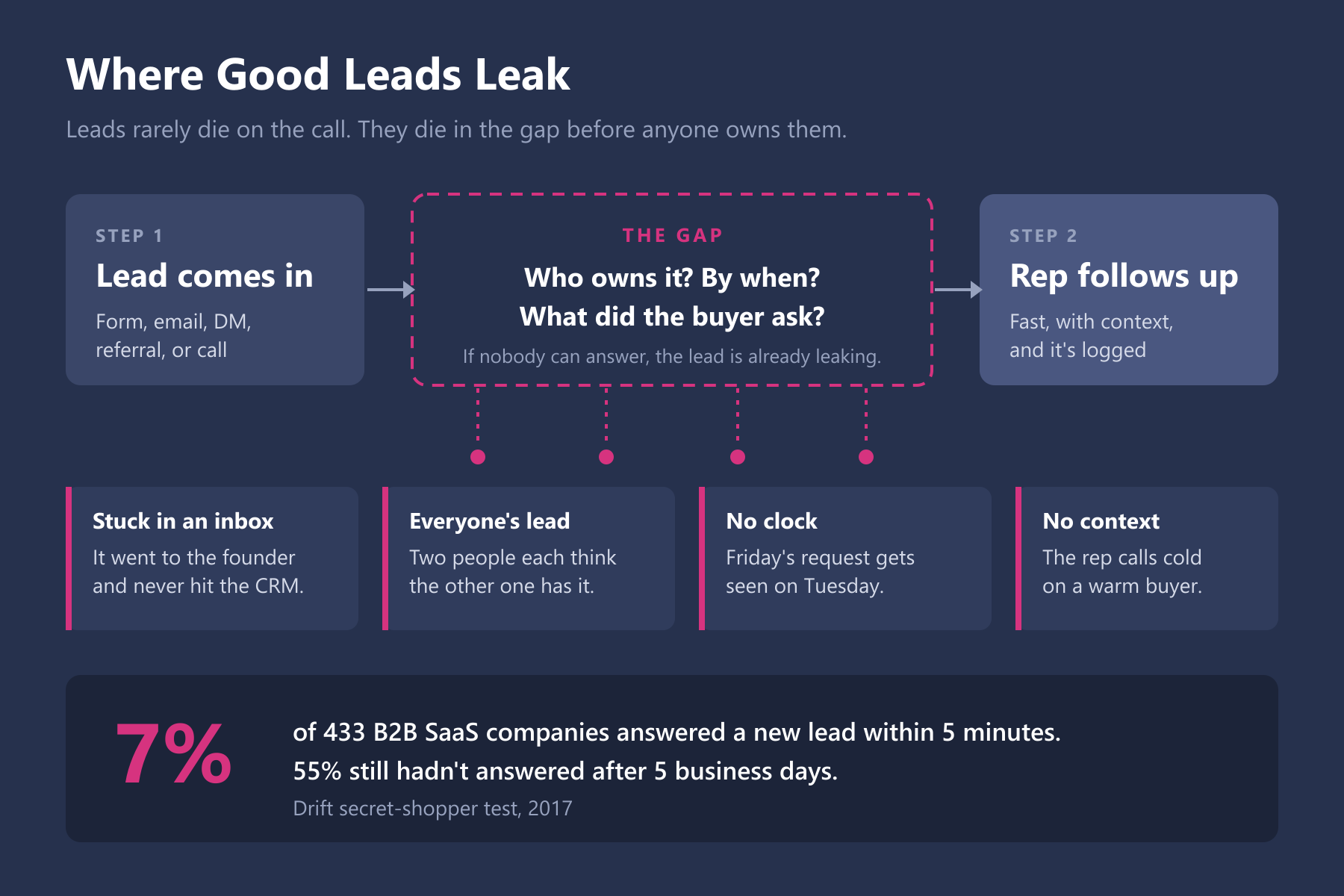
- Most companies are slow. Drift's 2017 test of 433 B2B SaaS companies found only 7% replied within five minutes, and 55% hadn't replied after five business days.
- Assign every lead by a written rule, not by whoever grabs it first, and name a backup for when the owner is out.
- Do this week: submit a test lead through your own website form and time how long it takes anyone to respond.
A buyer fills out your contact form on a Thursday afternoon. The notification goes to a shared inbox. You're on a customer call. Your salesperson assumes you saw it, since it's the kind of company you like to handle yourself. By Monday, the buyer has booked a call with someone else.
Nobody said no to that lead. Nobody did anything wrong on a sales call. The lead died in the gap between "interested" and "someone followed up," and nobody noticed because nothing in your system was watching that gap.
If you're at $1M to $10M ARR and still close most of the deals yourself, this gap is almost certainly open in your company. Leads come in through the website, your inbox, LinkedIn, referrals, and the occasional phone call. Some get worked. Some don't. You can't tell which, because the ones that die leave no trace.
The fix isn't more leads or a better closer. It's a handoff: a simple set of rules that makes sure every good lead has an owner, a deadline, and the context to follow up well.
“A lead that belongs to everyone belongs to no one. Put one name on it, or plan on losing it.”
Why do good leads fall through the cracks at small B2B companies?
Good leads fall through the cracks at small B2B companies because nobody owns them in the first hours after they arrive. Without a written rule for who takes each lead, how fast, and where it gets logged, every lead depends on someone noticing it. Busy people don't notice things consistently.
Big companies have routing software and a team whose job is to watch the queue. A founder-led company has a contact form that emails three people, a founder whose inbox is the unofficial CRM, and a first salesperson who isn't sure which leads they're allowed to touch. Each of those is a crack.
The four leaks in the diagram above cover almost every lost lead I see:
- Stuck in an inbox. The lead reaches the founder by email, text, or LinkedIn and never gets entered in the CRM.
- Everyone's lead. The lead goes to a shared address, and each person assumes someone else took it.
- No clock. Nobody agreed how fast a lead gets a response, so a Friday request waits until Tuesday.
- No context. The lead gets passed along as a name and an email, and the rep opens with a cold pitch to a warm buyer.
How fast should someone follow up on a new lead?
A founder-led B2B company should respond to a new inbound lead within 15 minutes during business hours and by the next business morning after hours. Speed matters because the buyer who reached out is comparing options right now, and the first useful conversation often sets the terms for the rest of the sale.
The research on speed is consistent, even though some of it is old. A Harvard Business Review study published in 2011 found firms that tried to contact a web lead within an hour were nearly 7 times as likely to qualify it, meaning a real conversation with a decision maker, as firms that tried an hour later. The same research audited 2,241 U.S. companies. Only 37% responded within an hour, and 23% never responded at all.
B2B software companies weren't much better in Drift's 2017 secret-shopper test. Of 433 B2B SaaS companies, only 7% replied to a demo request or sales inquiry within five minutes. More than half, 55%, hadn't replied after five business days.
An inbound lead is a buyer who already chose to talk
Buyers now start most sales conversations themselves. In 6sense's 2024 survey of 2,509 B2B buyers, buyers initiated first contact more than 80% of the time and were nearly 70% of the way through their buying process when they did. A buyer who fills out your form isn't browsing. They've done their homework and picked you as one of the calls worth making. Making that buyer wait days is how you lose a deal you never knew you had.
My own rule has been 15 minutes during business hours for a demo request or a sales inquiry. That's fast enough to catch the buyer while they're still thinking about the problem, and slow enough that a small team can hit it without living in their inbox.
What does a clean lead handoff include?
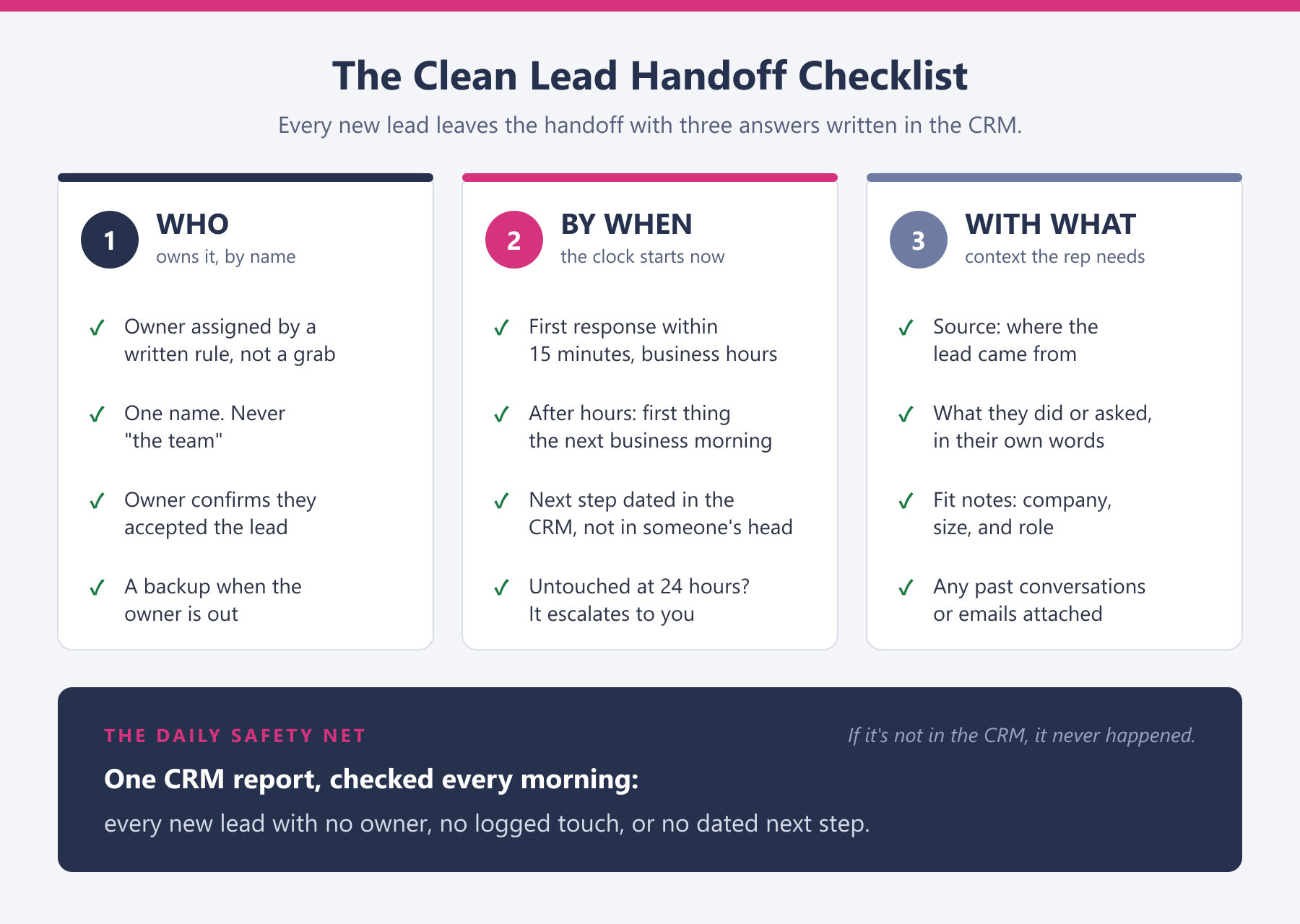
A clean lead handoff includes three answers written in the CRM for every new lead: who owns the lead by name, by when that person must respond, and what context the buyer already gave. Add a daily report that catches any lead missing one of the three. That's the whole system, and a small team can run it.
Who: one owner, assigned by a written rule
Every lead gets one person's name. Not "sales." Not "the team." Decide the rule in advance: by territory, by company size, by product, or in rotation. Then write it down so nobody has to guess and nobody has to fight. The owner confirms they've accepted the lead, and a named backup covers vacations and sick days.
By when: a response clock that starts on arrival
The clock starts when the lead arrives, not when someone notices it. Set 15 minutes for business hours and the next morning for after hours. Every first conversation ends with a dated next step in the CRM. Any lead untouched after 24 hours goes to you, with the owner's name on it.
With what: the context the buyer already gave you
Pass along what the buyer did and said, not just their name. Where the lead came from, what they asked in their own words, whether they fit your ideal customer, and any past emails or calls. A rep who opens with "I saw you asked about moving your team off spreadsheets" gets a reply. A rep who opens with "Thanks for your interest" gets deleted.
The daily safety net
Build one CRM report and look at it every morning: new leads with no owner, no logged touch, or no dated next step. It takes two minutes. This report is what turns "we try to follow up" into "we follow up." If you need help making the CRM the place where this lives, start with making your CRM the single source of truth.
“If it isn't in the CRM, it never happened. A lead that never happened can't be followed up.”
How do I know if leads are falling through the cracks right now?
A founder can find out whether leads are falling through the cracks with four checks that take less than an hour: a test lead, an inbox audit, a CRM report, and one question to the team. Lost leads leave no trace on their own, so you have to go looking.
- Send yourself a test lead. Use a personal email, fill out your own contact form, and time the response. Try it once during business hours and once on a Friday afternoon.
- Audit your own inbox and DMs. Search the last 60 days for anyone who asked about pricing, a demo, or a call. Check whether each one is in the CRM.
- Pull the untouched-leads report. Find every lead created in the last 30 days with no logged activity. That list is your crack, measured.
- Ask your team one question. "If a lead comes in right now, whose is it?" If you get different answers, the rule doesn't exist yet.
Where do founders usually get the lead handoff wrong?
Founders usually get the lead handoff wrong by keeping themselves as the router. Leads go to the founder first, and the founder decides who gets what when there's time. That works at ten leads a month. It breaks the moment the founder gets busy, and a busy founder is when leads pile up.
What I've seen in real sales teams
Years ago, two of my salespeople came into my office arguing over who owned an account. I cut the presentation short and asked, "What do the sales rules say?" They told me it was a gray area. So I told them if they couldn't work it out, I would, and they'd live with my answer, even if that meant giving the account to a third salesperson. They settled it in five minutes.
The lesson has stuck with me for decades. Gray areas in ownership don't just cause fights. They cause leads to sit while people figure out whose turn it is. Written rules end most of the arguments before they start, and they let the manager be a manager instead of a referee. Salespeople don't quit companies. They quit chaos, and unclear lead ownership is chaos.
Other handoff mistakes I see over and over
- Handing off the name without the story. The founder had a great ten-minute conversation, then forwards a business card. The rep starts over, and the buyer feels it.
- First come, first served. Reps grab the leads that look easy and leave the rest. Assign by rule instead.
- No escalation. Nobody finds out a lead was ignored until the buyer mentions it, if they ever do.
- "Just checking in" follow-ups. A follow-up with nothing new in it is a permission slip for the buyer to delete the email.
What should happen after the first follow-up?
After the first follow-up, the lead owner should run a short, planned sequence of useful touches across email, phone, and LinkedIn over about two weeks, then log an outcome. Every lead ends in one of three places: a booked conversation, a clear no, or back to nurture with a reason written down. No lead should just fade away.
Each touch should add something: an idea for their problem, a relevant article, a short answer to the question they asked. If the buyer goes quiet, the lead doesn't disappear. It moves to nurture with a note on what happened, so the next person who touches it knows the history. If you're still sorting out which leads deserve this sequence at all, define your lead stages first.
This is systems before people. Once the handoff works with you in it, it works for your first salesperson, and later for the sales manager you hire. If you don't have the time to build it, this is the kind of foundation a Fractional Sales Leader puts in during the first weeks of an engagement.
Frequently Asked Questions
Q: Should I assign leads by round-robin?
Round-robin is a good default for a team of two to five salespeople selling the same product to the same kind of buyer. It's fair, and it's easy to explain. Skip it when some leads need a specialist, such as a large company or a specific industry, and route those by rule instead.
Q: I'm the only one selling. Do I still need a lead handoff?
Yes. A solo founder still needs the clock, the CRM entry, and the daily report, because the handoff is from "arrived" to "worked," not from one person to another. Build it now and adding your first salesperson becomes a change of name in one field.
Q: Does an auto-reply or chatbot count as the first response?
An auto-reply confirms you received the request. It doesn't count as the first response, because nobody has read what the buyer asked. A chatbot or AI assistant can help after hours by answering basic questions or booking a time, but a person should still follow up by the next business morning.
Q: What about leads that come to me directly through referrals or LinkedIn?
Log referral and LinkedIn leads in the CRM the same day, with the same owner, clock, and context rules as a form fill. Direct leads are often your warmest leads, and they're the ones most likely to be lost, because they live in your personal inbox where nobody else can see them.
Q: How do I hold reps to the response time without micromanaging?
Hold reps to response time by reviewing the numbers weekly, not by watching them hourly. Look at average first-response time and the untouched-leads report together, and talk about the misses. Clear rules plus a regular review is accountability. Checking over shoulders all day is micromanagement. For more, see sales accountability without micromanaging.
Are good leads slipping through your cracks?
Let's spend 30 minutes finding where your leads leak and setting up a handoff that gets every good one worked.
Schedule a 30-Minute CallAbout the Author
Louie Bernstein
Fractional Sales Leader with 50 years of sales experience helping $1M–$10M ARR companies build scalable, repeatable sales systems. Founder of MindIQ (INC 500). LinkedIn Top Voice in Sales Management, Sales Operations, and Sales Coaching.