Key Takeaways:
- Reps spend only about 28% of their week actually selling (Salesforce). Every extra field you demand competes with that, which is why "log everything" quietly becomes "log nothing."
- The CRM nobody trusts is a doom loop: reps don't log, data goes bad, leaders rebuild the forecast in a spreadsheet, reps see the CRM is ignored, so they log even less.
- You don't need 40 fields. You need five right on every deal: stage with a real exit criterion, next step and date, buyer contacts engaged, an honest close date, and an honest amount.
- Even good data rots. B2B contact data decays around 22.5% a year (MarketingSherpa/HubSpot) and the average contact changes jobs every 18 months, so a CRM that isn't maintained is wrong within a year on its own.
- Break the loop by making the CRM the meeting, not the homework. Run your pipeline review off the CRM and nothing else, and reps update it, because it's the only version that counts.
Every founder I work with has some version of the same confession: "We have a CRM, but nobody really trusts what's in it." The forecast lives in a spreadsheet. The real deal status lives in the rep's head. The CRM is a graveyard of stale opportunities with close dates from last quarter.
Here's the thing: this is completely normal, and it's completely fixable. The CRM nobody trusts isn't a technology problem or a lazy-rep problem. It's a system problem, and it runs in a predictable loop that you, the founder, are usually feeding without realizing it.
A forecast is only as good as the data underneath it. If you want the pipeline math to work, you need a CRM you can actually believe. Let's build one.
Why Reps Don't Log, and Why That's Your Problem
Start with a fact that reframes everything: reps spend only about 28% of their week actually selling (Salesforce). The other 70-plus percent goes to admin, internal meetings, hunting for information, and yes, CRM data entry. Every field you add to the form is a tax on the tiny sliver of time you actually want them spending with buyers.
So when reps don't log, they're not being lazy. They're being rational. If updating the CRM takes twenty minutes, doesn't help them close, and nobody looks at it anyway, of course it slides. The problem is that their rational choice becomes your strategic blindspot. You can't forecast, coach, or scale off data that doesn't exist.
Reps don't skip the CRM because they're lazy. They skip it because it costs them time and gives them nothing back. Fix that trade and the logging fixes itself.
The Cost of a Forecast You Re-Build in a Spreadsheet
Here's the loop I see in almost every $1M to $10M ARR company, and once you see it, you can't unsee it.
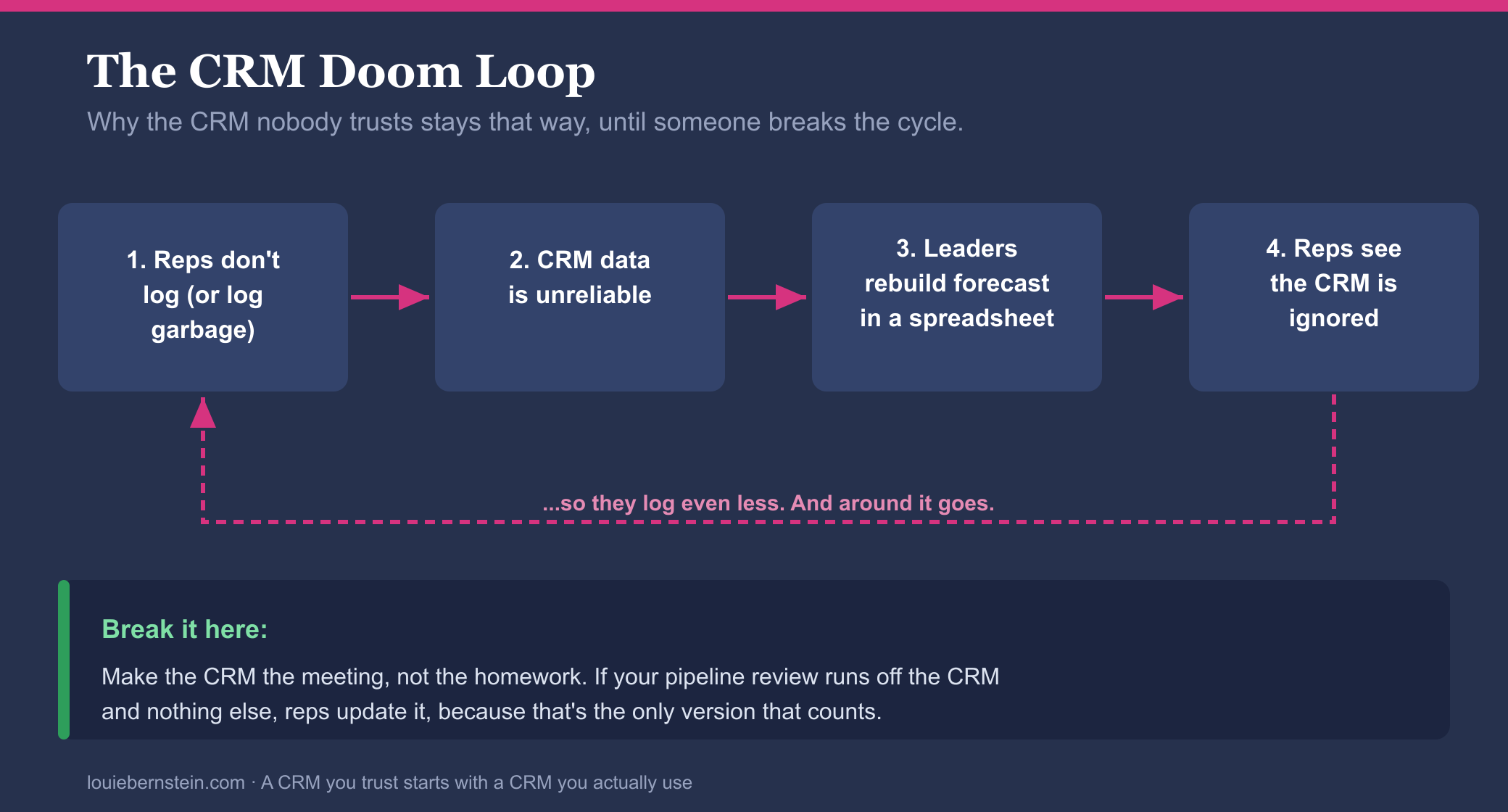
Look at step three, because that's the one founders control. When the CRM data is shaky, the natural move is to rebuild the forecast by hand in a spreadsheet, pulling numbers from reps in a meeting. It feels responsible. It's actually the thing that kills the CRM. The moment you rebuild the forecast outside the CRM, you've told every rep that the CRM doesn't matter, so they stop maintaining it, so it gets worse, so you rebuild it again next quarter. Every spreadsheet forecast is a vote against your own system.
Minimum Viable CRM Discipline for a Small Team
The fix is not more fields. It's fewer, enforced. For a small team, you need exactly five things right on every open deal. Not forty. Five.
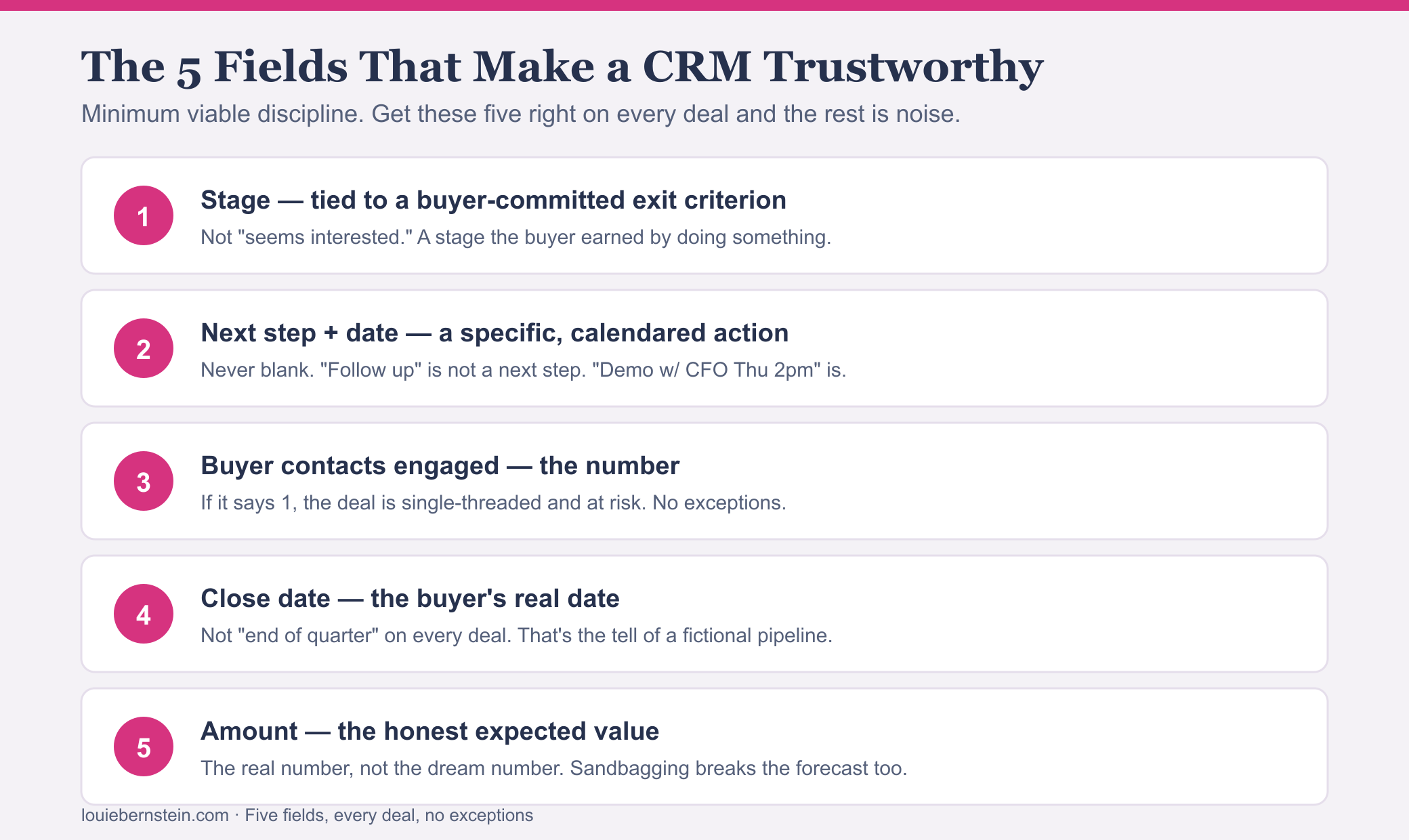
That's it. Stage, next step, contacts, close date, amount. Notice these aren't vanity fields, each one feeds a decision. Stage and amount feed the forecast. Next step tells you if the deal is alive. Contacts tell you if it's single-threaded. Close date tells you when. If a rep keeps those five honest, you can run the whole business off the CRM. Everything beyond these five is optional until the basics are rock solid.
Making the Right Data the Easy Data to Enter
People do what's easy. So the trick isn't to demand discipline, it's to engineer it. Make the five fields the path of least resistance:
- Delete unused fields. Every field you remove makes the five that matter more likely to get filled. A shorter form is a more-completed form.
- Use dropdowns, not free text for stage and next-step type. Clicking beats typing.
- Make "next step + date" required to save the record. If the field can't be blank, it won't be.
- Log during the call, not after. A quick note while you're on the phone beats a "catch up on CRM" session that never happens.
- Give the data back. Show reps their own win rate and velocity. When the CRM helps them win, they feed it.
Killing Vague Notes and Fictional Close Dates
Two specific bad habits poison more CRMs than anything else, and both are easy to spot in a review. The first is vague shorthand: notes like "good call," "circling back," or "he's interested" that mean nothing to anyone but the rep, and often nothing even to them a month later. The second is the fictional close date, when every single open deal is dated for the last day of the quarter. That's not a forecast, it's a wish, and it's the fastest way to know a pipeline is fiction.
Kill both by making close dates come from the buyer, not the rep's hope. "When does the buyer need this live?" produces a real date. "When do you think it'll close?" produces end-of-quarter every time. And it's worth remembering that even accurate data doesn't stay accurate: B2B contact data decays about 22.5% a year (MarketingSherpa/HubSpot), and the average B2B contact changes jobs roughly every 18 months. That job-change stat is also why single-threaded deals die: your one contact leaves, and your only relationship walks out with them.
If every deal in your CRM closes on the last day of the quarter, you don't have a forecast. You have a pile of hope with dates attached.
When the CRM Becomes the Meeting, Not the Homework
Here's the single move that breaks the doom loop for good: make the CRM the meeting, not the homework. Run your weekly pipeline review directly off the CRM, on the screen, live, and refuse to discuss any deal that isn't updated in it. No side spreadsheets. No "let me tell you what's really going on." If it's not in the CRM, it doesn't exist for the purposes of the meeting.
The first week or two will be uncomfortable. Deals will be missing, dates will be wrong, and reps will be caught out. That discomfort is the system installing itself. By week three, everyone updates the CRM before the meeting, because it's now the only version of reality that counts. You've flipped the incentive: the CRM stopped being homework nobody checks and became the meeting everybody prepares for.
If you're a founder with no CRM at all, or one so neglected it's beyond saving, don't over-buy. Start with the five fields in a simple tool, or even a clean spreadsheet, and the one rule that the pipeline review runs off it. Building that discipline, and the review cadence that enforces it, is exactly what a Fractional Sales Leader installs for $1M to $10M ARR companies, without the cost of a full-time VP of Sales. The tool matters far less than the habit.
Frequently Asked Questions
Q: Why doesn't my team update the CRM?
Because it costs them time and gives them nothing back. Reps already spend only about 28% of their week selling (Salesforce), so every extra field competes with that. If updating the CRM doesn't help them close and nobody looks at it, skipping it is the rational choice. Fix the trade, fewer required fields, and run your pipeline review off the CRM so it visibly matters, and logging improves fast.
Q: What are the minimum fields a small team needs in the CRM?
Five: the stage (tied to a buyer-committed exit criterion), the next step and its date, the number of buyer contacts engaged, the buyer's real close date, and the honest deal amount. That's enough to forecast, spot single-threaded deals, and see which deals are alive. Everything beyond these five is optional until the basics are consistently right. Fewer fields, strictly enforced, beats many fields loosely ignored.
Q: How do I make the CRM the single source of truth?
Run your weekly pipeline review directly off the CRM and nothing else. No side spreadsheets, no verbal "what's really going on." If a deal isn't updated in the CRM, you don't discuss it. The first couple of weeks are uncomfortable as gaps get exposed, but by week three reps update before the meeting because it's the only version that counts. Make it the meeting, not the homework.
Q: Should I keep forecasting in a spreadsheet if the CRM is messy?
No, that's the trap. Rebuilding the forecast in a spreadsheet is what keeps the CRM messy: it signals to reps that the CRM doesn't matter, so they stop maintaining it, so you rebuild again. Every spreadsheet forecast is a vote against your own system. Clean up the five core fields, then force the forecast to come from the CRM. Painful once, permanent after.
Q: How fast does CRM data actually go stale?
Faster than most founders think. B2B contact data decays around 22.5% a year (MarketingSherpa/HubSpot), and the average B2B contact changes jobs roughly every 18 months. So even a CRM that was accurate when entered is meaningfully wrong within a year if nobody maintains it. That's an argument for lightweight, continuous updates as part of the sales rhythm, rather than a big annual "data cleanup" project that's obsolete before it finishes.
Q: I'm a founder with no CRM yet. What should I do first?
Don't over-buy software. Start with the five core fields in a simple, affordable CRM, or even a clean spreadsheet, and add one rule: your pipeline review runs off it and nothing else. The habit matters far more than the tool. Once the discipline is real, you can graduate to a fuller CRM without importing chaos. Setting up that first lightweight, trustworthy system is a common early project for a Fractional Sales Leader.
Forecasting from a spreadsheet because you don't trust the CRM?
In 30 minutes I'll show you the five fields to enforce and how to make the CRM the meeting, so your team keeps it current and your forecast lives in one place. See how a Fractional Sales Leader can help at louiebernstein.com.
Schedule a 30-Minute CallAbout the Author
Louie Bernstein
Fractional Sales Leader with 50 years of sales experience helping $1M–$10M ARR companies build scalable, repeatable sales systems. Founder of MindIQ (INC 500). LinkedIn Top Voice in Sales Management, Sales Operations, and Sales Coaching.